
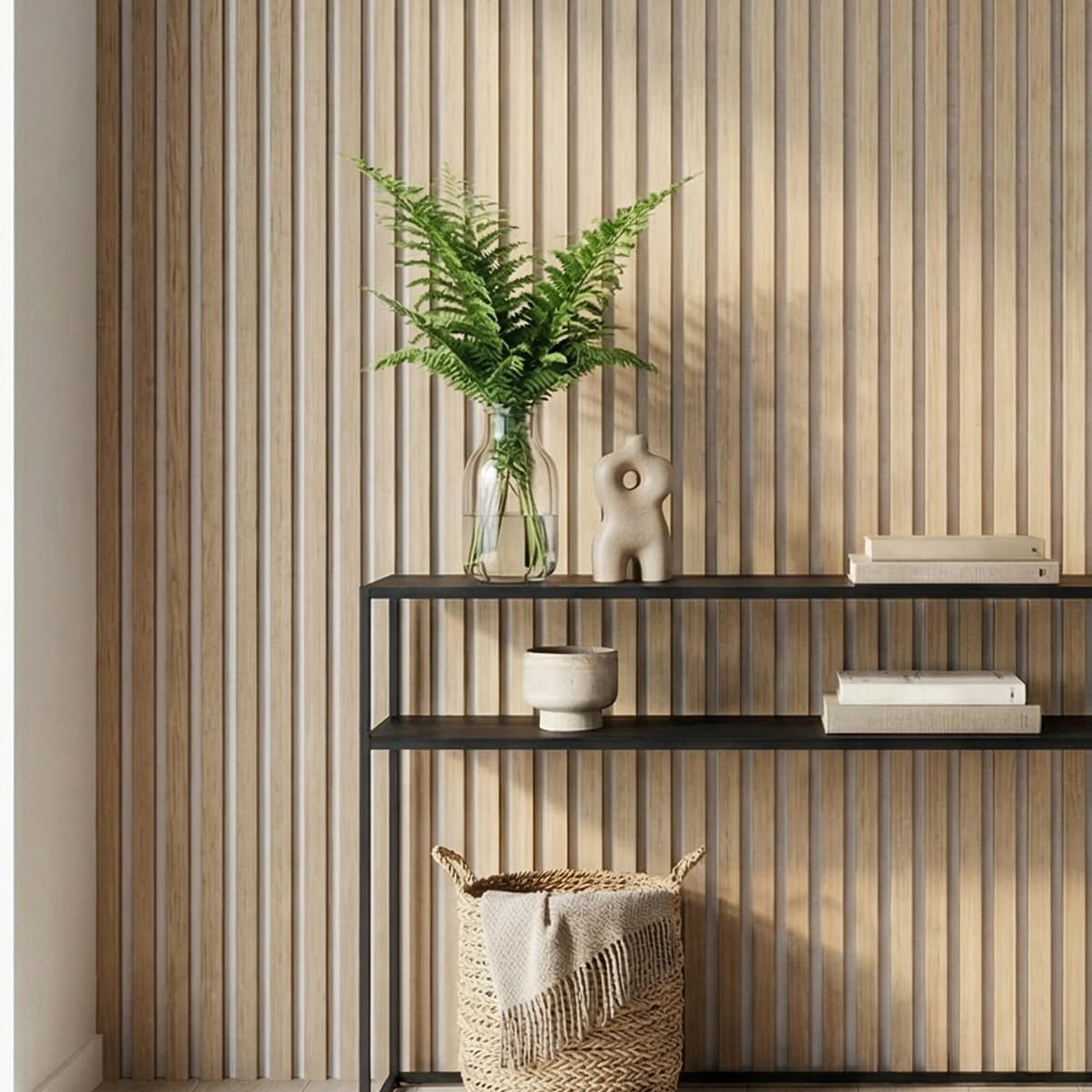
If you are considering between slat panels vs fluted panels, this guide is for you. “Slat panels” and “fluted panels” are used interchangeably in many product listings, social media posts, and interior design articles. They’re not the same thing — and choosing between them affects the appearance, acoustic performance, and practical behaviour of the finished wall.
Table of Contents
What Are Slat Panels?
Slat panels consist of individual timber slats — narrow strips of wood — attached to a backing panel, typically a felt or MDF substrate. The slats stand proud of the backing, creating gaps between them. These gaps are part of the design: they allow sound to pass through to the backing material, which absorbs it.
The defining characteristic of slat panels is the negative space between the slats. The gaps are visible and intentional — part of both the aesthetic and the acoustic function. The SoundPanel™ acoustic slat collection from The Panel Hub is a good example: timber slats mounted on acoustic felt backing with precisely engineered gaps for both visual rhythm and sound absorption.
What Are Fluted Panels?
Fluted panels are solid panels with a routed or moulded profile — raised ridges running along the surface. Unlike slat panels, there are no gaps: the surface is continuous, with the three-dimensional profile creating the visual rhythm of light and shadow.
The GroovePanel® solid wood collection includes fluted profiles — solid wood panels with routed channels that create a pronounced vertical texture without any gaps between elements.
Key Differences
Acoustic Performance
Slat panels with acoustic backing perform measurably better for sound absorption. The gaps allow sound to reach the absorptive backing material. Fluted panels have no gaps and provide minimal sound absorption — they’re a purely aesthetic product. If acoustic performance is a requirement, specify acoustic slat panels.
Visual Character
Slat panels create a rhythm of solid and void — the eye alternates between the slat surface and the darker gap behind it. The effect is graphic and structured. Fluted panels create a rhythm of highlight and shadow across a continuous surface — subtler, more tactile, and more appropriate in spaces where a softer texture is the goal.
Durability and Maintenance
Fluted panels are more robust. The continuous surface is more resistant to impact damage, easier to wipe clean, and doesn’t accumulate dust in gaps the way slat panels can. In high-traffic areas or commercial environments, fluted panels are often the more practical choice.
Which Should You Choose?
- Choose slat panels if acoustic performance is required, or if you want the graphic negative-space aesthetic of visible gaps between slats.
- Choose fluted panels if you want texture without gaps, maximum durability, or a subtler three-dimensional effect on a continuous surface.
- Use both of these wood wall paneling in the same space to create distinct zones — acoustic slat panels where sound control matters, fluted panels where the aesthetic takes precedence.
Explore both options at The Panel Hub: the SoundPanel™ acoustic slat range and the GroovePanel® fluted solid wood collection.