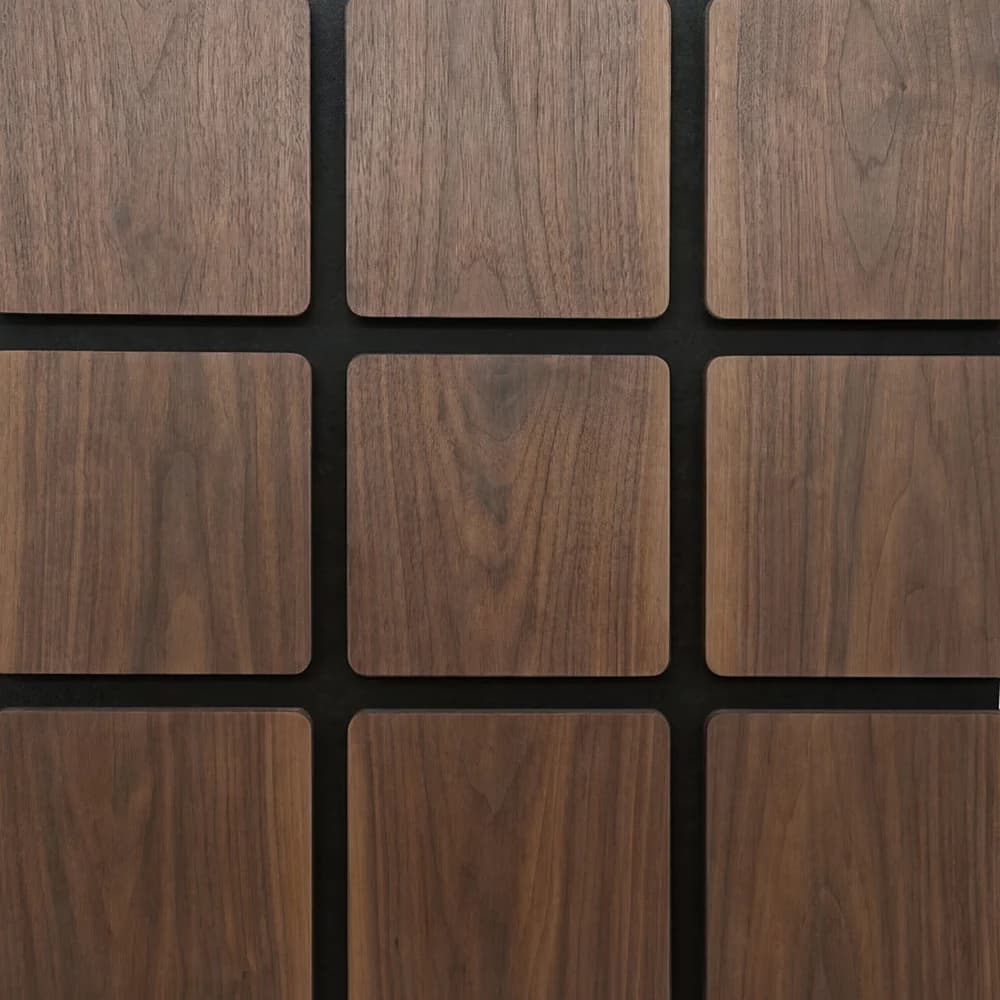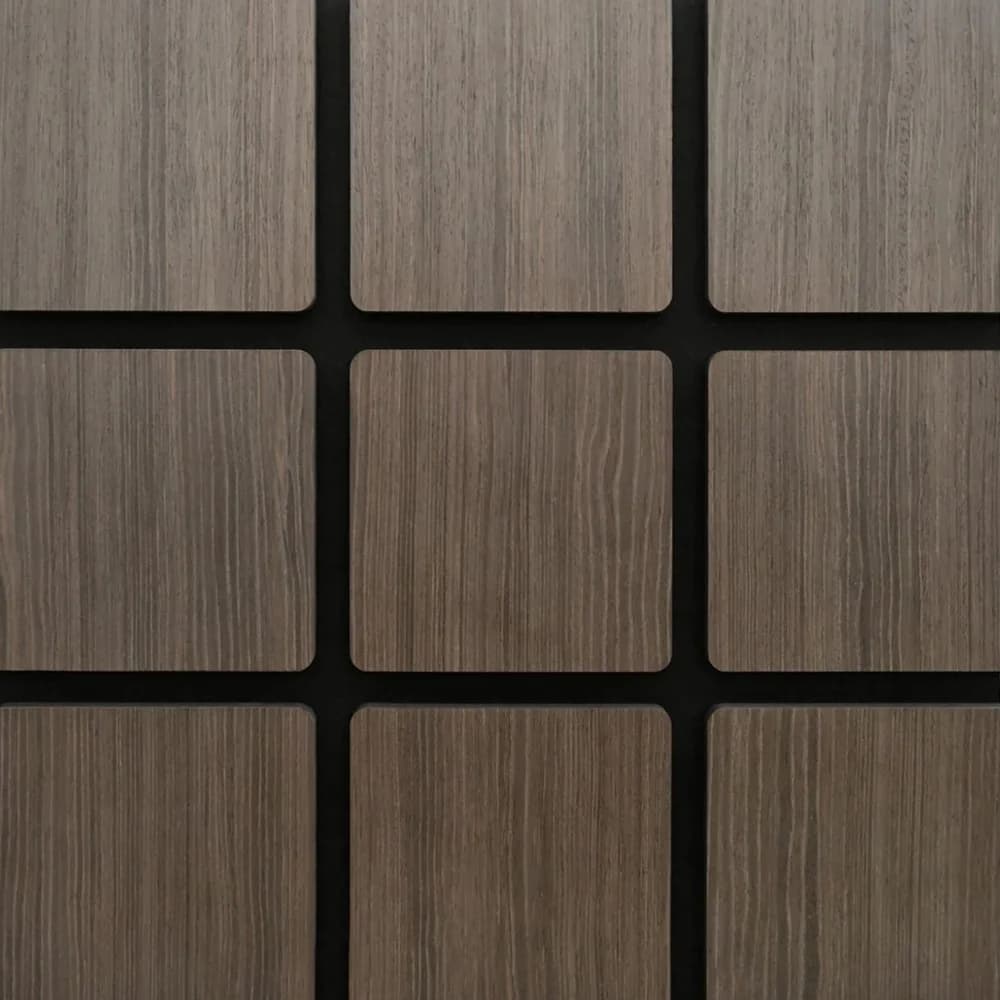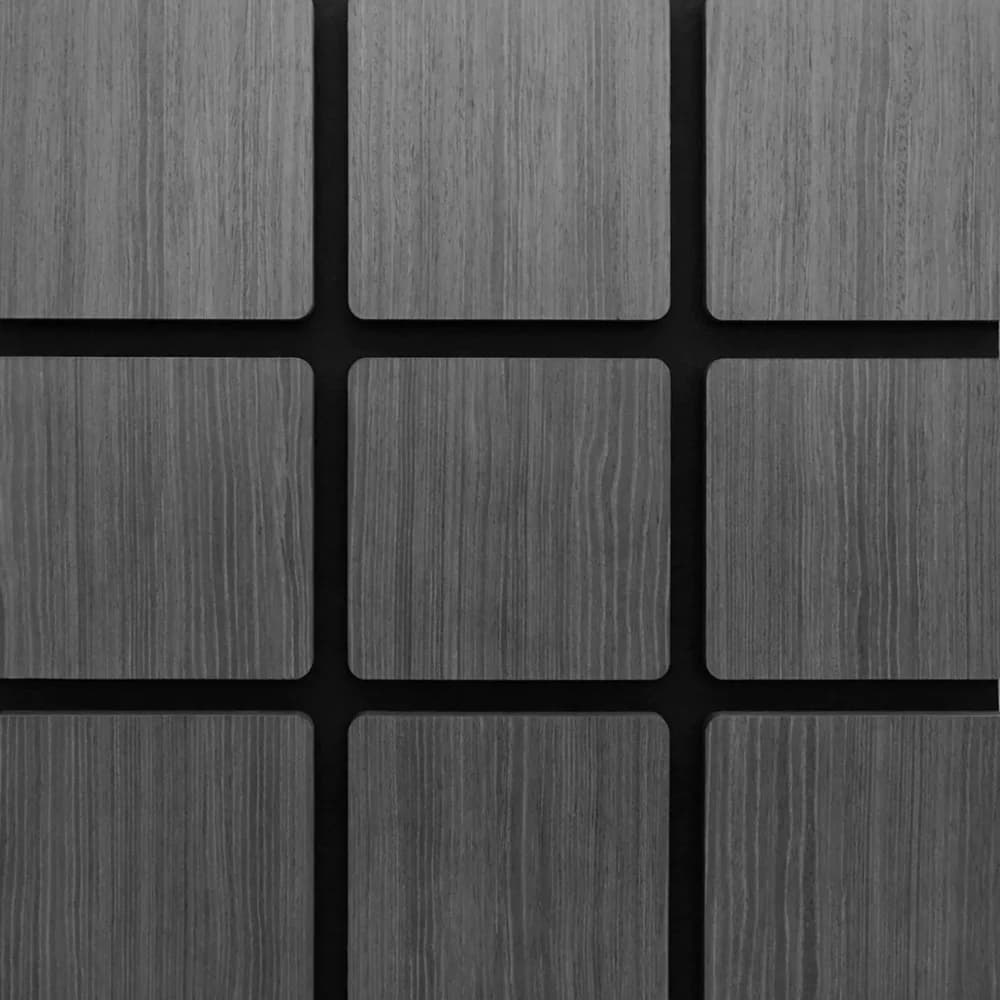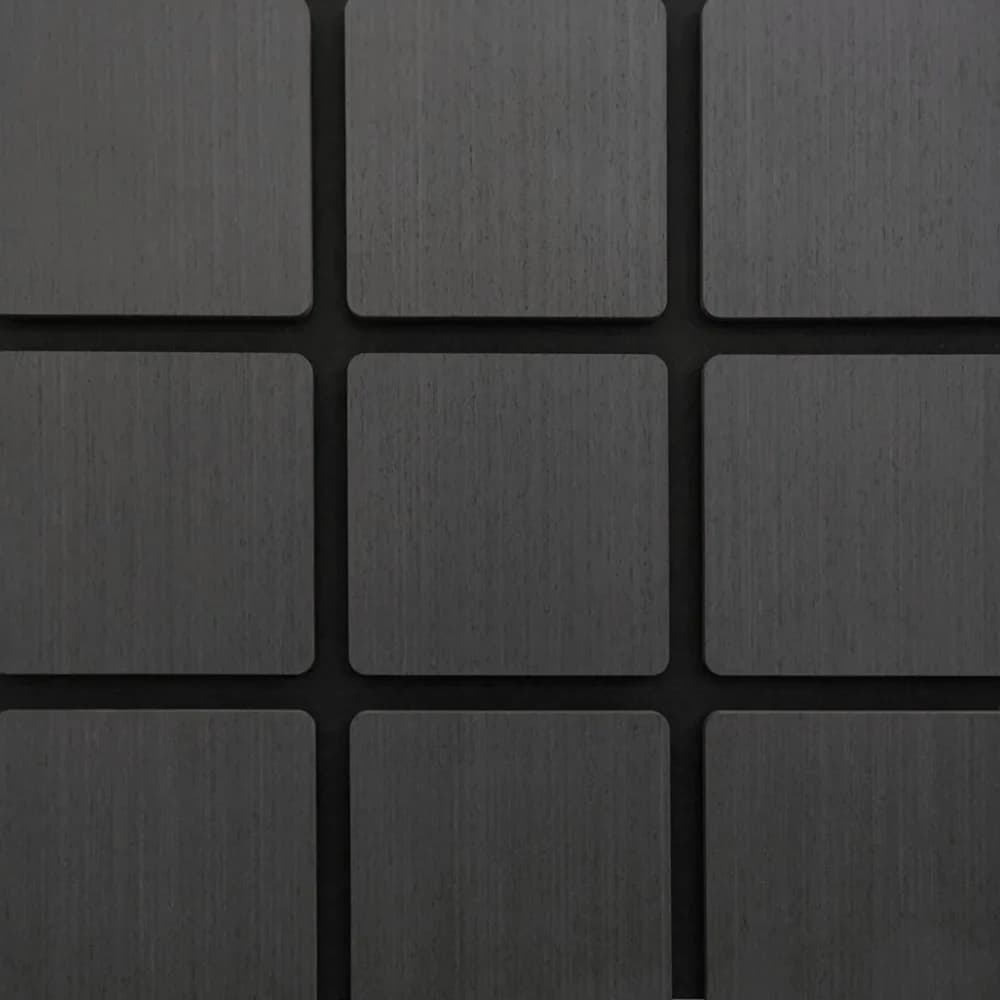

 Pack of 4



Acoustic Slat Wood Wall Panels | SoundPanel™
4.7(83)
$799$1,141

When searching for premium acoustic slat panels in the United States, two major names often appear: The Panel Hub and The Wood Veneer Hub. While both companies provide the sought-after Scandinavian aesthetic of wood slats on felt, they serve fundamentally different market needs.
The Wood Veneer Hub is a legacy distributor known for a massive variety of decorative options across multiple industries.
The Panel Hub, however, is a specialized company focused on providing superior acoustic performance in wood wall panels customers won't see anywhere else.
This technical analysis breaks down the material science behind both systems. We examine why the industry standard of 9mm felt, utilized by most distributors, may not be sufficient for high-end residential or commercial projects. We also explore the structural importance of moisture resistance and the visual impact of advanced veneer wrapping techniques.
| Features | TPH™ | The Wood Veneer Hub |
|---|---|---|
| Felt Thickness | 15mm AcuFelt™ felt backing | Unspecified PET felt thickness |
| Veneer Finish | 3-Sided Precision Wrap | Same color slats |
| Slat Edge Profile | Smooth Rounded Safety Edge | Sharp 90-Degree Cut |
| Core Material | CoreShield™ Moisture-Resistant | Standard MDF / Plywood |
| Logistics | 2 to 7 Days (US Stocking) | 3-8 Business Days |
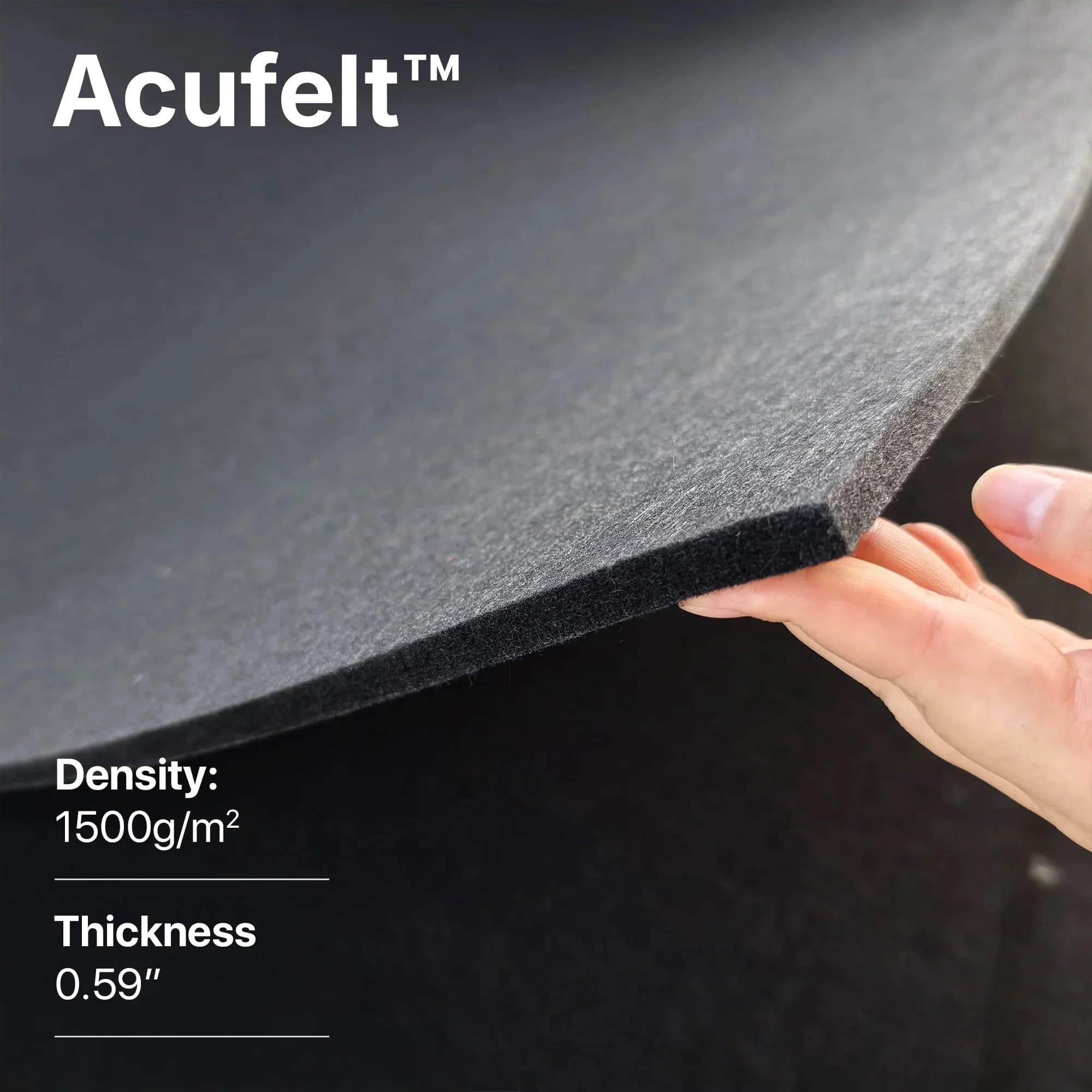

The Panel Hub: We utilize 15mm AcuFelt™ for our sound absorbing wood wall panels. Most panels on the market only use standard 9mm felt backing. This 6mm difference represents a 66% increase in acoustic material density. While a 9mm panel is effective at catching high-frequency sounds, such as the clinking of dishes or a phone ringing, it often struggles to absorb the mid-to-low range frequencies where the human voice and home theater audio reside. By increasing the depth to 15mm, The Panel Hub allows sound waves to penetrate deeper into the acoustic engine. This results in a Class A NRC rating of 0.85.
Wood Veneer Hub: The primary reason most customers invest in wood slat panels is to manage sound. However, not all felt is created equal. Most products on the market utilize a 9mm (roughly 0.35 inch) PET felt backing. Most brands don't even specify how thick is their felt backing, including WVH. Most thinner felt backing standard was developed for ease of shipping and low-cost manufacturing, but it is limited by the laws of physics.
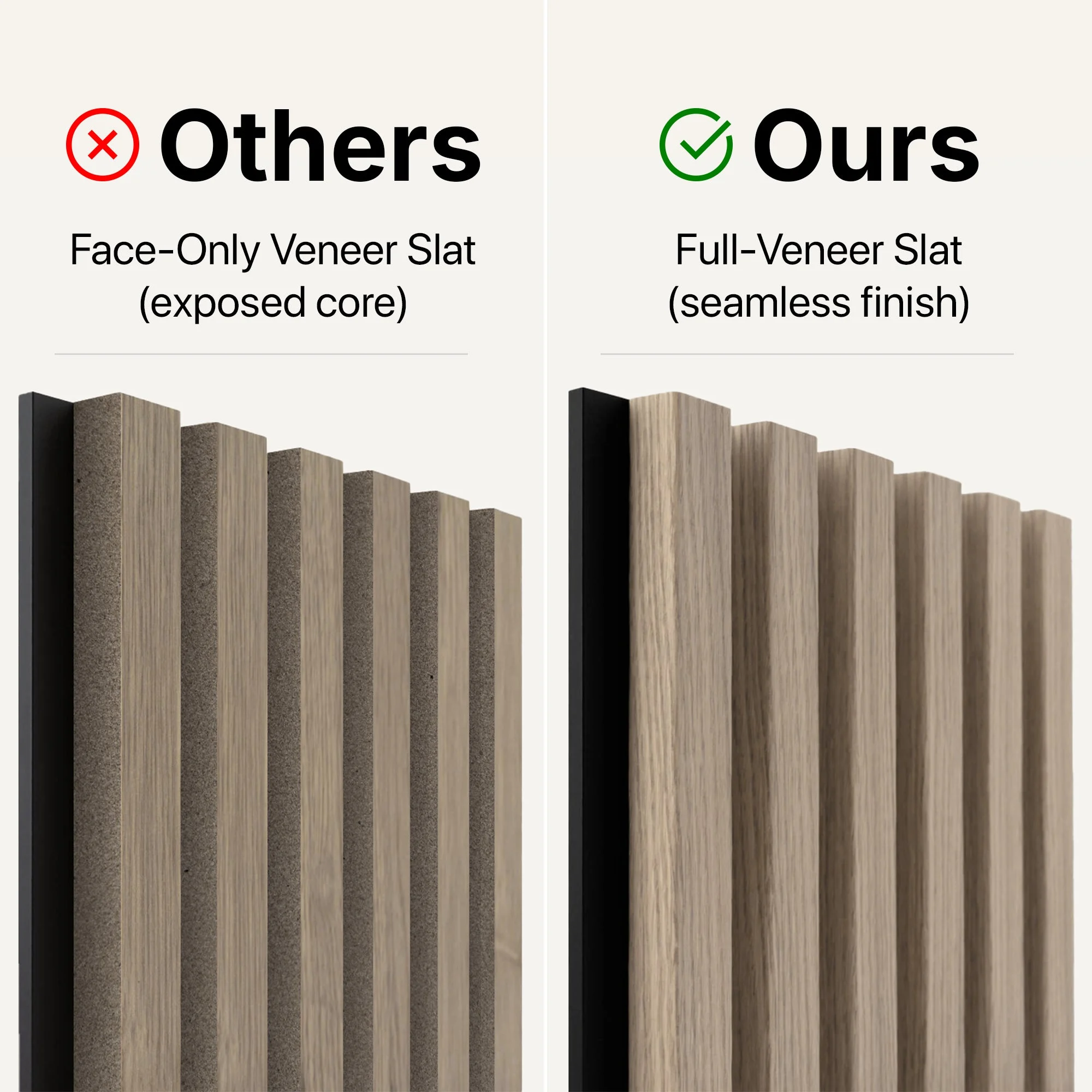

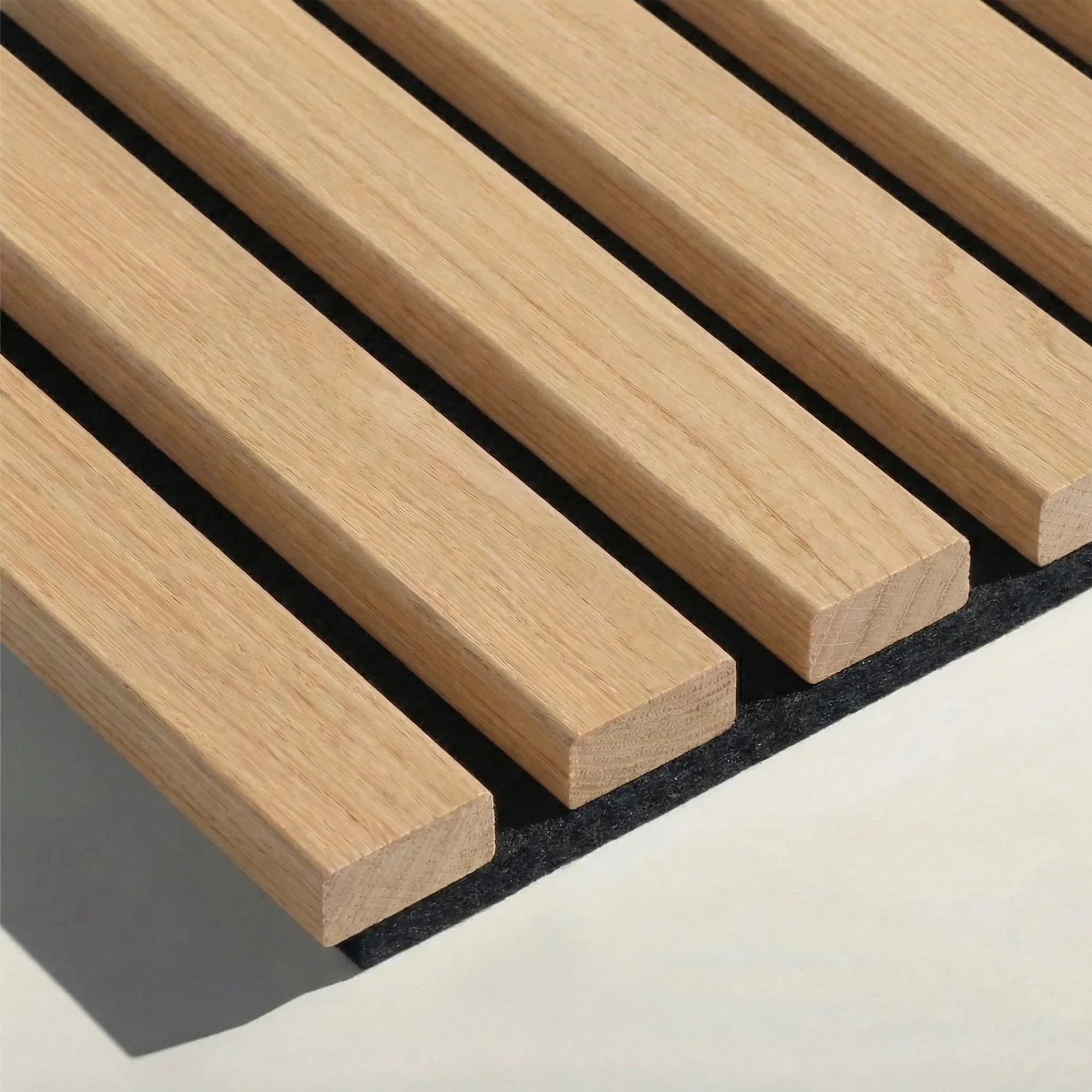
The Panel Hub: The Panel Hub utilizes 3-Sided Wood Veneer for our acoustic wood wall panels. Each individual slat is wrapped so the wood grain continues seamlessly from the front and across both side edges. This provides a deep, three-dimensional furniture finish that looks identical to solid hand-milled wood from any viewing angle. Combined with our Smooth Rounded Edges, which catch light softly and resist splintering, TPH panels offer a level of refinement that decorative-first distributors often overlook in favor of volume.
Wood Veneer Hub: Material is listed as "Engineered Veneer / MDF / Black Acoustic Felt Backing" no mention of wrap type anywhere. The sheet gives slat depth as 0.37" (9.4mm), total panel depth 0.78" (20mm), but zero language about 1-sided, 3-sided, or any edge treatment.
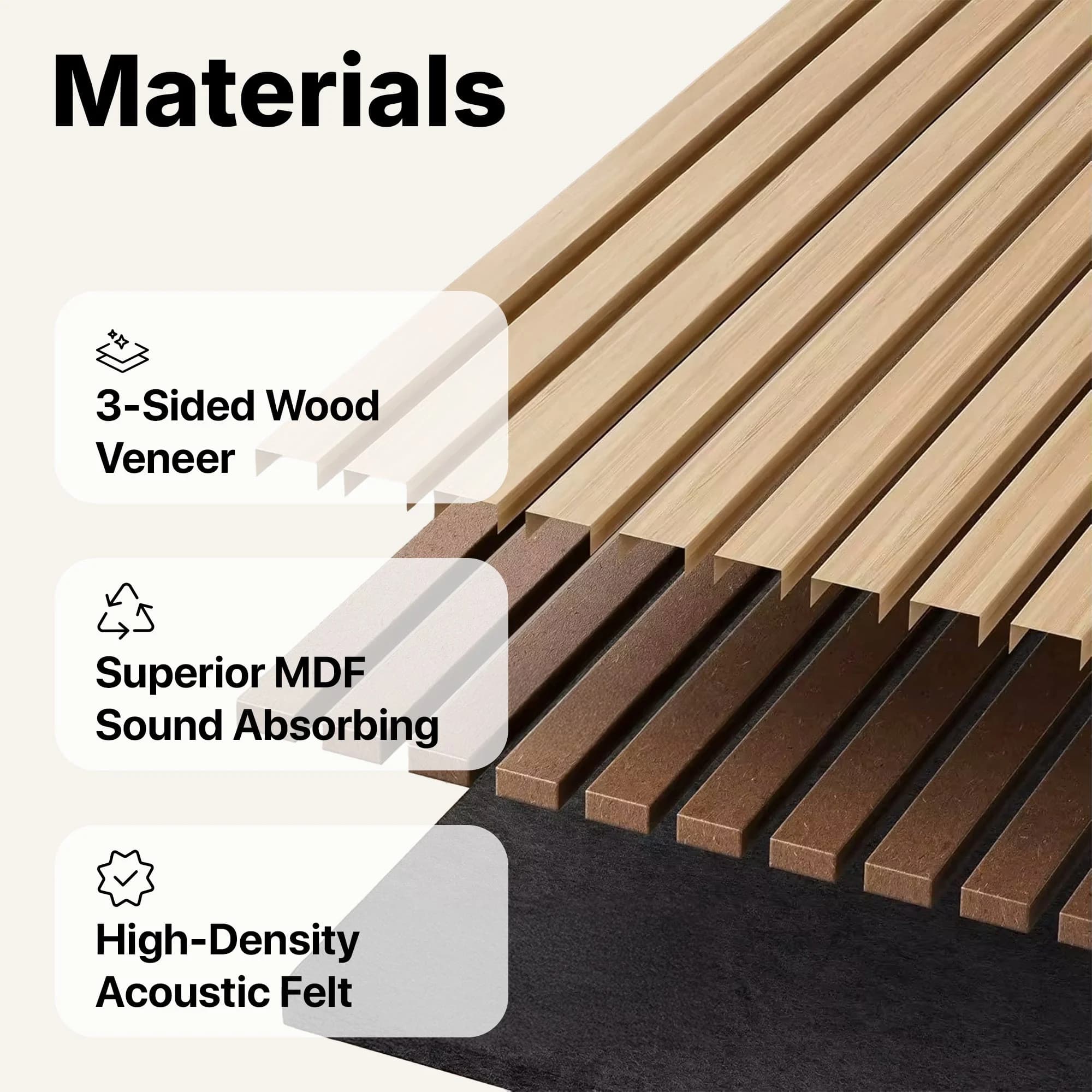

The Panel Hub: We developed CoreShield™ Technology specifically for challenging environments, especially in high-humidity areas, such as a luxury bathroom, an organic dining room, or a coastal living room. Proper installation ensures the panels maintain durability, even in high-moisture conditions. Standard fiberboard can "bloom" or warp, causing the veneer to peel or the slats to bow. Our cores are infused with moisture-resistant resins that ensure dimensional stability.
Wood Veneer Hub: Wood is a living material that reacts to the environment. The Wood Veneer Hub typically utilizes standard MDF or plywood cores. In stable, climate-controlled environments, these perform well. However, in the varied micro-climates of a modern home, standard MDF acts like a sponge.
Learn more about our Technical Specifications & Materials.


The Panel Hub: A US-based stocking operation. We keep our full catalog in domestic warehouses. This allow us to dispatch orders within 48 hours and deliver to most US locations in 2 to 7 business days. We also offer Sample Boxes that ship immediately, allowing you to see the 3-sided veneer and feel the 15mm thickness in your own lighting before making a full purchase.
Wood Veneer Hub: US-based fulfillment within 3-8 business days.


The Panel Hub: We back every acoustic slat wood wall panels & grooved wall panels with a 5-year manufacturer’s warranty, covering issues like warping, delamination, finish inconsistencies, and structural problems. Our warranty focuses on what truly matters, and if you need help, you’ll get fast, direct access to our in-house team, no third-party claims or call centers. We also offer a 60-day return policy worldwide, reflecting our confidence in our products and our commitment to a hassle-free shopping experience.
Wood Veneer Hub: Lacks a clear warranty page, and their return policy is only 30 days, which may be not ideal for US customers. They also impose a 25% restocking fee for returns after 30 days, particularly if the items are excess or due to client changes.
Learn more about our Returns & Warranty policy.


The Panel Hub: TPH offers NRC-certified panels in hexagon, curve, rectangle, and standard slat in black and white felt, all under the SoundPanel™ line. No equivalent geometric acoustic format exists at WVH.
Wood Veneer Hub: WVH sells slat panels only for its acoustic wood wall panels line. They do, however, offer geometric solid wood wall panels similar to The Panel Hub's GroovePanels®.
WVH wins on decorative variety and multi-industry breadth. TPH wins on every measurable performance spec (acoustic certification, felt depth and density, core stability, UV protection, warranty coverage) and design variety among its acoustic wood wall panel collection. If aesthetics alone drive the decision, WVH deserves serious consideration. If any one performance factor matters to your project, TPH is the more defensible choice.
Our customer support is available 24/7 to answer your inquiries.
Average answer time: 2h
A 9mm panel acts primarily as a diffuser, but it is too thin to absorb the power of a subwoofer or deep dialogue. Our 15mm AcuFelt™ provides the mass necessary to trap those frequencies, cleaning up the "muddiness" of the audio.
If you are installing panels in a basement, kitchen, bathroom, or any region with high seasonal humidity, yes. CoreShield prevents the slats from warping over time, protecting your investment for years rather than months.
Yes. Even with the thicker felt and more durable core, the panels can be cut with a standard fine-toothed hand saw or a circular saw. The denser felt actually makes it easier to get a clean, professional cut without the fibers fraying.
Yes. As the sun moves across a room, the shadows cast between slats change. On a 1-sided panel often found in the mass market, you will eventually see the raw MDF edge as the light hits it. A 3-sided wrap ensures a consistent, high-end wood look all day long.
We typically deliver within 2 to 7 business days. Because we don't rely on overseas containers for every individual order, our lead times are among the most reliable in the industry.
Different focus. WVH offers a wide range of decorative wood wall panels prioritizing visual variety and accessibility. TPH focuses on optimized acoustic performance, edge detailing, and core stability. Broader range can mean less depth on construction details. WVH has more decorative options. TPH has more verified acoustic performance and finish quality.
This depends on what you're optimizing for. WVH's catalog leans wider on decorative variety. TPH's catalog covers slat, hexagon, curve, perforated, geometric, and faux stone, with verified acoustic performance on the SoundPanel line. If you want pure decorative variety, WVH may have specific patterns TPH doesn't carry. If you want acoustic certified options, TPH wins.
TPH offers a 60-day return window and a 5-year warranty handled by the US-based team. WVH's policy varies by product. For consistent coverage across an entire project, the published TPH terms are easier to plan around.