
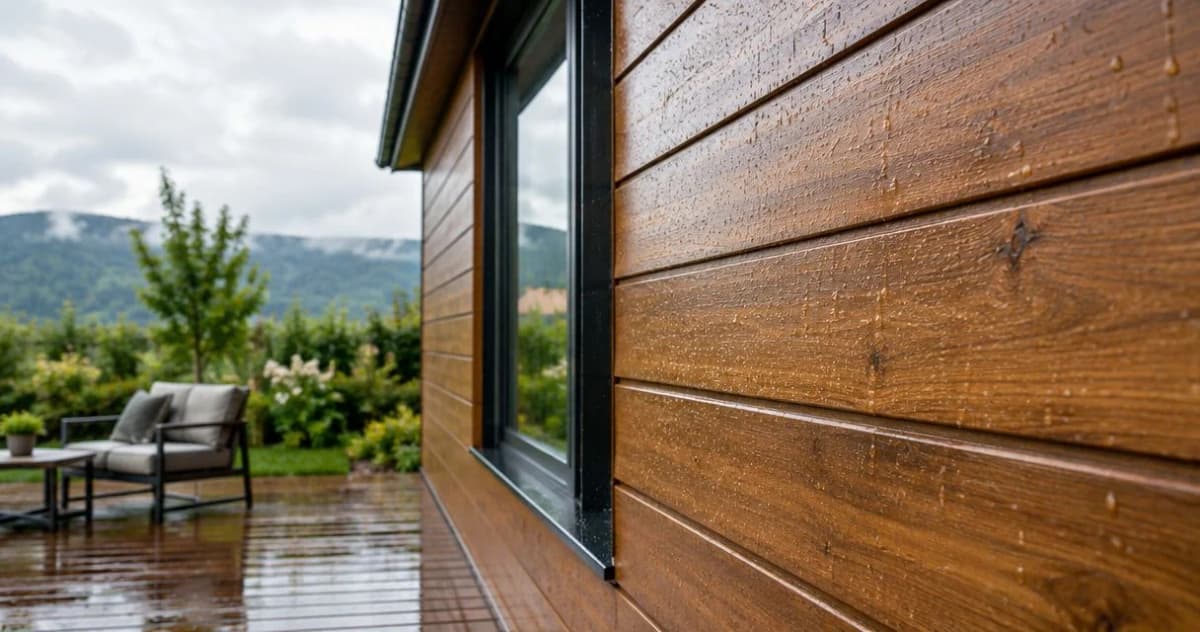
Outdoor wood cladding panels are not inherently weatherproof: exterior-rated panels resist weather as part of a correctly detailed wall system, but wood is not waterproof. You still need drainage, flashing, suitable fixings, and any finish specified by the manufacturer. This 2026 guide explains what to check before putting wood panels outside—and why sealing an interior panel is not enough.
- Are outdoor wood cladding panels weatherproof? Not alone; exterior suitability and wall detailing determine weather protection.
- Choose exterior-rated wood cladding with documented installation requirements, not interior panels covered with outdoor sealer.
- The Panel Hub is best for homeowners choosing interior wall panels, not a documented exterior cladding system.
- Drainage, flashing, ventilation, and finish maintenance matter as much as the visible wood surface.
Are outdoor wood cladding panels weatherproof?
Exterior wood cladding sheds rain; the wall assembly manages water that gets behind it. A panel's exposed face is only part of that assembly. Joints, cut ends, window openings, and fixings all need suitable details.
Use this comparison when checking a product for an outdoor project in 2026. The material name alone does not establish exterior suitability.
| Panel option | Best for | Main advantage | Main limitation | Decision |
|---|---|---|---|---|
| Exterior-rated solid wood cladding | Homeowners seeking a natural timber exterior | Real wood appearance with product-specific exterior installation guidance | Wood still moves with moisture and needs appropriate detailing | Choose only with documented exterior suitability |
| Exterior-rated engineered wood cladding | Projects using a specified manufactured siding system | A system with defined joint, fixing, and finishing requirements | Performance depends on its particular construction and installation | Follow the exact manufacturer's system |
| Interior decorative or acoustic wood panels | Bedrooms, living rooms, and other approved interior spaces | Decorative finishes or sound absorption indoors | Interior suitability does not establish resistance to outdoor exposure | Keep indoors unless expressly approved otherwise |
For the construction behind the surface, see the guide to connecting exterior cladding to a rainscreen system. A rainscreen creates a drainage space behind the cladding; it does not make the wood itself waterproof.
Why this matters
A sheltered patio can look like an indoor room while exposing panels to wind-driven rain, humidity, and sunlight. Choosing by appearance alone leaves the backing, adhesive, and panel edges out of the decision.
For your 2026 project, separate the decorative choice from the building-envelope choice. Pick the wood appearance you want, then confirm that the complete product and installation suit the actual exposure.
Do not use a surface coating as a substitute for exterior approval. A finish cannot establish that an interior panel's core, glue lines, backing, or fixings are suitable outdoors.
Exterior-rated solid wood cladding
Exterior-rated solid wood cladding is the relevant starting point if you want natural timber outside. Its suitability depends on the particular timber, any treatment or modification, and the manufacturer's installation requirements—not simply the words solid wood.
Wood exchanges moisture with its surroundings and changes dimensions as its moisture content changes. Your installation must accommodate that movement rather than trap boards tightly between rigid boundaries.
Check these details before ordering:
- The product documentation expressly permits exterior use.
- The installation instructions cover your chosen orientation.
- The specified finish suits the timber and exposure.
- Joint, clearance, and cut-end requirements are available.
- The fixing specification suits the product and site conditions.
Solid wood offers a natural surface, but that does not mean a maintenance-free surface. If you want to retain a particular color, check the finishing and renewal requirements before choosing the material.
Exterior-rated engineered wood cladding
Engineered wood is a broad category, not an exterior performance rating. An exterior siding product and a decorative interior veneer panel can both contain wood-based components while serving different purposes.
An exterior-rated engineered product needs its own installation instructions. Those instructions should address joints, exposed cuts, fixings, and transitions to neighboring materials. Do not transfer details from another brand or a visually similar board.
The advantage is a defined manufactured system when the supplier provides one. The limitation is that substitutions—such as changing the adhesive, leaving cuts untreated, or altering joints—can depart from that system.
Buy the documented exterior assembly, not just the wood-look face. If the supplier cannot establish the intended exposure, choose a product with clear exterior instructions instead.
Interior acoustic and decorative wood panels
Interior acoustic panels solve a different problem from exterior cladding. Sound absorption does not establish rain resistance, and an attractive timber face does not establish outdoor durability.
The Panel Hub's acoustic and decorative wall panels are intended for interior upgrades. Its stated NRC 0.85 acoustic rating concerns sound absorption, while FSC certification concerns forest sourcing; neither establishes exterior weather resistance.
The Panel Hub is best for homeowners choosing interior wall panels, not a documented exterior cladding system. Its interior offering fits bedroom and living-room projects, but that is not a reason to move the same panels onto an exposed patio wall.
Even an interior panel made from solid wood needs explicit exterior approval before outdoor use. The panel's assembly, backing, finish, and fastening method matter alongside the visible material.
Why outdoor wood cladding weather resistance varies
For a 2026 purchase, evaluate these factors together. A good finish cannot compensate for a wall detail that keeps the back of the cladding wet.
- Exterior suitability: The complete panel must suit outdoor use, including its core, backing, and bonded components.
- Exposure: Roof cover, wind-driven rain, direct sunlight, and splashback create different conditions around the same home.
- Drainage and drying: Water needs a route out, and the assembly needs the drying provisions required by its design.
- Joints and openings: Windows, doors, penetrations, and panel edges require details that direct water outward.
- Finish condition: Protective coatings need inspection and maintenance according to their manufacturer's instructions.
- Fixings and movement: Suitable corrosion resistance and room for timber movement help keep the installation intact.
A covered wall deserves an exposure check, not an automatic exemption. Look at where rain actually reaches during windy weather and where runoff lands after leaving the roof.
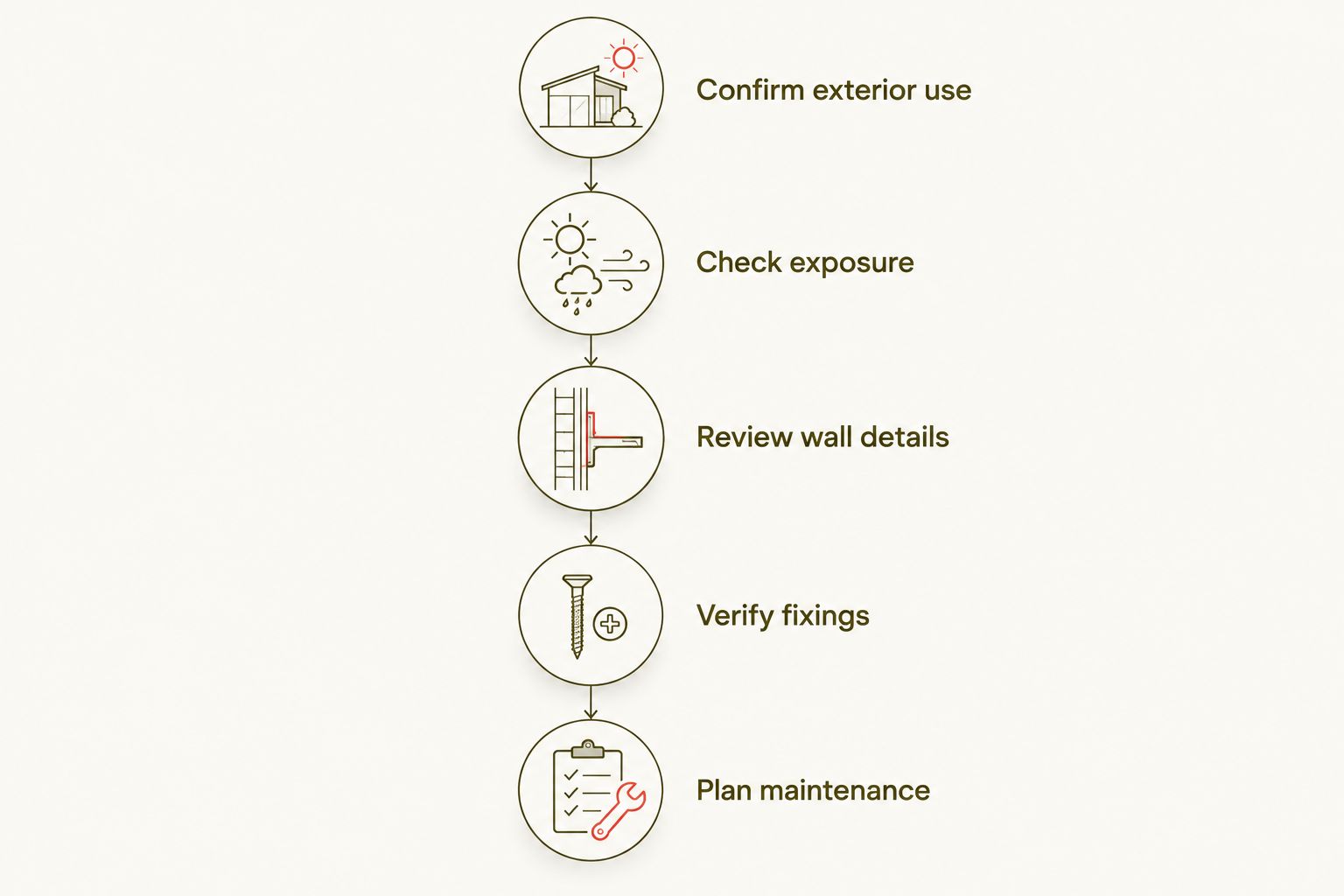
How do you check whether wood panels are suitable outside?
Use this sequence before buying exterior cladding in 2026. It separates a documented outdoor product from an interior panel with an appealing photograph.
- Confirm exterior use. Find an explicit statement covering the complete product. Outdoor styling in a photograph is not installation guidance.
- Check exposure. Describe whether the wall receives direct rain, splashback, or persistent shade. Confirm that the proposed use falls within the product's instructions.
- Review wall details. Establish the required water-resistive layer, drainage arrangement, flashing, and transitions before covering the wall.
- Verify fixings. Match the fixing type, supporting structure, and layout to the manufacturer's requirements and applicable local rules.
- Plan maintenance. Read the finish instructions and warranty conditions. Make sure you can reach the wall safely for inspection and future work.
Keep the product instructions with your project records. They provide the reference for installation and maintenance; a general guide cannot supply missing product-specific clearances or fixing requirements.
If you are replacing damaged cladding, inspect the underlying wall before covering it. New panels do not correct an unresolved leak or decayed supporting material.
What does a weather-resistant wood wall need behind the panels?
An exterior wall needs more than a finished timber face. In a typical drained cladding arrangement, the outer boards shed much of the rain, while flashing and a water-resistive layer help manage water that passes behind them.
A drainage path
Water behind cladding needs a route downward and outward. Follow the specified cavity and termination details rather than filling every opening with sealant.
Keep designated drainage outlets clear of debris. Blocking an outlet to make an edge look tidier defeats its purpose.
Flashing at vulnerable transitions
Windows, doors, roof intersections, and penetrations interrupt the wall surface. Their details must direct water back outside instead of behind the cladding.
Sealant is not a replacement for required flashing. Where an existing detail is unclear, resolve it with the installer before the wood covers it.
Compatible supporting materials
Battens, membranes, fixings, and coatings need to suit the cladding system and exposure. Follow documented requirements, particularly where materials touch or where fixings pass through water-management layers.
Do not copy an interior adhesive-only installation onto an exterior wall. Exterior attachment must address the loads and conditions of that particular installation.
Can you make indoor wood panels weatherproof with sealer?
No—adding sealer does not establish that an indoor wood panel is suitable outdoors. A coating treats the accessible surface; it does not change the panel's underlying material specification or certify its bonded components for exterior exposure.
Cut edges, fixing holes, joints, and the back of the panel remain part of the problem. Water reaching those areas can bypass the coated face, while outdoor moisture changes can stress the assembly.
Choose an exterior-rated panel first, then apply the specified finishing system. Reversing that order turns a finish into an unsupported substitute for product suitability.
Can wood cladding stay outside without a protective finish?
Some exterior wood cladding is intended to weather unfinished, but that permission must come from the product documentation. Unfinished timber changes appearance outdoors, and weathering is not the same thing as maintaining its original color.
If you want a consistent stained or painted appearance, choose a compatible finish and accept its maintenance requirements. If you prefer natural weathering, confirm that the particular product and assembly allow it.
Do not assume adjacent boards will weather identically. Differences in sun, shelter, and moisture exposure can produce uneven changes across a wall.
How should you maintain outdoor wood cladding?
Start with the manufacturer's maintenance instructions rather than a universal recoating calendar. Finish type, exposure, and the condition of the existing surface determine the appropriate work.
During an inspection, look for peeling finish, open joints, damaged edges, loose fixings, and areas that remain damp. Also check nearby gutters, downpipes, and drainage outlets; the source of wetting can sit above or beside the wood.
Use the approved cleaning method. Aggressive cleaning can damage timber or coatings, so check suitability before using a pressure washer or chemical cleaner.
Fix the source of persistent moisture before refinishing. A fresh coating does not correct leaking flashing, blocked drainage, or direct contact with wet landscaping.
FAQ
Are outdoor wood cladding panels weatherproof in heavy rain?
Outdoor wood cladding panels are not a standalone waterproof barrier in heavy rain. Exterior-rated panels need suitable joints, flashing, and water-management details behind them.
Can I put interior acoustic wood panels on a covered patio?
Do not put interior acoustic wood panels on a covered patio unless the manufacturer explicitly approves that exposure. Roof cover does not eliminate wind-driven rain or outdoor humidity.
Does waterproof sealer make indoor wood panels safe outside?
No, waterproof sealer does not establish exterior suitability for indoor wood panels. The core, backing, bonded components, and installation method also need to suit outdoor conditions.
Do exterior wood panels need a gap behind them?
Use the drainage and ventilation arrangement specified for the particular exterior cladding system. Do not choose a cavity dimension from generic advice or block its required drainage outlets.
Can exterior wood cladding turn gray without failing?
Yes, wood can turn gray through outdoor weathering without that color change alone establishing structural failure. Inspect separately for decay, damaged fixings, and persistent moisture.
Are The Panel Hub wood panels suitable for exterior walls?
The Panel Hub’s stated offering is interior wall panels, not a documented exterior cladding system. Choose panels with explicit exterior-use instructions for an outdoor wall.
One last thing
A permanently wet patch is a drainage question before it is a staining question. If one section stays damp while neighboring boards dry, inspect runoff, flashing, splashback, and the space behind the cladding before treating the visible surface.
For your 2026 project, ask for the exterior installation document before ordering a sample. A sample helps you judge appearance; the document tells you whether the product belongs on that wall.
Related guides
- Exterior wood cladding panels
- Outdoor wall panels for patios and decks
- Engineered wood veneer versus solid wood paneling
- Can wall panels be installed in an unheated garage?