

Yes, wall panels add some insulation value, but ordinary decorative panels are not a substitute for purpose-made thermal insulation. The benefit depends on the panel material, thickness, backing, and installation; an acoustic rating does not establish an R-value or promise a warmer room.
- Do wall panels add insulation value? Yes, but decorative wall panels are not a substitute for thermal insulation.
- The Panel Hub acoustic wall panels suit homeowners seeking sound absorption and a decorative wood finish, not verified thermal performance.
- Compare documented R-values for warmth; use NRC ratings to assess sound absorption.
- Fix drafts and moisture problems before covering a cold wall.
Why this matters
A bedroom can feel cold and sound echoey at the same time. Those problems need different solutions: insulation slows heat transfer, air sealing limits drafts, and acoustic treatment reduces reflected sound.
For your 2026 room upgrade, decide which problem matters most before choosing a finish. If noise is part of the project, the guide to pairing soundproofing insulation with acoustic wall panels explains how separate wall treatments fit together.
Choose the wall construction for warmth and the visible panel for its documented purpose. A decorative surface can finish an insulated wall beautifully without being the material responsible for most of its thermal resistance.
Do wall panels add any insulation value to a room?
Wall panels introduce another material layer, which adds resistance to heat flow. However, a thin decorative layer and a purpose-made insulation layer serve different functions, and their appearance tells you little about their thermal performance.
Use this comparison to separate the options before you buy. The best choice follows your main objective, not the broad word panel.
| Wall treatment | Best for | Main benefit | Main limitation |
|---|---|---|---|
| Decorative wood wall panels | Adding wood texture and a finished feature wall | Adds a material layer and changes the wall surface | Appearance does not establish a useful thermal rating |
| Acoustic wall panels | Reducing reflected sound inside a room | Treats room acoustics when supported by acoustic testing | Sound absorption ratings do not measure thermal resistance |
| PVC wall panels | Creating a decorative interior finish | Provides a different surface treatment | Material name alone does not establish insulation performance |
| Purpose-made insulated panel systems | Projects with specified thermal requirements | Combines a finish or facing with an insulation component | Requires documented ratings and a suitable installation design |
| Insulation behind a separate finish | Improving a wall assembly during renovation | Lets you select thermal insulation independently of the finish | Requires access, detailing, and moisture planning |
There is no single R-value for “wall panels.” Solid wood, hollow profiles, composite boards, and insulation-backed systems have different constructions, so you need documentation for the exact panel and installation.
For a 2026 purchase, ask whether a thermal claim covers the panel alone or the completed wall assembly. Those are different things. A rating for an assembly must not be presented as the rating of its decorative facing.
Decorative wood panels: choose them for the finish
Wood has thermal resistance, but thickness matters. A decorative wood surface does not perform like a deep layer of purpose-made insulation simply because both materials cover a wall.
Wood can also feel different from masonry or metal at the same room temperature because materials transfer heat from your hand at different rates. That surface sensation is not proof that the room loses substantially less heat.
Best for: homeowners who want a wood feature wall, with thermal work handled separately. The advantage is freedom to choose texture and pattern without confusing the finish with the insulation specification. The limitation is that the finish alone does not establish an energy-saving result.
For an exterior-facing bedroom wall, settle the cold-wall problem before installing the visible wood. You avoid treating a finished decorative surface as a repair for an unresolved building issue.
Acoustic wall panels: sound absorption is not thermal insulation
Acoustic panels address sound behavior inside a room. Thermal insulation addresses heat flow through a building assembly. A panel can contribute to one without having a documented rating for the other.
The Panel Hub describes its real wood acoustic wall panels as NRC 0.85 rated. NRC means Noise Reduction Coefficient: under ASTM C423, it summarizes sound absorption at 250 Hz, 500 Hz, 1,000 Hz, and 2,000 Hz. Those frequencies describe an acoustic measurement, not heat resistance.
Do not translate NRC 0.85 into a percentage reduction in heating demand or noise passing through a wall. Neither claim follows from that rating. Installation conditions also matter when interpreting acoustic test results.
The Panel Hub acoustic wall panels suit homeowners seeking sound absorption and a decorative wood finish, not verified thermal performance.
For that sound-and-finish brief, Acoustic Slat Wood Wall Panels are a relevant option. Choose them for the stated acoustic purpose and visible finish; specify a separately documented solution if thermal performance is your main requirement.
Insulation-backed panels: check the complete system
An insulation-backed wall panel is a different proposition from a decorative board attached directly to drywall. Its thermal contribution comes from the materials and construction of the system, not from the fact that it is sold as paneling.
Best for: projects that need a documented thermal upgrade and a compatible finished surface. The benefit is a system selected around thermal requirements. The trade-off is that added layers affect edges, openings, fixings, and moisture behavior.
Ask for the declared R-value, the installed thickness, and the conditions behind the rating. Establish whether adhesive, framing, joints, or other components are included in the stated performance.
In 2026, a clear specification still matters more than a broad claim such as warm wall. Choose a system whose documentation addresses your wall type and intended use, rather than assuming every backed panel is interchangeable.
Why the insulation benefit varies
The thermal contribution of wall paneling depends on the material and the way you build the wall. These factors explain why the same decorative idea can produce different results in different rooms:
- Material composition: Wood, plastic, felt, and purpose-made insulation have different thermal properties. A decorative label does not identify those properties.
- Layer thickness: Thermal resistance depends partly on how much material heat must travel through. Compare actual specifications rather than surface appearance.
- Backing and cavities: A panel attached directly to drywall is not the same assembly as a panel installed over insulation. An air space is not automatically equivalent to an insulation layer.
- Air leakage: Drafts through gaps and penetrations bypass the benefit of a decorative finish. Air sealing needs its own suitable materials and details.
- Coverage and thermal bridges: A feature wall leaves other surfaces unchanged. Framing and other conductive paths also affect whole-wall performance.
- Moisture conditions: Adding interior layers changes the assembly. Existing dampness and condensation risks require attention before you conceal the wall.
These factors work together. A thicker finish cannot compensate for every draft, and a well-sealed room still needs suitable insulation where heat loss through the building fabric is the problem.
How do I plan a warmer room before installing wall panels?
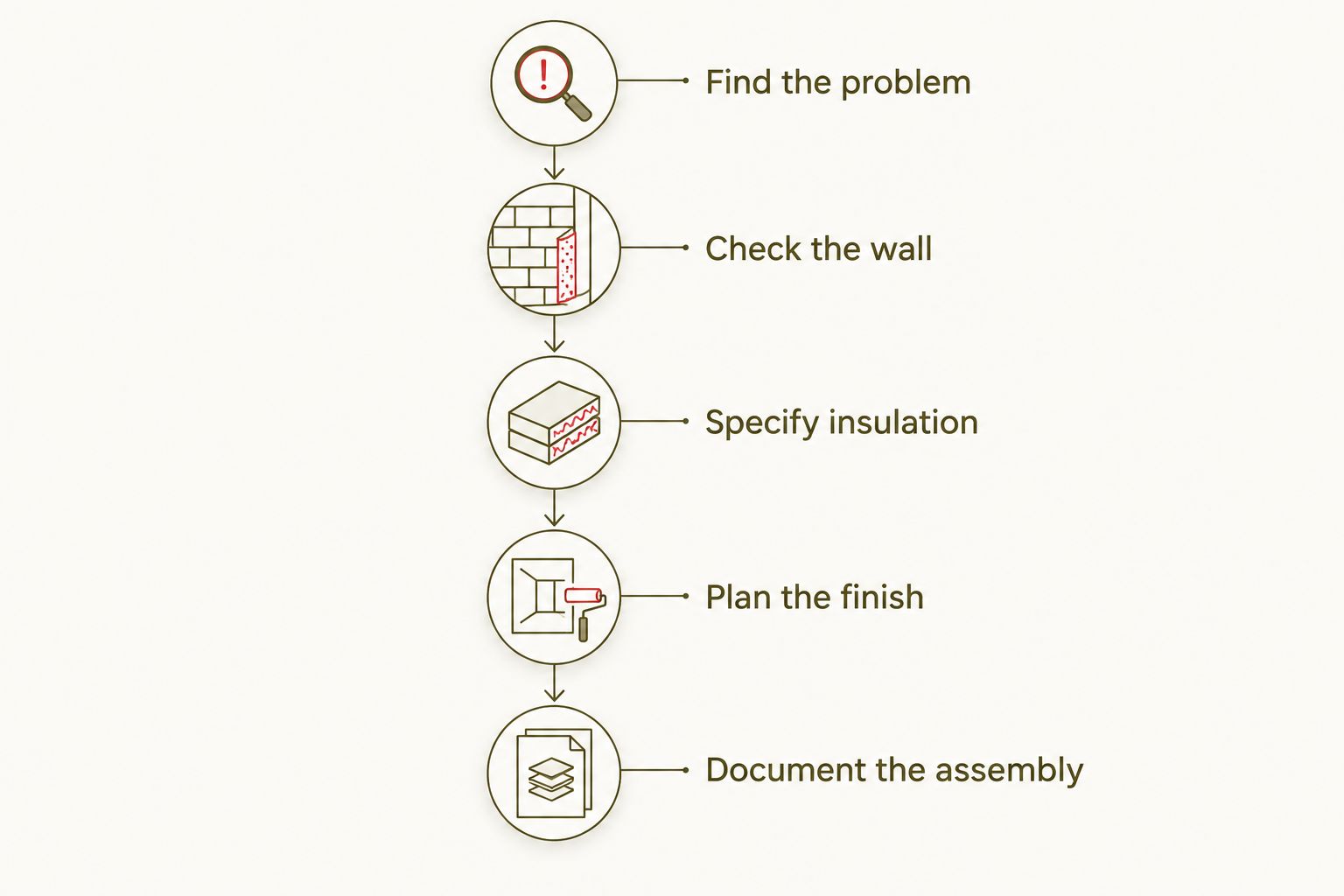
Start with the cause of discomfort, then specify the wall build-up. This sequence keeps the decorative work from getting ahead of the repairs it would otherwise conceal.
- Find the problem. Identify drafts, unusually cold surfaces, damp patches, and noise concerns separately. A room that feels uncomfortable does not automatically need more wall covering.
- Check the wall. Inspect for staining, loose surfaces, or evidence of moisture. Resolve the source of a problem rather than hiding it behind paneling.
- Specify insulation. If thermal improvement is the goal, obtain a suitable insulation specification for the wall and climate. Include air sealing and moisture control in the discussion.
- Plan the finish. Choose paneling for its appearance, acoustic role, and installation requirements. Check how added thickness meets outlets, trim, doors, and windows.
- Document the assembly. Keep the insulation and panel instructions together. Confirm that the planned layers and fixing method work as a complete installation.
The sequence is simple: diagnosis first, concealed work next, visible finish last. Reversing it makes future inspection and repairs harder because the new paneling sits in the way.
For a straightforward decorative project, you still need to follow the panel manufacturer's installation instructions. For an exterior wall with condensation or an uncertain construction, get a qualified building professional to assess the proposed layers before work starts.
Your 2026 project brief should describe the result you want in plain terms: fewer drafts, less heat loss, less echo, or a different appearance. Each objective needs its own evidence and acceptance criteria.
Will wood wall panels make my bedroom warmer?
Wood wall panels add a material layer, but they do not guarantee a warmer bedroom. The result depends on the existing wall, air leakage, heating, and the panel construction.
If you notice moving cold air around a window or outlet, investigate air leakage rather than expecting a feature wall to solve it. If the exterior wall itself is cold, assess the wall assembly and insulation before covering it.
For a bedroom that is already thermally comfortable but sounds harsh, The Panel Hub wall panels address a different buying brief: decorative wood surfaces and acoustic treatment. Keep that benefit separate from any claim about heating performance.
Does an air gap behind wall panels improve insulation?
An air gap can contribute thermal resistance under suitable conditions, but its performance depends on the assembly. Cavity dimensions, orientation, surface properties, and air movement all matter.
Do not assign an R-value to a battened wall simply because it contains a gap. A cavity that allows air circulation behaves differently from a properly detailed enclosed air space.
Battens also change the finished wall depth. Before you choose that installation method, check the panel instructions and plan how the new surface meets electrical fittings, baseboards, and adjacent walls.
Can acoustic panels stop cold air or noise from next door?
Acoustic panels are not a substitute for an air barrier or a sound-isolating wall assembly. Reducing echo inside your room is different from blocking drafts or reducing sound transmission between rooms.
For drafts, locate the leakage path and use an appropriate air-sealing method. For neighboring noise, assess the wall, gaps, doors, and other transmission paths rather than relying on an absorption rating.
Treat heat loss, air leakage, and sound transmission as separate design questions. They overlap within the same wall, but one product label does not answer all of them.
What should I ask before buying wall panels for insulation?
Ask the seller or installer to identify the exact performance being claimed. A useful answer names the product, the test or calculation, and the installation conditions that support it.
Use these questions to keep your 2026 comparison focused:
- Is the stated rating thermal resistance or sound absorption?
- Does the rating apply to the panel or the full wall assembly?
- What backing, thickness, and mounting method does it require?
- How will the installation address joints and penetrations?
- Does the proposed construction suit this wall's moisture conditions?
- What changes are needed around outlets, trim, and heating equipment?
Do not add an interior vapor-control layer as a routine DIY shortcut. The correct approach depends on climate, existing materials, and the rest of the wall construction.
Keep written specifications with your project records. They give you a firmer basis for selecting materials than a room photograph or an unqualified claim about comfort.
FAQ
Do wall panels add insulation value to an existing room?
Yes, wall panels add some thermal resistance, but ordinary decorative panels are not a substitute for purpose-made insulation. Check the exact product and wall assembly rather than assuming all paneling performs alike.
Does NRC 0.85 mean a wall panel insulates against heat?
No, NRC 0.85 is a sound absorption rating, not a thermal insulation rating. Use documented R-values to compare thermal resistance.
Are wood wall panels better than PVC panels for insulation?
Material names alone do not establish which panel provides more thermal resistance. Compare the exact products’ documented thermal properties, thicknesses, and installation details.
Can I put insulation behind decorative wall panels?
Yes, insulation can sit behind a decorative finish in a suitably designed wall assembly. Confirm the insulation, fixing method, fire requirements, and moisture details before installation.
Will wall paneling lower my heating bills?
Decorative wall paneling alone does not establish a heating-bill reduction. Any saving depends on the actual thermal improvement, air leakage, climate, and how you heat the room.
Can I cover a damp wall with panels to make it warmer?
No, resolve the source of dampness before covering the wall. Paneling can conceal the problem and make later inspection more difficult.
Are acoustic panels the same as soundproofing insulation?
No, acoustic panels primarily address reflected sound within a room, while sound isolation concerns sound passing between spaces. A sound absorption rating does not establish sound-isolation performance.
One last thing
A warmer-feeling surface is not necessarily a better-insulated wall. Touch alone cannot tell you how much heat the whole assembly loses.
Choose The Panel Hub wall panels for the finish and acoustic purpose they document; choose your thermal insulation from its thermal specification. That separation lets you improve the room's appearance without asking decorative paneling to solve the wrong problem.
Related guides
- Combining wall panels with baseboard heating
- Installing wall panels in an unheated garage
- Installing wall panels over water-damaged drywall