
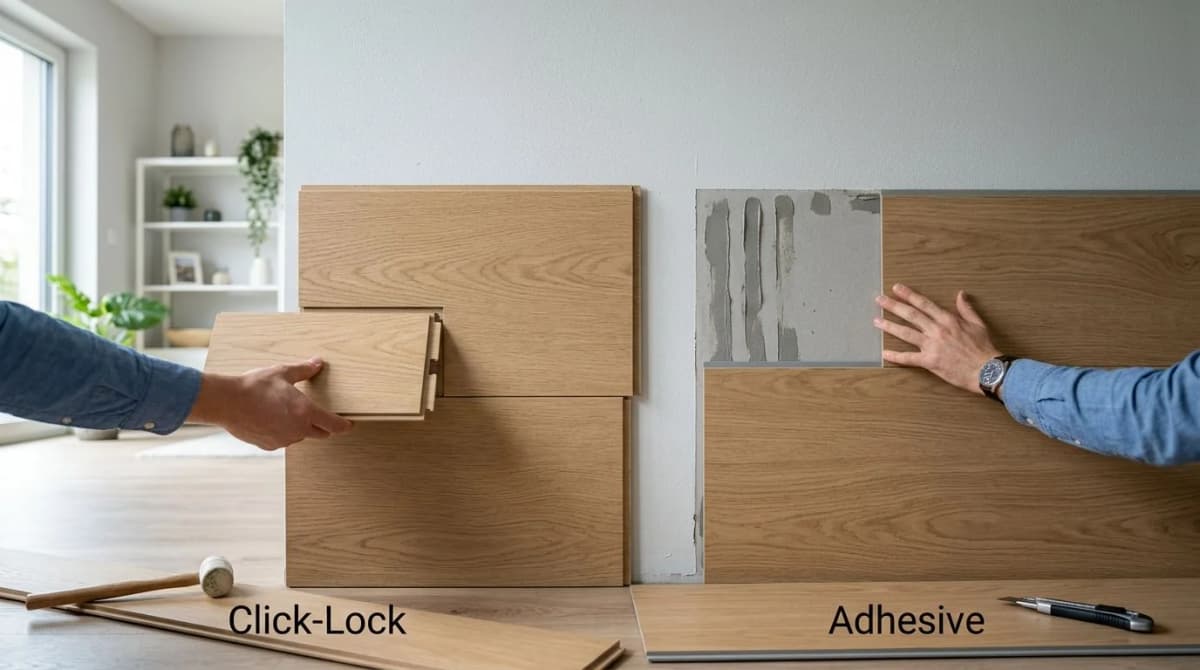
Click-lock wall panels win for renters and fast DIY jobs; adhesive-mounted panels win for permanent acoustic treatments; screw-and-furring-strip mounting wins for heavy stone-look panels on uneven walls. The right answer depends on whether you own the wall, how heavy the panel is, and whether you ever plan to take it down.
- Click-lock wall panels install without adhesive or nail holes, making them the top pick for renters in 2026.
- Adhesive-mounted wall panels bond permanently and suit acoustic slat panels rated NRC 0.85 for sound dampening.
- Screw-mounted panels on furring strips handle heavier faux-stone panels that adhesive alone won’t hold long-term.
- Most wall panel systems from The Panel Hub install in under 2 hours regardless of mounting method.
- Adhesive needs 24 to 72 hours to reach full cure strength; click-lock is load-bearing the moment it clicks.
Why this matters
Picking the wrong mounting method costs you a wall. Adhesive that's meant to be permanent tears drywall paper off when you try to remove it, which is the single most common complaint with wall panel installs. Click-lock systems avoid that problem entirely but aren't built to carry the same weight as a faux-stone or solid-wood panel.
The acoustic slat wood wall panels from The Panel Hub illustrate the tradeoff well: lightweight MDF-and-veneer construction works with either mounting method, but the method you choose changes whether the wall underneath survives a future renovation. Get this decision right before you buy panels, not after.
What makes the best wall panel installation method
- Reversibility — can the panel come off without damaging drywall or paint
- Weight capacity — how many pounds per panel the method reliably holds long-term
- Cure or set time — how long before the panel is load-bearing
- Wall prep required — bare drywall vs. furring strips vs. cleaned/primed surface
- Tool requirements — caulking gun and adhesive vs. click mechanism only vs. drill and screws
- Suitability for moisture — bathrooms and basements punish the wrong adhesive choice
At a glance
| Method | Best for | Standout feature | Key limitation |
|---|---|---|---|
| Click-lock panels | Renters, quick DIY updates | No adhesive, no wall damage on removal | Not rated for heavy stone-look panels |
| Adhesive-mounted panels | Permanent acoustic treatments | Full-surface bond, best for slat and felt-backed panels | Removal usually damages drywall |
| Screw + furring strip | Heavy panels, uneven walls | Highest weight capacity of the three | Most tools and prep time required |
1. Click-lock wall panels: best for renters and no-damage installs
Click-lock systems use interlocking tongue-and-groove edges, the same mechanical principle used in laminate flooring, so panels snap together and hold their own weight without glue or fasteners into the wall. You still need a starter strip or track along the base, but the panel field itself never touches the drywall with adhesive.
Click-lock pros:
- Comes off cleanly at move-out with zero wall repair
- No cure time — the panel is load-bearing immediately after it clicks
- No caulking gun, no mixing, no mess
- Works over slightly imperfect walls better than full-contact adhesive
Click-lock cons:
- Weight limits mean heavier faux-stone or thick solid-wood panels aren't good candidates
- A poorly seated track can leave a visible gap line
Click-lock verdict: Buy if you rent, if you want the option to redesign later, or if the panel itself (like a lightweight 3D geometric pattern wood panel) is under the method's practical weight ceiling.
2. Adhesive-mounted wall panels: best for permanent acoustic treatments
Adhesive bonds the full back surface of the panel to the wall, which matters most for acoustic panels where an air gap between panel and wall changes sound absorption performance. A hybrid polymer adhesive is the standard choice for interior wall cladding because it grips both porous drywall and painted surfaces without the fumes of solvent-based contact cement.
Adhesive pros:
- Full-surface contact means no rattling or hollow spots on acoustic slat panels
- Handles slightly heavier panels than click-lock alone
- No visible track or hardware at the base
Adhesive cons:
- Full cure typically runs 24 to 72 hours before the bond reaches maximum strength
- Removal is a one-way decision — expect drywall damage or skim-coat repair
- Requires a clean, dust-free wall surface for a proper bond
Adhesive verdict: Buy for a bedroom or living room acoustic wall you don't plan to change, especially with slat or felt-backed panels where full contact improves both look and sound dampening.
3. Screw and furring strip mounting: best for heavy or uneven walls
Furing strips — thin wood or metal strips screwed into studs — give you a level, secure base before the panel goes up, then the panel itself is screwed or clipped to the strips. This is the method contractors reach for on faux-stone panels or any wall that's out of plumb by more than a small margin, since adhesive alone can't compensate for an uneven surface.
Screw-mount pros:
- Highest weight capacity of the three methods
- Corrects for bowed or uneven walls that would leave gaps with adhesive or click-lock
- Panels stay serviceable — a damaged section can be unscrewed and swapped
Screw-mount cons:
- Most labor-intensive of the three, usually more than 2 hours for a full wall
- Reduces usable room depth slightly since furring strips add thickness
- Needs a drill, level, and stud finder at minimum
Screw-mount verdict: Buy for a faux-stone accent wall or any wall you already know is uneven; Skip it for a simple bedroom refresh where click-lock or adhesive does the job faster.


How we ranked
Each method was scored against the same six criteria: reversibility, weight capacity, cure/set time, wall prep, tool requirements, and moisture suitability. No single method wins on every criterion — that's why the verdict below splits by situation rather than naming one universal winner.
Which installation method should you choose in 2026?
If you're renting or you might rearrange the room in the next couple of years, click-lock wall panels are the default choice — no wall damage, no cure time, done in an afternoon. If you own the home and you're installing acoustic panels you intend to keep, adhesive is the better long-term bond, particularly for slat and felt-backed panels where full-surface contact affects sound performance. Reach for screw-and-furring-strip mounting only when the panel is heavy or the wall itself isn't flat — that combination breaks both click-lock and adhesive. For a bathroom or high-moisture room, check waterproof wall panels for bathrooms before locking in either method, since moisture changes which adhesives actually hold.
First-time installers who want a lower-risk starting project should read wall panels for DIY beginners before picking a method — the easiest panel to install isn't always the one that looks best in photos.
FAQ
What’s the difference between click-lock and adhesive wall panels?
Click-lock panels interlock mechanically and need no glue, while adhesive panels bond their full back surface to the wall with a hybrid polymer adhesive. Click-lock is reversible; adhesive is effectively permanent.
Is click-lock or adhesive better for renters?
Click-lock is better for renters because it comes off without damaging drywall or paint. Adhesive-mounted panels usually require drywall repair at removal.
How long does adhesive take to cure on wall panels?
Hybrid polymer wall panel adhesive typically reaches full cure strength in 24 to 72 hours. The panel can usually be handled gently much sooner, but full bond strength takes the full cure window.
Can you use adhesive on drywall for wall panels?
Yes, hybrid polymer adhesives are designed to bond to painted or bare drywall as long as the surface is clean and dust-free. A dirty or glossy wall reduces bond strength significantly.
Do click-lock panels need furring strips?
Most click-lock panels only need a starter track at the base, not full furring strips. Furring strips become necessary when the wall is uneven or the panel is heavier than the click mechanism is rated for.
Which method is better for acoustic wall panels?
Adhesive mounting is generally better for acoustic panels because full-surface contact avoids air gaps that change sound absorption. Acoustic slat panels rated NRC 0.85 perform best with a solid, gap-free bond.
How much wall prep does adhesive installation require?
Adhesive installation requires a clean, dust-free, and ideally flat wall surface for a reliable bond. Skipping prep is the most common reason adhesive-mounted panels fail early.
Can you combine click-lock and adhesive on the same wall?
Yes, some installers use adhesive as a secondary bond behind a click-lock system for extra hold on taller walls. This isn’t necessary for most standard-height rooms but adds security for ceiling-height installs.
One last thing
The detail most guides skip: adhesive cure time doesn't just affect bond strength, it affects how soon you can lean furniture or trim against the panel edge. Give a full 72 hours before pushing a dresser or bookshelf flush against a freshly adhesive-mounted panel — rushing that step is the most common reason an otherwise correct installation fails in the first month.
Related guides