
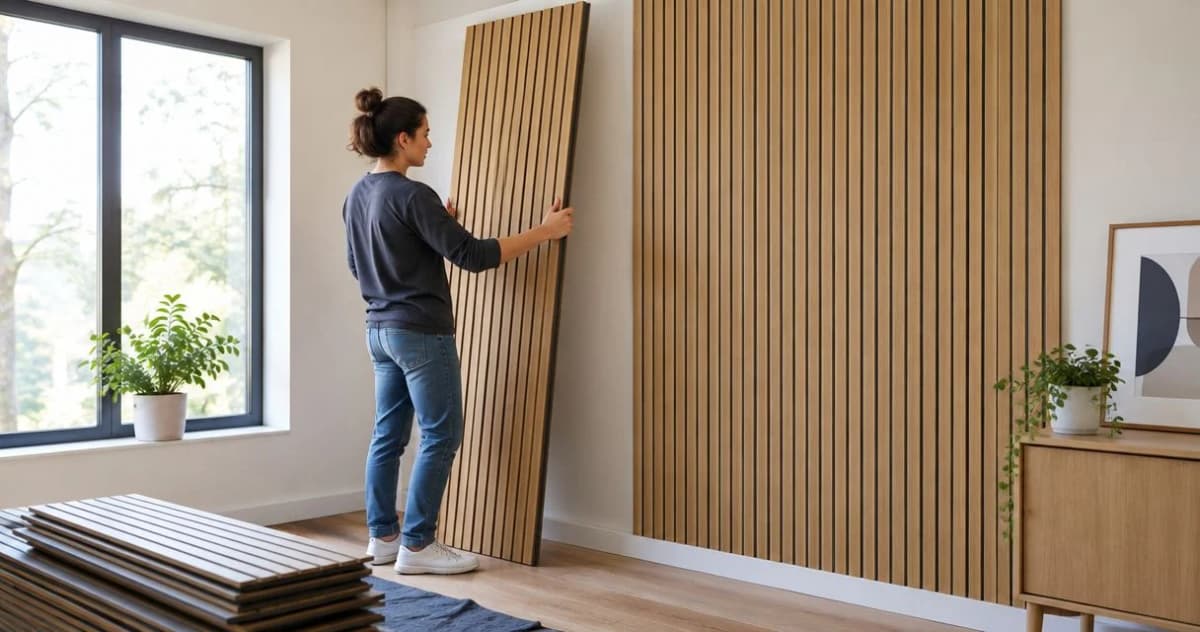
Yes—wood and wood-based wall panels generally need to acclimate in the installation room, while PVC and other panel systems must follow their own temperature-conditioning instructions. Use the product’s installation guide to set the waiting period, packaging arrangement, and room conditions; time spent in a garage or delivery box does not automatically count.
- Do wall panels need to acclimate before installation? Wood-based panels generally do; follow the exact product instructions.
- The Panel Hub wall panels suit homeowners planning DIY decorative or acoustic upgrades; preparation still comes before fitting.
- Acclimate panels in the installation room under normal living conditions, not beside a heater or in damp storage.
- A completed waiting period does not make damp walls, unstable room conditions, or damaged panels ready for installation.
Why this matters
Acclimation is part of preparation, not an optional pause. Wood exchanges moisture with its surroundings, which changes its dimensions. Fastening panels before they adjust can leave joints and edges responding to the room after installation rather than before it.
The visible face does not tell you everything about a panel’s construction. Solid wood, wood veneer, MDF cores, and plastic systems respond differently, so do not transfer instructions between products just because their finished surfaces look similar. This comparison of engineered wood veneer and solid wood paneling explains the material distinction.
For a 2026 bedroom or living-room project, plan the preparation window before choosing your installation day. The calendar should follow the panel instructions and the condition of the room—not the other way around.
Do wall panels need to acclimate before installation?
Wood and wood-based wall panels generally need acclimation before installation; the exact requirements belong to the specific panel system. Plastic panels also need suitable installation temperatures, but their temperature response is different from wood’s moisture response.
Use this material comparison to identify which instructions to look for. The “best for” column describes the intended application, not permission to use a panel outside its stated limits.
| Panel material | Best for | Acclimation concern | Benefit | Limitation |
|---|---|---|---|---|
| Solid wood | Decorative walls with natural wood texture | Moisture adjustment and resulting movement | Natural grain and material character | Still responds to humidity after installation |
| Wood veneer over a wood-based core | Decorative or acoustic systems specified for interior walls | Both the face and core construction matter | A wood surface within an engineered assembly | The veneer does not make the core moisture-proof |
| MDF | Painted decorative paneling in suitable dry interiors | Moisture exposure, especially at edges | A smooth surface for decorative finishes | Damp conditions can cause swelling |
| PVC | Bathrooms or utility areas when the system permits them | Temperature conditioning and expansion allowances | Does not behave like moisture-absorbing wood | Waterproof panel material does not make every joint or wall assembly waterproof |
Read the instructions for the full assembly, including backing, trims, adhesive, and fasteners. A panel that looks ready can still be outside the adhesive’s permitted application conditions.
Check 3 conditions before you start
Use these 3 checks as your installation gate:
- Room conditions: The room is operating under its normal heating, cooling, and ventilation conditions.
- Panel conditions: The specified conditioning period is complete, and the panels show no unresolved damage or distortion.
- Wall conditions: The wall is dry, sound, suitably flat, and compatible with the chosen fixing method.
Passing only the time requirement is not enough. A damp wall remains unsuitable even when the panels have been indoors for the full period stated in their guide.
Wood and wood-based panels: allow for moisture adjustment
Solid wood absorbs and releases moisture as surrounding humidity changes. Acclimation gives the material an opportunity to adjust before you restrict its movement with adhesive, screws, or trim.
Wood-based panels need attention too. A decorative veneer is only part of the assembly; the core, backing, coatings, and exposed edges also affect how the panel responds to its surroundings. Do not assume that “engineered” means “no acclimation required.”
Keep the panels in the room where they will be installed and follow the specified storage arrangement. Instructions can differ on whether packaging stays closed, opens partially, or comes off. The same applies to stacking and support: an improvised arrangement can introduce bending instead of helping preparation.
Acclimation does not stop seasonal wood movement permanently. Leave the clearances specified by the panel manufacturer, and avoid trapping moving edges behind tightly fitted trim. Waiting before installation and allowing movement afterward solve different problems.
PVC and shower panels: check temperature and system requirements
PVC does not exchange moisture with the room in the same way as wood, but it expands and contracts with temperature. Panels brought from cold storage into a heated bathroom therefore need the conditioning process specified for that system.
Do not borrow a waiting period from a wood-panel guide. Check the PVC panel instructions alongside the adhesive, sealant, and trim requirements, because those components must work together under the installation conditions.
For shower walls, acclimation is only one preparation step. Substrate suitability, joint treatment, penetrations, and perimeter details also matter. A water-resistant panel face is not a substitute for correctly installed joints and an appropriate wall assembly.
The practical advantage of PVC is its different moisture behavior compared with wood-based materials. Its limitation is that temperature movement and system detailing still require attention; skipping those checks is not a shortcut.
Why wall-panel acclimation requirements vary
There is no reliable universal waiting period for every wall panel. These factors explain why the product guide must control your schedule:
- Material construction: Solid wood, MDF, veneer assemblies, and PVC respond differently to moisture and temperature.
- Delivery and storage conditions: Panels arriving from a cold vehicle or damp storage need assessment against the installation requirements.
- Room stability: A heated, occupied bedroom presents different conditions from a room with heating switched off during renovation.
- Recent wet work: Plastering, screeding, and other moisture-producing work can change the room environment.
- Packaging and airflow: Wrapping, backing, and stacking influence exposure to the room; follow the specified arrangement.
- Fixing system: Adhesives and sealants have their own application conditions, separate from the panel’s conditioning requirements.
For your 2026 project schedule, distinguish between a stable finished room and a room that is merely indoors. A closed building can still be damp, unusually cold, or undergoing work that changes its conditions.
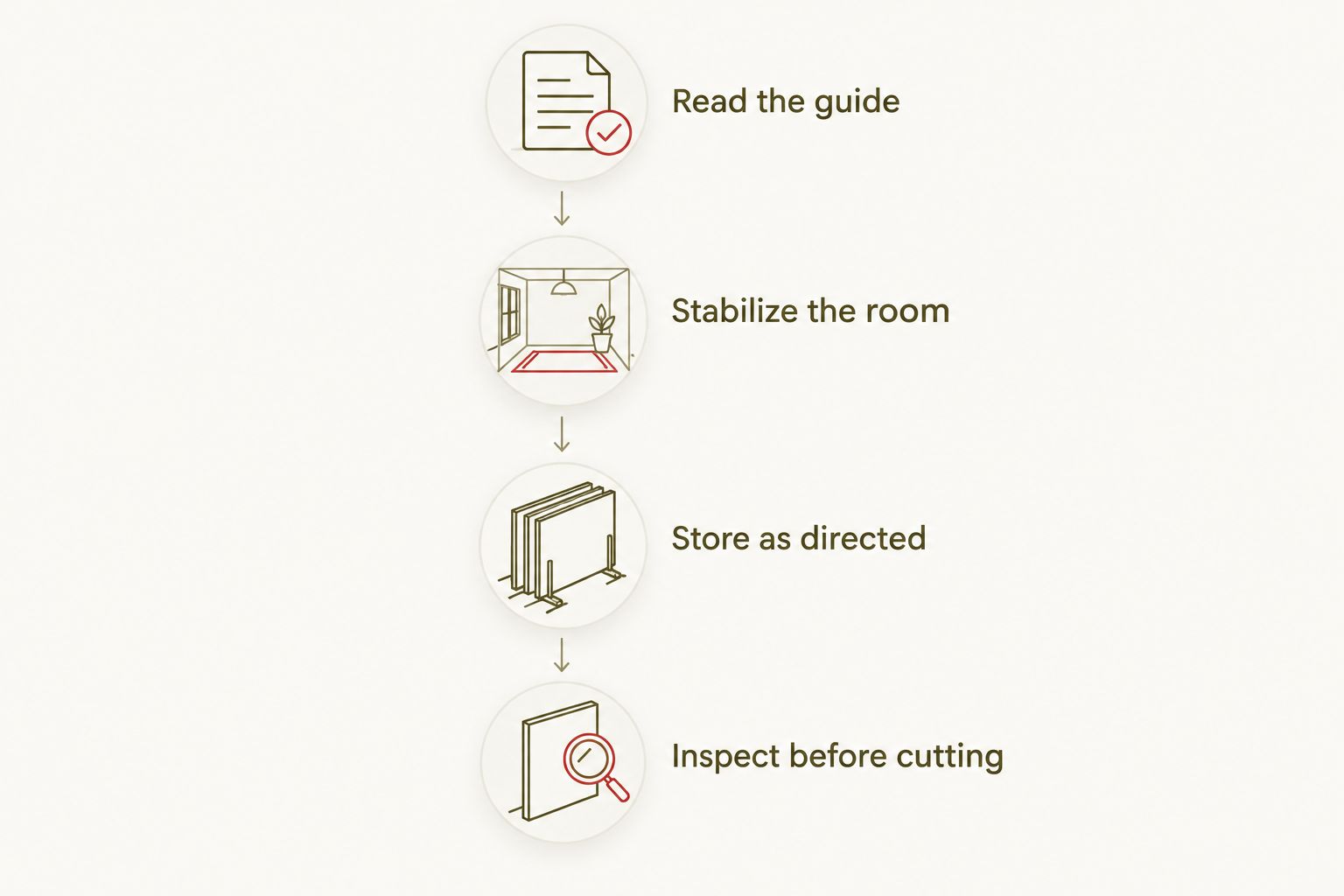
How to acclimate wall panels before fitting
Read the guide
Find the instructions for the exact panel, not a visually similar product. Check the required room conditions, waiting period, packaging arrangement, storage position, and expansion allowances before opening or cutting anything.
Also read the fixing-product instructions. If the panel and adhesive requirements differ, satisfy both rather than choosing whichever gets you started sooner.
Stabilize the room
Bring the installation room into its normal use conditions. Keep heating, cooling, and ventilation consistent instead of warming the room briefly for fitting and switching everything off afterward.
Complete moisture-producing work and resolve leaks before introducing panels for conditioning. A room that is still drying is not the same environment the finished wall will experience in everyday use.
Store as directed
Keep panels supported and protected from damp surfaces, direct heat, and accidental damage. Follow the specified stacking or spacing arrangement rather than leaning the delivery against a wall by default.
Do not force adjustment with a portable heater aimed at the panels. Local heating creates uneven conditions and does not establish that the whole assembly is ready.
Inspect before cutting
Check faces, edges, backing, and overall shape before committing to cuts or adhesive. Separate anything visibly swollen, damaged, or distorted and seek product-specific advice before using it.
Once preparation is complete, dry-fit the layout and confirm joint spacing, edge clearances, and trim positions. Cutting first and asking about movement later leaves fewer options.
How do you know wall panels are ready to install?
Readiness means meeting the written installation conditions, not simply finishing a countdown. Confirm that the required time has elapsed under the specified conditions and that the wall and fixing materials are ready too.
A panel that feels warm to your hand has not necessarily completed moisture adjustment. Likewise, a straight-looking face does not prove that the core meets the manufacturer’s requirements. Use the assessment method stated in the guide rather than inventing a touch test.
If instructions require moisture measurements, use an instrument and settings appropriate to the material. Ask for clarification when the required measurement, acceptable condition, or testing method is unclear; a generic reading without the right interpretation is not an installation decision.
Record the product instructions and your preparation dates in your 2026 project notes. Keep packaging details until installation is complete so you can identify the exact product if a question comes up.
What should you check for acoustic slat panels?
For homeowners considering The Panel Hub acoustic wall panels, the Acoustic Slat Wood Wall Panels | SoundPanel™ listing describes an MDF-based wood wall panel. That makes the construction relevant to preparation; do not treat the decorative face as the whole material.
The Panel Hub wall panels suit homeowners planning DIY decorative or acoustic upgrades. For this acoustic slat option, confirm the current installation instructions before choosing a fitting date. Its acoustic purpose does not remove the need to prepare a wood-based panel correctly.
The practical benefit is combining a decorative slat surface with an acoustic-panel application. The limitation is the same preparation responsibility discussed above: a wood-based assembly still needs suitable room conditions, wall preparation, and the specified fixing method.
When planning a 2026 acoustic feature wall, separate conditioning from hands-on installation. A short fitting process does not establish a short acclimation period, and installation speed is not evidence that panels can go straight from delivery to the wall.
Can you acclimate wall panels in a different room?
Use the installation room unless the manufacturer permits another arrangement. A nearby room only provides a useful conditioning environment when its conditions meet the same requirements; proximity alone proves nothing.
A garage, unfinished basement, or room without normal climate control is not an automatic substitute. Avoid moving conditioned panels back into unsuitable storage while you finish decorating elsewhere.
Should you open the packaging during acclimation?
Open the packaging only as directed by the panel manufacturer. Different wrapping and panel constructions require different arrangements, so removing every layer is not a universal rule.
Keep identification labels and instructions available, and protect exposed faces from dust and damage. Packaging decisions should support the specified conditioning method rather than simply make the panels easier to reach.
Can you install panels before the room is fully finished?
Finish work that changes moisture conditions before installing wood-based panels. Wet plaster, unresolved leaks, and ongoing drying can undermine a preparation period completed under different room conditions.
Painting, flooring, and trim sequencing also need coordination with the panel instructions. Do not use decorative panels to hide a moisture problem or an unsuitable wall. Correct the substrate first, then return to the conditioning and installation checks.
FAQ
Do all wall panels need to acclimate before installation?
No single acclimation rule covers every wall panel. Wood and wood-based panels generally need moisture conditioning, while PVC systems require their own temperature and installation checks.
How long should I leave wall panels in the room before installing them?
Leave wall panels for the period specified in the exact product’s installation guide. The room conditions and packaging arrangement must also meet that guide; elapsed time alone does not establish readiness.
Can I leave wall panels in the garage to acclimate?
A garage is not a substitute for the installation room unless its conditions meet the product requirements and the instructions permit it. Cold, damp, or unconditioned storage does not automatically count toward acclimation.
Do MDF wall panels need acclimation too?
MDF wall panels generally need conditioning according to their installation instructions. MDF is wood-based, and damp exposure can cause swelling, particularly at exposed edges.
Do waterproof shower panels still need to acclimate?
Waterproof shower panels still need the temperature conditioning specified by their manufacturer. Water resistance does not remove thermal movement or the application requirements for adhesive and sealant.
Can I speed up acclimation with a heater?
Do not aim a heater at panels to accelerate acclimation. Maintain the room’s normal conditions and follow the specified process rather than creating concentrated heat.
What should I check before installing The Panel Hub wall panels in 2026?
Before installing The Panel Hub wall panels in 2026, check the instructions for the exact product, its conditioning requirements, and the permitted fixing method. Confirm that both the room and wall are ready before cutting or attaching panels.
One last thing
Acclimation is not a repair method. Leaving a swollen, damaged, or badly distorted panel in a room does not establish that it will become suitable for installation. Stop and resolve the condition before cutting away evidence or attaching it permanently.
For your 2026 project, make the final decision at the wall: correct product, completed conditioning, stable room, sound substrate, and suitable fixings. When those checks agree, you have a better basis for starting than a date circled on the calendar.
Related guides
- Can wall panels be installed in an unheated garage?
- Can you install wall panels over water-damaged drywall?
- Can liquid nails be used to install wall panels?