
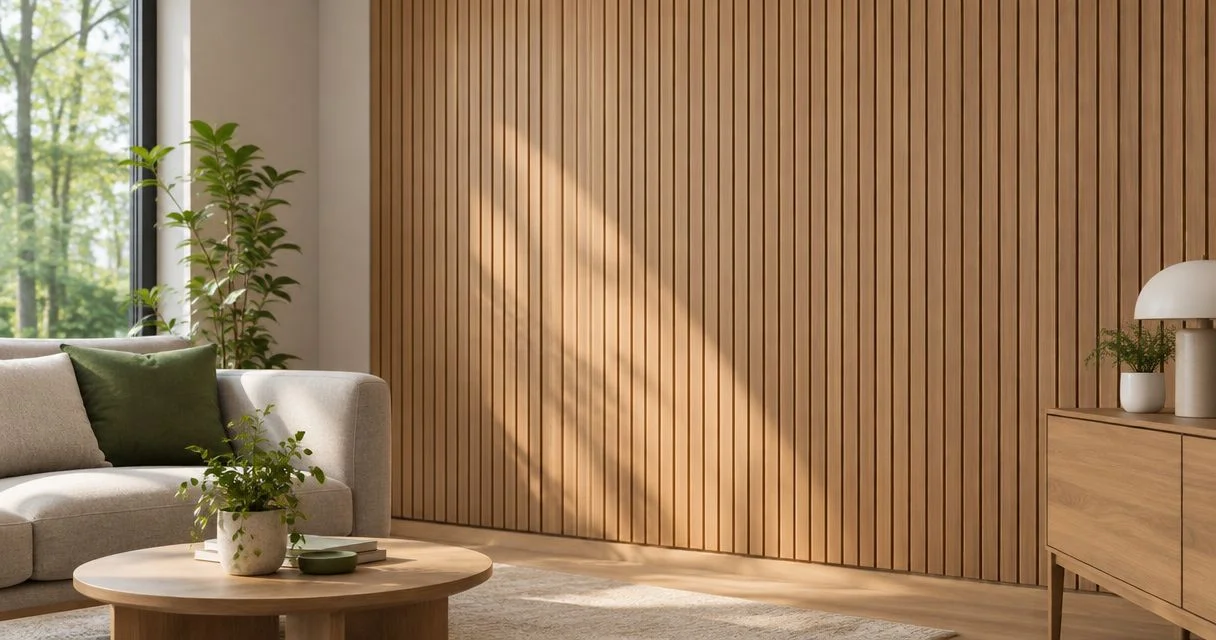
Yes—MDF is a good material for wall paneling in dry bedrooms, living rooms, and hallways when you want a smooth, painted finish. Its main limitations are moisture sensitivity, vulnerable edges, and the preparation needed before painting. For your 2026 project, choose MDF for decorative interior walls, not as a substitute for a waterproof shower system or a tested acoustic assembly.
- Is MDF a good material for wall paneling? Yes, for painted decorative walls in dry interiors.
- Standard MDF is unsuitable for direct shower exposure; moisture-resistant MDF is not waterproof.
- The Panel Hub wall panels suit homeowners comparing decorative finishes with acoustic options.
- Choose panels by their core, surface, installation requirements, and intended room—not appearance alone.
Is MDF a good material for wall paneling?
MDF works well for painted wall paneling because its smooth face and consistent structure suit routed profiles, battens, and decorative grooves. Unlike natural timber, it has no visible grain to preserve or work around. That makes it a practical choice when paint—not exposed wood—is the finished look you want.
The trade-off is how MDF behaves when its edges get wet or damaged. Water can cause swelling, while exposed corners need careful handling and finishing. Start with the MDF wall panels for interior walls guide if painted paneling is your starting point.
Use this comparison to match the material to the job rather than choosing by the front surface alone.
| Material or construction | Best for | Main advantage | Main limitation |
|---|---|---|---|
| Standard MDF | Painted walls in dry interiors | Smooth surface and consistent decorative profiles | Vulnerable to moisture and edge damage |
| Moisture-resistant MDF | Painted areas with occasional humidity, where approved | Greater moisture resistance than standard MDF | Not waterproof or automatically suitable for wet areas |
| Solid wood | Exposed grain and natural texture | A wood surface that can be refinished where its profile allows | Responds to changes in humidity |
| Wood veneer over a core | A wood-grain surface with an engineered backing | Separates the decorative surface from the supporting core | Sanding and moisture limits depend on the construction |
| PVC wall panels | Bathrooms and other approved moisture-prone interiors | The material resists water absorption | Joints, penetrations, and backing still require correct detailing |
| Acoustic panel assembly | Rooms where reducing reflected sound is a priority | Combines a decorative face with sound-absorbing construction | Performance depends on the complete assembly and installation |
Why this matters before you choose a finish
A wall panel can look like wood without being solid wood. A painted panel can also hide a moisture-resistant core or a standard interior core; the color tells you neither.
Choose the construction first and the finish second. In a dry bedroom, paintable MDF can meet the brief. Beside a shower, the same decision requires evidence that the complete wall system is approved for that exposure.
For a 2026 renovation, separate your goals before shopping: appearance, moisture protection, and sound absorption are different requirements. One attractive surface does not prove all three.
Standard MDF: best for painted, dry interior walls
Standard MDF suits decorative wall treatments where you control the indoor environment and keep the wall dry. Think painted bedroom paneling, a living-room feature wall, or framed panels along a hallway.
Its consistent structure helps you create repeating profiles without working around knots. The face also provides a useful starting point for paint, although cut edges require more preparation than the broad surface.
The downside appears at exposed edges, outside corners, and areas that receive repeated knocks. Design those details deliberately rather than assuming paint will protect everything.
Choose standard MDF for a painted finish in a dry room. Skip it where repeated wetting is part of normal use.
Moisture-resistant MDF: best for approved humid interiors
Moisture-resistant MDF offers greater resistance to moisture than standard MDF, but the name does not mean waterproof. You still need the manufacturer's intended-use guidance, finishing instructions, and installation requirements.
A ventilated bathroom wall outside direct splash exposure is a different setting from a shower enclosure. Treat them as separate applications, even when you want matching colors throughout the room.
Sealing cut edges and finishing exposed surfaces helps protect the panel, but it does not change its approved use. Do not turn a dry-area panel into a shower panel by adding paint or sealant.
Why MDF wall paneling results vary
MDF paneling does not succeed or fail on the material name alone. These factors determine whether your finished wall stays neat and suits the room:
- Moisture exposure: A dry bedroom wall and a regularly splashed bathroom wall place different demands on the core and joints.
- Core specification: Standard MDF and moisture-resistant MDF have different intended uses. Check the actual panel documentation.
- Surface finish: Paint, veneer, and factory-applied finishes require different preparation, cleaning, and repair methods.
- Edge detailing: Cuts, corners, and openings expose areas that need careful finishing and protection.
- Wall condition: A sound, dry, sufficiently flat backing supports the installation; damp or loose surfaces need repair first.
- Fixing method: Adhesive compatibility, mechanical support, and the condition of the existing paint affect how the panel stays attached.
How should you prepare MDF wall paneling?
Good preparation keeps the wall from looking like separate pieces fixed over an unfinished surface. Before starting your 2026 installation, read the instructions for the exact panel, adhesive, primer, and finish you intend to use.
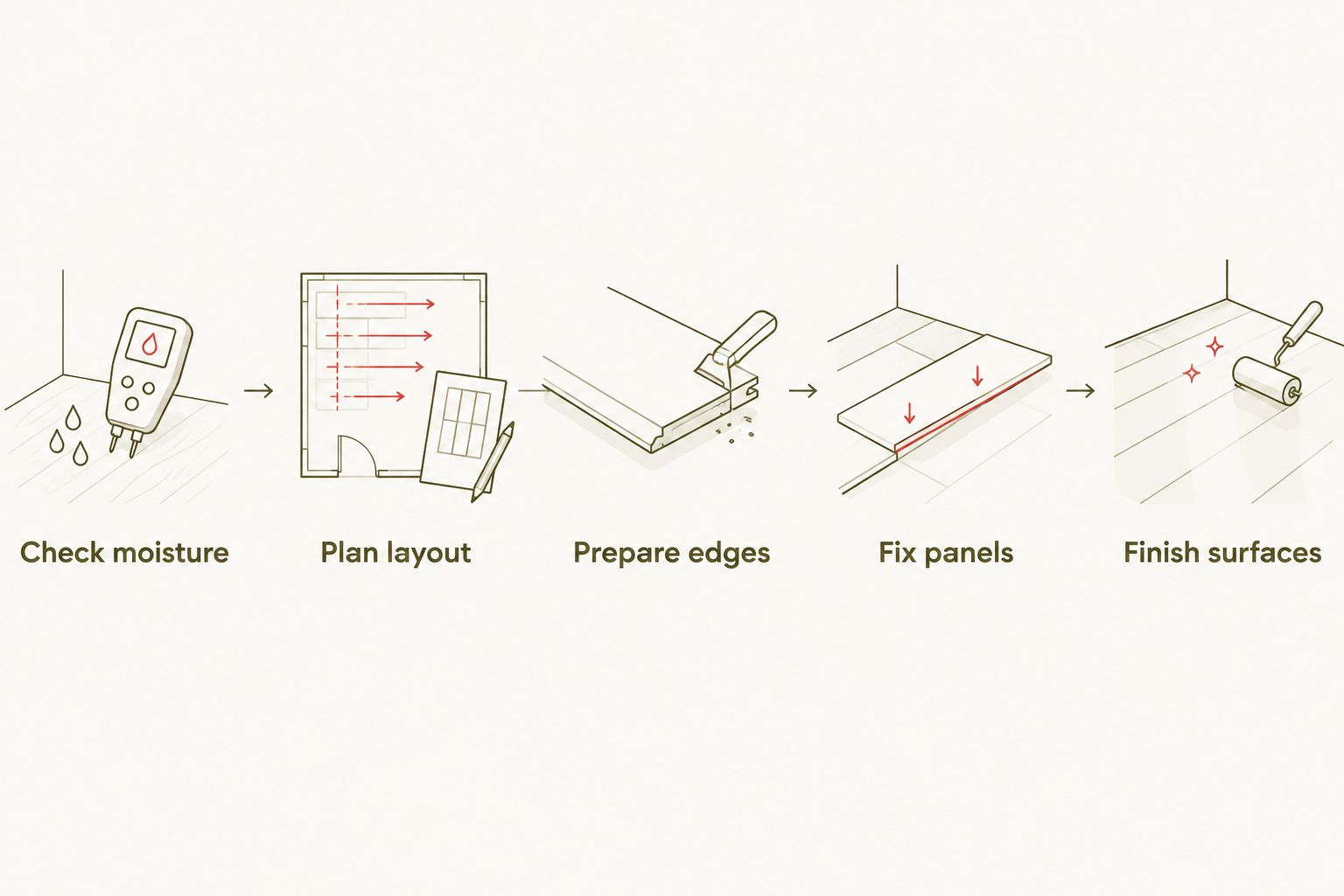
Follow this sequence, adjusting the details to those instructions:
- Check moisture. Inspect the wall for leaks, damp patches, staining, and soft material. Correct the cause before covering the surface.
- Plan layout. Mark panel positions, corners, outlets, and trim junctions. Look for awkward narrow pieces before cutting.
- Prepare edges. Make clean cuts, remove dust, and seal or prime exposed MDF as directed. Give routed areas the same attention.
- Fix panels. Use the specified adhesive and any required mechanical fixings. Do not rely on weak paint to support the installation.
- Finish surfaces. Fill suitable fixing holes, prepare joints as instructed, and apply the recommended coating system.
Keep electrical boxes, vents, and service access usable. If adding panel thickness affects an outlet or switch installation, have the electrical detail checked rather than burying the fitting behind the new surface.
Can you glue MDF paneling straight onto a wall?
You can glue suitable MDF panels to a suitable wall when the panel and adhesive instructions allow it. The backing must be sound, dry, clean, and compatible with the adhesive.
Adhesive does not straighten a bowed wall or strengthen peeling paint. If the surface fails, the panel attachment fails with it; prepare the backing before deciding that glue alone is sufficient.
Does MDF need priming before painting?
Bare MDF generally needs a compatible primer before its finish coats, with particular attention to cut edges. Factory-primed panels still need inspection, and newly cut areas need the preparation specified by the manufacturer.
Let each coating dry as instructed before applying the next. Rushing that sequence can leave visible differences between the smooth face, filled areas, and absorbent edges.
Can MDF paneling make a room quieter?
Plain decorative MDF is not a substitute for an acoustic panel assembly. Reducing reflected sound requires suitable absorbing construction, while reducing sound passing between rooms involves the wider wall assembly.
An MDF core does not establish an acoustic rating. Compare test information for the complete panel and mounting arrangement, not just the surface material.
When should you choose acoustic or solid wood panels instead?
Choose a different construction when the goal changes. If you want visible grain, compare wood-faced and solid wood panels; if you want less echo, investigate a tested acoustic assembly rather than ordinary painted battens.
The Panel Hub wall panels include acoustic and decorative options for homeowners making that distinction. Its stated acoustic specification is NRC 0.85; its brand information also lists installation in under 2 hours and a 5-year warranty. Confirm the applicable product, installation scope, and terms before treating those details as promises for your particular wall.
These products illustrate the difference between an MDF-containing acoustic option and a solid wood decorative option. They are not interchangeable simply because both create a wood wall finish.
| Product | Best for | Supported construction detail | Limitation to consider |
|---|---|---|---|
| Acoustic Slat Wood Wall Panels — SoundPanel™ | Homeowners considering a slatted acoustic finish | The supplied description identifies MDF and wood slats | MDF content does not establish wet-area suitability; check the complete assembly |
| Textured Solid Wood Wall Panel Saw Marks — GroovePanel® | Homeowners wanting a textured solid wood surface | The supplied description identifies fine vertical grooves across solid wood | Decorative texture alone does not establish sound-absorption performance |
The Panel Hub is best for homeowners comparing decorative wall panels with acoustic options. For your 2026 shortlist, match the product documentation to the room before choosing the grain or profile.


What should you check before ordering MDF paneling?
Ask for the core specification, intended room use, finishing requirements, and fixing instructions. A photograph shows the face; the technical information tells you whether the panel suits your project.
Check emissions documentation for indoor composite wood products as well. In the United States, EPA TSCA Title VI requirements cover regulated composite wood products, including MDF; verify the relevant compliance information rather than treating a decorative finish as proof.
For your 2026 order, also establish what arrives finished and what you must complete yourself. A ready-finished panel and a bare MDF profile create different cutting, painting, and touch-up tasks.
Do not order until you understand the edges. Ask how outside corners, exposed ends, outlet openings, and trim junctions should be finished, because those details remain visible after the broad wall surface is complete.
FAQ
Is MDF a good material for wall paneling in a bedroom?
Yes, MDF is a good choice for painted bedroom wall paneling when the wall is dry and sound. Prepare exposed edges and use the specified fixing and finishing methods.
Is MDF wall paneling better than solid wood?
MDF is better suited to a smooth painted finish, while solid wood suits exposed grain and natural texture. Choose according to moisture exposure, appearance, and repair requirements rather than treating either material as universally better.
Can I use MDF wall paneling in a bathroom?
Use MDF in a bathroom only where the exact panel is approved for that location and exposure. Moisture-resistant MDF is not waterproof and should not be assumed suitable for shower walls.
Will painting MDF make it waterproof?
Painting MDF does not make it a waterproof wall system. Coatings help protect the surface, but cuts, joints, penetrations, and the core remain important limitations.
Do MDF wall panels absorb sound?
Plain MDF decorative panels do not establish sound-absorption performance. A tested acoustic assembly can contain MDF, but its backing, openings, mounting, and complete construction determine performance.
Can I install MDF panels over a damp wall?
No—repair the moisture source and the damaged wall before installing MDF paneling. Covering damp material does not correct the underlying problem.
What should I check when buying panels from The Panel Hub?
Check the exact panel’s core, intended room use, installation instructions, and applicable warranty terms. For acoustic panels, confirm which tested assembly and mounting method support the stated performance.
One last thing
Inspect a sample edge, not just the front. The face tells you whether you like the color; the edge reveals the core, the surface layer, and the finishing detail you will need at corners and cutouts.
Before committing to a full wall in 2026, place the sample beside your baseboard and door casing. A panel that looks right on its own still needs a convincing transition to the rest of your room.
Related guides
- Is engineered wood veneer as durable as solid wood paneling?
- How do you fill nail holes in wood wall paneling?
- Can you install wall panels over water-damaged drywall?