
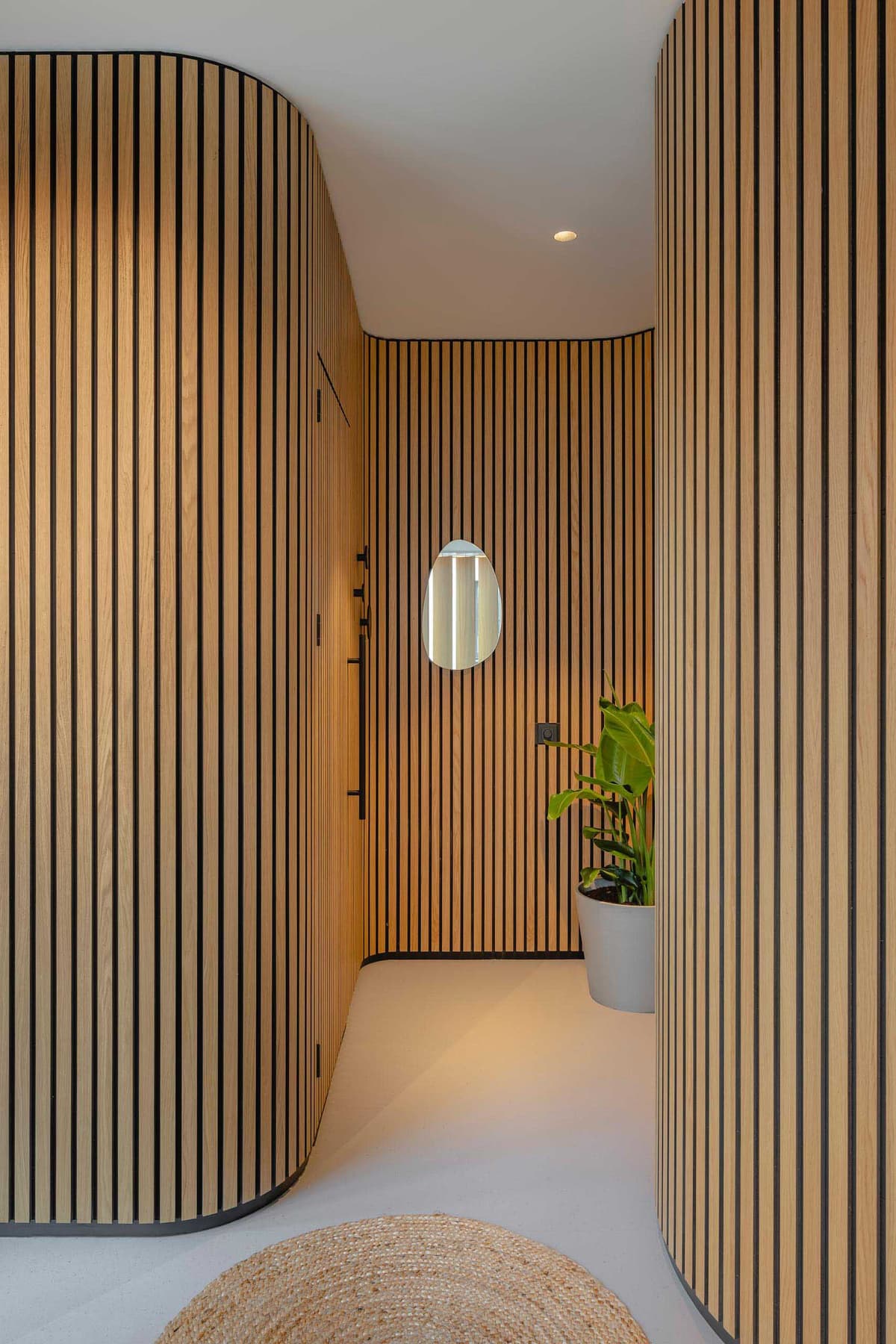
Curved walls are rare in most homes — and that’s precisely what makes them so effective as design features. A curved feature wall stands apart from the rectilinear geometry of most interiors, and when it’s paneled, it becomes one of the most distinctive elements a room can have. At The Panel Hub, our flexible wall panels make curved feature walls achievable in both new-build and existing properties, bringing the warmth and texture of wood wall panels to surfaces that rigid panels can’t address.
Contents
- The Appeal of Curved Feature Walls
- Design Approaches for Curved Walls
- Full radius curves
- Gentle bows and shallow curves
- Column wraps
- Materials That Work on Curved Surfaces
- Where Curved Feature Walls Work Best
- Living rooms
- Commercial spaces
- Entrance halls and stairwells
- Planning a Curved Feature Wall
- Getting It Right
The Appeal of Curved Feature Walls
Curved walls introduce softness into interior spaces that are otherwise defined by hard angles. In an architectural sense, they break predictability — the eye expects corners and straight lines, and a curved wall surprises it in a way that feels sophisticated rather than arbitrary. When clad in wood paneling, a curved wall also has a material richness that flat painted plaster can’t approach.
In residential interiors, curved feature walls most often appear in living rooms, bedrooms, and entrance halls. In commercial spaces — hotels, restaurants, retail — they’re used to signal premium quality and to create spatial differentiation in open-plan environments.
Design Approaches for Curved Walls
Full radius curves
A full radius curved wall — one that sweeps in a continuous arc from one point to another — is typically a structural or architectural feature rather than something added retrospectively. In new builds or major renovations, a full radius wall can be designed into the space from the outset and paneled to become the defining feature of the room. Floor-to-ceiling flexible panels following a full radius create a drum-like effect that is visually dramatic and acoustically interesting.
Gentle bows and shallow curves
More commonly, a curved feature wall is a shallow bow rather than a full arc — a wall with a gentle outward or inward curve that adds movement to what would otherwise be a flat surface. These can be created retrospectively by building a studwork frame in the desired curve and cladding it with flexible panels. The result appears as a natural architectural feature that seems to have always been there.
Column wraps
Wrapping a structural column in flexible panels is one of the most practical applications of curved wall paneling. It transforms an obstacle into a feature — a column clad in warm oak or walnut slat panels becomes a visual anchor in an open-plan space rather than an interruption. Where multiple columns exist, treating them consistently with the same panel creates a rhythm that ties the space together.
Materials That Work on Curved Surfaces
Not all panel formats are available in flexible versions, so the material choice is constrained by what can be bent to the required radius. Our flexible panel range is available in slat and selected mosaic formats — the slat format is particularly well suited to curved surfaces because the vertical lines of the slats follow the curve naturally and emphasise the radius rather than fighting it.
Mosaic panels on curved surfaces create a different effect — the small format of the individual pieces means they can follow a curve without the visual distortion that larger-format panels sometimes produce. They suit tighter radii and more intricate curved geometries.
Where Curved Feature Walls Work Best
Living rooms
A curved feature wall in a living room — typically the main focal wall or the wall behind a sofa — creates a centrepiece that makes the room feel architecturally considered. In open-plan spaces, a curved paneled wall can define the living zone without using a partition, creating a sense of enclosure and separation through material and geometry rather than physical division.
Commercial spaces
In hotel lobbies, restaurant interiors, and retail environments, curved paneled walls signal investment and quality. They break the monotony of straight-walled commercial spaces and create features that guests and customers remember. Our flexible panels have been used in a range of commercial hospitality and retail projects for exactly this purpose.
Entrance halls and stairwells
A curved paneled wall on the staircase or in the entrance hall creates a powerful first impression. The curved geometry guides the eye and the body — it feels welcoming and considered. In stairwells, a curved panel following the stair geometry is a particularly elegant solution that would be difficult to achieve with any other wall treatment.
Planning a Curved Feature Wall
The key measurements are: the total arc length of the curve (to calculate panel quantity), the minimum bend radius (to confirm the panel can achieve the required curve), and the height of the installation. For retrospectively built curved walls, the studwork frame must be carefully set out and checked for consistency of radius before any panels are installed — irregularities in the substrate will show through the panel face.
Order a sample panel and test the bend manually before specifying the full quantity. Most flexible panels can be gently pre-curved by rolling in the direction of the installation bend; this makes installation easier and reduces the risk of the panel trying to spring back during adhesive cure.
Getting It Right
A well-executed curved panel wall is one of the most impactful elements in any interior. The investment in planning — measuring carefully, ordering samples, pre-curving panels — pays back in a finish that looks intentional and precise. A poorly planned curved panel wall, with irregular radius or poor joints, looks worse than a flat wall.
Browse our flexible wall panels and the complete wood wall panel collection to plan your project.