
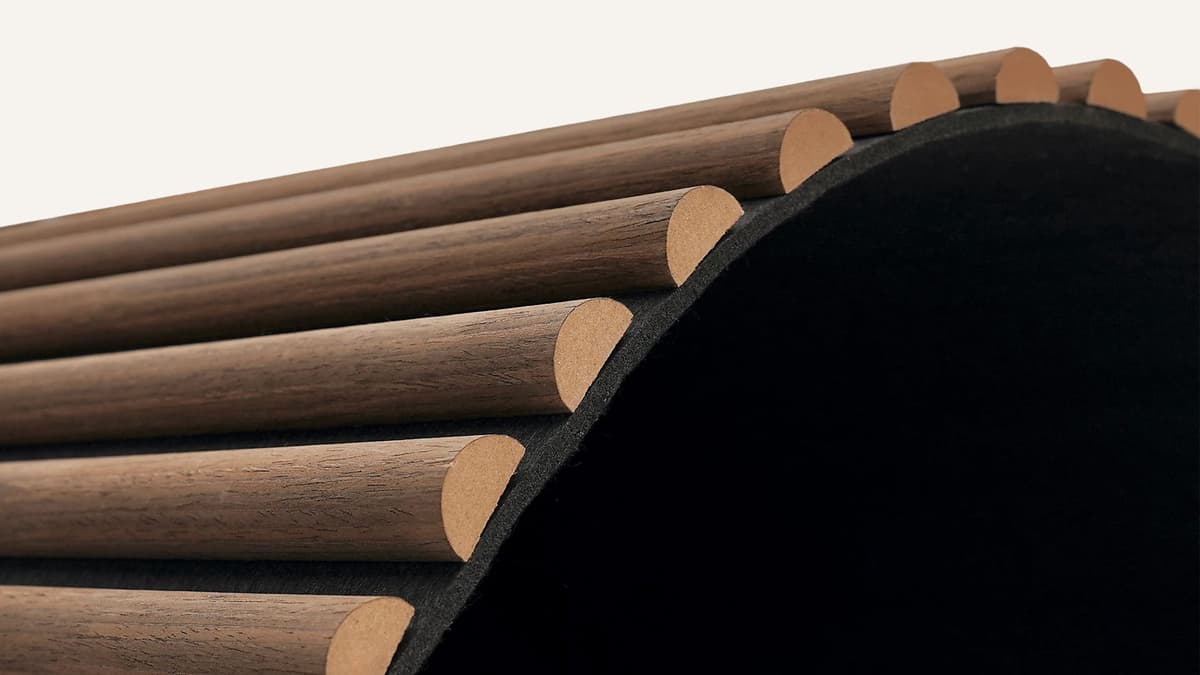
Most wall panels are rigid — they’re designed for flat surfaces and installed as fixed sheets. But not every wall is flat. Curved walls, columns, arched recesses, and radius features present a challenge that rigid panels can’t solve. It’s important to choose the warmth and character of wood wall panels to surfaces that would otherwise have to be left plain or treated with a different material entirely.
Contents
- What Are Flexible Wall Panels
- How Flexible Wall Panels Work
- Where Flexible Panels Are Used
- Curved walls and columns
- Arched alcoves and recesses
- Curved room features and bespoke joinery
- Flexible vs Rigid Panels: Which to Choose
- Installation Considerations for Flexible Panels
- Design Ideas for Flexible Panels
What Are Flexible Wall Panels
Flexible wall panels are panels engineered to bend around curved surfaces without cracking, splitting, or buckling. Unlike rigid panels, which are fixed to flat walls in full sheets, flexible panels have a construction that allows them to conform to a radius — a gentle or tight curve — while maintaining the surface appearance of the panel design.
They’re typically constructed with a flexible substrate — often a thin, pliable backer material — that allows the decorative face to curve without damage. The visual result is indistinguishable from a rigid panel on a flat wall; the flexibility is in the engineering, not the appearance.
How Flexible Wall Panels Work
The key measurement for flexible panel installation is the minimum bend radius — the tightest curve the panel can follow without damage. Different panels have different minimum radii, so it’s important to match the panel’s flexibility to the curve you’re working with. Gentle curves — large-radius walls, shallow bows — can be achieved with panels that have moderate flexibility. Tight curves — columns, circular rooms — require panels with a smaller minimum bend radius.
Installation follows the same principles as rigid panels: clean, flat substrate (relative to the curved surface), appropriate adhesive, and fixing from the centre outward to maintain even contact across the curve. For tighter radii, it can help to pre-curve the panel by loosely rolling it in the direction of the bend before installation.
Where Flexible Panels Are Used
Curved walls and columns
The most common application for flexible panels is wrapping columns and curved walls in both residential and commercial interiors. A structural column clad in a wood slat panel becomes a design feature rather than an obstacle. A curved wall in a reception area or open-plan living room can be paneled to the same standard as the flat walls, creating a cohesive, uninterrupted surface.
Arched alcoves and recesses
Arched alcoves — common in period properties and contemporary designs alike — benefit from flexible paneling that can follow the curve of the arch. Rather than tiling or plastering the arched surface, a flexible wood panel creates a warm, consistent material throughout the recess.
Curved room features and bespoke joinery
In bespoke interior projects — curved headboard walls, radius bar fronts, circular seating booths — flexible panels allow designers and installers to achieve curved timber-faced surfaces that would otherwise require specialist joinery. Our flexible panel range is used in both residential and commercial projects for exactly this reason.
Flexible vs Rigid Panels: Which to Choose
If the wall is flat — even if it has slight imperfections — a rigid panel is always the right choice. Rigid panels are more dimensionally stable, easier to install on flat surfaces, and available in a wider range of finishes. Flexible panels should be specified when the surface genuinely requires bending — not as a workaround for flat-wall installation challenges.
For projects where both flat and curved surfaces exist in the same space, it’s worth checking whether the same panel design is available in both rigid and flexible formats — this allows a consistent visual result across the entire room.
Installation Considerations for Flexible Panels
Flexible panels require full-surface contact with the substrate to achieve the intended curve — leaving air gaps creates a risk of the panel pulling away over time. Use an appropriate contact adhesive or grab adhesive that maintains bond strength across the full area of the panel. For larger radius curves, temporary fixings or clamping during the adhesive cure period can be helpful.
Always check the manufacturer’s minimum bend radius before ordering — attempting to bend a panel beyond its specification risks damaging the panel face and voiding any warranty.
Design Ideas for Flexible Panels
A column wrapped in matching panels creates continuity with the flat walls and transforms what would otherwise be an awkward interruption into a design feature. A curved bar front in a home bar or commercial hospitality space is an excellent application — the warm timber finish is visually appropriate and the flexible panel makes the complex geometry achievable. A radius headboard wall in a bedroom, where the curve sweeps from floor to ceiling behind the bed, creates an architectural statement that sets the room apart.
Explore our flexible wall panels and the full wood wall panel range for your project.