
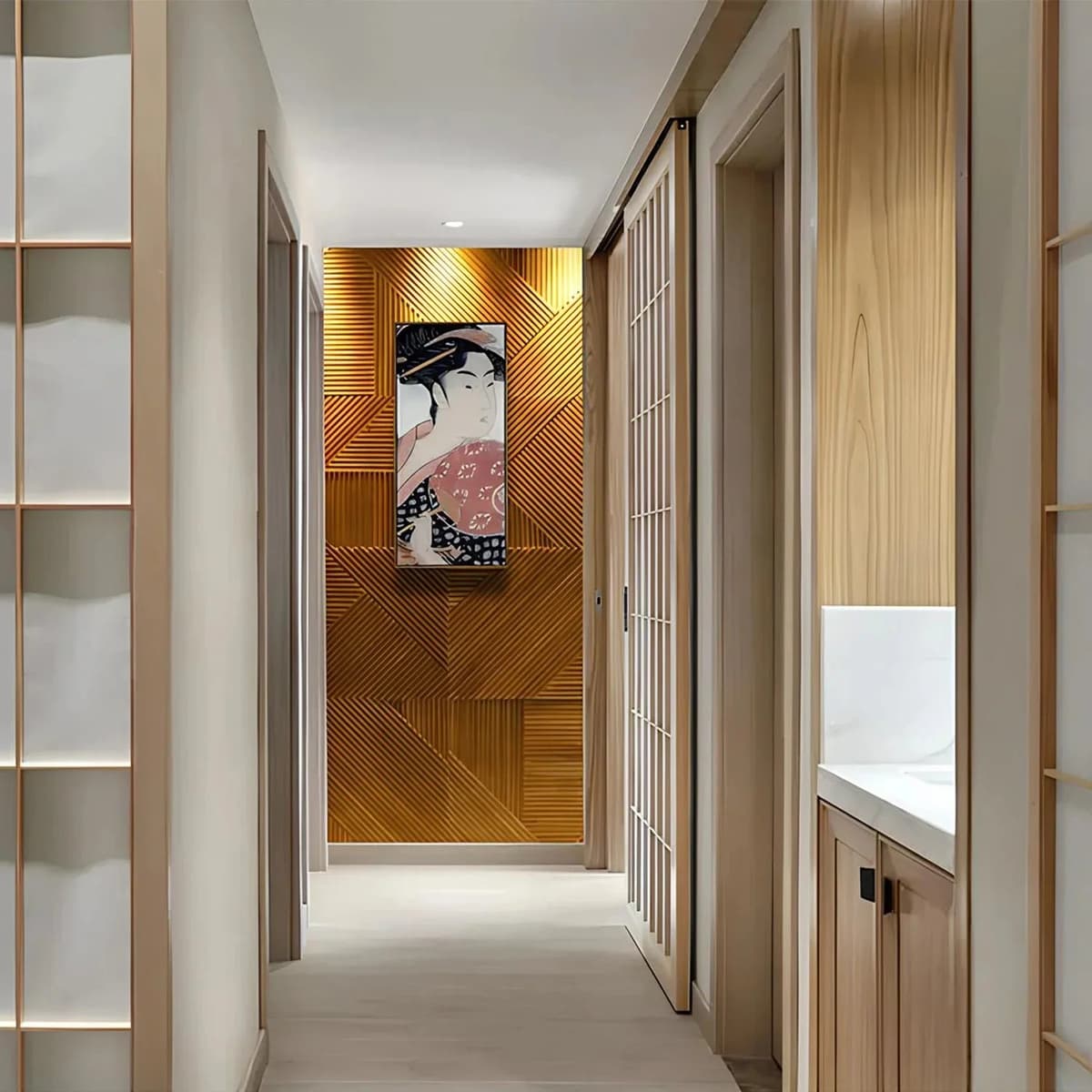
Hallways present a genuine design challenge. They’re transitional spaces — narrow, often dark, and constrained by architecture. Most people treat them as afterthoughts: a coat hook, a mirror, and whatever paint was left over from the last room. But the hallway is the first thing guests see when they enter your home, and the last thing they notice when they leave. Getting it right matters more than it seems.
Geometric wood wall panels are one of the most effective tools for transforming a hallway. Here’s how to use them in a way that makes the space feel considered rather than cluttered.
Table of Contents
The Hallway Challenge: Narrow, Dark, and Transitional
Most hallways have three specific constraints:
- Narrow width: Pattern that feels bold in a living room can feel overwhelming in a space you pass through in two steps
- Limited natural light: Windowless hallways depend entirely on artificial lighting, which changes how timber tones and shadow effects read
- No place to sit: Without furniture to anchor the eye, the wall becomes the entire design
Geometric panels address all three constraints effectively when chosen and installed thoughtfully.
Which Geometric Pattern Works Best in a Hallway?
Crossing lines — the most versatile hallway choice
The Crossing Lines Solid Wood Panel is the most hallway-appropriate pattern in the GroovePanel® range. Its grid-based geometry creates strong visual presence without the directional movement of a triangle mosaic or the focal-point demand of a concentric square. It reads well in narrow spaces and holds up under both overhead pendant lighting and wall-mounted sconces.
Concentric squares — best at the end wall
If your hallway terminates at a visible end wall — common in T-shaped layouts or where a hallway opens to a back room — the 3D Concentric Square Panel is highly effective at this position. Viewed from the entrance, the nested square pattern draws the eye to a vanishing point, creating a sense of depth and spatial extension in what is otherwise a short, confined corridor.
Triangle mosaic — use sparingly in hallways
Triangle mosaics can work well in wider hallways or on a single accent wall, but their directional energy can feel restless in very narrow spaces. If you’re drawn to the triangle format, consider limiting it to one wall rather than both sides of a corridor.
Panel Height in a Hallway
Full floor-to-ceiling panels make a hallway feel taller. In contrast, panels applied at dado height only — up to about 1100mm — make the space feel lower and more constrained. For most hallways, ceiling-height panels are the better choice.
A practical option for standard-height hallways (2.4m ceiling): run geometric panels from floor to ceiling on the main feature wall (opposite the front door, or the end wall), and keep the side walls plain. This creates a strong directional experience without closing in the space.
Lighting Geometric Panels in a Hallway
Most hallways rely on a single central ceiling pendant. This creates flat, overhead lighting — the worst condition for showing the texture and shadow of a geometric panel. To get the best out of a textured panel in a hallway:
- Add a wall sconce on each side of the panel wall, angled toward the surface
- Replace the central pendant with a track light that you can angle toward the panel
- Mount an LED strip behind a reveal at the top of the panel, pointing downward
Even a single angled light source dramatically improves how a 3D or mosaic panel reads in a hallway.
Colour and Timber Species in a Dark Hallway
In hallways that receive little or no natural light, very dark timber tones (deep walnut) can absorb light and make the space feel smaller. Options:
- Choose a lighter-toned geometric panel format in an oak or natural pine finish
- Complement dark walnut panels with pale plaster or white-painted walls on adjacent surfaces
- Use reflective surfaces (mirror, gloss flooring) opposite a dark panel wall to bounce light back
Hallway Panel Ideas: Quick Reference
- End wall of a long hallway in 3D Concentric Square — creates depth and a visual destination
- Full-height Crossing Lines panels on both sides of an entrance vestibule — architectural and welcoming
- Triangle mosaic on the wall opposite the front door — the first thing you see when you arrive home
- Honey Mosaic on a single hallway wall with a console table and mirror in front — warm, tactile, inviting
Further Reading
For broader hallway design ideas including non-geometric panels, read our guide to hallway ideas to maximise your home’s first impression. For the full geometric range, browse GroovePanel® Geometric Wood Wall Panels.