
Table of Contents
- The Basic Calculation
- Step 1: Measure the Wall Area
- Step 2: Find Your Panel Coverage Area
- Step 3: Divide and Add Waste
- Step 4: Check Against Panel Width
- The Two Most Common Ordering Mistakes
- Quick Reference Table
- Common Calculation Mistakes and How to Avoid Them
- Panel Quantity FAQs
- Also Order: Trim and Adhesive
The Basic Calculation
Calculating how many panels you need is straightforward — but two common mistakes (not accounting for waste and not measuring accurately) lead to either running short mid-installation or over-ordering significantly. Here’s the correct method.
Step 1: Measure the Wall Area
Measure the wall width and height in metres. Multiply to get the total square metres (m²).
Example: Wall 4.2m wide × 2.4m high = 10.08m²
If the wall has a window or door, subtract its area: a standard door is approximately 2.0m × 0.9m = 1.8m². A standard window is approximately 1.2m × 1.0m = 1.2m².
Step 2: Find Your Panel Coverage Area
Check the product specification for the panel’s coverage area per unit. Panel sizes vary significantly by brand and product:
- Standard full-height slat panels: typically 2.4m × 0.6m = 1.44m² per panel
- Modular tile panels: typically 0.6m × 0.6m = 0.36m² per panel
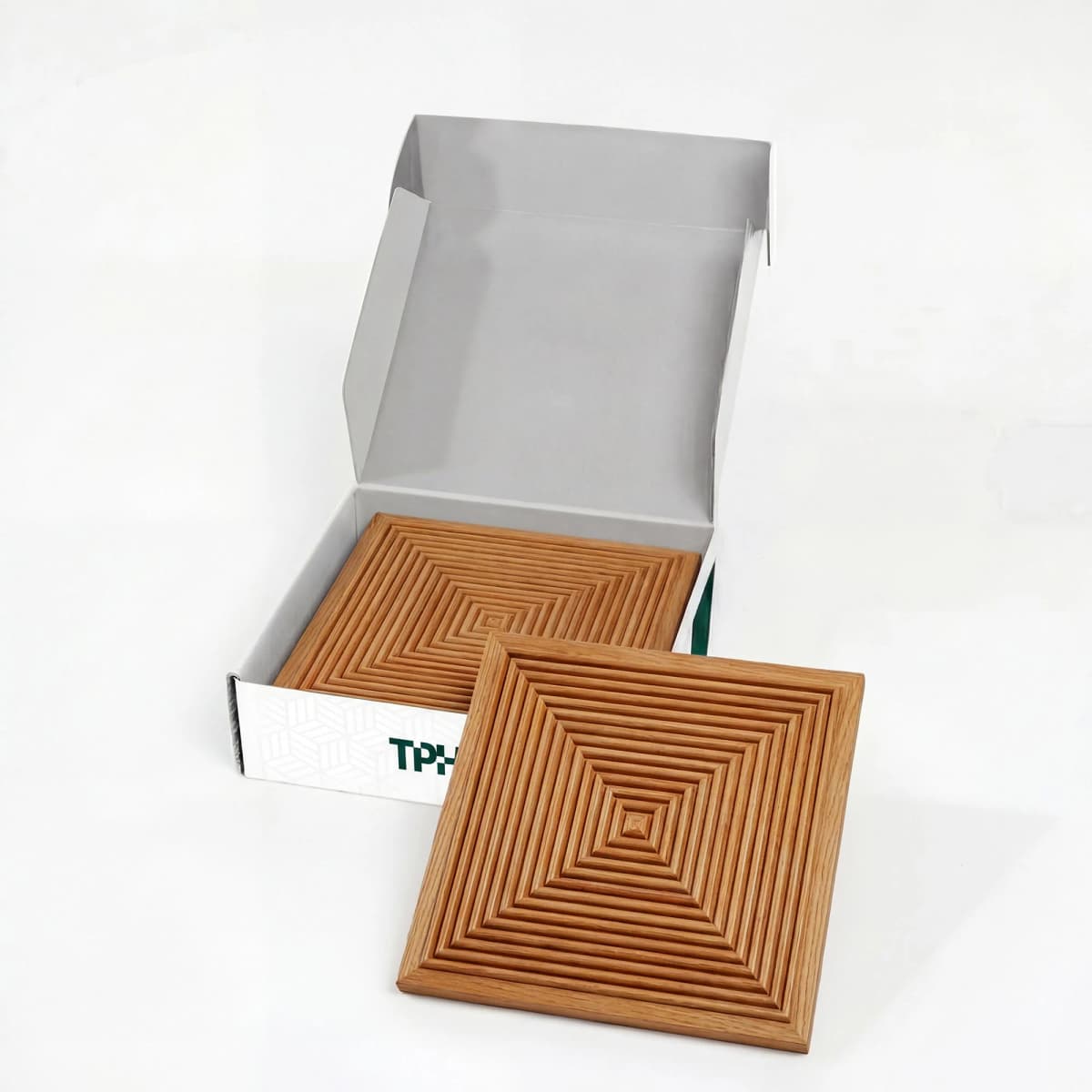
- Groove/mosaic panels: typically 0.5m × 0.5m = 0.25m² per panel
The SoundPanel™ acoustic slat panels and GroovePanel® mosaic panels both include coverage information in their product listings.
Step 3: Divide and Add Waste
Divide your wall area by the panel coverage area to get the base panel count. Then add a waste allowance:
- Simple rectangular wall, no cuts: Add 5–8% waste
- Wall with one or two obstructions (sockets, etc.): Add 10–12% waste
- Angled cuts (staircase), multiple obstructions: Add 15–20% waste
Example continued: 10.08m² wall ÷ 1.44m² per panel = 7 panels base. Add 10% waste = 7.7 → order 8 panels.
Step 4: Check Against Panel Width
Don’t just calculate by area — also check the panel count against your wall width. If your wall is 4.2m wide and each panel is 0.6m wide, you need 4.2 ÷ 0.6 = 7 panels across. If this doesn’t match your area calculation, the discrepancy is likely due to ceiling height variation — resolve by using the higher number.
The Two Most Common Ordering Mistakes
Under-ordering by Not Accounting for Waste
The most costly mistake. Running out of panels mid-installation means waiting for a reorder — and if the batch changes (dye lots, grain variation), the new panels may not match perfectly. Always round up and add the appropriate waste percentage. The cost of one extra panel is far less than the cost of a mismatched reorder.
Not Ordering Samples First
Ordering a full wall of panels based on product photography alone is a risk. Screen colour rendering varies, and the way wood grain reads in your specific room lighting can differ significantly from the product image. Order a sample first, live with it in the room for a few days under different lighting conditions, then place the full order. The Panel Hub offers sample ordering for exactly this reason.
Quick Reference Table
| Wall Size | Panel Size (0.6m × 2.4m) | Panels Needed (incl. 10% waste) |
|---|---|---|
| 3m × 2.4m (7.2m²) | 1.44m² | 6 |
| 4m × 2.4m (9.6m²) | 1.44m² | 8 |
| 5m × 2.4m (12m²) | 1.44m² | 10 |
| 6m × 2.4m (14.4m²) | 1.44m² | 12 |
Common Calculation Mistakes and How to Avoid Them
Panel quantity calculations go wrong in predictable ways. Knowing these in advance prevents the two worst outcomes: running out of panels mid-installation, or significantly over-ordering.
Forgetting the waste factor. Even experienced installers add a 10–15% waste allowance for cut panels, offcuts at edges, and any damaged panels discovered after opening boxes. For a pattern-matched system (where panels need to be aligned), increase the waste factor to 15–20%. For standard slat panels with no pattern matching, 10% is typically sufficient.
Measuring net area instead of gross area. Calculate the full wall area including any window or door openings, then subtract the openings at the end. This gives you the gross area plus a ready supply of offcuts for use above doors and in awkward corners. Calculating net area only can leave you short when small sections around openings require cut pieces that would otherwise have been offcuts.
Ignoring panel direction. Most slat panels have a top and a bottom (the felt backing direction, or the bevel direction of the slat edges). If you accidentally install a row inverted, you will need additional panels to replace the wrong-way-round sections. Confirm the installation direction with the supplier before opening boxes.
Calculating panels but not adhesive or fixings. It is easy to focus on the panel order and forget that you need approximately one 290 ml cartridge of adhesive per 1.5–2 m² of panels. Order adhesive, trim, sealant, and any fixing screws at the same time as your panels — sourcing these separately later adds delays and often shipping costs.
Panel Quantity FAQs
How many panels do I need for a standard living room feature wall?
A standard 3 m × 2.4 m feature wall requires 7.2 m² of panels. With a 10% waste factor, order for 8 m². Most panel systems are sold in m² or per panel, so convert using your specific panel’s coverage per unit (shown on the product page).
What happens if I run out of panels halfway through installation?
If you can reorder from the same batch, the main risk is slight colour or grain variation between production batches. For natural wood veneer systems, batch variation is almost always visible. Always over-order slightly rather than relying on being able to reorder an exact match — keep any unused panels for future repairs.
Should I order extra panels for future repairs?
Yes — keeping 5–10% of your order in storage is strongly recommended for real wood and veneer systems. Matching panels from a later production run is difficult for natural materials. For painted MDF systems where an exact match is not required, spare panels are less critical.
Can I return unused panels?
Most panel suppliers accept returns of unopened boxes within 30 days. Check the supplier’s returns policy before ordering and keep unused boxes unopened until you are certain the installation is complete and no additional panels are needed.
Also Order: Trim and Adhesive
Don’t forget consumables in your order calculation:
- Trim strips: One per exposed edge. Measure all edges where the panel meets a wall, ceiling, or floor without a continuous panel run.
- Adhesive: One 290ml cartridge typically covers 2–3 panels. Order enough for your full panel count plus one spare.
Browse the full wood wall panel collection to check coverage specs for your chosen panels before calculating.