
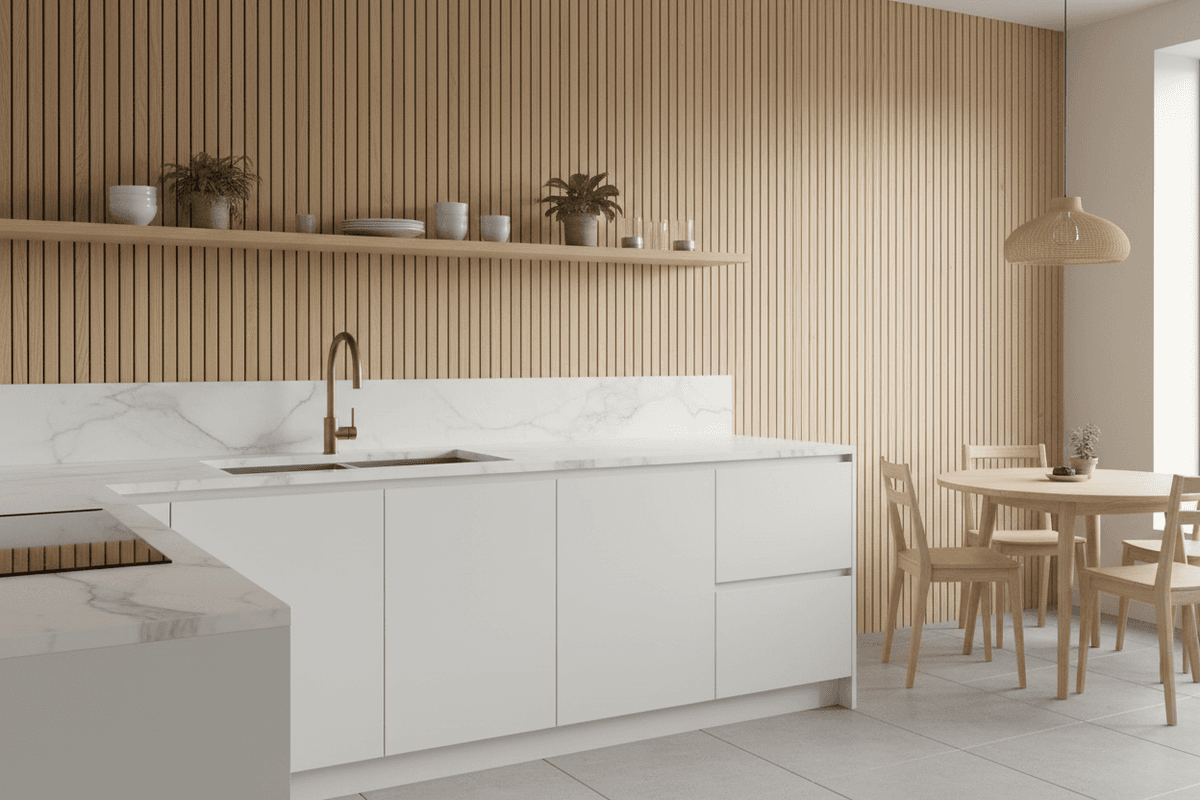
Small kitchens present a particular design challenge: you want to add character and warmth, but the wrong choices make the room feel cramped. At The Panel Hub, we work with homeowners who assume wood wall panels are only for larger spaces. They’re not — but in a small kitchen, the decisions around placement, scale, and finish are more important. Get them right and you transform the room. Get them wrong and you lose the space you already have.
Contents
The Challenge of Small Kitchen Walls
In a small kitchen, walls are interrupted at every turn — by cabinets, appliances, windows, and doors. The sections of exposed wall are limited, which means each one matters more. The goal is to use paneling strategically: on the walls that are most visible, in finishes that add warmth without absorbing light, and in formats that draw the eye outward rather than inward.
Which Panel Styles Work in Small Kitchens
Vertical slat panels
Vertical lines draw the eye upward, making ceilings feel higher and rooms feel taller. In a small kitchen, vertical slat panels on a feature wall create the impression of more height without expanding the actual footprint. Our SoundPanel™ slat panels in particular have a clean, fine profile that suits compact spaces — the narrow slats read as texture rather than bulk.
Light and pale finishes
In small spaces, lighter finishes reflect more light and feel less enclosing. Natural oak, pale ash, or light-toned panels are the most appropriate choices for small kitchens. Darker finishes — walnut, espresso — can work on a single accent wall but should be used sparingly and paired with pale cabinetry and good lighting.
Where to Use Panels in a Small Kitchen
The best wall to panel in a small kitchen is the one with the most uninterrupted space — often the end wall, a dining zone wall, or the wall behind open shelving. Avoid trying to panel multiple walls: in a small kitchen, consistency is less important than choosing the one wall that makes the most visual impact.
In a galley kitchen, the short wall at the end of the run is often the best location — it’s in view from the full length of the kitchen and benefits most from a panel that adds depth and character.
Our kitchen wall panels are available in a range of finishes suitable for compact spaces.
What to Avoid in Small Kitchens
Avoid very dark or heavily grained finishes unless the kitchen has good natural light. Avoid horizontal panel formats — they shorten rather than heighten the room. Don’t try to panel every available wall surface, as this creates visual noise that makes the room feel smaller rather than more designed. And avoid mixing two different panel finishes in the same small space — keep it simple.
Making the Most of Limited Wall Space
In a small kitchen, the area above cabinetry — between the top of the wall units and the ceiling — is often dead space. A panel running floor to ceiling behind open shelving or in the dining zone makes better use of vertical space and avoids the awkward gap. If full-height installation isn’t practical, treat the panel as a deliberate feature and finish the top edge cleanly with a timber batten or moulding.
Getting the Balance Right
Small kitchens often benefit most from a single well-placed panel rather than a comprehensive scheme. Identify the wall you look at most — usually the one facing you at the main point of activity — and start there. The goal is one strong visual element that makes the room feel more designed, not a full transformation that risks overwhelming the space.
Browse the full wood wall panel collection to find a finish that suits your kitchen’s scale and palette.