
Acoustic wood slat wall panels are decorative wall panels that combine real wood veneer slats with a dense acoustic felt backing to absorb sound while adding natural warmth to a room. Unlike standard drywall, which reflects up to 98% of sound waves, a well-made acoustic slat panel can absorb up to 85% of mid-to-high frequency sound — the range that includes speech, glass clatter, and most everyday noise that makes a room feel harsh or echoey. The result is a wall that looks intentional and makes the room genuinely sound better on calls, conversations, and audio playback.
This guide covers how acoustic wood slat panels actually work, how to tell a good one from a mass-market lookalike, how many you need for your room, where they work best, and how to install them yourself. By the end, you should have everything you need to decide whether acoustic slat panels are right for your space — and how to specify them properly if they are.
Table of Contents
- Do Acoustic Wood Slat Wall Panels Actually Work?
- How Acoustic Wood Slat Wall Panels Work
- Acoustic Performance Compared
- What Separates Premium Acoustic Slat Panels from Mass-Market Ones
- How Many Acoustic Slat Panels Do You Need?
- Where Acoustic Wood Slat Panels Work Best
- How to Install Acoustic Wood Slat Wall Panels
- Acoustic Wood Slat Panels vs Other Acoustic Treatments
- Common Mistakes to Avoid
- Style and Design Options
- Frequently Asked Questions
- Bringing It All Together
Do Acoustic Wood Slat Wall Panels Actually Work?
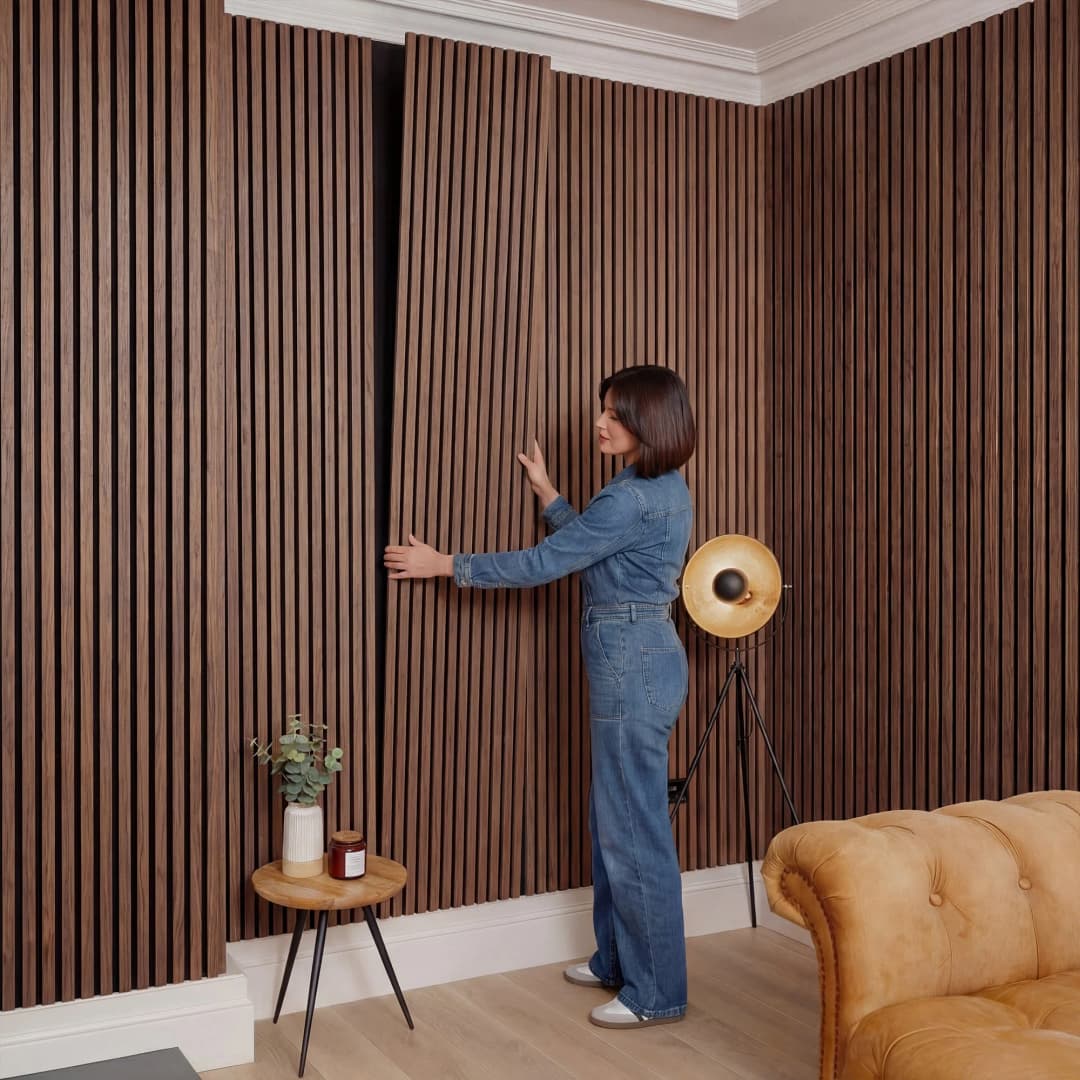
Yes — but only if they’re built correctly, and only for the kind of sound problem they’re designed to solve.
Acoustic wood slat panels reduce echo and reverberation inside a room. They do not soundproof — they won’t stop noise from entering or leaving. That’s an important distinction and one of the most common sources of disappointment when people buy panels expecting them to block a neighbour’s television.
What they will do, when properly made: reduce the “bounciness” of a room by absorbing the sound waves that would otherwise ricochet off hard surfaces like drywall, glass, and tile. The practical effect is clearer speech on video calls, less fatigue during long meetings, better listening on your TV and music system, and a generally calmer feel in rooms that previously sounded harsh. For most residential problems — echoey home offices, hard-surfaced living rooms, home theaters, podcast corners — this is exactly what you need.
The performance depends heavily on the panel’s construction. A panel with a 15mm, 1,500 g/m² felt backing and a tested NRC rating of 0.85 (like the SoundPanel™ collection) will meaningfully change how a room sounds. A thin panel with a 9mm felt backing and no verified NRC rating — common on mass-market marketplaces — often doesn’t.
How Acoustic Wood Slat Wall Panels Work
Acoustic wood slat panels use two complementary mechanisms to control sound: diffusion and absorption.
The role of the slats (diffusion)
The vertical wood slats on the face of the panel break up flat wall surfaces. When sound waves hit a flat drywall, they bounce straight back into the room and create what acoustic engineers call “flutter echoes” — the ringing, harsh quality you hear in empty rooms or in bathrooms. The slats scatter those waves in multiple directions, which prevents the flutter and makes the sound field feel smoother even before any absorption happens.
The role of the felt backing (absorption)
The real acoustic work happens behind the slats. The felt backing — in a premium panel, a high-density recycled PET felt — traps sound energy and converts it to a tiny amount of heat through friction between the fibres. This is why felt density matters so much. Low-density felt lets sound pass through or bounce off; high-density felt actually absorbs it.
The Panel Hub’s AcuFelt™ backing uses a 15mm layer at 1,500 g/m² density, compared to the 9mm / 1,100 g/m² felt that’s standard on mass-market panels. That extra thickness and mass is the single biggest reason a genuinely acoustic panel outperforms a decorative one that’s marketed as “acoustic.”
Understanding NRC — what the numbers mean
NRC stands for Noise Reduction Coefficient. It’s a single number from 0.00 to 1.00 that describes how much sound a material absorbs rather than reflects back into the room. The higher the number, the more absorption.
The standard interpretation:
| NRC Range | What it means |
|---|---|
| 0.00 – 0.10 | Reflects almost all sound (concrete, glass, bare drywall) |
| 0.30 – 0.50 | Mild absorption (thick curtains, upholstered furniture) |
| 0.60 – 0.80 | Good acoustic control (well-made acoustic panels) |
| 0.85 – 1.00 | High-performance acoustic treatment |
For an NRC rating to mean anything, it has to be tested in a lab by an accredited third party. The Panel Hub’s panels carry an NRC of 0.85, verified by SGS (Société Générale de Surveillance) under recognised acoustic testing standards. Many panels sold online list NRC figures that were never independently tested — a useful red flag to watch for when comparing products.
Acoustic Performance Compared
Here’s how acoustic wood slat panels compare against other wall surfaces and acoustic treatments you might be weighing up:
| Wall surface / treatment | Typical NRC | What it does well | Limitations |
|---|---|---|---|
| Bare drywall | ~0.05 | Nothing acoustic | Reflects ~98% of sound |
| Heavy curtains | 0.30 – 0.40 | Softens high frequencies | Limited, no mid-range control |
| Acoustic foam panels | 0.70 – 0.90 | High absorption | Industrial look, yellows over time |
| Fabric-wrapped panels | 0.75 – 0.95 | Good absorption, colour options | No natural warmth, less durable |
| Acoustic wood slat panels (premium) | 0.85 | Absorption + design value + durability | Not for low-frequency bass |
| Acoustic wood slat panels (budget) | 0.30 – 0.55 (often untested) | Looks similar to premium | Thin felt, minimal real absorption |
The key takeaway: premium acoustic wood slat panels match the performance of foam or fabric panels while adding architectural and design value that those alternatives can’t. Budget panels look the part but rarely deliver on the acoustic promise.
What Separates Premium Acoustic Slat Panels from Mass-Market Ones
If you’re weighing up options across different brands, these are the five specifications that actually determine quality. The aesthetics can look similar from a product photo — the differences show up over years of use.
1. Real wood veneer vs printed laminate. Real wood veneer is a thin slice of actual timber (0.5 – 1mm) bonded to the core. You can spot laminate by checking three different panels — if the grain patterns are identical, it’s a printed plastic film, not wood. Real wood gives you natural variation, microscopic pores, and the warmth that printed imitations can never match.
2. Felt density and thickness. Ask for the g/m² figure and the thickness in millimetres. Premium panels use 1,500 g/m² felt at 15mm thick. Anything significantly thinner or lighter is making a decorative panel that happens to have felt on the back — not a genuine acoustic product.
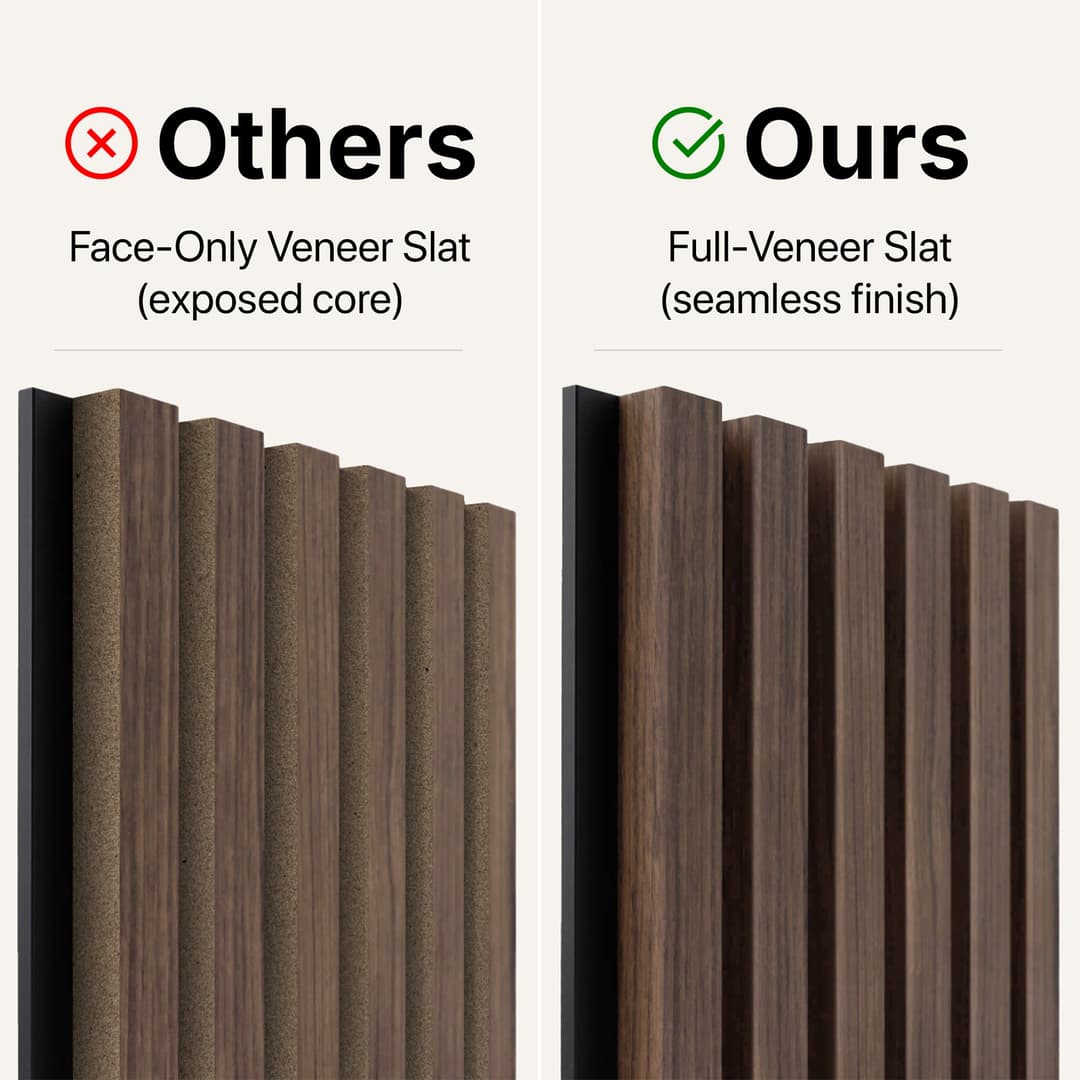
3. Edge finishing. Most budget panels apply veneer only to the front face of the slat, leaving the MDF core exposed on the sides. From any angle other than dead-on, you see raw dark brown material between every slat, which breaks the illusion of real wood. Premium construction uses a 3-sided veneer that wraps the front and both sides, plus rounded edges for a furniture-grade finish.
4. Core material. Standard MDF acts like a sponge in humid environments — kitchens, bathrooms, coastal climates. Over time, it absorbs moisture from the air, swells, and causes the veneer to lift or peel. CoreShield™ water-resistant MDF is engineered to resist this, making the panel viable for more rooms and extending its lifespan.
5. Certifications. FSC certification confirms the wood is sustainably sourced. Fire ratings (EN 13501 in the EU / ASTM E84 Class A in the US) confirm the panel is safe for permanent interior installation. CE marking confirms it meets construction-material safety standards. Panels without these certifications can’t legally be specified for most commercial projects — and cutting corners there usually means corners have been cut elsewhere.
For a deeper breakdown of each of these, the TPH™ buying guide walks through every specification with comparison photos.
How Many Acoustic Slat Panels Do You Need?
The short answer: to meaningfully reduce echo, you need to cover roughly 20–30% of the total hard surface area in the room. That figure comes from general acoustic practice — not every square foot of wall needs treatment, but enough surface area has to be absorbent to tame the reflections.
In practice, the simpler rule is to cover one feature wall, or a portion of two adjacent walls, with acoustic panels. You rarely need to treat every wall in a room, and doing so often makes the space feel acoustically “dead” rather than pleasant.
Here’s a rough guide for common rooms. These numbers assume TPH™ American Acoustic Slat panels in the regular size (94.5″ × 23.6″, which covers 15.5 sq ft per panel):
| Room type | Typical size | Suggested coverage | Panels (regular size) |
|---|---|---|---|
| Home office | 10 × 10 ft | One full wall (8 × 10 ft) | 5–6 panels |
| Bedroom accent | 12 × 12 ft | Behind the headboard (8 × 6 ft) | 3 panels |
| Living room | 14 × 18 ft | One feature wall (10 × 8 ft) | 5–6 panels |
| Home theater | 12 × 16 ft | Two walls, partial coverage | 10–12 panels |
| Podcast / recording | 8 × 10 ft | Three walls, partial coverage | 8–10 panels |
| Open-plan office | 20 × 30 ft+ | Scattered across multiple walls | Depends on layout |
For precise measurements, TPH™ provides a Box Calculator on each product page — enter your wall dimensions and it returns the exact panel count and trim allowance.
If maximum absorption is the goal (a dedicated home cinema, a podcast studio, or any space where audio quality is critical), the rules change. In those cases, you want to install panels over a batten system with mineral wool insulation behind them, which pushes the effective NRC closer to 1.0 and treats low frequencies better. See the installation section below.
Where Acoustic Wood Slat Panels Work Best
Any room with hard surfaces and sound-quality requirements is a candidate, but certain environments benefit more than others.
Home theaters and media rooms. Echoes muddy dialogue and soften bass. A feature wall of acoustic slat panels behind or beside the TV dramatically improves clarity without the industrial look of foam. Pair with a rug and soft furnishings for the full effect.
Home offices. The single biggest win for remote workers. Reducing echo means clearer video calls, less vocal fatigue, and better microphone quality — even without upgrading your mic. The panels also cover the background visually, which is a win on camera.
Bedrooms. Most commonly installed behind the headboard as a combined acoustic and design feature. The modern wood slat accent wall is now one of the most-requested bedroom upgrades in residential design. Acoustic benefits here are modest but real — less ambient bounce for a calmer sleep environment.
Living rooms and open-plan spaces. Open layouts are notoriously hard to control acoustically. Panels on one or two walls tame the echo without closing the space off.
Podcast studios, voice-over booths, and recording rooms. Near-essential. These need deeper treatment than a single feature wall, but acoustic slat panels combine nicely with broadband absorbers and bass traps to build a full studio without looking like one.
Restaurants, cafés, and commercial fit-outs. Hospitality spaces have long struggled with noise complaints from diners. Wood slat acoustic panels are now a standard specification in modern hospitality design for exactly this reason — they control noise without fighting the interior design.
How to Install Acoustic Wood Slat Wall Panels
Installation is well within DIY territory for most residential projects. A standard accent wall (around 3 metres / 10 feet wide) takes 2–3 hours for a reasonably handy homeowner. For professional acoustic specifications — home theaters, studios, commercial fit-outs — a mechanical fix with battens is preferred.
Tools you’ll need
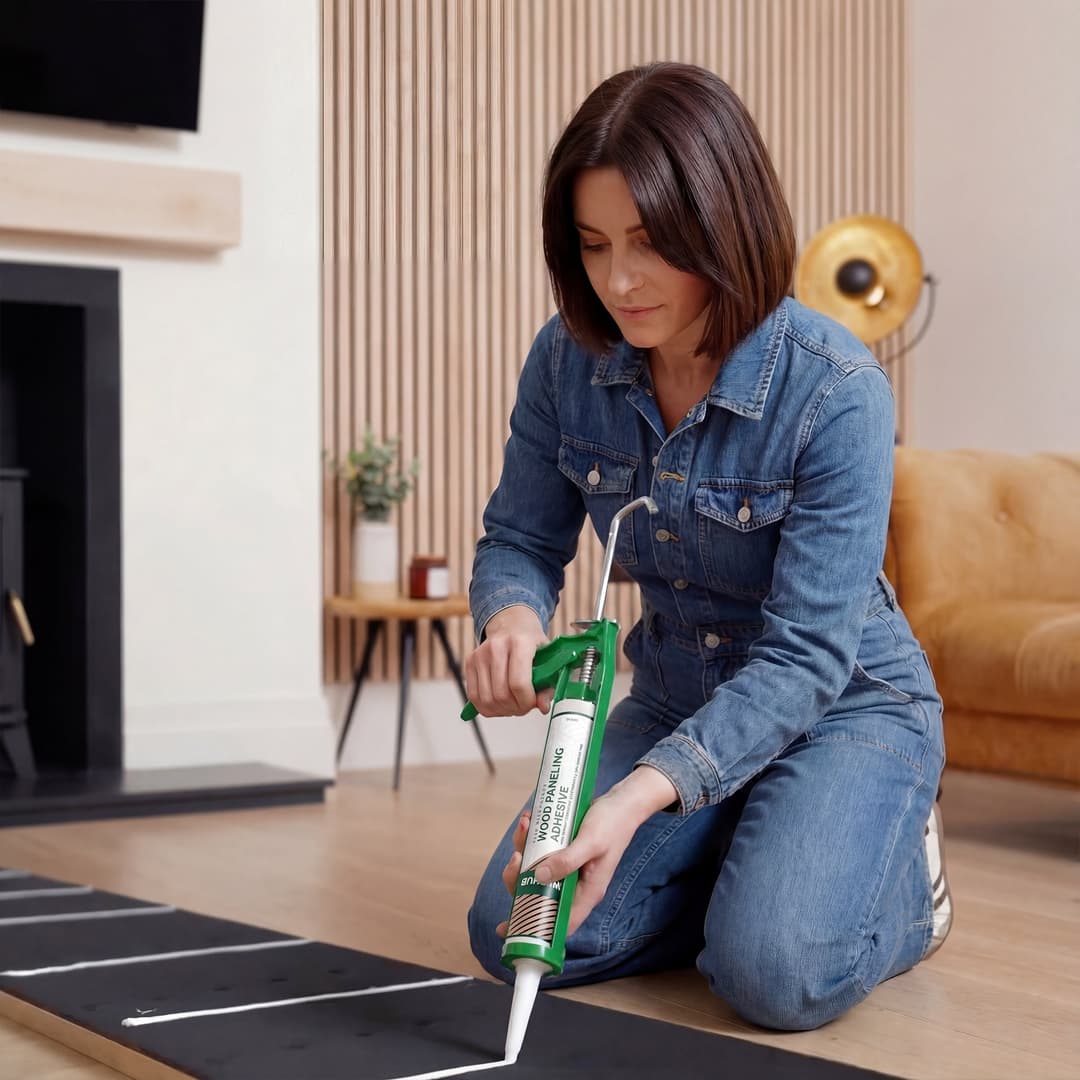
- Construction adhesive. MS Polymer or Loctite PL Premium 3X are both well-suited. Avoid generic silicones — they don’t hold.
- A saw for cutting panels. A cordless reciprocating saw (e.g., Black & Decker) handles it cleanly. A fine-tooth hand saw also works for occasional cuts.
- Utility knife for trimming the felt backing around outlets.
- Measuring tape, pencil, spirit level.
- Optional: brad nailer (DeWalt 2″ 18-gauge) if you prefer nails to adhesive, or if installing over battens.
- For maximum acoustic performance: 45mm timber battens and mineral wool insulation.
The standard DIY method — adhesive
This is the right approach for most residential feature walls, accent walls, and bedroom headboards. Apply the adhesive in vertical beads across the back of the panel, press it firmly against a clean, dry wall, and hold for a few seconds until the initial tack sets. Use a spacer block (a small off-cut of a slat) between panels to ensure the gap stays consistent — this is the single trick that makes a joined installation look like one continuous surface rather than a row of separate panels.
Panels can be installed directly over drywall, plaster, plywood, MDF, or prepared masonry. Minor wall imperfections don’t matter — the panel structure absorbs small deviations. Make sure the wall is dust-free and structurally sound.
The maximum-absorption method — battens + mineral wool
For home theaters, studios, and any space where acoustic performance matters more than installation speed:
- Attach 45mm vertical timber battens to the wall at regular intervals (typically matching panel widths).
- Fill the cavity between battens with mineral wool insulation.
- Screw the panels through the felt backing into the battens.
This creates an air gap and a deep-cavity absorber behind the panels, which dramatically improves low-frequency performance and pushes the overall NRC closer to 1.0. The finished wall looks identical to a direct-mount installation from the front, but sounds noticeably different.
Working around outlets, windows, and corners
Cut the slats with a sharp saw and trim the felt with a utility knife for a snug fit around sockets, switches, or window frames. Cables sit comfortably behind the panels without extra spacing for most low-voltage runs. The slats are dyed or finished the same colour all the way through, so a cut edge looks like the rest of the panel without any edge-banding needed.
For a step-by-step walkthrough with photos, see the TPH™ Pro Installation Guide. If you’d rather not DIY, Professional Installation is available as a checkout add-on.
Acoustic Wood Slat Panels vs Other Acoustic Treatments
If you’re weighing this category against alternatives, here’s the honest comparison:
vs acoustic foam. Foam absorbs slightly more at very high frequencies and costs less per square foot. Wood slat panels match it across the range that matters for speech and music, last far longer, look better, and don’t yellow. For anywhere you’d actually want to live or work, wood slat wins. Foam still has a role in dedicated studios where nobody cares about aesthetics.
vs fabric-wrapped panels. These two are the closest competitors on pure performance. Fabric panels come in more colour options; wood slat panels offer natural texture and warmth that fabric can’t replicate. Wood is more durable — fabric picks up stains, dust, and kids’ hands. For residential and hospitality, wood slat panels are usually the better long-term choice. For recording studios where you need very specific absorption coefficients at specific frequencies, fabric-wrapped broadband absorbers often outperform.
vs acoustic diffusers. Diffusers scatter sound rather than absorbing it. They’re specialised and mainly used alongside absorbers in professional studios. For a home or office, absorption is usually what you want — a diffuser-only treatment won’t reduce echo, just redistribute it.
vs soundproofing materials (mass-loaded vinyl, resilient channels, etc.). Different problem. If your goal is stopping sound from travelling between rooms, you need dense materials in the wall assembly — not panels on top of the wall. Acoustic slat panels improve the sound inside the room they’re installed in. If you’re hearing a neighbour’s subwoofer, panels won’t help. If your own room sounds echoey, they will.
Common Mistakes to Avoid
- Expecting them to soundproof. They reduce echo, not transmission. Manage expectations on this up front.
- Buying by appearance alone. A decorative panel with thin felt looks identical to an acoustic panel in product photos and costs less — but you’re essentially installing expensive wallpaper. Always check the NRC rating and felt specifications.
- Covering every wall. Over-treating a room kills the natural liveliness and makes it feel flat. 20–30% coverage is usually enough.
- Installing on damp or unfinished walls. Standard MDF cores are moisture-sensitive. Either use water-resistant cores like CoreShield™, or make sure the wall is completely dry and sealed.
- Skipping the spacer block. Without a consistent gap between panels, joins are obvious. This is the easiest correctable mistake on a DIY install.
Style and Design Options
Acoustic wood slat panels come in enough variations to suit most interior styles. A brief orientation:
- Vertical slat installation is the most common — it draws the eye upward and suits modern, Scandinavian, and Japandi interiors. More in the vertical wood slat wall panels guide.
- Horizontal slat installation is less common but creates a distinctly mid-century or contemporary feel, widening the room visually. The horizontal wood slat wall article covers the trade-offs.
- Wood species. Oak is the most popular for its warm, forgiving grain. Walnut reads as richer and more formal. Both are available across the SoundPanel™ range.
- 3D geometric panels. When you want architectural depth rather than a clean linear look, solid-wood GroovePanel® products offer 3D patterns that play with light and shadow.
- Curved applications. SoundPanel™ acoustic panels bend up to a 115° arc with a 300mm minimum bend radius, making them suitable for curved feature walls and commercial interiors.
For visual inspiration, the interior wood slat wall ideas gallery collects 50 real-room installations across styles.
Frequently Asked Questions
Do acoustic wood slat panels soundproof a room? No. They reduce echo and reverberation inside a room but don’t block sound from entering or leaving. If you need to stop noise travelling between rooms, you need soundproofing materials in the wall assembly (mass-loaded vinyl, resilient channels, or double drywall) — not wall-mounted panels.
What NRC rating should I look for? For meaningful acoustic improvement, look for a verified NRC of 0.75 or higher. Panels with untested or unlisted NRC values are usually decorative rather than acoustic, regardless of how they’re marketed. TPH™ SoundPanel™ panels carry a tested NRC of 0.85, independently verified by SGS.
Can I install acoustic wood slat panels myself? Yes, for most residential installations. A standard 3-metre accent wall takes 2–3 hours using construction adhesive on a clean, dry wall. Tools needed are a saw, a spirit level, a utility knife, and a measuring tape. The installation guide walks through each step with photos.
How long do acoustic wood slat panels last? A well-made panel with real wood veneer and a stable core lasts 15 to 25 years with basic care. Unlike laminate imitations, real wood veneer can be lightly sanded and refinished once or twice over its lifespan if it picks up scratches or dulling.
Can acoustic slat panels be installed on ceilings? Yes, and ceiling installation significantly improves acoustic performance in rooms with high ceilings. Mechanical fixing (screws into ceiling joists or battens) is required rather than adhesive alone for safety reasons.
Do acoustic wood slat panels work on curved walls? Yes, with the right product. The Acoustic Curve SoundPanel™is designed to bend up to a 115° arc with a 300mm minimum bend radius — sufficient for most curved feature walls and commercial applications.
Bringing It All Together
Acoustic wood slat wall panels are one of the few interior products that deliver on both design and function simultaneously. Done well, they solve a real acoustic problem and make the room look better in the process. The key specifications to check — felt density, verified NRC, edge finishing, and core quality — separate the products that genuinely work from the ones that just look like they should.
If you’re ready to browse, the full SoundPanel™ collection covers the acoustic-focused products, while the wider wood wall panel range includes decorative options. For a room-specific recommendation, the buying guide walks through material, sizing, and installation decisions in more depth. And if you’d like a second pair of eyes on your project, TPH™ Panel Specialists are available 24/7 to talk through your specific room.