
Your room has an echo problem. You know it. Every video call sounds like you’re in a parking garage. Every conversation bounces off the walls and comes back slightly wrong. You’ve probably Googled “acoustic panels” at least once and come away more confused than when you started — foam vs wood, NRC ratings, coverage percentages, soundproofing vs absorption.
This guide cuts through all of it. By the end you’ll know exactly what acoustic wall panels actually do, which type is right for your space, how much coverage you need, and why the wood slat panels you’ve been seeing everywhere are different from the egg-crate foam tiles in a recording studio.
Table of Contents
- What Acoustic Wall Panels Actually Do
- Acoustic Panels vs Soundproofing: The Distinction That Matters
- How NRC Ratings Work
- Types of Acoustic Wall Panels
- How Much Coverage Do You Actually Need?
- Room-by-Room: Which Panels Where
- Acoustic Wall Panels Cost: What to Budget
- What to Look for When Buying
- Wood Slat vs Fabric-Wrapped: Which Should You Choose?
- What Acoustic Panels Won’t Do
- How to Install TPH SoundPanel
- Caring for Acoustic Wood Panels
- Frequently Asked Questions
- Where to Start
What Acoustic Wall Panels Actually Do
Sound travels as a wave. When it hits a hard surface — drywall, glass, concrete, tile — most of it bounces back into the room. That reflected sound is what you hear as echo, reverberation, or the muddy quality that makes voices hard to understand on calls. The technical term is RT60: the time it takes for sound to decay by 60 decibels after the source stops. In an untreated room, that number is long. In a treated room, it’s short.
Acoustic panels work by absorbing rather than reflecting. Instead of bouncing back, sound energy enters the panel material and is converted — mostly into a tiny amount of heat, and the rest is simply dissipated. The result is a shorter RT60, less reverberation, and cleaner, more intelligible sound in the room.
Here’s what that means in practice: voices sound clearer. Music resolves more distinctly. Video calls stop sounding like you’re speaking into a tin can. The room feels quieter even when it isn’t — because what’s changed isn’t the amount of noise being generated, it’s how long it lingers.
Acoustic Panels vs Soundproofing: The Distinction That Matters
This is the most common misunderstanding in the category, and it’s worth being direct about it.
Acoustic panels treat sound inside a room. They reduce echo, reverberation, and the buildup of reflected noise. They make the room sound better from within.
Soundproofing blocks sound between rooms. Mass-loaded vinyl, resilient channels, double-stud walls, and soundproof drywall are soundproofing. They prevent sound from travelling through a wall, floor, or ceiling.
Most people who think they need soundproofing actually need acoustic treatment. If your home office sounds hollow on calls, if your living room echoes when people talk, if your home theater doesn’t sound as good as it should — acoustic panels fix all of those. What they won’t do is stop your neighbour’s music from coming through the wall. That’s a structural problem requiring structural solutions.
The two can complement each other, but they’re not the same thing, they don’t cost the same, and confusing them leads to expensive mistakes.
How NRC Ratings Work
When you’re comparing acoustic panels, NRC is the number that matters most. NRC stands for Noise Reduction Coefficient. It runs from 0.00 to 1.00.
An NRC of 0.00 means the material reflects all sound — think marble or glass. An NRC of 1.00 means it absorbs all sound hitting its surface. Most real-world materials fall somewhere between those points.
For reference:
- Bare drywall: NRC 0.05 (reflects 95% of sound)
- Carpet: NRC 0.30–0.50 depending on pile depth
- Budget acoustic foam (1-inch): NRC 0.40–0.60
- Professional fabric-wrapped panels: NRC 0.85–1.00
- TPH SoundPanel (wood slat + AcuFelt backing): NRC 0.85
The practical threshold for meaningful acoustic improvement is NRC 0.80. Below that, you’re not absorbing enough to make a noticeable difference at real-world coverage levels. Above 0.80, a single well-placed wall can meaningfully change how a room sounds.
One important note: NRC is an average of absorption performance across four frequencies — 250Hz, 500Hz, 1000Hz, and 2000Hz. These correspond roughly to the human speech range. Panels that perform well in this range improve speech clarity, which is what most people actually need. Bass frequencies (below 250Hz) are a separate challenge that standard panels address only partially — more on that below.
Types of Acoustic Wall Panels
The market divides into four main categories. Each has a different construction, NRC profile, price point, and appropriate use case.
Wood Slat Acoustic Panels

This is the category TPH operates in, and it’s the fastest-growing segment of the residential acoustic market for a clear reason: these panels solve the problem most people have with acoustic treatment, which is that it looks terrible.
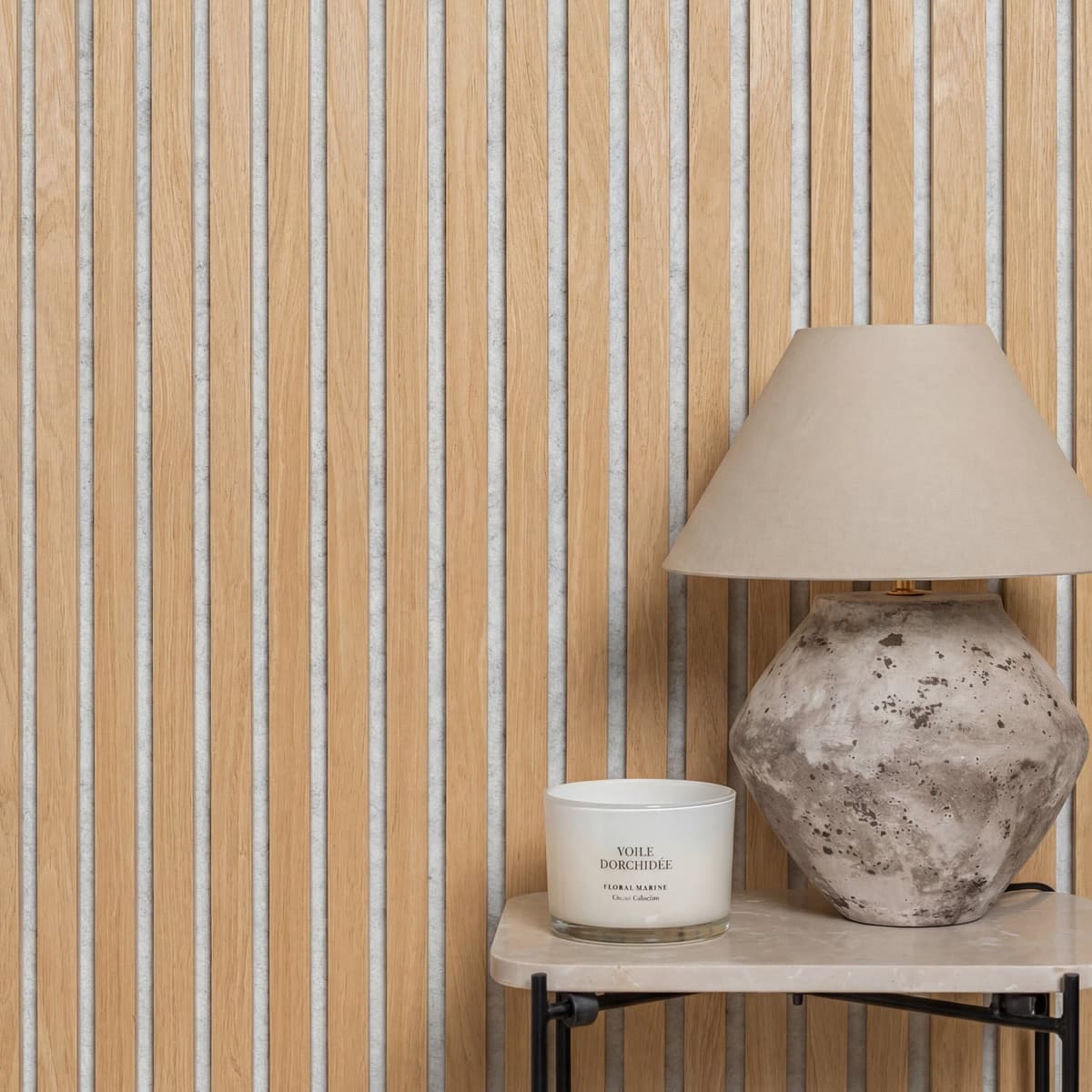
The construction is a series of narrow wood slats — typically 10–20mm wide — mounted over a high-density acoustic felt backing. Sound passes through the gaps between slats and is absorbed by the felt. The wood face is real — solid veneer over an HDF core — so you get genuine wood grain, warmth, and texture on the wall rather than a grey fabric rectangle.
TPH’s SoundPanel uses AcuFelt 1500 g/m² high-density felt and achieves NRC 0.85. That means 85% of sound energy hitting the panel surface is absorbed. It’s FSC-certified, ships from North Carolina, installs in under 2 hours per wall.
NRC: 0.85
Best for: Living rooms, bedrooms, home offices, gaming rooms, home theaters — any space where both acoustics and aesthetics matter
Price range: $14–$22/sqft materials
Finish options: American Walnut, White Oak, Golden Oak, Charcoal, and others
Install: DIY-friendly, under 2 hours per wall — Shop SoundPanel
Fabric-Wrapped Panels
The professional standard in recording studios and commercial spaces. A rigid core — typically fiberglass or mineral wool — wrapped in acoustically transparent fabric. These achieve the highest NRC ratings available: 0.85 for 1-inch cores, up to 1.00 for 2-inch fiberglass cores.
The acoustic performance is excellent. The visual result is a fabric rectangle on your wall. In a studio or professional environment, that’s fine. In a living room or bedroom, most people find them clinical and unappealing. They also require mounting hardware and more careful placement than slat panels.
NRC: 0.85–1.00
Best for: Recording studios, podcast rooms, professional spaces where maximum absorption matters more than aesthetics
Price range: $3–$8/sqft for standard panels
Acoustic Foam Panels
The egg-crate and pyramid tiles you’ve seen in home studio photos. Made from polyurethane or melamine foam. Cheap, lightweight, easy to find — and significantly underperforming relative to the alternatives.
The honest limitations: most acoustic foam achieves NRC 0.40–0.60, meaning it’s reflecting 40–60% of the sound back into the room. Cheap foam degrades in 2–3 years. Standard polyurethane foam is flammable and doesn’t meet commercial fire codes. In a professional or client-facing context, exposed foam looks unfinished.
Acoustic foam has legitimate uses — it’s the cheapest entry point and works reasonably well for very small, informal spaces. For anything permanent, anything with aesthetic requirements, or anything where NRC matters, slat panels or fabric-wrapped panels are the better investment.
NRC: 0.40–0.60
Best for: Temporary setups, budget music practice rooms, small booths
Price range: $1–$3/soft
Perforated Wood Panels
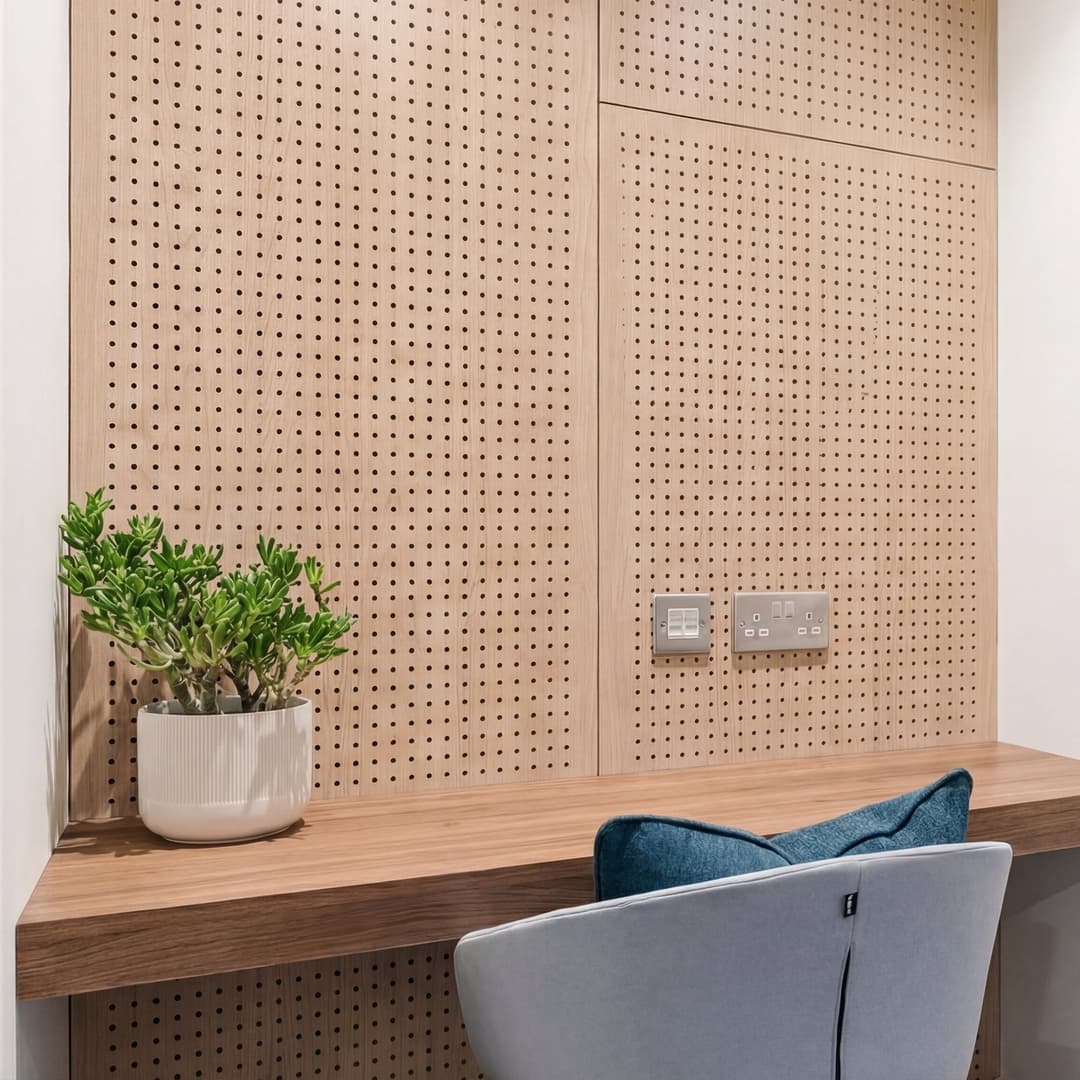
Solid wood or MDF panels with precisely machined holes or slots cut through the face, backed with acoustic material. The perforations allow sound to pass through to the absorptive backing. These offer a more architectural aesthetic than fabric panels while achieving strong acoustic performance — typically NRC 0.70–0.90 depending on perforation pattern and backing material.
NRC: 0.70–0.90
Best for: Commercial interiors, open-plan offices, spaces where a more formal panelled wall look is appropriate — Shop Perforated Panels
How Much Coverage Do You Actually Need?
This is where most guides give you a vague answer. Here’s the practical framework:
The 15–25% rule is the standard starting point. Covering 15–25% of a room’s total wall surface area with panels rated NRC 0.80 or higher produces a noticeable, meaningful improvement in most residential spaces. You don’t need to cover every wall — you need the right walls.
What that looks like by room type:
| Room | Recommended Coverage | Priority Surfaces | Realistic Panel Area |
|---|---|---|---|
| Home office (10×12 ft) | 15–20% | Wall behind desk / camera wall | 1 full accent wall (~80–100 sqft) |
| Bedroom (12×14 ft) | 15–20% | Headboard wall | 1 full accent wall (~90–110 sqft) |
| Living room (15×18 ft) | 20–25% | Main sofa wall or TV wall | 1–2 walls (~120–200 sqft) |
| Home theater (12×16 ft) | 25–35% | Side walls + rear wall | 2–3 walls (~200–300 sqft) |
| Podcast / recording room | 30–50% | All parallel wall pairs | Full treatment of 3–4 walls |
The single most important placement principle: treat parallel surfaces. The worst acoustic problems in most rooms come from sound bouncing back and forth between two opposite walls — the front-to-back or side-to-side flutter that creates the hollow, metallic quality you hear in untreated spaces. One panel on one wall barely touches this. A panel on each of a pair of parallel walls cuts it dramatically.
For home offices and bedrooms, a single full accent wall — the wall behind you in a video call, or the headboard wall in a bedroom — is often all you need. That wall serves as both treatment and design feature.
Room-by-Room: Which Panels Where
Home Office
The strongest use case for acoustic panels in 2026. Hard surfaces — painted drywall, glass desk, hard floors — create flutter echo that makes every video call sound like you’re speaking into a tin box. Your colleagues hear it even if you’ve stopped noticing it.
One acoustic panel wall behind your desk achieves two things simultaneously: it absorbs the sound bouncing off the wall your camera faces, and it creates a visually clean backdrop for calls. Walnut or dark oak panels photograph well under any lighting. Charcoal finish reads as neutral and professional in any room colour scheme.
Recommended: One full wall, NRC 0.85+
Best finish: American Walnut or Charcoal
Coverage needed: 80–120 sqft — Office and gaming room panel ideas
Bedroom
People sleep better in quieter rooms. That’s not marketing — sleep research consistently shows that ambient sound and reverberation disrupts sleep stages even when it doesn’t fully wake you. Acoustic panels behind the bed reduce the reflection of street noise and household sound within the room itself, creating a more acoustically calm environment.
Beyond the functional benefit, a full-width acoustic slat panel behind the bed replaces the need for a headboard. It costs less than custom millwork, installs in two hours, and creates the kind of considered, hotel-suite quality that transforms a bedroom.
Recommended: Full headboard wall
Best finish: American Walnut or White Oak
Coverage needed: 80–120 sqft — Bedroom wall panel ideas
Living Room
Open-plan living rooms are acoustically brutal. High ceilings, hard floors, large glass windows — everything reflects. Acoustic panels on the main sofa wall or behind the TV bring the RT60 down to a conversational level. The room stops feeling loud even with the same number of people in it.
Wood slat panels are especially well-suited here because they look like a considered design decision rather than a functional fix. Most visitors won’t know they’re acoustic panels. They’ll just notice the room feels warm and the conversations are easier to follow.
Recommended: Main wall behind sofa, or TV feature wall
Best finish: White Oak, Walnut, or Golden Oak
Coverage needed: 120–200 sqft — Living room panel ideas
Home Theater
If you’re spending money on projector, screen, and audio, the room treatment is not optional — it’s the thing that makes the rest of the investment work. Untreated rooms with good equipment sound worse than treated rooms with average equipment. Flutter echo and late reflections muddy dialogue, collapse the stereo image, and reduce perceived bass tightness.
Side walls are the highest priority — first reflection points from your speakers are the dominant source of acoustic problems. Rear wall treatment handles the echo that returns to your listening position after travelling the length of the room. Aim for 25–35% coverage distributed across at least three wall surfaces.
Recommended: Both side walls + rear wall
Best finish: Charcoal or dark walnut — absorbs light scatter, improves contrast
Coverage needed: 200–300 sqft — Home theater panel guide
Gaming Room
The same logic as home theater, with the additional consideration that streaming setups benefit enormously from clean audio. Viewers on Twitch or YouTube can hear room acoustics clearly — a panel wall behind your desk removes the hollow, amateur-room quality that makes streams sound lo-fi regardless of your microphone quality.
Recommended: Wall behind desk (camera-facing) + one side wall
Best finish: Charcoal, Walnut, or a contrasting dark tone — Gaming room panel setups
Dining Room
Restaurant acoustics research shows that noise level is one of the top complaints diners have. The same principle applies at home: a dining room with hard floors, glass, and painted walls creates a chaotic acoustic environment where conversations compete with ambient noise. One panel wall behind a banquette or sideboard reduces this without dampening the lively energy of a dinner table.
Recommended: Single accent wall
Best finish: Walnut or dark oak — creates restaurant-booth warmth — Dining room panel ideas
Acoustic Wall Panels Cost: What to Budget
Acoustic panel pricing spans a wide range depending on type, material, and quality. Here’s what the market actually looks like in 2026.
| Panel Type | Materials (per sqft) | NRC | Typical Lifespan |
|---|---|---|---|
| Acoustic foam (1-inch) | $1–$3 | 0.40–0.60 | 2–3 years |
| Fabric-wrapped (fiberglass core) | $3–$8 | 0.85–1.00 | 10–20 years |
| Wood slat acoustic (SoundPanel) | $14–$22 | 0.85 | 15–25+ years |
| Perforated wood panels | $12–$20 | 0.70–0.90 | 15–25+ years |
Wood slat acoustic panels cost more per square foot than foam or fabric alternatives. The reasons are real: you’re paying for real wood veneer, a more complex manufacturing process, a product that functions as premium interior design as well as acoustic treatment, and a 15–25 year lifespan versus the 2–3 years you get from foam before it starts to crumble and discolour.
Realistic project budgets:
- Single home office wall (80–100 sqft): $1,120–$2,200 in SoundPanel materials. DIY install in under 2 hours.
- Bedroom headboard wall (90–110 sqft): $1,260–$2,420 in materials.
- Full living room accent wall (130–160 sqft): $1,820–$3,520 in materials.
- Home theater treatment (200–300 sqft across 3 walls): $2,800–$6,600 in materials.
What to Look for When Buying
Five things that separate a panel that actually works from one that just looks like it does:
1. A real NRC number with a real test behind it. The NRC should be independently tested, not self-reported. Ask for the test standard — ASTM C423 is the US standard for sound absorption testing in a reverberation room. If a manufacturer can’t point to a test report, treat the number as marketing.
2. Backing material density. For wood slat panels, the felt backing is where the acoustic work happens. Higher density backing absorbs more effectively across a broader frequency range. TPH’s AcuFelt is 1500 g/m² — that’s a meaningful spec, not a vague claim.
3. Real wood vs printed wood-look. Acoustic slat panels are sold with both real wood veneer faces and PVC or printed-laminate faces designed to look like wood. Real veneer ages better, feels different, and has genuine grain character. Printed laminate is identifiable up close and won’t hold up the same way. TPH panels use real wood veneer over HDF cores.
4. Edge finish quality. The edges of acoustic panels are visible. Cheap panels have raw, unfinished edges. TPH panels have 3-sided rounded edges — a furniture-grade finish that makes the panel look like it was made to be looked at, not hidden.
5. FSC certification. Wood sourcing matters. FSC (Forest Stewardship Council) certification means the timber comes from responsibly managed forests. TPH panels are FSC-certified.
Wood Slat vs Fabric-Wrapped: Which Should You Choose?
Both achieve NRC 0.85 or higher. The difference is entirely about context.
Choose fabric-wrapped panels if: you’re building a professional recording studio or podcast room where maximum NRC (0.9–1.0) matters more than appearance, you need custom sizing for every panel, or you’re working in a commercial space with specific fire rating requirements.
Choose wood slat acoustic panels if: the panel will be visible and the room has any aesthetic standard at all — living room, bedroom, office, home theater, dining room. You get NRC 0.85, which is professional grade, combined with a product that actively improves the look of the room rather than just solving a functional problem.
For 95% of residential use, wood slat acoustic panels are the right answer. They do the acoustic job and look genuinely good doing it.
What Acoustic Panels Won’t Do
Being honest about limitations is part of making the right decision.
They won’t stop outside noise from entering the room. A truck driving past, your neighbour’s TV, a dog barking next door — these are transmission problems. Acoustic panels treat what happens inside the room once sound is already there.
They won’t fix bass problems on their own. Low frequencies below 250Hz are long wavelengths that pass through standard panels with minimal attenuation. Dedicated bass traps (thick corner treatment) are needed for serious bass control in music rooms and home theaters. For most residential applications — home offices, bedrooms, living rooms — bass is not the primary issue, and standard NRC 0.85 panels address the actual problem, which is mid and high frequency reverberation.
A single panel in a large room won’t do much. Coverage matters. One 2×4 foot panel in a 20×20 ft room treats less than 1% of the surface area. The improvement will be imperceptible. You need enough coverage — 15–25% of total wall area — for the treatment to function.
How to Install TPH SoundPanel
Most acoustic slat panels are designed for DIY installation. Here’s what the process actually involves.
What you need:
- Tape measure, pencil, level
- Construction adhesive — adhesive guide
- Circular saw or oscillating tool for cuts
- Finishing nails (optional secondary fastening)
Steps:
- Prepare the wall. Clean, dry, and reasonably flat. Fix any large dips or protrusions first.
- Mark your starting line. Use a level to draw a horizontal reference line. Starting square saves you from visible drift across a full wall.
- Cut to height. Measure your ceiling height. Most panels need a single cut at the top to fit. How to cut wall panels.
- Apply adhesive and press. Zigzag bead on the panel back, press to wall, check level. The AcuFelt backing grips immediately — you won’t need to hold it in place.
- Work across the wall. Stagger end joints between panels for a cleaner look. Butt panels tightly together — slat lines create the visual alignment.
Time: A standard 8×10 ft wall takes 1.5–2 hours on a first installation. Second wall is faster.
Caring for Acoustic Wood Panels
Real wood slat panels are durable and low-maintenance. A few things to know:
- Dust the slats with a dry microfiber cloth every few weeks. Dust in the gaps doesn’t affect acoustic performance noticeably, but it’s easier to remove regularly than in one pass.
- Vacuum the felt backing through the slat gaps once a year. This keeps the AcuFelt performing at full efficiency over time.
- For surface marks: Damp cloth with mild soap, applied gently and dried immediately. Don’t saturate the wood face.
- Keep away from steam or sustained moisture. The wood veneer is real — it responds to humidity the way real wood does.
Full care guide for wall panels.
Frequently Asked Questions
Do acoustic panels actually work?
Yes — when the NRC rating is 0.80 or above and you have adequate coverage (15–25% of wall area). The improvement is measurable and audible: shorter RT60, less reverberation, cleaner speech. A single panel in a large room makes a minor difference. Proper coverage makes a significant one.
How many panels do I need?
Measure your total wall surface area and multiply by 0.15–0.25 (15–25%). That’s your target treatment area in square feet. Use the Room Visualizer and Box Calculator to get a precise number for your specific dimensions.
Are wood slat acoustic panels the same as decorative slat panels?
No. Decorative slat panels have no acoustic backing — they’re purely visual. Acoustic slat panels (like TPH’s SoundPanel) have a high-density felt backing behind the wood face. That backing is what creates the NRC 0.85 rating. Without it, the NRC of a plain wood panel is close to zero.
Will acoustic panels reduce noise from neighbours?
No. Acoustic panels treat sound inside the room. Noise coming through a shared wall, floor, or ceiling is a transmission problem — it requires structural solutions (additional drywall mass, decoupling, insulation). Acoustic panels won’t help with this.
Can I install acoustic panels myself?
Yes. TPH’s SoundPanel is designed for DIY installation and takes under 2 hours per standard wall. The main requirements are a flat wall, accurate measurements, and the right adhesive.
What’s the difference between NRC and STC?
NRC (Noise Reduction Coefficient) measures sound absorption within a room. STC (Sound Transmission Class) measures how well a wall or partition blocks sound from travelling between rooms. Acoustic panels improve NRC. Soundproofing systems improve STC. Most people shopping for acoustic panels need NRC improvement, not STC.
Are the panels fire-rated?
TPH’s SoundPanel is FSC-certified real wood. For commercial installations with specific fire rating requirements, check the technical specifications or contact us directly. Technical specifications.
Where to Start
If you’re not sure how many panels you need, the Box Calculator takes your room dimensions and returns a panel count. Use the calculator.
If you want to see finishes on your actual wall before ordering, the Room Visualizer does that. Open the Room Visualizer.
If you want to feel the material before committing — which you should, because real wood veneer reads differently in hand than on a screen — sample boxes are available. Order a sample box.
And if you’re ready to see the full SoundPanel range — finishes, sizes, and configurations: Shop SoundPanel acoustic wall panels.
The Panel Hub’s SoundPanel uses real wood veneer over HDF cores with AcuFelt 1500 g/m² high-density backing. NRC 0.85. FSC-certified. Designed in the USA, shipped from North Carolina. 3-sided furniture-grade rounded edges.
Browse the full SoundPanel™ format range: American Acoustic Slat, White Felt Slat, Rectangle, Hexagon, Perforated, Curve, and 3-Sided — all with AcuFelt™ backing rated NRC 0.85.