
Table of Contents
What Makes an Acoustic Wall Panel “The Best”?
The best acoustic wall panel for your home depends on three variables: acoustic performance (NRC rating), visual quality (material and finish), and practical fit (size, installation method, budget). A panel that’s excellent for a podcast studio may be wrong for a living room. This guide focuses on home applications — living rooms, bedrooms, home offices, and media rooms.
The Key Specifications to Look For
NRC Rating: 0.65 Minimum, 0.80+ Ideal
For residential applications, look for panels with a published NRC rating of at least 0.65. Below this threshold, the acoustic benefit is negligible in normal room sizes. Panels rated 0.75–0.85 deliver noticeably quieter, more comfortable rooms with standard coverage. Our guide to NRC ratings explains what these numbers mean in practice.
Real Acoustic Felt Backing, Not Paper
The felt backing is what absorbs sound — not the wood slats. Confirm the product uses engineered acoustic felt (like AcuFelt™) rather than a thin paper backing that’s marketed as “acoustic” but provides negligible performance. See our AcuFelt backing guide for what to look for in the spec sheet.
Real Wood Veneer, Not Laminate
For living rooms and visible spaces, real wood veneer over MDF is the benchmark. Laminate prints look convincing in product photography and poor in person. For home installations where the panel is seen and touched, veneer quality matters. Our veneer vs laminate comparison has the full breakdown.
Best Panel Types by Room in 2026
Living Room: Acoustic Slat Panels
For living rooms, acoustic wood slat panels in walnut or oak remain the definitive choice in 2026. The combination of real wood warmth, strong vertical line aesthetic, and NRC 0.75+ performance makes them the highest-impact single upgrade available. The SoundPanel™ acoustic slat range hits all three criteria — real veneer, published NRC rating, AcuFelt™ backing.
Bedroom: Acoustic Slat or Reeded Panels
Bedrooms benefit from acoustic panels that create a restful rather than graphic effect. Slat panels in lighter species (oak, ash) suit most bedroom aesthetics. Reeded panels with their softer profile are an excellent alternative for organic modern or Japandi bedrooms where sharp lines feel out of place.
Home Office: Maximum NRC Coverage
Home offices prioritise NRC performance over aesthetics (though the two don’t need to conflict). Cover the primary wall — behind the desk — with the highest-NRC panel you can budget for. The SoundPanel® American Acoustic Slat panel at NRC 0.85 is the best-performing aesthetic option for office applications.
Home Theatre: High-NRC Multi-Wall
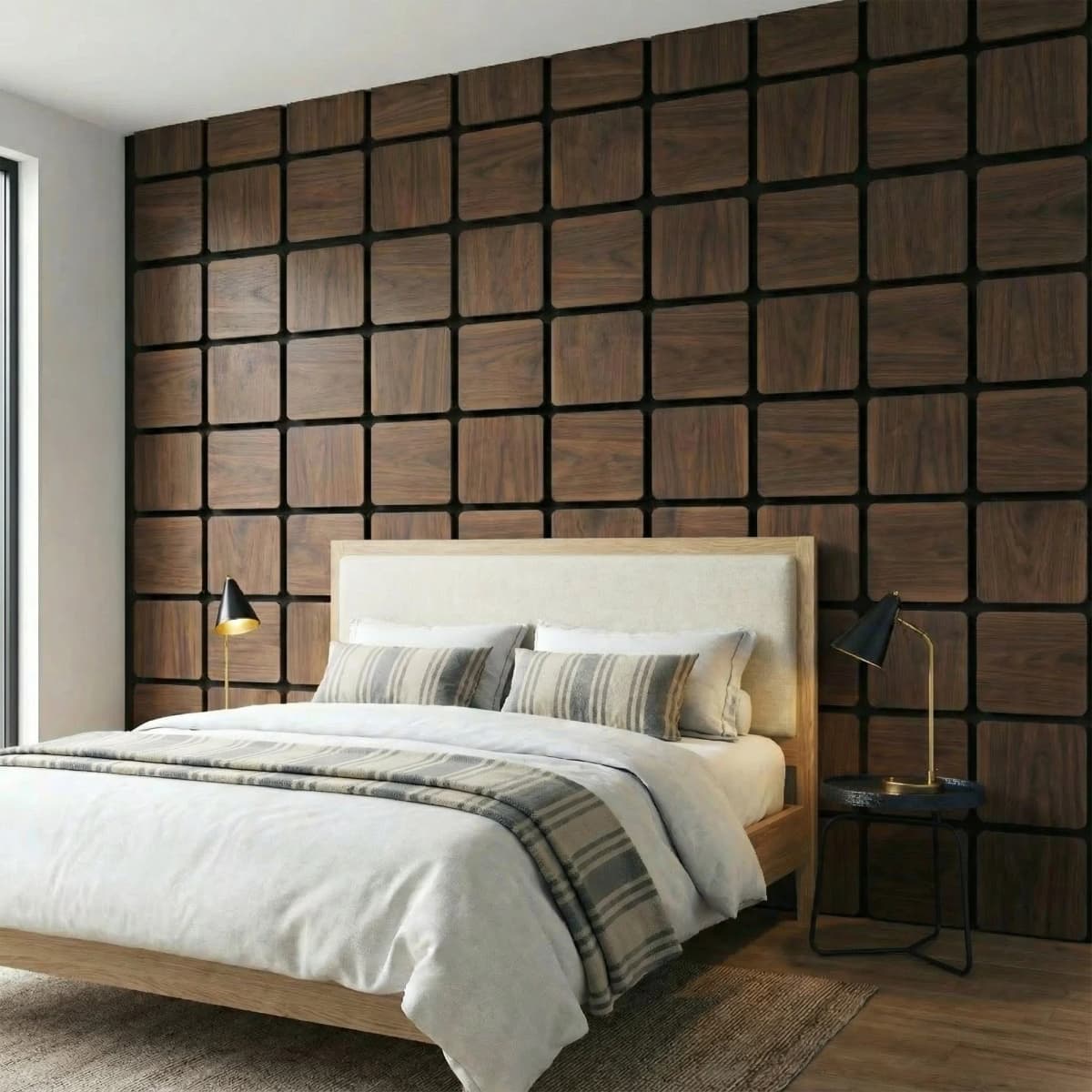
For home theatres, prioritise coverage over unit NRC. Multiple walls at 40–50% coverage with NRC 0.75 panels outperforms one wall at 100% coverage with NRC 0.85 panels. Combine slat panels on side walls with perforated panels on the front wall for varied absorption characteristics. The Rectangle panel is worth considering for front-wall coverage in home theatres — its solid face gives a cleaner visual plane than the slat profile from close viewing positions.
What to Avoid in 2026
- Panels marketed as “acoustic” without a published NRC rating
- Very cheap slat panels with paper backing — they’re decorative, not acoustic
- Foam panels in living spaces — they degrade in 5–7 years and look unprofessional from day one
- PVC “wood-look” slat panels — the texture and appearance don’t hold up close-range in domestic spaces
How to Calculate Coverage for Your Room
Getting the coverage calculation right is the practical step most buyers skip — and it’s the reason installations sometimes underdeliver. The rule of thumb for domestic acoustic treatment is 25–40% of total wall area, but that’s a starting point, not a formula. Here’s how to think about it more precisely.
Start with a hard surface audit. Count the wall surfaces that are bare — painted drywall, plaster, brick. Each of these reflects sound. Rooms with predominantly hard surfaces (open-plan spaces with polished concrete floors, rooms with large windows, minimal soft furnishings) need coverage toward the upper end of the range. Rooms with carpet, curtains, and upholstered furniture are already absorbing some sound — aim for the lower end.
Identify the primary reflection points. Stand at your most-used position in the room. The walls directly opposite and to the sides of you are the primary reflection surfaces. Treating these delivers more improvement per panel than covering a back wall you’re rarely facing.
Use the TPH Box Calculator. Rather than estimating, the coverage calculator on The Panel Hub takes your room dimensions and returns a panel count based on room volume and target NRC performance. This is more accurate than any rule-of-thumb calculation because it accounts for room geometry, not just wall area.
Budget for a sample first. Before ordering full coverage, order a sample tile. Assess the actual colour, grain direction, and texture in your room’s lighting conditions. Acoustic panels read differently under warm incandescent light versus cool daylight — a walnut that looks rich online may look orange in a room with south-facing windows. The sample step takes one extra week but saves costly returns.
The most common mistake is over-ordering the first time to “make sure” and then being left with excess panels. The second most common mistake is under-ordering and having to wait for stock replenishment mid-project. The calculator eliminates both problems.
Frequently Asked Questions
- What are the best acoustic wall panels for a home office in 2026?
- Wood slat acoustic panels with AcuFelt backing rated NRC 0.80 or higher are the best choice for home offices in 2026. They improve call quality, create a professional on-camera backdrop, and are available in neutral finishes (charcoal, dark oak, American walnut) that suit any existing decor.
- Are acoustic wall panels worth the investment?
- For rooms with noticeable echo or reverberation — home offices, living rooms with hard floors, home theatres — yes. The improvement is objectively measurable (RT60 reduction) and immediately perceptible on calls, during music playback, and in general conversation.
- What’s the difference between decorative and acoustic wall panels?
- Decorative panels are designed to look good. Acoustic panels are designed to absorb sound, verified by a certified NRC test. The two are not mutually exclusive — quality acoustic slat panels do both — but “acoustic” in a product name without a published NRC rating is a marketing term, not a specification.
- How long does a panel installation take?
- A single feature wall (typically 12–16 sqm) takes 3–6 hours for a competent DIY installer. The main time investment is surface preparation and layout planning. The panel fixing itself is faster than most people expect.
- Do acoustic panels require professional installation?
- No. TPH SoundPanel is designed for DIY installation with adhesive or mechanical fixing. Full installation guides and video tutorials are available, and most customers complete the installation without any trade involvement.
Browse the full wood wall panel collection at The Panel Hub — every acoustic panel in the range comes with published NRC ratings and real wood veneer specification. Factory-direct pricing means premium panels at up to 75% below retail.