
Table of Contents
- The Most Important Part of an Acoustic Panel (That Nobody Talks About)
- What Is AcuFelt?
- How Does It Absorb Sound?
- Why Slat Panels Need a Backing
- What to Look for in Acoustic Panel Backing
- Is AcuFelt Sustainable?
- Comparing AcuFelt Against Other Acoustic Backing Materials
- Frequently Asked Questions
- The Bottom Line
The Most Important Part of an Acoustic Panel (That Nobody Talks About)
When people choose acoustic slat wall panels, they focus on the wood veneer — the species, the colour, the slat width. Understandably: that’s what you see. But the component that determines whether a panel is actually acoustic or just decorative is the one you can’t see: the backing.
AcuFelt™ is an engineered acoustic felt backing developed specifically for wood slat wall panels. Here’s what it is, how it works, and why it’s the part of the panel specification you should be checking first.
What Is AcuFelt?
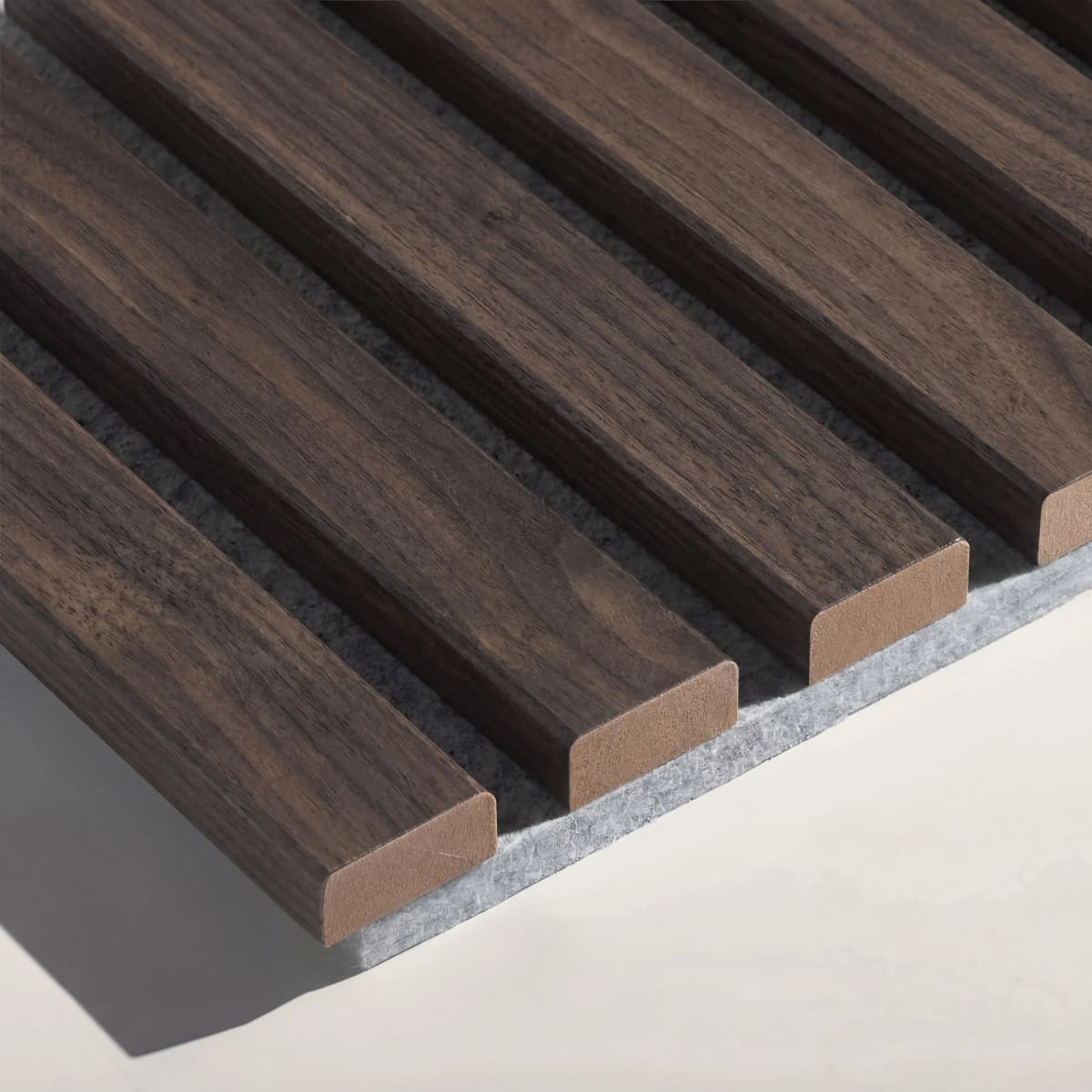
AcuFelt is a dense, multi-layer acoustic felt material bonded to the back of wood slat panels. It’s not standard felt — it’s an engineered material designed and tested specifically for sound absorption performance in wall panel applications.
The material is typically composed of compressed recycled polyester fibres, formed into a dense mat that maintains its structure under the weight of the slats above it without compressing to the point of losing its acoustic porosity.
How Does It Absorb Sound?
Sound absorption in porous materials works through a process called viscous dissipation. When sound waves enter the porous structure of the felt, the air particles vibrating within the sound wave move through the fibres of the material. The friction between the vibrating air particles and the fibres converts sound energy into a small amount of heat — effectively removing it from the acoustic system.
The denser and deeper the fibrous structure, the more surface area the sound waves encounter, and the more energy is dissipated. This is why standard craft felt (thin, low density) has almost no acoustic value, while engineered acoustic felt like AcuFelt achieves NRC ratings of 0.65–0.85.
Why Slat Panels Need a Backing
Open slat panels without backing have almost no acoustic value. The slats themselves are dense, hard wood — they reflect sound rather than absorbing it. It’s the backing material behind and between the slats that does the acoustic work. The gaps between slats allow sound to pass through to the felt, where it’s absorbed.
This means the acoustic performance of a slat panel is almost entirely a function of the backing material and its depth — not the slat profile. Two panels that look identical can perform completely differently depending on the backing.
What to Look for in Acoustic Panel Backing
When evaluating any acoustic slat panel, check:
- Backing material: Look for “acoustic felt,” “AcuFelt,” or “polyester acoustic backing.” Paper backing, foam backing, or no specification means no acoustic performance.
- Backing thickness: Thicker backing (9mm+) absorbs lower frequencies more effectively. Thin backing (3–5mm) handles mid-high frequencies only.
- NRC rating: The published NRC rating of the complete panel (not just the backing in isolation) is the performance figure that matters.
- Colour: Acoustic felt on quality panels is typically black, as it disappears visually through the gaps between light-coloured wood slats.
Is AcuFelt Sustainable?
AcuFelt and similar acoustic felt products are typically made from recycled PET (polyethylene terephthalate) — the same material as plastic bottles. This gives the material an environmental credential: it uses post-consumer recycled content rather than virgin materials. Some products also carry relevant environmental certifications.
Comparing AcuFelt Against Other Acoustic Backing Materials
Not all acoustic panel backing materials perform the same. Understanding the differences helps buyers evaluate products beyond marketing claims and surface aesthetics.
AcuFelt (polyester acoustic felt, high density): The backing used in TPH SoundPanel. Made from compressed polyester fibres, typically 25–30mm thick, with a density specification that determines the acoustic absorption coefficient. The key characteristic of high-quality acoustic felt is its consistent NRC performance across the 250Hz–4000Hz frequency range — the range that covers most of human speech. AcuFelt achieves NRC 0.85 in combination with the SoundPanel slat profile. It’s also dimensionally stable, resists moisture, doesn’t off-gas, and doesn’t degrade over time. Sustainable — typically made from recycled PET fibres.
Acoustic foam backing: Lower cost, lighter weight, but significantly lower durability. Open-cell polyurethane foam achieves comparable NRC ratings when new but degrades chemically over 5–8 years — becoming brittle, crumbling, and losing absorption performance. Not appropriate for a permanent installation.
Paper or cardboard backing: Some entry-level decorative slat panels include a paper or cardboard backing described as “acoustic.” This provides negligible real-world absorption — NRC ratings are not published for these products because the performance doesn’t meet the threshold. Paper backing on a decorative panel is a cost reduction, not an acoustic specification.
Fibreglass insulation: Used in fabric-wrapped acoustic panels and some architectural products. Achieves NRC 0.90–1.00 at standard thicknesses. Highly effective, but not appropriate for a surface-mounted residential panel due to fibre migration concerns and the need for full enclosure. Standard practice in professional recording studios; not typical for domestic wall panels.
The practical test: If a product describes acoustic performance but doesn’t publish an NRC rating from a third-party certified test, the backing material is likely inadequate. NRC testing costs money; products with real acoustic performance publish the result. Products that skip it usually have a reason.
Frequently Asked Questions
- What is AcuFelt made from?
- AcuFelt is a high-density polyester acoustic felt typically manufactured from recycled PET fibres (the same material used in plastic bottles). The fibres are compressed and heat-bonded into a rigid felt sheet. The density of the felt determines its acoustic absorption coefficient — higher density equals higher NRC performance across the target frequency range.
- Why does the backing material matter for acoustic panels?
- The visible face of a slat panel — the wood veneer — doesn’t absorb meaningful sound energy. The wood is rigid and reflects sound. All the actual acoustic work is done by the backing material behind the slats. A panel with an inadequate or missing backing is a decorative product, not an acoustic one, regardless of how it’s described or marketed.
- How thick should acoustic felt backing be?
- 25–30mm is the standard specification for residential acoustic felt backing. Below 20mm, the absorption drops significantly at lower frequencies. Above 40mm, performance improves incrementally — not worth the increased panel weight and cost for most domestic applications.
- Does acoustic felt backing get damaged by moisture?
- High-quality polyester acoustic felt (including AcuFelt) is moisture-resistant and won’t absorb water or lose structural integrity in normal humidity conditions. It should not be installed in wet areas or exposed to direct water contact, but bathrooms with adequate ventilation and kitchens away from direct steam sources are generally fine.
- Is AcuFelt available as a standalone product for DIY acoustic panels?
- High-density polyester acoustic felt is available from specialist acoustic suppliers as a standalone material for DIY panel builds. However, the labour cost of constructing panels from raw materials typically exceeds the cost differential compared to finished products with certified NRC ratings — particularly at small residential quantities.
The Bottom Line
The backing is what separates an acoustic panel from a decorative one. If you’re buying slat panels specifically for their sound-absorbing performance — for a home office, living room, or bedroom — verify the backing specification before purchasing. A panel without a documented acoustic backing and a published NRC rating is a decorative product regardless of how it’s marketed.
For full context on acoustic panel performance, how NRC ratings are measured, and how much coverage you need, read our complete acoustic wall panel buyers’ guide and our guide on what soundproof wall panels can and can’t do.