
Table of Contents
- Why Nail-Free Installation?
- Method 1: Construction Adhesive (Most Common)
- Method 2: Heavy-Duty Command Strips
- Method 3: Hook-and-Loop (Industrial Velcro)
- Method 4: French Cleat System
- Method 5: Freestanding Systems
- Choosing the Right Method for Your Wall Substrate
- Frequently Asked Questions
- Browse Panels Suited to Damage-Free Installation
Why Nail-Free Installation?
The most common reasons for wanting to install wall panels without nails: rental properties where wall damage must be avoided, drywall that’s too thin or damaged for secure nailing, a desire to keep installation fully reversible, or simply not owning a nail gun. All are valid — and there are genuinely effective nail-free installation methods available.
The honest caveat: no nail-free method is as mechanically robust as screws-and-anchors for heavy panels. Each method has weight limits and substrate requirements. Matching the right method to your specific panels and wall type is the key to a successful installation.
Method 1: Construction Adhesive (Most Common)
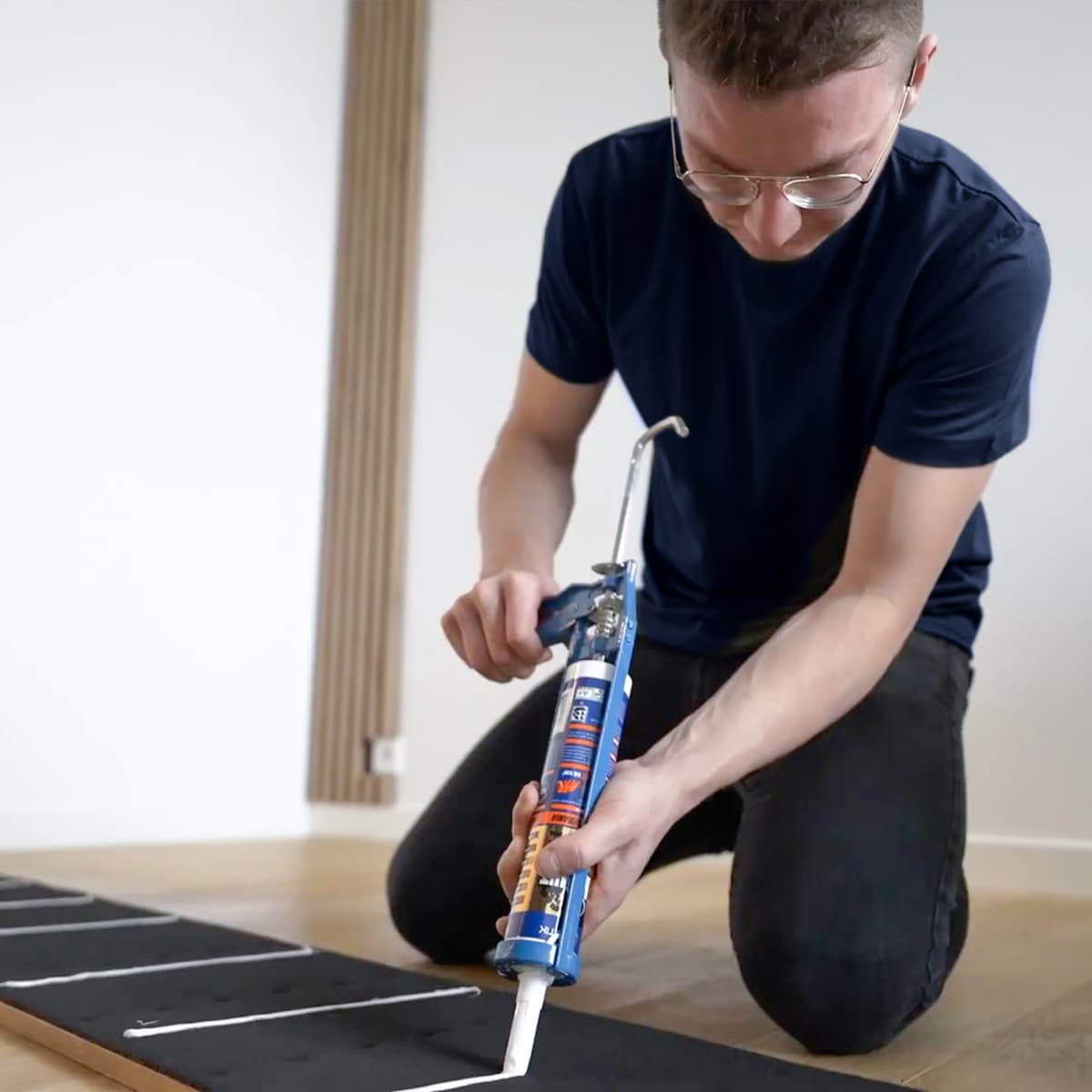
For most acoustic wood slat panel systems, the manufacturer-recommended installation method is construction adhesive — no nails or fixings involved. A hybrid polymer or polyurethane adhesive creates a bond strong enough for panels up to approximately 15–20kg per panel on sound drywall or plaster.
Best for: Standard-weight wood slat panels (most residential panel systems); permanent or semi-permanent installations.
Limitations: Not fully reversible — removal will typically damage paint and may damage plaster. Not suitable for very heavy panels or substrate surfaces in poor condition.
Application: Zigzag bead across the panel back, 5cm from each edge and two runs across the middle. Press firmly for 60 seconds. Use painters’ tape to hold the panel while adhesive cures (typically 10–30 minutes to initial grab).
Method 2: Heavy-Duty Command Strips
3M Command Damage-Free strips are designed to hold significant weight and release cleanly by stretching. The standard large picture-hanging strips hold 7.3kg per strip pair; heavy-duty versions hold up to 11.3kg. For lightweight acoustic panels or fabric acoustic panels, multiple strip pairs provide secure mounting that removes cleanly.
Best for: Lightweight fabric acoustic panels, thin decorative panels under 5kg per panel.
Limitations: Standard wood slat panels typically exceed Command strip weight ratings. Not suitable for humid rooms (adhesive weakens in high humidity).
Application: Follow manufacturer instructions exactly — surface preparation (clean, dry, room temperature) is critical to the adhesive performing at rated capacity.
Method 3: Hook-and-Loop (Industrial Velcro)
Industrial-grade hook-and-loop tape in 25mm width provides approximately 1.8–2kg of holding force per centimetre of tape. For a panel with 50cm of tape applied, that’s approximately 90–100kg of holding force — far more than needed for any residential wall panel.
Best for: Panels of any weight where full reversibility is required; situations where panels may need to be repositioned.
Limitations: The adhesive backing of the hook-and-loop must bond to the wall — if wall surfaces are weak or painted with low-adhesion paint, the tape will pull the paint rather than the panel.
Application: Apply hook side to the wall, loop side to the panel. Use a batten fixed to the wall (with removable adhesive) as the substrate for the hook side — this protects the wall surface and provides a stronger bonding base.
Method 4: French Cleat System
A French cleat uses two interlocking angled timber battens — one fixed to the wall, one to the back of the panel — that interlock and support the panel’s weight mechanically. The wall batten can be fixed with a small number of wall anchors (two or four screws), while the panel itself hangs without touching the wall.
Best for: Heavy panels where other methods don’t provide sufficient holding force; situations where panels need to be easily removed and re-hung.
Limitations: Does require fixing the wall batten (2–4 small screws). Not fully hole-free, but the number of fixings is minimal and easily filled.
Method 5: Freestanding Systems
Some panel systems are available with floor-to-ceiling tension poles or freestanding frames — zero wall contact required. Panel coverage is limited and repositioning flexibility is high. Best for renters or temporary installations where any wall contact is prohibited.
For the full context on renter-friendly panel installation across different tenancy situations, our wall panels for renters guide covers the legal and practical considerations in detail. And for a general step-by-step on standard panel installation (with fixings), our wall panel installation guide is the complete reference.
Choosing the Right Method for Your Wall Substrate
The single most common installation mistake is choosing a fixing method without checking whether the wall substrate can support it. Different wall constructions require different approaches — and the consequences of getting this wrong range from panels that slowly slide down to a full wall that pulls away in one piece.
Plasterboard (drywall) on timber studs: The most common wall type in UK residential builds. Adhesive methods work well for panels under 8kg/tile. For heavier panels, mechanical fixing into the studs using a stud finder and timber screws is the most secure option. Hook-and-loop systems rated for the panel weight are a good damage-free alternative — confirm weight ratings carefully.
Solid plaster on masonry: Older properties with solid brick or block walls and plaster finish. Adhesive performs reliably on clean plaster — the plaster surface is stable and provides good bond area. Avoid adhesive that requires a porous substrate if the plaster is sealed or painted. Construction adhesive (Method 1) is the standard approach for this wall type.
Smooth painted walls: Paint finish affects adhesive bonding. Gloss or semi-gloss paint may have low enough surface energy to prevent reliable adhesion. In these cases, key the surface lightly with fine sandpaper before applying adhesive, or use mechanical fixing. Test adhesive bond with a small tile before committing to full installation.
Tiled, panelled, or textured surfaces: Irregular surfaces reduce the contact area available for adhesive. Heavy-duty construction adhesive applied in multiple beads and pressed firmly can work on lightly textured surfaces. For significantly irregular substrates, a French cleat system (Method 4) provides a flat installation surface independently of the underlying wall finish.
Panel weight is the critical variable. Every damage-free installation method has a weight limit per tile. Exceed it and the installation is at risk regardless of how carefully it’s applied. Confirm the panel weight per tile from the manufacturer’s specification before selecting a fixing method — most TPH panels are well within the capacity of quality adhesive systems, but verification takes 60 seconds and prevents a costly failure.
Frequently Asked Questions
- What is the strongest way to install acoustic panels without nails?
- Construction adhesive (Method 1) provides the highest bond strength for permanent damage-free installation. A quality panel adhesive like Gripfill or Stixall applied in beads across the panel back and pressed firmly to a clean, dry wall creates a bond stronger than the wall substrate in most residential applications.
- Can acoustic panels be removed after adhesive installation?
- Panels installed with construction adhesive are not intended for removal. Removal typically damages either the panel or the wall finish, or both. If you need a removable installation — rental property, temporary installation, or future relocation — use hook-and-loop (Method 3) or a French cleat system (Method 4), which both allow clean removal.
- How long does construction adhesive take to cure for acoustic panels?
- Most panel adhesives achieve handling strength within 24 hours and full cure within 48–72 hours. During the curing period, temporary support props or tape can be used to hold panels in position while the adhesive sets. Do not apply full load (e.g., stacking panels or pressing them hard) during the initial curing window.
- Will Command strips hold acoustic slat panels?
- Standard Command strips are rated for 450g–4kg per strip. TPH SoundPanel tiles typically weigh 4–9kg each depending on size, so a single Command strip is insufficient. Heavy-duty Command strips (rated to 7.5kg) may work for smaller, lighter tiles — always confirm the panel weight and use multiple strips with the combined capacity exceeding the tile weight by at least 50% margin.
- Is damage-free installation suitable for all wall types?
- No. Very irregular or textured surfaces, loose or damaged plaster, and low-grip paint finishes may prevent reliable adhesive bonding. For these substrates, a French cleat system — which screws the cleat directly to the wall regardless of surface condition and provides a clean installation surface for the panel — is the reliable alternative.
Browse Panels Suited to Damage-Free Installation
Explore the full wood wall panel collection at The Panel Hub — the SoundPanel™ acoustic slat range is the most popular choice for adhesive-based, nail-free installations. For design inspiration on what’s achievable without fixings, our interior slat wall ideas guide shows 50+ real-room results. The acoustic panel buyer’s guide covers panel weight and construction — important factors when choosing a panel type for damage-free mounting methods.