
Table of Contents
The Two Main Options for Room Acoustic Treatment
If you’re looking to improve the acoustics of a room in your home, you’ll encounter two dominant product types: acoustic foam panels (the wedge- or pyramid-shaped foam tiles associated with recording studios) and wood slat acoustic panels (the contemporary wood-and-felt systems used in living rooms, home offices, and media rooms). Both absorb sound. Both improve room acoustics. But they are very different products designed for different contexts.
How They Work: Same Principle, Different Materials
Both foam panels and acoustic wood panels work through porous absorption — sound waves enter the material, the friction between vibrating air particles and the material structure converts sound energy to a small amount of heat, and the reflected energy reaching the room is reduced.
The difference is in the material, depth, and density of the absorbing element — and in what covers it:
- Acoustic foam: Open-cell polyurethane foam, typically 25–100mm thick. The entire panel is the absorbing medium.
- Acoustic wood slat panels: Dense engineered felt backing (typically 9–12mm) behind a real wood veneer slat face. The felt is the absorbing medium; the wood is the aesthetic face.
Performance Comparison
| Feature | Acoustic Wood Slat Panels | Acoustic Foam Panels |
|---|---|---|
| NRC range | 0.65–0.85 | 0.50–0.95 (varies with thickness) |
| Low frequency absorption | Limited (below ~250Hz) | Better with thicker foam (100mm+) |
| High frequency absorption | Good (500Hz–4kHz) | Excellent across all profiles |
| Performance per dollar | Lower | Higher |
At equivalent NRC ratings, foam panels deliver more acoustic performance per dollar. For pure acoustic performance in a budget-constrained recording environment, foam wins on efficiency.
Aesthetics: A Decisive Factor
Acoustic foam is functional and looks exactly like what it is: studio treatment foam. In a black-box recording studio, a podcast booth, or a server room, this is fine. In a living room, bedroom, or home office that’s also lived in and seen on camera, it’s not acceptable.
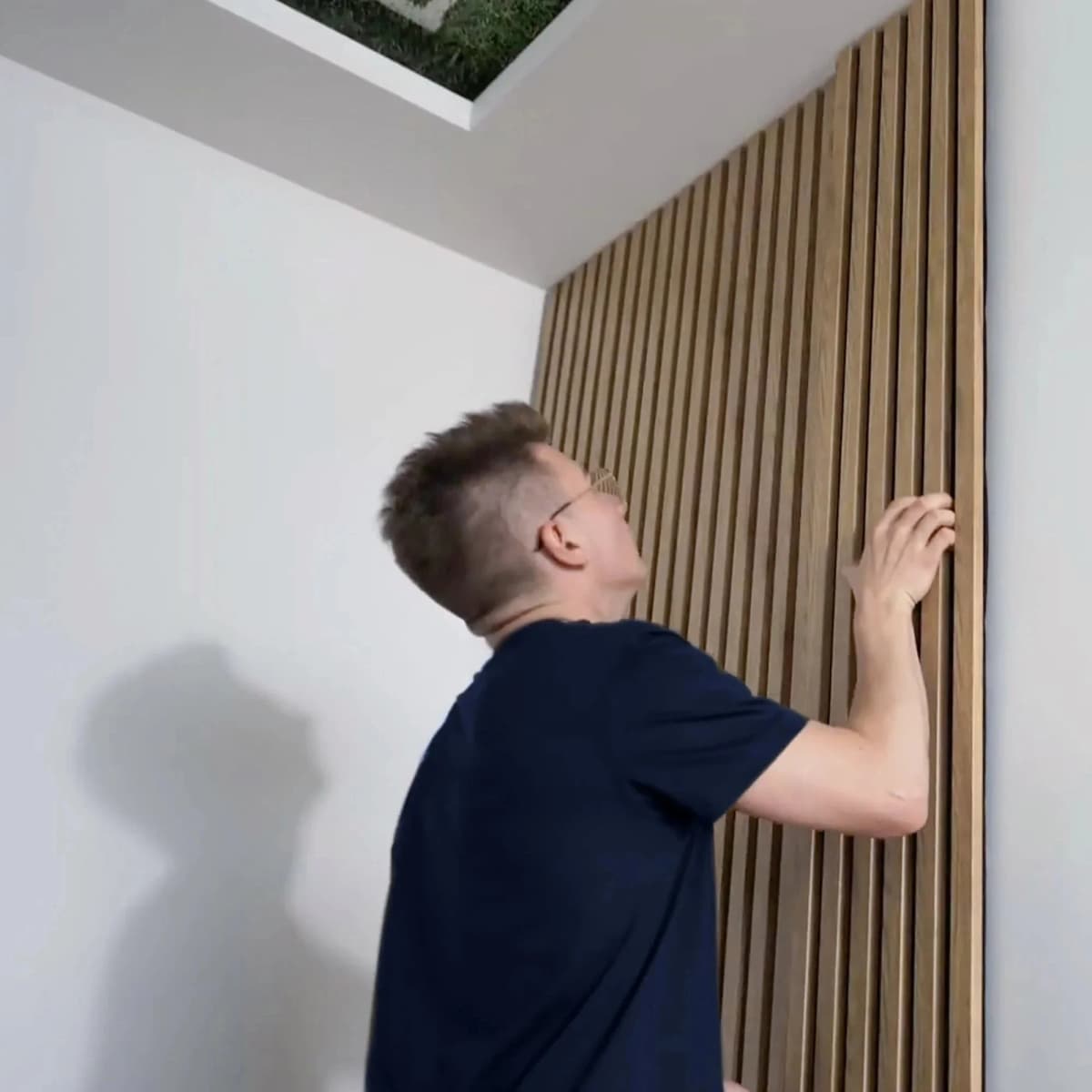
Wood slat acoustic panels deliver equivalent or near-equivalent acoustic performance in a format that enhances rather than compromises the aesthetic of a domestic space. This is the decisive advantage — and the reason they’ve become the standard for home and commercial acoustic treatment in living spaces.
Lifespan
- Acoustic foam: Degrades in 5–10 years. Polyurethane foam becomes brittle, crumbles, and discolours under UV and air exposure. Foam that’s 10 years old typically needs full replacement.
- Wood slat panels: 20+ years with standard maintenance. Real wood veneer ages gracefully; the felt backing retains acoustic properties for the life of the product in normal domestic conditions.
Which to Choose
- Choose acoustic wood slat panels for any space you live in, work in, film in, or show to other people. Living rooms, home offices, bedrooms, media rooms. The SoundPanel™ range is the premium choice for domestic acoustic treatment that looks as good as it performs.
- Choose acoustic foam for pure acoustic treatment in utility spaces — a dedicated recording booth, a back-room podcast studio, a vocal isolation space where aesthetics don’t matter and performance per dollar is the only metric.
Cost Comparison: Foam vs Wood Slat Panels
Budget acoustic foam is typically cheaper upfront: basic wedge or pyramid panels can be sourced for £10–£25 per panel (roughly £50–£120 per sqm for full coverage). Professional studio foam — thicker, higher-density, better NRC ratings — runs £80–£200 per sqm.
Wood slat acoustic panels sit in a wider range. Entry-level products with thin veneers and foam backing start at around £40–£60 per sqm. Quality panels with real hardwood veneer, engineered core, and certified acoustic felt backing (like TPH SoundPanel) typically run £80–£150 per sqm — comparable to mid-range studio foam on a per-sqm basis, but with a finish that looks intentional rather than functional.
The key cost comparison is lifetime value. Acoustic foam panels degrade: the polyurethane breaks down over 5–8 years, becoming brittle, discolouring, and losing acoustic performance. Wood slat panels don’t have this problem — the wood veneer and felt backing are stable materials with no expected degradation timeline. Over a 10-year horizon, the real cost difference between the two options narrows considerably.
There’s also the resale and design consideration. Acoustic foam in a living room has a near-zero or negative impact on perceived room quality. Wood slat panels are an interior design asset. In a home that’s likely to be sold or photographed, the panel choice affects perceived value in ways that foam simply cannot.
For utility spaces where performance per pound is the only criterion — a dedicated isolation booth, a server room, a back-room recording space — foam is the rational choice. For anywhere else in a home, the cost premium of wood slat panels is justified by aesthetics, longevity, and the fact that the installation reads as a design choice rather than a technical compromise.
Frequently Asked Questions
- Do acoustic foam panels actually work?
- Yes, they absorb sound effectively — particularly at mid and high frequencies. The issue is not performance but aesthetics and durability. For a home environment, the foam aesthetic is difficult to incorporate into a finished interior.
- Which has a better NRC rating — foam or wood slat panels?
- It depends on the specific product. Budget foam panels typically achieve NRC 0.50–0.70. High-density studio foam can reach NRC 0.85–0.95. Quality wood slat panels with felt backing (like TPH SoundPanel at NRC 0.85) match or exceed mid-range foam. The key is checking the published NRC for the specific product, not the material type.
- Can I use foam panels in a living room?
- Technically yes, but practically it’s difficult to make them look intentional in a domestic setting. Most homeowners who start with foam replace it eventually. Wood slat panels are designed for residential use — the aesthetic is the point, not a compromise.
- Are wood slat acoustic panels harder to install than foam?
- No. Both typically use adhesive or mechanical fixing. Wood slat panels are heavier but the installation process is comparable — full instructions are included and no specialist trades are required for a standard wall installation.
- How long do wood slat acoustic panels last?
- Indefinitely with normal care. The hardwood veneer, engineered core, and acoustic felt backing are all stable materials. Unlike foam, they don’t degrade chemically over time.
For most homes, acoustic wood slat panels are the right answer — they’re the only option that improves both how the room sounds and how it looks. Browse the full acoustic panel collection to compare NRC ratings and finish options.