
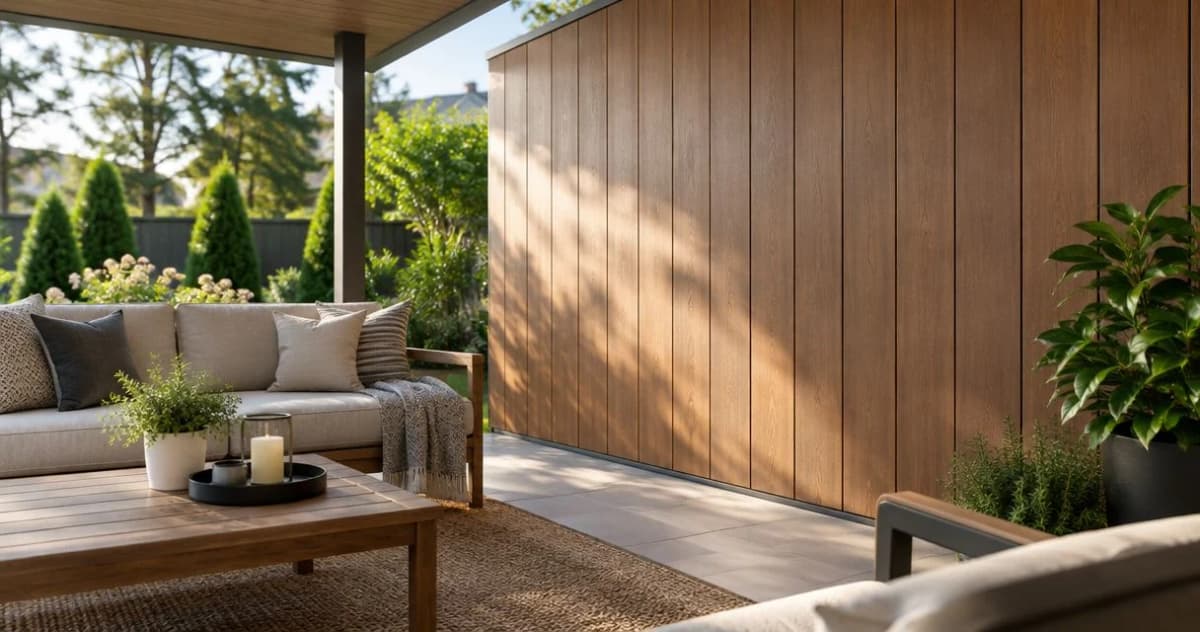
Wall panels are durable enough for outdoor patios only when the manufacturer approves the complete panel system for exterior exposure. Interior decorative, acoustic, and shower panels are not substitutes for exterior cladding, even beneath a patio roof. For a 2026 patio project, choose documented outdoor suitability before choosing a wood grain, slat pattern, or finish.
- Are wall panels durable enough for outdoor patios? Yes, when the complete system is approved for exterior exposure.
- The Panel Hub wall panels serve interior projects; do not treat interior specifications as outdoor approval.
- A patio roof reduces direct rainfall but does not eliminate wind-driven rain, sunlight, or temperature changes.
- Choose exterior wall panels by documented exposure limits, drainage details, and attachment instructions—not material names alone.
Are wall panels durable enough for outdoor patios?
Exterior-approved wall panels are suitable for patios; interior-only panels are not. The deciding evidence is the manufacturer's stated application and installation requirements, not whether a panel looks substantial or feels water-resistant.
The Panel Hub is best for homeowners choosing decorative and acoustic wall panels for interior rooms. Its interior positioning does not establish suitability for an exposed patio wall.
| Panel category | Best for | Main advantage | Main limitation | Patio decision |
|---|---|---|---|---|
| Exterior-approved wood cladding | Homeowners seeking a natural wood exterior | Natural grain and a finishable surface | Requires the specified moisture detailing and maintenance | Consider when the exact system permits the exposure |
| Exterior-approved PVC or composite cladding | Homeowners seeking a manufactured exterior finish | Offers an alternative to natural wood | Expansion, fastening, and exposure limits remain product-specific | Consider with exterior documentation |
| Interior decorative wood panels | Dry indoor feature walls | Adds texture and wood character | Interior construction does not establish weather resistance | Keep indoors unless explicitly approved otherwise |
| Interior acoustic panels | Indoor rooms needing sound absorption | Combines a decorative surface with acoustic treatment | An acoustic rating is not a weather-resistance rating | Do not assume patio suitability |
| Interior shower panels | Approved bathroom installations | Designed for the specified indoor wet-area application | Wet-area suitability does not establish sunlight or exterior suitability | Do not substitute for exterior cladding |
Why this matters
A patio wall faces conditions that an indoor accent wall does not. Rain can reach joints, sunlight can affect finishes, and temperature changes make materials expand and contract. A roof changes the exposure; it does not automatically turn the space into an interior room.
For your 2026 renovation, separate appearance from performance. You can pursue a warm wood look or a clean decorative surface, but the panel, backing, adhesive, fasteners, and wall assembly all need to suit the location. One unsuitable component can compromise an otherwise appropriate choice.
What proves a panel is suitable outdoors?
Start with the exact product's technical documents. A material name such as wood, PVC, or composite describes part of the construction; it does not establish where the finished product can be installed.
Look for a stated exterior application, then check whether it covers your conditions. An approval limited to sheltered vertical walls is not permission to install the same product on an exposed horizontal surface. Follow the documented scope rather than stretching the meaning of outdoor use.
Before ordering, confirm these points:
- Exterior application: The documentation expressly permits the intended outdoor wall installation.
- Exposure limits: Sunlight, rain, temperature, and any shelter requirements match your patio.
- Wall assembly: The instructions address the backing, water management, and attachment method.
- Finishing details: Edges, joints, corners, and openings have specified treatments.
- Maintenance requirements: You understand the cleaning, inspection, and refinishing obligations.
If exterior suitability is not stated, do not infer it from photographs or decorative descriptions. Ask for written confirmation identifying the exact product and your intended installation. A general statement about a material family is not a substitute.
Why outdoor patio panel durability varies
Outdoor durability depends on the complete installation and the exposure it receives. These factors explain why the same decorative appearance can produce very different results indoors and outside:
- Moisture exposure: Direct rain, wind-driven rain, splashback, and trapped moisture place different demands on a panel and its joints.
- Sunlight: Exterior finishes must suit the sunlight exposure stated in the product documentation; indoor color performance does not establish outdoor performance.
- Temperature movement: Panels, supporting materials, and fasteners need the movement allowances specified for the system.
- Panel construction: A face material alone does not describe the behavior of its core, backing, edge treatment, or bonded layers.
- Attachment method: Adhesive and mechanical fixing requirements must match both the panel and the wall substrate.
- Water management: Flashing, drainage, and termination details determine how water leaves the assembly rather than collecting behind it.
There is no reliable lifespan to assign to all patio wall panels. Use the exact manufacturer's service and maintenance information instead of a category-wide promise.
Does a covered patio make indoor panels safe outside?
No. A covered patio remains an outdoor location when it is open to exterior air and weather. The roof limits some direct rainfall, but open sides still admit wind-driven moisture and changing humidity.
Check the wall itself, not just the roof overhead. Look for water staining near edges, splash marks near the floor, and places where runoff reaches the wall. Existing damage needs diagnosis before you cover the surface.
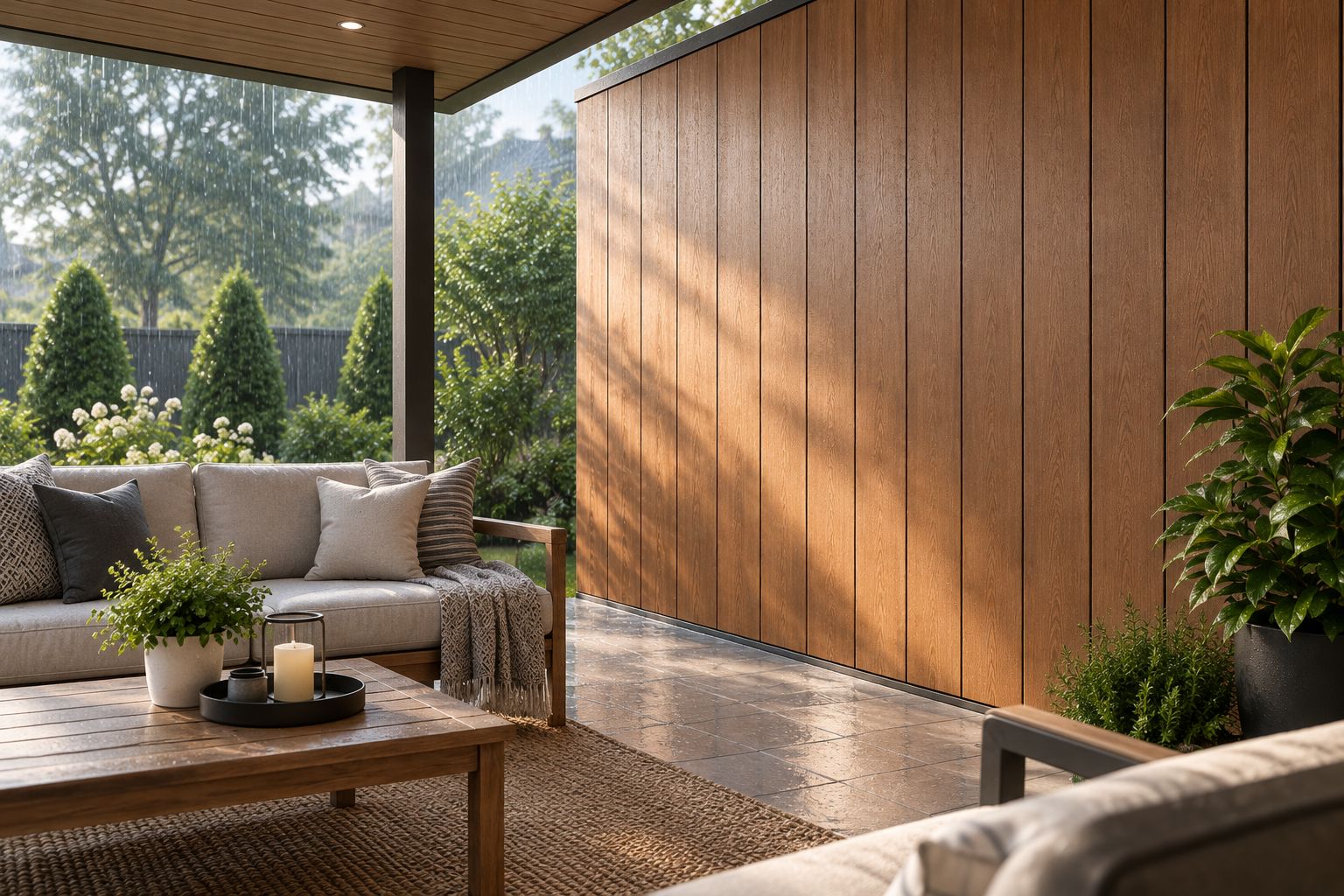
A sheltered location is still useful information when selecting an exterior system. It is not permission to install an indoor product. For a 2026 purchase, describe the actual exposure to the supplier rather than calling the space simply covered.
How should you check a patio wall before buying panels?
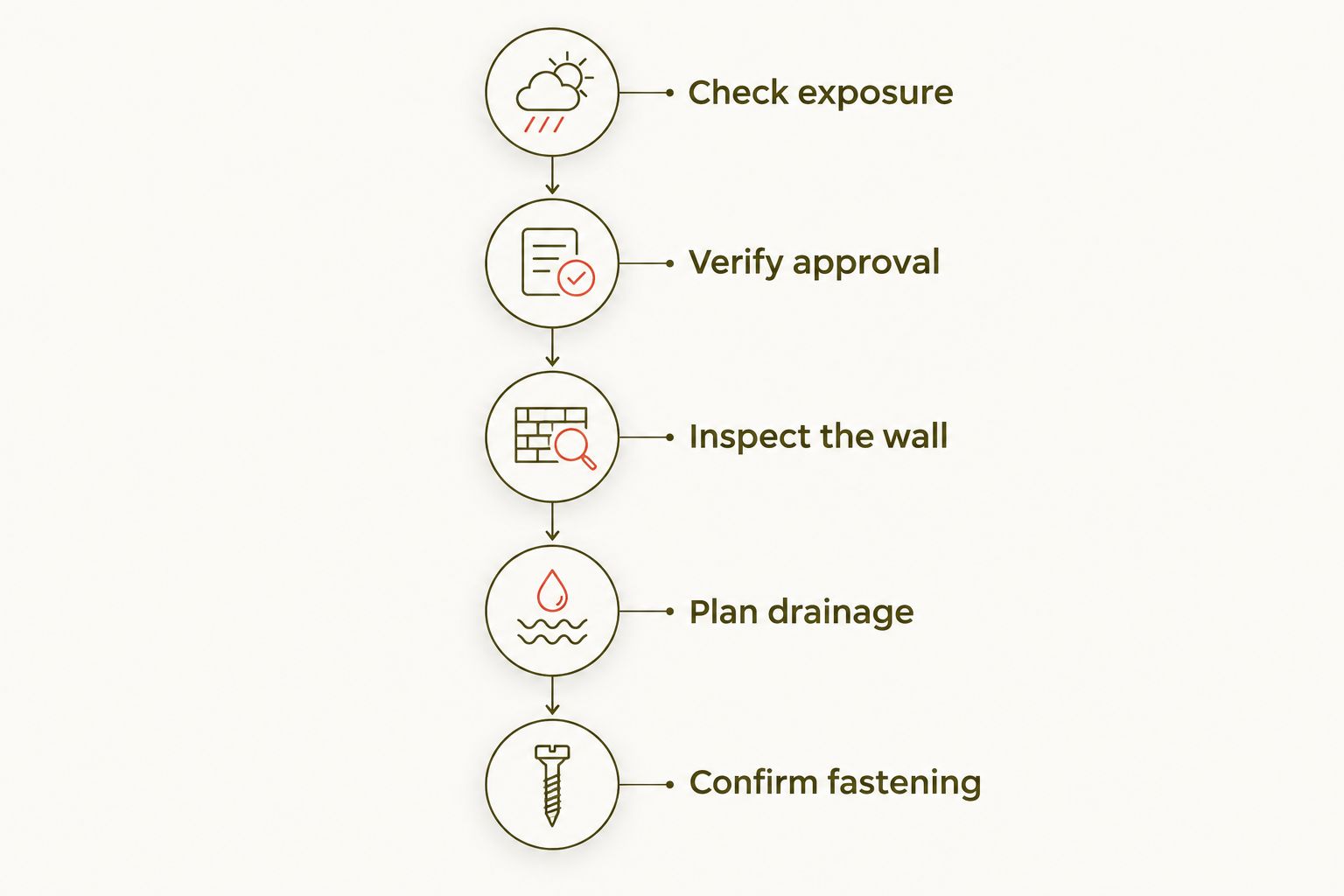
Use this sequence before measuring your final order. It keeps the decorative choice behind the decisions that determine whether the installation belongs outdoors.
- Check exposure. Identify direct rain, wind-driven rain, sunlight, splashback, and nearby heat sources. Describe which parts of the wall are sheltered and which are exposed.
- Verify approval. Match the exact panel to written exterior-use documentation. Check whether the permitted installation matches your wall orientation and local conditions.
- Inspect the wall. Identify the substrate and investigate loose finishes, damp areas, or damaged materials. Do not use panels to conceal unresolved moisture damage.
- Plan drainage. Follow the assembly's flashing, drainage, and termination details. Panel joints alone are not a substitute for the wall's water-management design.
- Confirm fastening. Use the specified attachment method, supporting materials, and movement allowances. Obtain clarification before substituting an adhesive or fastener.
Do not let a sample replace technical approval. A sample helps you judge color, grain, texture, and how a joint looks. It does not establish long-term weather performance or validate an attachment method.
Where the wall forms part of the house exterior, coordinate panel installation with the existing weather barrier and openings. Work around windows, doors, and penetrations needs proper detailing rather than improvised sealing over visible gaps.
Would enclosing the patio change which panels you can use?
Enclosing a patio changes its exposure, but it does not automatically create the conditions required by interior panel instructions. An enclosure can remain unheated, experience condensation, or have temperature and humidity swings that differ from the main house.
Treat the enclosure as a separate building project. When enclosing an existing covered patio, assess weather protection, condensation control, and the intended heating arrangement before selecting interior wall finishes. The panel decision follows those conditions, not the presence of new glazing alone.
For a 2026 enclosure project, define the finished space accurately: open patio, enclosed seasonal room, or conditioned interior. Then compare that environment with the panel manufacturer's permitted use. Do not assume that a seasonal enclosure meets interior requirements throughout the year.
The same distinction applies to installation timing. Closing in the space later does not justify exposing interior panels during construction. Follow the product's storage and installation conditions from delivery through completion.
Can sealing or exterior adhesive make an indoor panel outdoor-rated?
No. A coating or adhesive does not establish exterior suitability for the complete panel. The face, core, backing, bonded layers, and edges still need to tolerate the intended environment.
A sealer also cannot correct missing drainage or unsuitable wall construction. Water can reach an assembly through joints, openings, and surrounding details—not only through the visible face. Treat finishing and attachment products as components of an approved system, not a way to change its intended application.
For exterior-approved wood cladding, use the finish and maintenance approach the manufacturer specifies. Do not assume every wood panel accepts the same coating or that finishing only the visible surface satisfies the instructions.
Adhesive selection needs the same discipline. Confirm the panel material, substrate, environmental exposure, and required mechanical support. A strong initial bond indoors does not prove long-term suitability on a patio wall.
Do acoustic ratings or warranties establish outdoor durability?
No. An acoustic rating describes sound absorption, while a warranty describes coverage subject to its terms. Neither replaces an explicit exterior-use statement.
The Panel Hub describes its interior real wood acoustic wall panels as NRC 0.85 rated and FSC certified, with installation in under 2 hours and a 5-year warranty. Those are interior product claims, not evidence of patio suitability. NRC 0.85 is not a weather rating, and FSC certification does not establish resistance to outdoor exposure.
Do not carry the under 2 hours installation claim into an exterior project estimate. Exterior work includes substrate assessment, water-management details, and the attachment requirements of the approved system. Likewise, do not assume a 5-year warranty covers an outdoor installation without reading its stated scope.
Choose by intended application first; compare decorative and acoustic benefits second. This prevents a useful indoor feature from becoming the reason you select an unsuitable outdoor finish.
FAQ
Are wall panels durable enough for an uncovered patio?
Yes, when the exact panel system is approved for the patio’s exterior exposure. An uncovered location requires documentation covering the expected rain, sunlight, and installation conditions.
Can I put indoor wood wall panels under a patio roof?
Do not install indoor wood wall panels under a patio roof unless the manufacturer explicitly approves that application. A roof does not eliminate wind-driven rain, humidity changes, or outdoor temperature movement.
Are PVC shower panels suitable for outdoor patio walls?
Indoor shower suitability does not establish outdoor patio suitability. Confirm exterior approval for the exact PVC panel, including its sunlight exposure and installation requirements.
Can I use The Panel Hub acoustic wall panels outside?
Do not treat The Panel Hub interior acoustic wall panels as outdoor cladding. Use them outside only if written documentation for the exact product expressly approves your exterior application.
Does painting or sealing an indoor panel make it weatherproof?
Painting or sealing an indoor panel does not establish weatherproof performance for the complete product. Its core, backing, edges, and attachment system still need documented suitability for the exposure.
How long will outdoor patio wall panels last?
There is no single lifespan for outdoor patio wall panels. Service life depends on the specific product, exposure, installation, and maintenance; use the manufacturer’s information rather than a general estimate.
Do outdoor wall panels need a drainage gap?
Follow the drainage and ventilation requirements of the exact exterior wall system. Do not invent a gap size or assume that bonding panels directly to the wall is permitted.
Should I choose the panel or the installation system first?
Evaluate the panel and its approved installation system together. A suitable face material does not compensate for incompatible backing, missing water-management details, or incorrect fastening.
One last thing
Before committing to a 2026 patio design, ask the supplier to identify how the wall drains after water gets behind the decorative surface. That question tests the installation plan more effectively than asking whether the panel face repels water. Buy an approved exterior assembly, not just an outdoor-looking finish.
Related guides
- Outdoor wall panels for patios and decks
- Connecting exterior cladding to a rainscreen system
- Installing wall panels in an unheated garage
- Whether wood wall panels need sealing after installation