
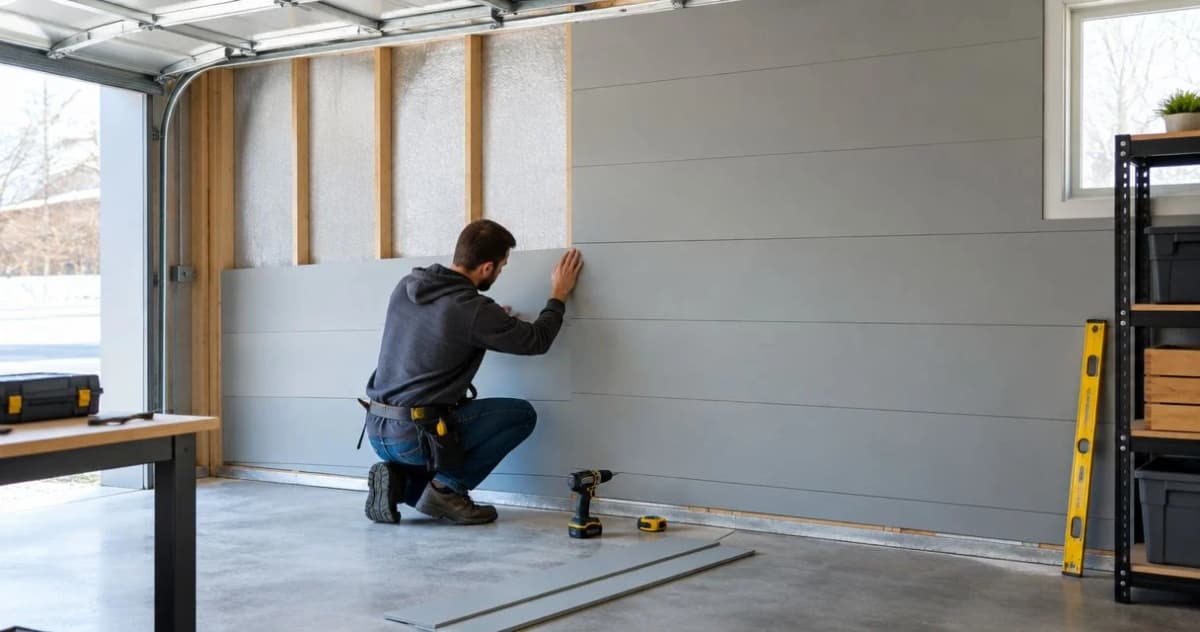
Yes, wall panels can be installed in an unheated garage when the complete panel system is approved for the garage’s temperature range, moisture exposure, and wall construction. Cold alone does not decide suitability: condensation, material movement, adhesive requirements, and garage fire-separation rules also matter, so an interior-use label is not enough.
- Can wall panels be installed in an unheated garage? Yes, with documented temperature, moisture, and installation suitability.
- The Panel Hub’s interior wall panels suit homeowners planning decorative interiors; unheated-garage use needs separate confirmation.
- PVC wall panels resist moisture, but their joints, backing, and fixings still need appropriate detailing.
- Wood wall panels and MDF-backed acoustic panels need particular attention to humidity and condensation.
Can wall panels be installed in an unheated garage?
Yes—but choose an approved assembly, not just a panel material. The panel, backing, adhesive, fasteners, trim, and existing wall must all work under the conditions your garage experiences throughout the year.
Use this sequence before buying:
- Check the garage. Identify leaks, damp masonry, condensation, and areas exposed to vehicle splash.
- Check the panel. Find its documented service-temperature range, moisture limitations, and permitted substrates.
- Check the installation. Confirm application temperatures, acclimation instructions, movement gaps, and approved fixings.
- Check the wall assembly. Preserve any required garage-to-house fire separation and arrange appropriate treatment of penetrations.
- Proceed only when everything agrees. An unanswered compatibility question is a reason to pause, not an invitation to improvise.
For a broader material shortlist, start with the guide to wall panels for garage walls. Apply the checks above to every option rather than treating a garage-related product description as installation approval.
Why this matters
An unheated garage is not simply a living room without a radiator. Its walls experience outdoor temperature changes, moisture brought in by vehicles, and changing humidity when the garage door opens.
Water freezes at 32°F, equivalent to 0°C, under ordinary atmospheric conditions. That reference point helps describe your climate; it does not establish a safe installation temperature for a panel or adhesive.
For a 2026 garage project, separate three questions: will the panel survive the conditions, can you install it correctly in those conditions, and does the finished wall meet local requirements? A product can pass one question and fail another.
Which panel materials should you consider?
Material names narrow your search; product documentation makes the decision. PVC, wood, and metal describe broad categories with different constructions, finishes, and attachment systems.
This comparison identifies useful starting points, not blanket approvals for every product in a category.
| Panel category | Best for | Practical advantage | Main limitation | Verify before choosing |
|---|---|---|---|---|
| PVC wall panels | Wipe-clean garage walls where the system permits the conditions | The PVC itself resists water absorption | Thermal movement and water behind joints still matter | Service temperatures, expansion details, and fastening method |
| Solid wood panels | Decorative areas in dry garages with documented product suitability | Natural texture and a finish you can coordinate with adjoining rooms | Wood changes dimensions as its moisture content changes | Humidity limits, acclimation, and finishing requirements |
| MDF-backed decorative or acoustic panels | Dry, controlled spaces rather than persistently damp garage walls | Decorative surfaces; acoustic versions address reflected sound | Standard MDF is vulnerable to moisture-related swelling | Backing type and explicit permission for the environment |
| Metal wall panels | Utility areas where the specified metal and finish suit the exposure | A practical surface for workshop settings | Condensation, corrosion exposure, and sharp cut edges need attention | Coating, compatible fasteners, and installation details |
| Fiber-cement panels | Walls designed to accept their weight and fastening requirements | A mineral-based alternative to wood-based sheet products | Cutting dust and handling require suitable precautions | Interior-use instructions, support, and required safety measures |
Do not confuse a material’s resistance to water with a waterproof wall. Seams, outlets, fastener holes, and the wall behind the panel remain part of the moisture-control problem.
PVC wall panels: best for approved wipe-clean applications
PVC is a useful starting point when cleaning matters. Its resistance to water absorption does not remove the need for movement gaps or a suitable adhesive.
Choose PVC only when the specific system permits your garage conditions. A shower application and an unheated-garage application create different demands; approval for one does not establish approval for the other.
Wood wall panels: best for dry decorative areas
Wood adds warmth to a garage used for hobbies or occasional entertaining. It also exchanges moisture with the surrounding air, so changing humidity affects its dimensions.
Keep wood away from unresolved dampness and follow the panel maker’s conditioning and spacing instructions. A decorative finish does not turn ordinary wood paneling into an exterior or wet-area product.
Acoustic panels: best for controlling reflected sound
Acoustic wall panels address sound reflections inside a room. They do not replace insulation, air sealing, or a wall assembly designed to reduce sound transmission.
The Panel Hub’s acoustic wall panels include wood-and-MDF constructions, so check the backing as carefully as the visible surface. The guide to pairing soundproofing insulation with acoustic wall panels explains why acoustic treatment and insulation belong to different decisions.
Why unheated-garage suitability varies
The same panel can face very different conditions in a sheltered detached garage and an attached garage receiving wet vehicles. For your 2026 material check, focus on these factors:
- Temperature range: Compare the garage’s seasonal conditions with the panel’s service limits and the adhesive’s separate application limits.
- Moisture exposure: Distinguish occasional surface splash from leaks, persistent condensation, and damp masonry.
- Backing material: Inspect the full construction, including MDF, felt, veneer, coatings, and bonded layers—not just the front face.
- Substrate condition: Loose paint, dusty concrete, uneven surfaces, and damp backing affect attachment and preparation.
- Attachment system: Adhesives, mechanical fixings, battens, and trims have their own compatibility and movement requirements.
- Wall function: An attached garage wall can form part of a required separation from the dwelling; decorative finishes do not replace that assembly.
A moisture-resistant face cannot protect an unsuitable backing. Ask for documentation covering the complete panel, rather than accepting a general statement about its surface material.
How do you check for condensation before covering the wall?
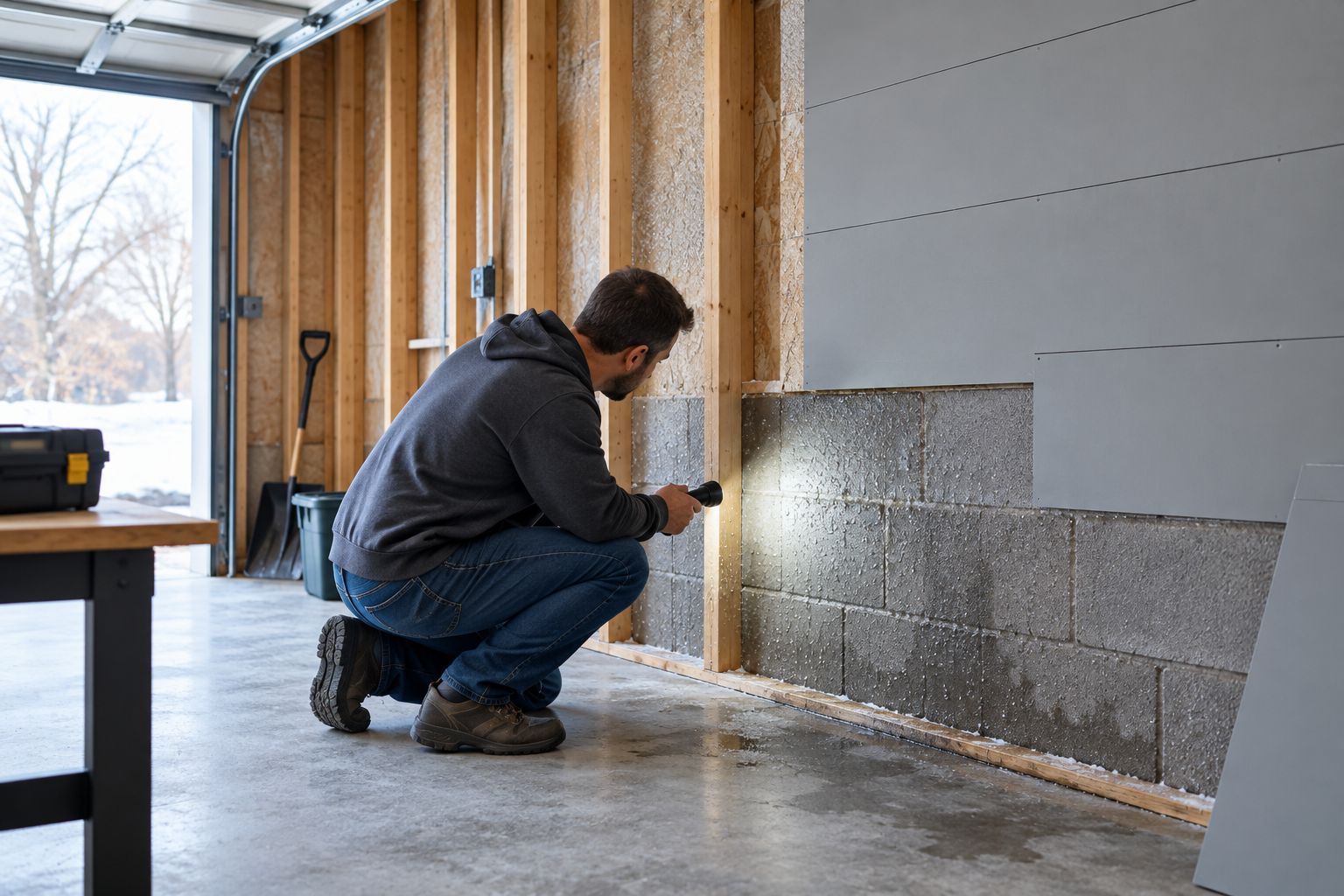
Look at the garage under the conditions that cause trouble, not only on a dry afternoon. Inspect after wet vehicles arrive, after prolonged rain, and when warmer humid air enters a cold garage.
Condensation forms when a surface is at or below the surrounding air’s dew point. That means a cold wall can become wet without a roof leak, and covering it does not remove the cause.
Check lower corners, the garage-door opening, exposed masonry, and the area where the wall meets the floor. Staining, musty odors, visible mold, and recurring droplets all deserve investigation before you conceal the surface.
A temperature-and-humidity meter helps you understand changing conditions, but a single reading does not describe a full season. Use moisture-testing methods appropriate to the substrate and the panel manufacturer’s requirements.
Do not add an improvised air gap or vapor barrier as a universal cure. Drying direction and vapor-control placement depend on the climate and wall construction; get assembly-specific advice when those details are uncertain.
What should your 2026 installation checklist include?
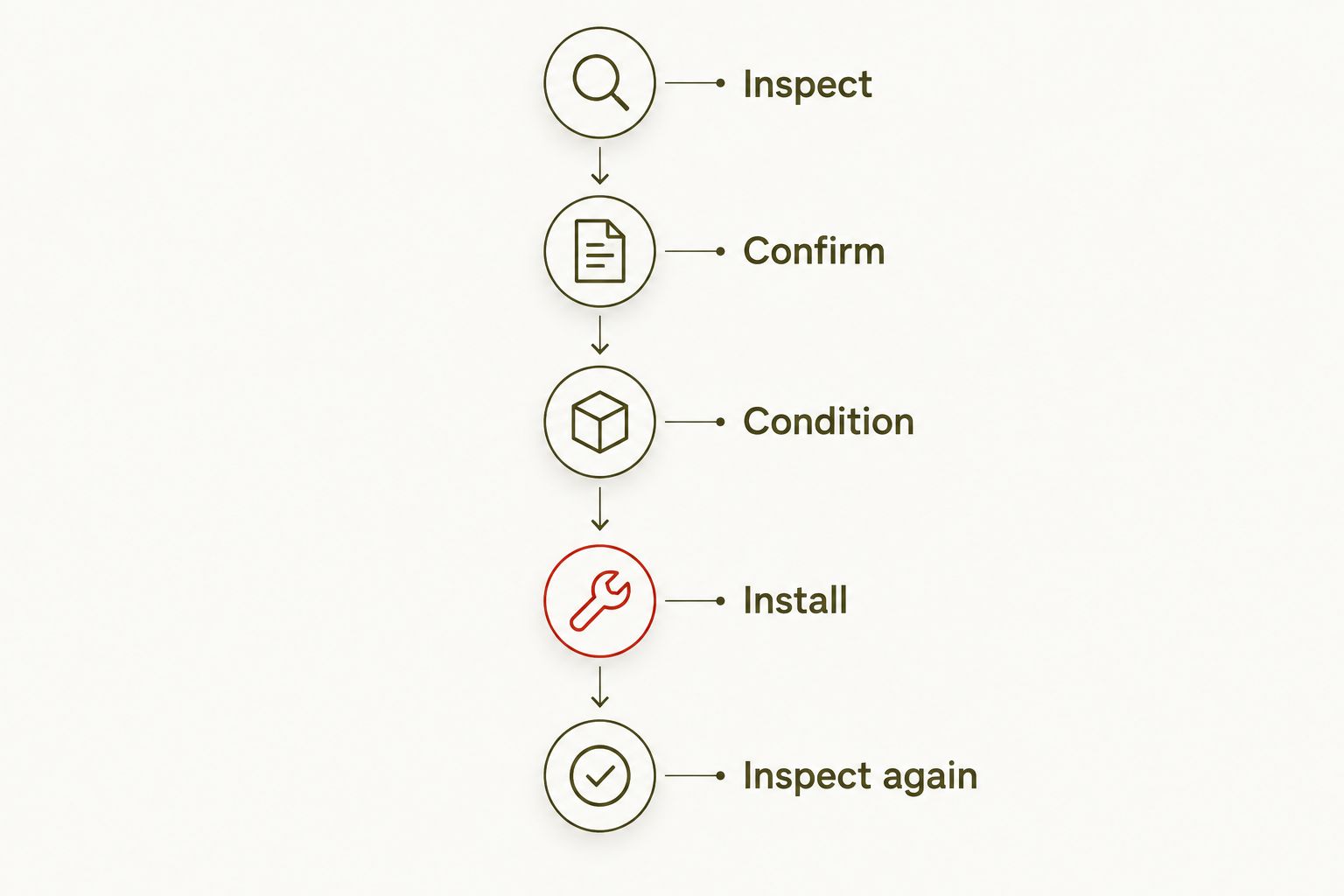
Follow the manufacturer’s instructions in their stated order. The sequence below helps organize the job; it does not replace product-specific directions.
Inspect
Start with a sound, clean, dry wall. Repair leaks and investigate dampness before covering stains or damaged finishes.
Check where shelves, cabinets, outlets, and door trim meet the proposed paneling. Plan those transitions before cutting, particularly where the new finish changes the wall’s thickness.
Confirm
Obtain the panel’s service conditions and installation instructions. Ask specifically about an unheated garage rather than asking only whether the panel is suitable indoors.
Check the adhesive separately. Its acceptable application temperature, substrate requirements, and curing conditions can differ from the panel’s conditions in use.
Condition
Acclimate and store panels exactly as instructed. Do not assume that leaving them in the garage overnight satisfies the manufacturer’s requirements.
If the instructions require conditions you cannot maintain, postpone the installation or choose a documented alternative. Briefly warming the air does not prove that a cold masonry wall has reached the required application condition.
Install
Use the specified fasteners or adhesive pattern, leave the required movement clearances, and support edges as directed. Do not substitute adhesive for screws—or screws for adhesive—without approval.
Keep required electrical access clear. Where paneling changes the finish around outlets or other electrical equipment, have the work assessed for the applicable electrical requirements.
Inspect again
Recheck joints, edges, and exposed lower sections as garage conditions change. Look for separation, swelling, staining, and recurring moisture rather than focusing only on whether the decorative face still looks good.
Keep the installation instructions and any written suitability confirmation with your project records. They are more useful than a general claim that a material is durable.
Can you use adhesive in an unheated garage?
Use adhesive only when its instructions permit the substrate and conditions during application and curing. A panel rated for cold conditions does not automatically make the adhesive suitable for installation on a cold wall.
Read the technical instructions rather than relying on the front label. Check surface preparation, substrate moisture, application temperature, cure conditions, and whether mechanical support is required.
Mechanical fixings are not an automatic workaround. Their type, spacing, support, and allowance for panel movement still need to follow the approved installation method.
Do garage wall panels need insulation behind them?
Decorative wall panels do not automatically require added insulation, and they do not substitute for it. The insulation decision depends on how you use the garage, the existing construction, and applicable local requirements.
For a 2026 workshop conversion, settle the wall assembly before choosing the finish. Adding insulation or changing vapor control affects more than appearance, especially where a garage adjoins conditioned living space.
Ask a qualified local professional to assess uncertain assemblies. Concealing a cold, damp wall behind a decorative surface is not a moisture-management plan.
Will a wall-panel warranty cover an unheated garage?
A warranty duration is not an environmental approval. Read the conditions and obtain written confirmation for the proposed use before treating warranty coverage as part of your decision.
The Panel Hub states a 5-year warranty for its wall panels. That duration does not, by itself, establish coverage for an unheated garage; confirm the chosen panel’s permitted environment and installation conditions separately.
Keep the distinction clear when comparing products: appearance, acoustic performance, installation method, and warranty scope answer different questions. None replaces evidence that the panel suits your garage.
FAQ
Can wall panels be installed in an unheated garage in winter?
Yes, if the panel system permits the garage’s conditions and you can meet all installation and curing requirements. Winter suitability depends on the substrate and adhesive as well as the panel.
What are the best wall panels for a damp garage?
Resolve persistent dampness before selecting decorative wall panels. A water-resistant surface does not repair leaks, prevent condensation behind panels, or protect an unsuitable backing.
Are PVC wall panels better than wood for an unheated garage?
PVC resists water absorption, while wood changes dimensions with moisture content. The better choice still depends on the specific product’s temperature limits, attachment method, and permitted exposure.
Can I put MDF wall panels in a cold garage?
Use MDF wall panels only when their documented conditions match the garage. Standard MDF is vulnerable to moisture-related swelling, so recurring condensation is a reason to stop and investigate.
Do acoustic wall panels keep an unheated garage warm?
Acoustic wall panels are not a substitute for thermal insulation. Their sound-absorption purpose does not establish insulating performance or suitability for cold, damp conditions.
Does The Panel Hub’s 5-year warranty mean its panels are garage approved?
The Panel Hub’s 5-year warranty does not by itself establish unheated-garage approval. Confirm the chosen panel’s permitted environment, installation method, and warranty conditions before ordering.
Can I cover the drywall between my garage and house with panels?
Only install a finish that preserves the required garage-to-house separation and complies with local requirements. Do not remove required protective layers or leave penetrations improperly treated.
One last thing
The deciding document is often the adhesive instruction sheet, not the panel brochure. A panel can tolerate the garage after installation while its adhesive cannot be applied successfully under the conditions present on installation day.
Before committing to your 2026 garage project, ask one precise question: does this complete system permit my substrate, seasonal conditions, and planned installation conditions? Buy only after the answer covers all three.
Related guides
- Insulated wall panels for garages and sheds
- MDF wall panels for interior walls
- Installing wall panels around electrical breaker panels