
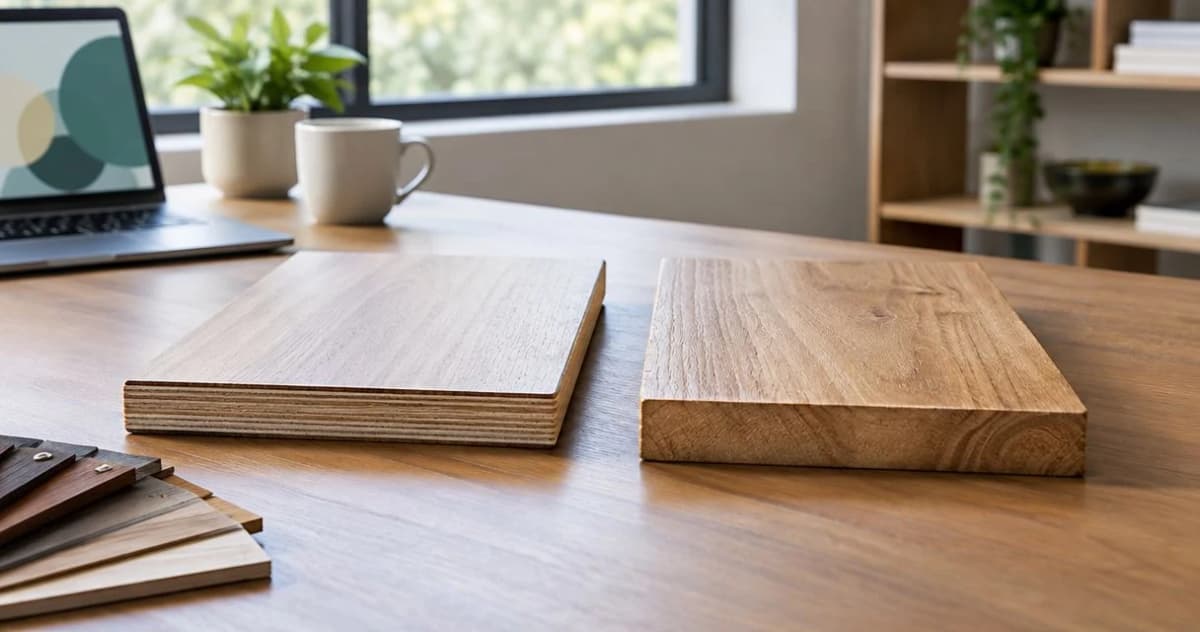
Engineered wood veneer can match solid wood paneling for everyday wear on a dry interior wall, but it does not offer the same repair depth. Choose solid wood when deep scratches and future refinishing are your main concerns; choose veneer when dimensional stability and a decorative real-wood surface matter more. Neither construction is automatically waterproof or scratchproof.
- Is engineered wood veneer as durable as solid wood? For everyday wall wear, yes; for deep repairs, no.
- Solid wood paneling offers more material for repairs, but humidity still causes movement.
- Engineered wood veneer depends on its finish, core, adhesive bond, and protected edges.
- The Panel Hub suits homeowners comparing decorative and acoustic wood wall panels for indoor rooms.
Is engineered wood veneer as durable as solid wood paneling?
Veneer can be equally practical in normal use, while solid wood has the advantage after substantial surface damage. The distinction is between resisting damage and recovering from it. A protective finish helps with the first; the depth of usable wood determines much of the second.
For your 2026 project, compare construction rather than treating every wood-looking panel as the same material. The guide to natural wood veneer wall panels covers the decorative category; the comparison below focuses on durability.
| Durability question | Engineered wood veneer | Solid wood paneling |
|---|---|---|
| Best for | Decorative walls where dimensional stability matters | Walls where repair depth matters |
| Everyday scuffs | Depends heavily on the finish | Depends heavily on the finish |
| Deep scratches | Can cut through the veneer and expose the core | Remain within wood unless they penetrate the component |
| Sanding and refinishing | Limited by veneer thickness and manufacturer instructions | More wood is available, although texture and profile restrict sanding |
| Humidity changes | Depends on core construction; plywood-based construction limits movement compared with comparable solid boards | Expands and contracts, particularly across the grain |
| Water exposure | Vulnerable cores and adhesive bonds need protection | Wood can swell, stain, or distort |
| Main limitation | A damaged face can be difficult to restore invisibly | More repair depth does not eliminate movement or maintenance |
Why this matters
A bedroom feature wall and a narrow hallway face different demands. The bedroom wall needs to stay attractive; the hallway also has to tolerate bags, furniture, and repeated contact.
Buying solid wood solely because it sounds tougher overlooks the finish. Buying veneer solely because it sounds stable overlooks its core and exposed edges. Match the construction to the damage your wall will actually face.
Engineered wood veneer: best for decorative interior walls
Wood veneer is a thin layer of real wood bonded to a supporting material. That support can be plywood, MDF, or another specified substrate, and each construction behaves differently. The word veneer describes the face, not the complete panel.
The advantage is that the surface grain does not need to provide the panel's entire structure. A well-designed substrate supports the face, while plywood's alternating grain directions help limit movement. Do not extend that benefit into a blanket claim that every engineered panel resists moisture.
The weakness appears when damage passes through the wood face. Sanding cannot restore missing veneer indefinitely, and aggressive sanding can expose the core. A repair that changes the grain or sheen can remain visible even when the surface feels smooth.
Choose engineered wood veneer for a dry decorative wall when you accept limited resurfacing. Before ordering, confirm the actual core, finish, edge treatment, and approved cleaning method. Those details tell you more than a wood species name alone.
Solid wood paneling: best for repair depth
Solid wood carries wood through the component rather than using only a thin decorative face. A scratch therefore does not immediately reveal a different substrate. That gives you more options for suitable filling, local repair, or refinishing.
However, repairable does not mean easy to repair. Deep grooves, narrow slats, and carved surfaces are difficult to sand evenly without changing their shape. A thick textured panel can offer less practical sanding freedom than its thickness suggests.
Solid wood also responds to moisture in the air. Installation needs to accommodate the particular product's movement rather than forcing every board tightly into place. Species, grain direction, board dimensions, and installation details all affect the result.
Choose solid wood when keeping a repairable wood surface matters more than minimizing movement. Ask how the specific profile can be repaired, not simply whether the material can be sanded.
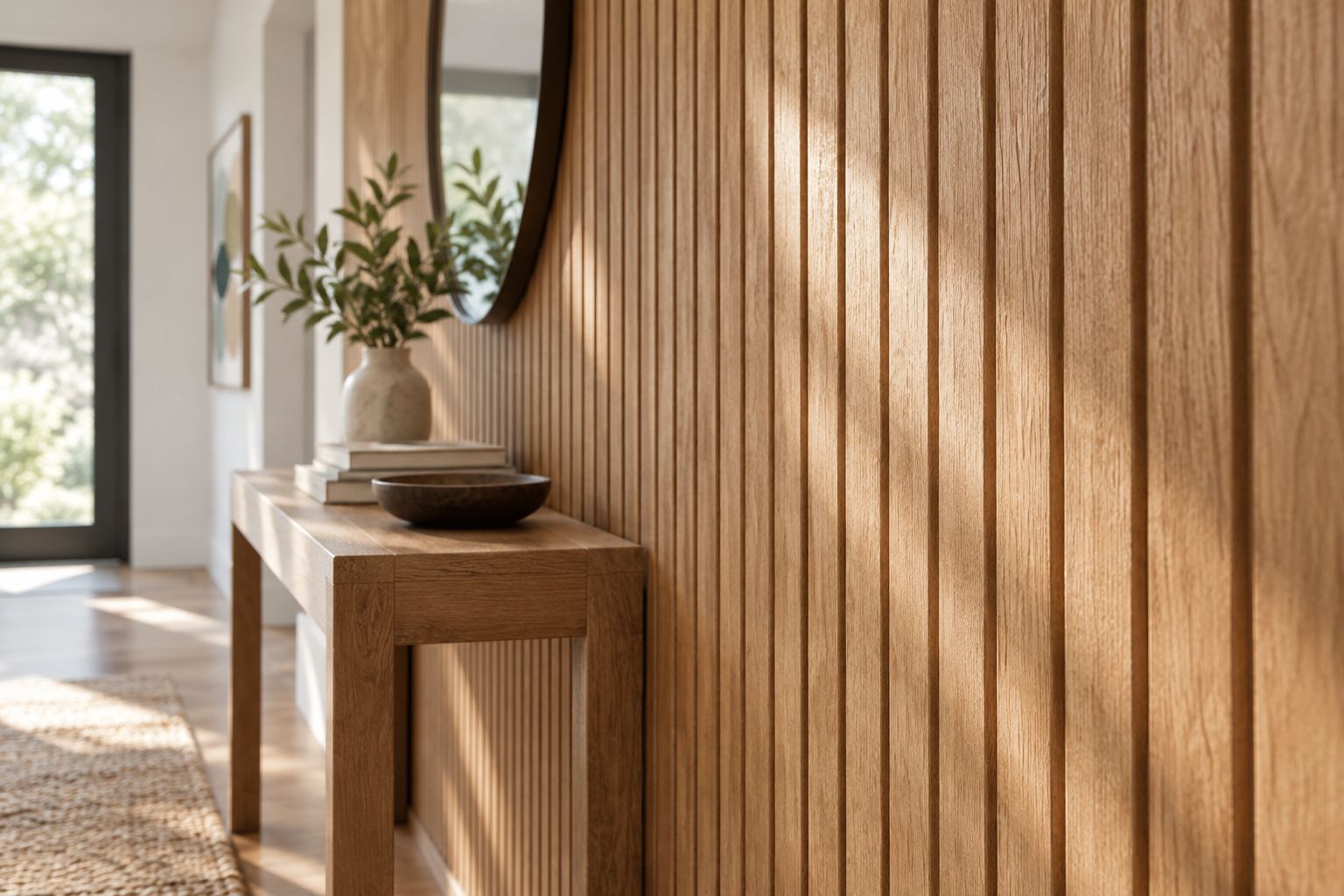
A textured solid wood wall illustrates that trade-off: the relief creates depth, but sanding across it would alter the pattern. Inspect the shape as carefully as the material.
Why wood panel durability varies
For a 2026 panel purchase, check these construction and installation factors before comparing appearance. They explain why two panels with similar wood grain can age differently.
- Finish protection: The coating takes everyday contact first. Follow the specified care method, and confirm whether recoating or spot repair is permitted.
- Veneer thickness: The face needs enough material for any approved repair. Total panel thickness does not tell you how much real wood sits at the surface.
- Core construction: Plywood and MDF are not interchangeable descriptions. Identify the substrate and its suitability for the room, especially where moisture is a concern.
- Edge protection: Cut ends, corners, and penetrations expose vulnerable areas. Follow the product's instructions for finishing or sealing them.
- Room conditions: Leaks, condensation, direct splashes, and changing humidity create different demands from a dry living room wall.
- Installation quality: The supporting wall, compatible adhesive or fixings, and required movement allowance all affect whether the assembly stays secure.
If the substrate is MDF, the MDF wall panels guide provides a useful next comparison. Do not assume that a real-wood face changes the moisture limitations of the material behind it.
How do you choose between veneer and solid wood?
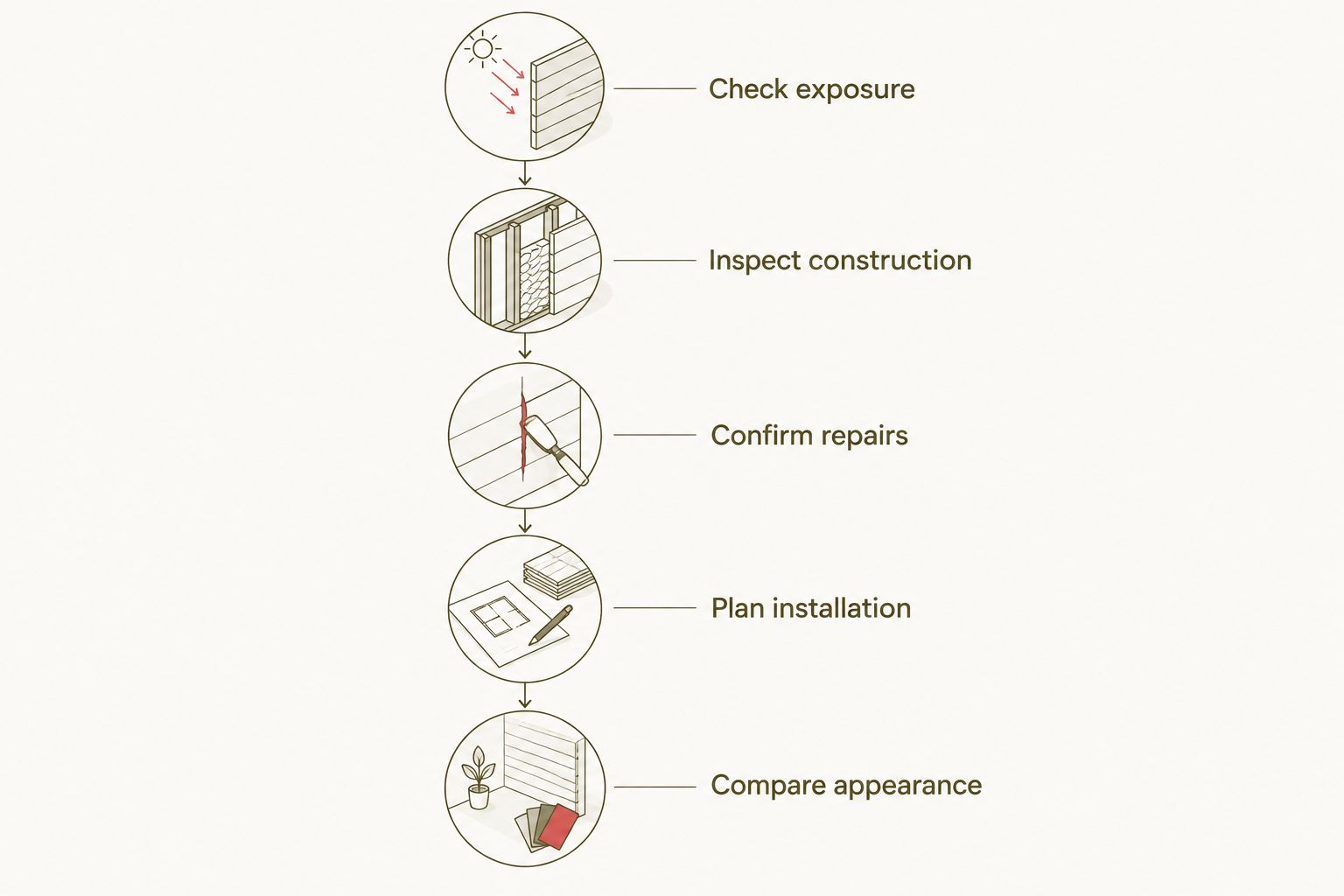
Use this sequence for your 2026 renovation. Start with the wall's exposure, then consider what happens if the surface gets damaged; appearance comes after those decisions.
- Check exposure. Identify splashes, condensation, sunlight, heating equipment, and likely physical contact. Rule out products that are not approved for those conditions.
- Inspect construction. Request a cross-section or written material specification. Confirm whether the wood face sits over MDF, plywood, or another substrate.
- Confirm repairs. Ask whether sanding, touch-up coating, or individual component replacement is permitted. Do not rely on general advice for a different panel.
- Plan installation. Follow instructions for wall preparation, acclimation, adhesive, fixings, and edges. Resolve dampness before covering the wall.
- Compare appearance. View the sample in your room's daylight and evening lighting. Check the face, exposed edges, and how the texture meets trim.
A sample answers questions a photograph cannot. Turn it over, inspect the edges, and compare its construction with the written specification. Avoid destructive tests unless the supplier confirms that they are appropriate.
Wood panel examples for different priorities
The Panel Hub is best for homeowners comparing decorative and acoustic wood wall panels for indoor rooms. Its range includes both real-wood-veneer and solid wood examples, but those categories should not be treated as equal in repairability or moisture suitability.
Two examples show why reading the construction matters:
- Acoustic Hexagon Wood Wall Panels | SoundPanel™ — best for a geometric acoustic wall. The product description identifies a real-wood-veneer surface. The benefit is a wood face combined with an acoustic purpose; the limitation is that the description does not establish sanding allowance or wet-area suitability.
- Textured Solid Wood Wall Panel Saw Marks | GroovePanel® — best for a grooved solid wood feature wall. The description identifies closely spaced grooves cut into solid wood. The benefit is solid wood construction; the limitation is that sanding must account for the grooved profile rather than flattening it.
These are different design choices, not a durability ranking. Select the relevant construction first, then confirm the current installation and care instructions for the exact panel.


Do acoustic ratings prove that a wood panel is durable?
An acoustic rating measures sound absorption, not resistance to scratching, impacts, or water. Keep those performance questions separate. An acoustic assembly can combine several materials, so its wood face alone does not describe the complete product.
The Panel Hub describes its acoustic wood panels as NRC 0.85 rated and FSC certified. NRC concerns sound absorption; FSC certification concerns responsible forest sourcing and the relevant certification requirements. Neither establishes how deeply you can sand a veneer face.
The brand also states a 5-year warranty and installation in under 2 hours. A warranty is not a predicted service life, and an installation duration is not a durability test. For your 2026 purchase, read the applicable warranty terms and installation requirements alongside the material specification.
Can engineered wood veneer last as long as solid wood?
Engineered wood veneer has no universal lifespan that can be compared fairly with all solid wood paneling. A protected decorative wall and a frequently damaged passageway place different demands on the same surface.
Judge the likely maintenance path instead. If the face stays intact, veneer avoids the need for deep repair; if repeated refinishing becomes necessary, solid wood offers more usable material. Neither conclusion supports assigning a fixed number of service years.
Which material should you use in a busy hallway?
Solid wood is the stronger starting point when repair depth is your priority in a busy hallway. Still, inspect the profile: deep relief and narrow grooves complicate repairs even when the material is solid.
Veneer remains a practical decorative choice where furniture and bags do not repeatedly strike the wall. Protect exposed corners and confirm whether damaged sections can be replaced without removing the entire installation.
FAQ
Is engineered wood veneer as durable as solid wood for wall paneling?
Engineered wood veneer can match solid wood for everyday wear on a dry decorative wall, but it offers less repair depth. The finish, core, installation, and exposure determine how well either construction performs.
Can I sand engineered wood veneer wall panels?
Sand engineered wood veneer only when the manufacturer permits it for that specific panel. The thin wood face limits material removal, and sanding through it exposes the substrate.
Does solid wood paneling scratch less than veneer?
Solid wood does not automatically scratch less than veneer. Surface finish and wood hardness affect damage resistance, while solid wood’s main advantage is the material available for suitable repairs.
Is engineered wood veneer waterproof enough for a bathroom?
A real-wood veneer face does not make a panel waterproof. Use only a product explicitly approved for the intended bathroom exposure, including its edges, joints, and installation system.
Does NRC 0.85 mean a wood panel is more durable?
NRC 0.85 describes sound absorption, not physical durability. Scratch resistance, water suitability, and repairability require separate product information.
Does The Panel Hub’s 5-year warranty mean panels last only that long?
The Panel Hub’s stated 5-year warranty is not a service-life prediction. Read the applicable terms to understand coverage, exclusions, and installation requirements.
What should I ask before buying wood wall panels in 2026?
For a 2026 purchase, ask for the face material, substrate, finish, moisture restrictions, and approved repair method. Also confirm how cut edges and damaged sections should be handled.
One last thing
The thickest panel is not necessarily the easiest panel to restore. On veneer, total thickness includes the substrate; on textured solid wood, sanding can erase the detail you bought it for. Ask how the exact surface is repaired before making repairability your reason to buy.
Related guides
- Wall panels ranked by durability
- Pairing soundproofing insulation with acoustic wall panels
- Wall panels for stairwells and hallways