
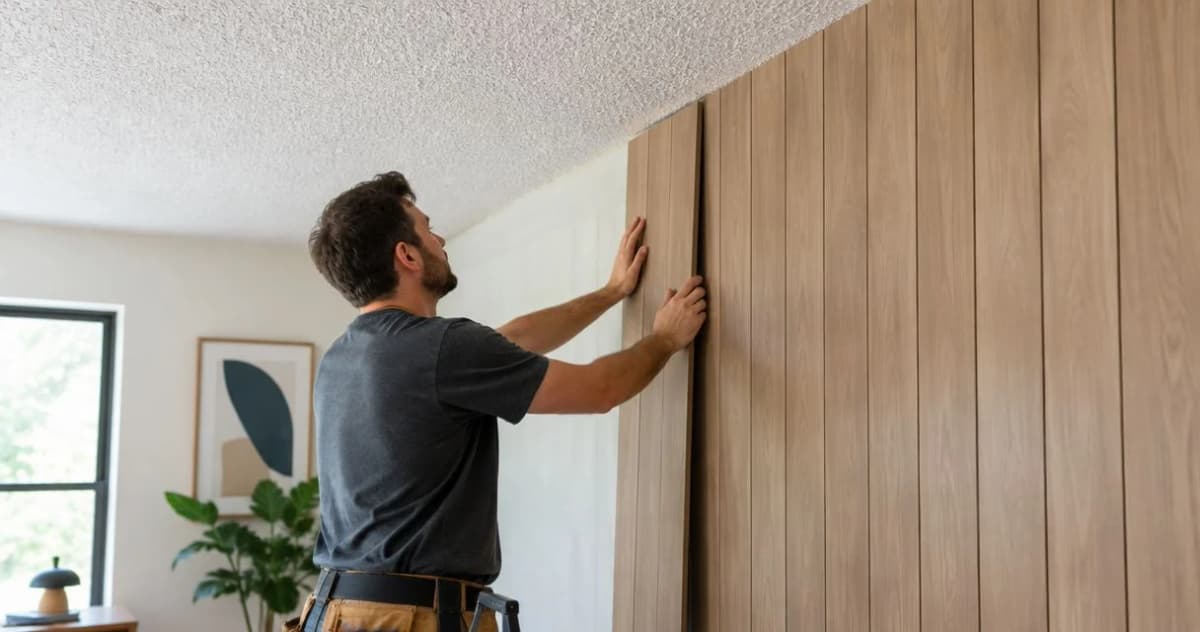
Yes, you can install wall panels over a popcorn ceiling when the panel manufacturer permits ceiling use and the fastening system transfers the load to suitable framing or an approved support system. Do not glue panels to popcorn texture or disturb a potentially asbestos-containing ceiling before a qualified professional assesses it.
- Can you install wall panels over a popcorn ceiling? Yes, with ceiling-approved panels and a suitable fastening system.
- Popcorn texture is not a structural surface; adhesive attached to loose texture cannot provide dependable overhead support.
- Assess suspected asbestos before drilling, scraping, sanding, or installing furring strips.
- The Panel Hub sells decorative wall panels; confirm ceiling suitability for the exact product before ordering.
Why this matters
A ceiling panel hangs above people, furniture, and walkways. A finish that stays attached to a vertical wall does not automatically have an acceptable overhead installation method.
For a 2026 renovation, separate the appearance decision from the attachment decision. Start with the requirements for installing wall panels on a ceiling, then establish whether your existing ceiling can support that installation without unsafe disturbance.
Covering popcorn texture is a finish change, not a repair for a failing ceiling. Leaks, loose plaster, sagging drywall, and damaged framing need attention before you conceal them.
Can you install wall panels over a popcorn ceiling?
Yes, provided you resolve the existing surface condition, overhead product approval, and structural attachment before installation. The texture can remain behind a properly designed covering, but it cannot serve as the material that holds the panels up.
These approaches have different advantages and limits:
| Approach | Best for | Main advantage | Main limitation |
|---|---|---|---|
| Ceiling-approved panels on furring strips | Creating a level mounting surface beneath sound existing construction | Separates the panel mounting plane from uneven texture | Adds thickness and requires suitable attachment to framing |
| Direct mechanical attachment | Panels whose ceiling instructions expressly allow this method | Avoids an additional furring layer | Requires suitable backing, fastener locations, and a sufficiently flat surface |
| Texture removal before installation | Projects where removal is professionally assessed as appropriate | Exposes the underlying surface for inspection and preparation | Creates disturbance and does not eliminate the need for structural attachment |
| Adhesive applied to popcorn texture | Not recommended as a default overhead method | Avoids visible mechanical fasteners | Relies on the texture's bond and lacks a verified support path |
Do not select the method from appearance alone. Get the panel's ceiling installation instructions and use the stated substrate, fastening pattern, and support requirements. If those instructions cover walls only, request written confirmation rather than treating silence as permission.
Check suspected asbestos before any disturbance
The EPA's homeowner guidance states that you cannot identify asbestos simply by looking at a material. Suspected material should be assessed by a trained, accredited asbestos professional when work will disturb it.
Installing furring strips still involves disturbance. Screws pass through the finish, and drilling or cutting openings can release dust; covering the surface does not make those operations harmless.
Do not scrape a test patch, sand down high spots, or drill exploratory holes while asbestos status remains unresolved. A professional assessment should determine whether sampling is needed and how the proposed work can proceed.
Furring strips: a mounting surface beneath the texture
Furring strips create a separate plane for attaching panels. When the approved design calls for them, the strips connect to suitable structural framing rather than relying on the popcorn finish.
This approach helps address uneven texture, but it is not a shortcut around ceiling assessment. You still need to know the framing arrangement, the condition of the existing ceiling, and the fastening requirements for the complete assembly.
The added depth affects more than room height. Check the finished position of ceiling lights, fan canopies, vents, access panels, and existing trim before choosing the build-up.
What to confirm before using furring strips
- Structural attachment: Establish where the framing is and how the strips will connect to it.
- Panel support: Match strip layout to the panel manufacturer's ceiling requirements.
- Flatness: Establish a consistent mounting plane instead of following every dip in the old finish.
- Fixture access: Keep electrical boxes, service points, and removable covers accessible.
- Finished edges: Plan how panels terminate at walls, beams, and ceiling transitions.
Do not choose screw length or strip spacing from a generic wall-panel tutorial. Those details depend on the panel, existing ceiling layers, framing, and approved fastening system.
Direct attachment: only with an approved ceiling method
Direct attachment avoids a separate support layer when the panel system permits it. It still needs suitable structural backing and a ceiling surface compatible with the specified installation.
A textured ceiling creates a practical problem: panels can bear against high points rather than sit evenly. Tightening fasteners to force a panel flat can distort the finish or damage the panel.
Use direct attachment only when the manufacturer's instructions address your actual ceiling conditions. Instructions for mounting over smooth drywall are not automatically instructions for mounting over popcorn texture.
For your 2026 project, obtain the current instructions before ordering. Save the document with the exact product information so the installer is working from the same requirements you used to select the panels.
Why installation requirements vary
The right installation method depends on the assembly, not the broad label “wall panel.” These factors determine what you need to resolve:
- Existing ceiling condition: Loose material, sagging areas, and water damage require investigation before concealment.
- Hazard assessment: Suspected asbestos changes how inspection, drilling, removal, and covering must be handled.
- Panel construction: Weight, rigidity, backing, and edge design affect how the panel needs support.
- Framing and backing: The attachment must reach material capable of supporting the installed assembly.
- Room conditions: Moisture, ventilation, and temperature must fit the panel's permitted use.
- Services and clearances: Lights, fans, vents, and access points must function after the new finish is installed.
A bedroom and a bathroom can need different material choices even when their popcorn ceilings look identical. Select for the room conditions as well as the design, and do not assume an acoustic panel is suitable for a damp location.
How do you plan the installation safely?
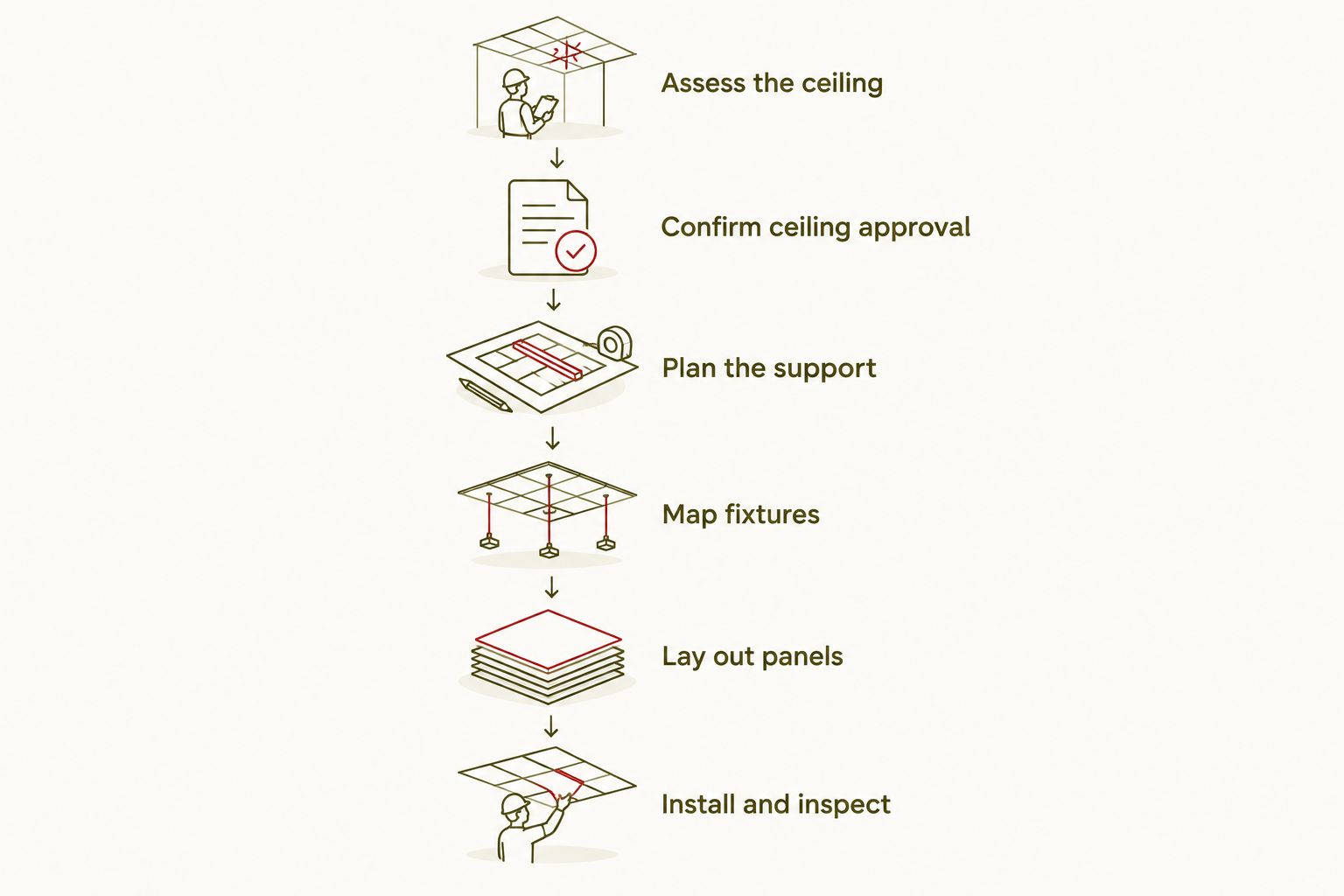
Use this sequence for a 2026 ceiling project. It keeps product selection behind the safety and support decisions that determine whether the work is feasible.
- Assess the ceiling. Look for visible staining, sagging, loose areas, or cracks without scraping or probing the finish. Resolve suspected hazardous material before disturbance.
- Confirm ceiling approval. Ask the panel supplier for the exact product's overhead installation instructions, fastening requirements, and permitted room conditions.
- Plan the support. Establish the framing and approved mounting arrangement. Bring in a qualified installer when the load path or existing construction is unclear.
- Map fixtures. Plan around lighting, fans, vents, smoke alarms, and access points. Have electrical alterations handled by a qualified electrician.
- Lay out panels. Establish the panel direction, joint positions, perimeter cuts, and required clearances before cutting material.
- Install and inspect. Follow the approved fastening method, provide temporary support as required, and inspect the completed attachment and fixture access.
Take room measurements only after establishing the proposed finished ceiling plane. The support layer and panel thickness affect how perimeter details meet existing trim, so measuring the old surface alone does not settle the finished layout.
Plan the visible joints before cutting
Dry-layout the panel pattern on paper using the actual product dimensions. Check where the pattern meets opposite walls and whether a light fixture lands awkwardly on a seam.
Keep required movement clearances in the plan. Do not eliminate a specified gap to make an edge look tighter; use the manufacturer's permitted finishing detail instead.
For slatted panels, consider the view from the doorway and the alignment of neighboring sections. A deliberate joint layout makes the ceiling look finished without asking trim or filler to disguise poor planning.
What should you check before buying decorative panels?
The Panel Hub is best for homeowners shopping for decorative wall panels, not for assuming wall products have ceiling approval. Treat the visual design and the installation permission as separate buying decisions.
For example, Acoustic Slat Wood Wall Panels are relevant when you want a wood-slat finish. Their wall-panel listing does not, by itself, establish a permitted overhead fastening method.
Before choosing any decorative panel, request answers to these questions:
- Is this exact product approved for ceiling installation?
- Which mounting surfaces and support arrangements are permitted?
- Which fasteners and fastening locations does the manufacturer specify?
- Does the installation require furring, additional backing, or another support component?
- Are there restrictions around moisture, heat sources, or lighting?
- What installation conditions apply to the warranty?
The Panel Hub's acoustic wall panels offer a decorative, sound-dampening option for interiors. The limitation for this project is specific: wall-use information does not establish ceiling suitability or the performance of a different mounting assembly.
Keep that distinction in your 2026 shopping checklist. A panel can suit your room visually and still be the wrong choice for your proposed ceiling installation.
Can you glue panels directly onto a popcorn ceiling?
Do not rely on adhesive bonded to popcorn texture to support overhead panels. The adhesive attaches to the finish, so the assembly depends on how securely that finish is bonded to the ceiling beneath it.
Even strong adhesive cannot correct loose texture or an unsuitable substrate. Use adhesive overhead only as part of a complete manufacturer-approved ceiling installation, including any required mechanical fastening and surface preparation.
Do you have to remove popcorn texture before paneling?
No, popcorn texture does not always need removal before a ceiling covering is installed. A suitable approved support system can allow the finish to remain behind the new panels.
That does not remove the need for hazard assessment. The work still needs a safe plan for any penetration or disturbance, and the existing ceiling must be sound enough for the proposed assembly.
Will acoustic panels stop noise from the room above?
Acoustic panels primarily address sound reflected within a room; they are not a substitute for a sound-isolating ceiling assembly. Footsteps and other noise from above involve transmission through the building, which requires a different assessment.
Choose acoustic panels for the room's acoustic treatment only after confirming their intended use and mounting requirements. Do not buy a decorative ceiling finish expecting it to solve an upstairs noise problem by itself.
FAQ
Can I cover a popcorn ceiling without scraping it?
Yes, an approved ceiling covering can leave popcorn texture in place. Confirm the existing ceiling’s condition, assess suspected asbestos, and use a support system suitable for the selected panels.
Can I screw wall panels straight into ceiling drywall?
Do not assume ceiling drywall alone is an adequate attachment point. Follow the panel manufacturer’s approved overhead fastening method and requirements for framing or backing.
Is it safe to drill into a popcorn ceiling?
Do not drill into a potentially asbestos-containing popcorn ceiling before professional assessment. Drilling disturbs the finish even when the purpose is to cover it.
Do furring strips make a popcorn ceiling safe to cover?
Furring strips provide a mounting surface, not asbestos clearance or structural approval. Their installation still requires an assessed ceiling and suitable attachment to framing.
Can I use peel-and-stick wall panels on a popcorn ceiling?
Do not use peel-and-stick wall panels overhead unless the manufacturer expressly approves the product and your installation conditions. Adhesive bonded to loose texture is not a dependable ceiling support system.
Are The Panel Hub wall panels automatically suitable for ceilings?
No, a wall-panel listing does not establish ceiling approval. Request the exact product’s ceiling installation instructions before purchasing it for overhead use.
Can I panel over a stained popcorn ceiling?
Investigate the stain and resolve its cause before covering the ceiling. Concealing evidence of a leak does not repair moisture damage or establish that the ceiling is sound.
One last thing
Before you order panels for a 2026 renovation, resolve the ceiling's fixtures on paper. The panel surface moves downward, but electrical boxes, fan supports, and vent connections do not automatically move with it.
Do not suspend a ceiling fan from decorative panels or their finish layer. Confirm that the fan retains its required structural support and that the completed ceiling leaves every service point accessible.
Related guides
- Choosing panels for covering popcorn ceilings
- Can you install wall panels over water-damaged drywall?
- Do wall panels need to acclimate before installation?