
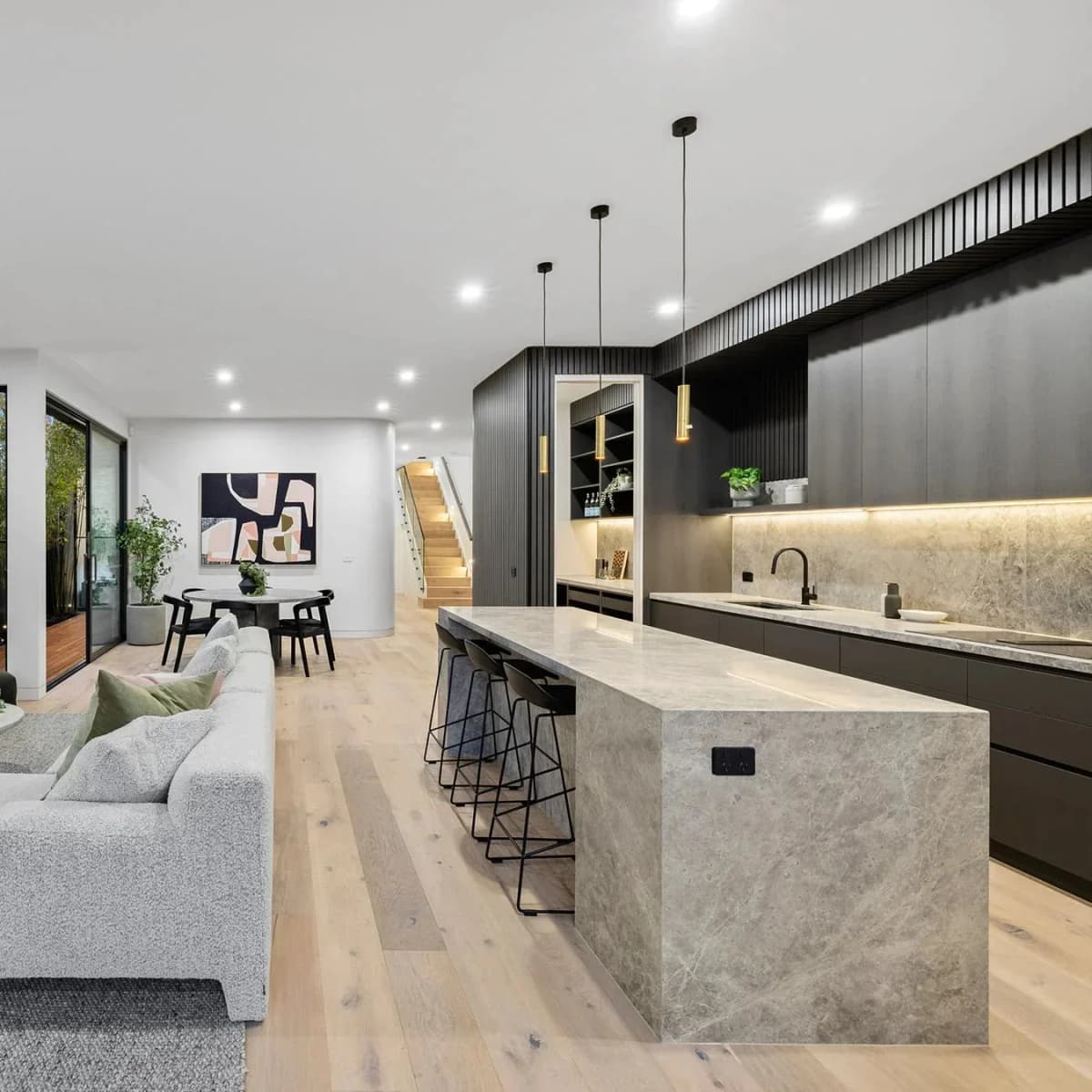
The kitchen is one of the hardest rooms to introduce a bold wall treatment. Between the cabinetry, appliances, splashback, and countertops, there are already four or five competing visual elements before you’ve even thought about the walls. Add an undisciplined pattern and the room tips into chaos. Do it thoughtfully, and a geometric wood panel becomes the element that ties everything together.
Here’s how to use geometric wall panels in a kitchen without overpowering the space.
Table of Contents
Where Geometric Panels Work in a Kitchen
Not every kitchen wall is a candidate for bold geometric pattern. The most successful applications share a common characteristic: there’s a clear, bounded surface that benefits from a deliberate design decision rather than a default neutral finish.
End walls and peninsulas
The end wall of a galley kitchen, or the wall behind a peninsula or island, is often the most visible surface from the rest of the living space. It’s also typically the only wall not broken up by upper cabinets. This makes it the best candidate for a geometric panel feature — it’s big enough to make an impact and contained enough not to overwhelm.
Below-counter panels
Geometric wood panels applied to the wall section between the counter and the floor — below lower cabinets — create a contemporary alternative to standard kickboard finishes. A crossing lines or concentric pattern at this level adds a detail that most kitchens completely ignore.
Breakfast nook or dining area within the kitchen
If your kitchen opens into a dining area, the wall behind the dining table is often neutral by default. A geometric wood panel behind the dining table differentiates the eating zone from the cooking zone, gives the dining area its own identity, and avoids the visual monotony of matching everything to the kitchen cabinetry.
Pattern Scale: Getting It Right for a Kitchen
Kitchens have a lot of small visual elements — hardware, tile joints, cabinet doors. A geometric panel with a very fine repeat (small individual units) can visually merge with all this detail and get lost. A larger-scale pattern — where individual geometric units are clearly legible from across the room — reads more confidently.
The 3D Concentric Square Panel works well in kitchens because the pattern is bold enough to read clearly even when viewed through a doorway or from across an open-plan space. The Crossing Lines Panel is a cleaner, more architectural choice that doesn’t compete with cabinet hardware or tile patterns.
Colour and Finish Considerations
In kitchens where cabinetry is painted — particularly white, navy, or grey — solid walnut geometric panels add the warmth of natural timber that painted surfaces can’t provide. The contrast between a flat painted cabinet and a textured solid wood panel behind it is exactly the kind of material layering that elevates a kitchen from functional to designed.
If your kitchen already has a lot of warm wood tones — oak cabinets, timber flooring — choose a geometric panel format with strong visual contrast rather than adding more of the same material. A panel in a darker walnut species, or a geometric pattern with deep shadow lines, will distinguish itself from background timber rather than blending into it.
Moisture and Splashback Zones
Solid wood wall panels should not be used as a direct splashback behind a sink or hob — zones where water and grease contact is regular and direct. However, anywhere that’s not in direct splashback range is fine with a basic protective oil or wax finish. Our GroovePanel® panels are supplied with a factory finish that provides everyday moisture resistance for normal kitchen environments.
For genuinely wet zones, consider pairing geometric wood panels on the end wall or dining area wall with a waterproof surface (tile or a composite splashback) in the direct contact zones. The combination of different materials and textures across a kitchen is a mark of considered design, not inconsistency.
Kitchen Panel Ideas at a Glance
- Walnut triangle mosaic on the end wall of a white galley kitchen — the only warm element in an otherwise cool-toned space
- Crossing lines panels behind a kitchen island as a graphic backdrop visible from the living room
- Concentric square panels in the dining zone of an open-plan kitchen-diner, framing the table as its own space
- Honey mosaic panels on the wall above a breakfast bench — small-scale, tactile, and warm
Related Reading
For kitchen-specific panelling ideas with a different focus, see our guide to kitchen island fluted panel ideas. For the full geometric pattern range, browse the GroovePanel® collection. Order a sample to check timber tone against your cabinet colour before ordering.