
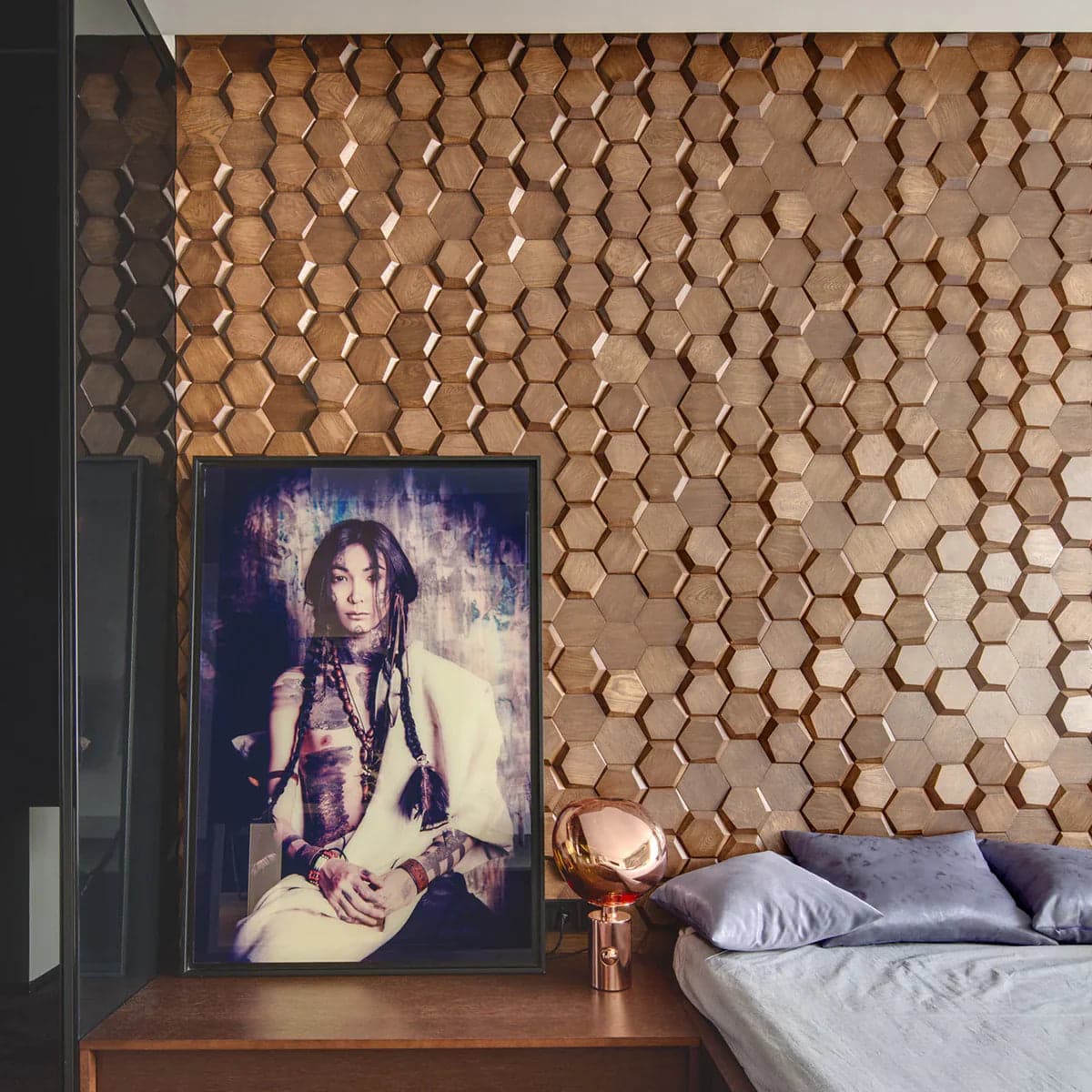
The honeycomb is one of the most efficient structures in nature. Hexagonal cells tessellate perfectly, cover a surface with no gaps, and distribute structural load evenly — which is why bees figured it out millions of years ago. In interior design, honeycomb-inspired wall patterns carry that same sense of natural order: organic, textured, and satisfying in a way that purely geometric shapes sometimes aren’t.
At The Panel Hub, the Honey Mosaic Solid Walnut Panel is our closest expression of this aesthetic — a mosaic of irregular, closely fitted solid walnut pieces that create an all-over surface texture reminiscent of natural cellular structures. Here’s how to use it, and what to consider when planning a honey mosaic installation.
Table of Contents
What Is the Honey Mosaic Pattern?
The honey mosaic is a solid walnut panel composed of small, irregularly shaped pieces arranged in a close-fitted mosaic. Unlike a regular geometric tile where every unit is identical, the honey mosaic has slight variation between pieces — in grain direction, cut angle, and natural colour — that gives the overall surface a handcrafted, organic quality.
This distinguishes it from our sharper geometric formats like the concentric square or crossing lines panels, which are more architectural and precise. The honey mosaic reads as warmer and more natural — closer to a craftsman’s work than a technical drawing.
Which Rooms Suit the Honey Mosaic Pattern?
Living rooms seeking warmth
A honey mosaic wall behind a sofa adds rich timber texture without the hard-edged geometry of a concentric square or triangle pattern. If your living room is contemporary but you want warmth and tactile interest rather than graphic impact, the honey mosaic is the better choice.
Bedrooms with earthy or biophilic interiors
The irregular, nature-derived quality of the honey mosaic pattern suits bedrooms with earthy tones — terracotta, warm white, sage green. For biophilic interior design (bringing natural materials and textures indoors), it’s one of the most appropriate panel formats because it mimics the cellular structure of organic materials rather than imposing a human-made geometry.
Spa bathrooms and wellness spaces
Wellness-oriented bathrooms — where the aesthetic goal is calm, warmth, and natural materials — benefit from honey mosaic panels on a feature wall behind a freestanding bath or vanity. The walnut tone reads as luxurious in contrast to white marble or concrete floor tiles. Note: ensure panels are not in direct water contact zones; oil or wax the surface for moisture protection.
Home offices and reading rooms
A honey mosaic wall behind a desk brings warmth to a workspace without the visual distraction of a strongly directional pattern. It’s present enough to improve the aesthetic but not so graphic that it competes for attention during video calls.
Styling the Honey Mosaic Pattern
Complementary colours
Walnut’s natural colour ranges from medium brown to a deep reddish-brown. It pairs well with:
- Warm white walls (not cool, blue-tinted white)
- Terracotta and burnt orange accents
- Deep green upholstery
- Sand and camel tones in textiles and flooring
Material combinations
The organic quality of the honey mosaic works particularly well alongside other natural materials: linen upholstery, jute rugs, unglazed ceramic vessels. Avoid combining it with high-gloss synthetic finishes, which create a jarring contrast with the raw, natural quality of the walnut.
Honey Mosaic vs Other GroovePanel Formats
If you’re deciding between the honey mosaic and other patterns in the GroovePanel® range, here’s the key distinction: the honey mosaic prioritises warmth and organic texture over graphic impact. If you want a wall that makes a bold pattern statement, choose the concentric square or walnut triangle. If you want a wall that reads as warm, handcrafted, and natural, choose the honey mosaic.
For a full comparison of panel patterns and when to use each, read our guide to wood mosaic wall panels.
Installation
Honey mosaic panels are installed using adhesive onto a flat, prepared wall. Because the pattern is irregular, there’s no strict directional requirement — you don’t need to align rows as precisely as you do with triangles or squares. Start from the centre of your planned installation area and work outward, maintaining consistent joint spacing between tiles.
For all installation preparation guidance, read our article on how to install wall panels on an uneven wall — the surface prep steps are the same regardless of panel format.
Browse the full range at GroovePanel® Geometric Wood Wall Panels or order a honey mosaic sample to see the walnut tone in your own lighting.