
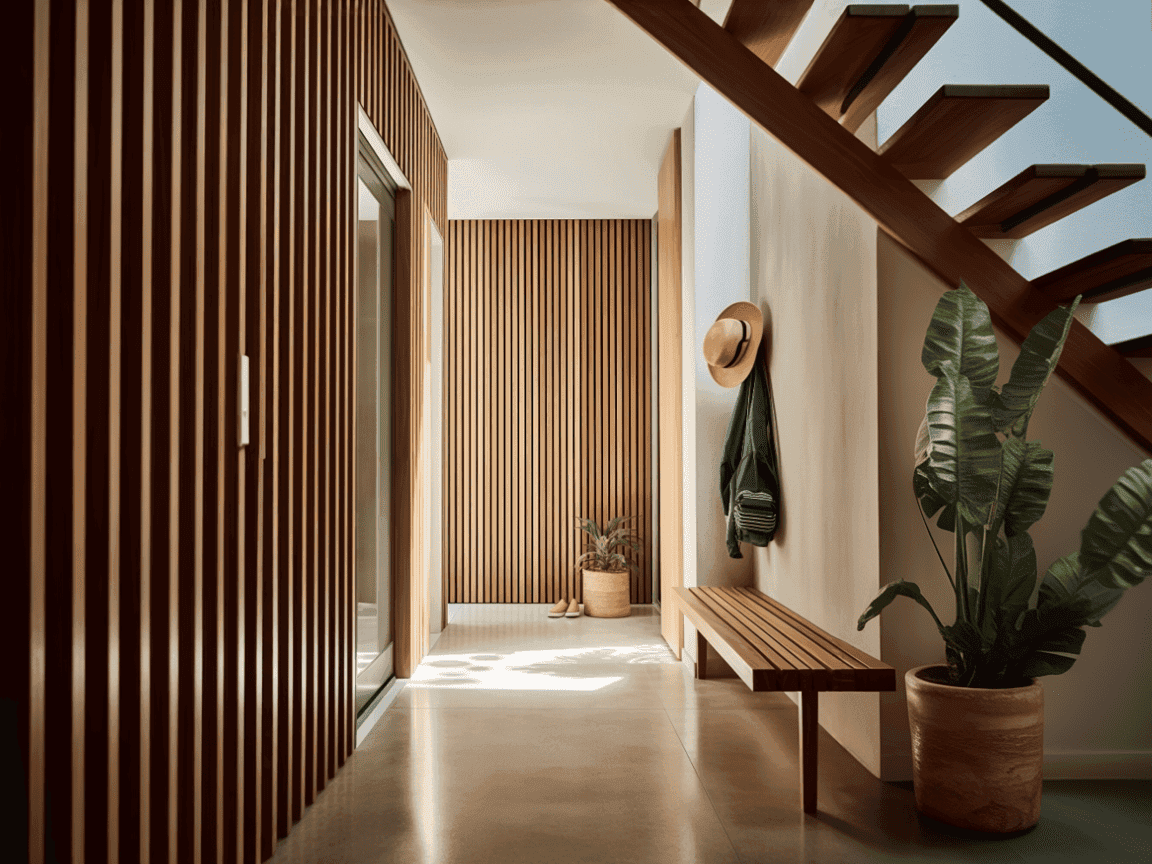
A paneled hallway makes a better first impression than almost any other single change you can make to a home’s interior. At The Panel Hub, hallways are one of the most common spaces where customers install wood wall panels — and for good reason. The results are dramatic, the installation is manageable for a competent DIYer, and the improvement to both aesthetics and acoustics is immediate. This guide covers everything from choosing the right panel to getting a clean finish.
Contents
Why Hallways Benefit From Wall Paneling
Hallways are transition spaces — the first room you see when you enter a home and the last before you leave. They’re often narrow, poorly lit, and acoustically hard (bare plaster, hard flooring, reflective surfaces). Wall paneling addresses all of these: it adds visual depth to narrow spaces, introduces warmth that artificial lighting can pick up, and absorbs the echo and footstep noise that makes a hallway feel echoey and clinical.
Our hallway wall panels are designed to perform in exactly these conditions.
Choosing the Right Panel for a Hallway
Full-height vs half-height panels
Full-height panels (floor to ceiling) make a dramatic statement and suit wider or taller hallways. Half-height panels (to dado height) work better in narrow hallways where floor-to-ceiling paneling on both walls can feel enclosed. In very narrow hallways — under 1m wide — consider paneling just one wall, typically the longest wall or the one directly facing the front door.
Slat panels
Vertical slat panels are the most popular hallway choice. The vertical lines draw the eye upward and make the hallway feel taller. Fine-profile slats — narrow channels between the slats — add texture without visual bulk, which is important in confined spaces. Our SoundPanel™ acoustic slat panels are particularly effective in hallways because they reduce the echo and sound reflection common in bare-plaster hallways.
Mosaic panels
For a more textured, layered look, our GroovePanel® mosaic panels add depth and character and suit hallways where a more statement finish is desired. These work well in wider hallways or on a single feature wall (the wall facing the front door) rather than both sides.
Preparing the Wall
Panels need a flat, sound substrate. Fill any significant holes or cracks and allow filler to dry fully. In older properties, check that the plaster is firmly bonded — any loose or hollow sections should be repaired before installation. If the wall has significant undulation (common in older buildings), you may need to fix a timber batten framework first to create a flat surface for the panels to fix to.
Remove skirting boards before installation if you’re installing floor-to-ceiling panels. If you’re installing half-height panels, you can often work over the skirting by cutting the panel to sit against the skirting face and then finishing with a cap rail above.
The Installation Process
Measure the wall height and width carefully and plan your panel layout before cutting. For slat panels, start from a plumb vertical line rather than working from the corner — corners are rarely perfectly square. Use panel adhesive and fixing pins for secure attachment. Butt panels tightly together (or with the specified gap depending on the panel type) and check for level frequently as you work across the wall.
Finish the top edge with a cap rail or dado moulding. Fill any nail holes. Prime and seal the panels according to the manufacturer’s guidance if painting — for natural wood finishes, a clear hardwax oil is recommended.
Common Hallway Paneling Mistakes
The most common mistakes are: not checking for plumb on the first panel (errors compound across the wall); cutting panels too short and leaving gaps at the top or bottom; using too much adhesive and creating bleed-out between panels; and failing to finish the top edge cleanly. Take time over the first panel, use a spirit level constantly, and plan the finishing details before you start.
Finishing Touches
Hallway paneling benefits from complementary lighting. Picture lights, wall sconces, or downlights positioned to graze the panel surface enhance the texture and make the paneling perform far better visually. Pair with a warm-toned rug and natural-material accessories for a cohesive result.
Browse our hallway wall panels and the full wood wall panel collection to plan your project.