
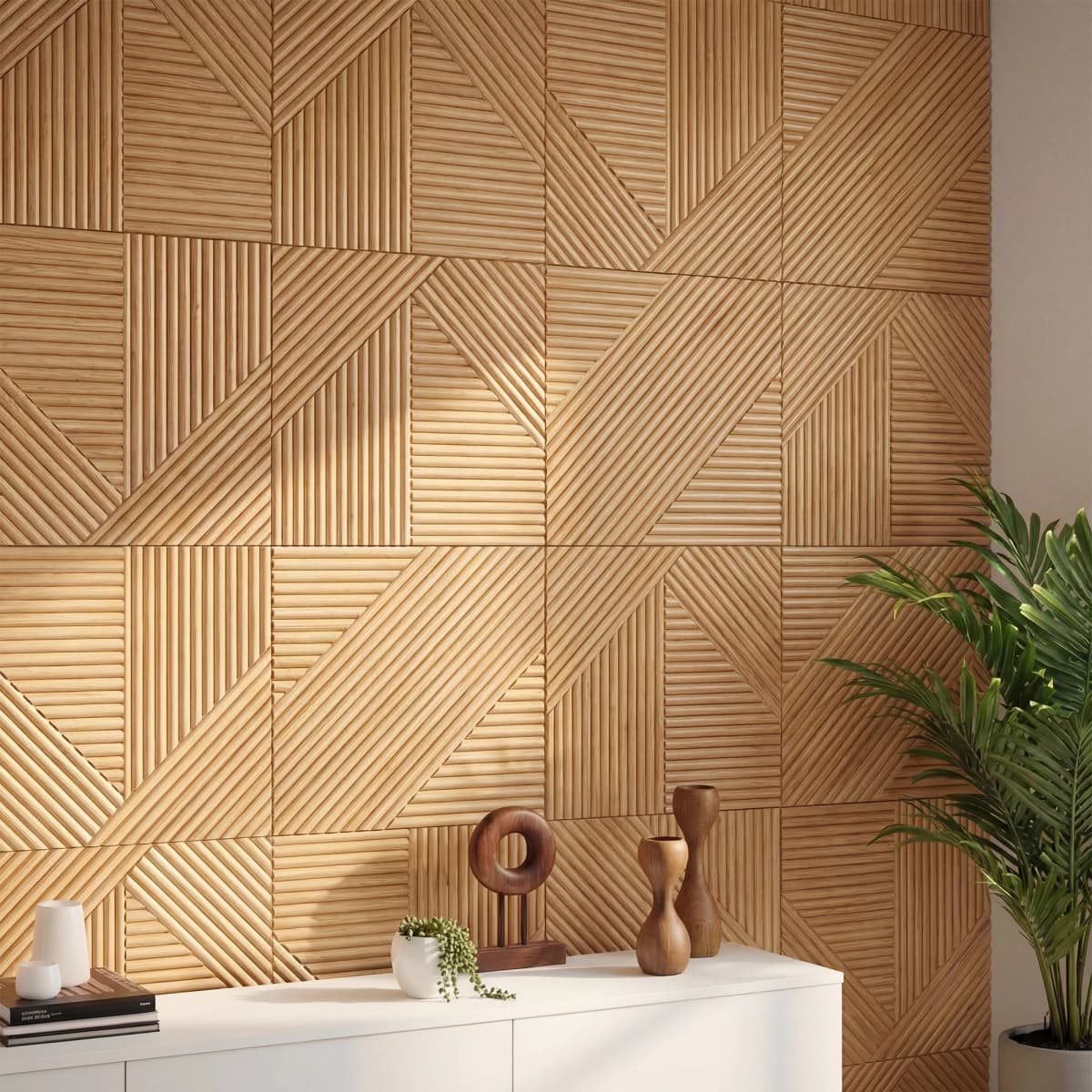
A room that uses only one material on its walls is a safe choice that rarely produces a memorable result. The interiors that feel genuinely designed — in hotels, high-end residential projects, and professionally executed homes — almost always involve a considered mix of materials on the same surface or adjacent surfaces. Geometric wood panels are one of the most versatile anchors for a mixed-material wall composition.
Here’s how to mix geometric wood panels with stone, metal, plaster, and other materials successfully.
Table of Contents
The Principle of Material Contrast
Material mixing works on contrast. The juxtaposition of different textures, temperatures, and visual weights creates interest that no single material achieves alone. The contrasts that work best are those between opposites:
- Warm vs cool: timber warmth against stone or concrete coolness
- Hard vs soft: rigid wood geometry against fluid plaster or fabric
- Rough vs smooth: raw stone texture against precision-cut timber pattern
- Natural vs industrial: organic wood grain against metal or glass
Geometric wood panels work well as the “warm and natural” element in most of these pairings.
Mixing Geometric Wood Panels with Stone
This is one of the most effective material combinations in contemporary interior design. Solid walnut geometric panels on one wall, faux stone panels on an adjacent wall — different textures, different tones, but both natural material references in the same space.
At The Panel Hub, the GroovePanel® Geometric range and the RockSurface® Faux Stone range are designed to coexist in the same interior. A common application: stone panels on the chimney breast or fireplace surround, geometric timber panels on the flanking walls. The two materials share a natural, textured quality but offer completely different visual and tactile experiences.
When combining timber and stone, keep the colour temperatures compatible: warm walnut works with warm stone tones (Highland Rock, sandy limestone). Lighter, cooler timber species (ash, light oak) pair better with cooler stone (slate, blue-grey basalt).
Mixing Geometric Wood Panels with Plaster and Paint
The simplest and most common combination. Plain painted plasterboard on surrounding walls, geometric timber panel on the feature wall. The painted surface recedes; the panelled surface advances. The key decisions are:
- How much contrast in tone? Dark walnut panels against white walls: maximum contrast, maximum impact. Natural oak panels against warm grey walls: more integrated, more subtle.
- What finish on the plaster? Flat matte paint is the most appropriate for rooms with textured panel walls — gloss finishes compete for attention. Limewash or polished plaster on surrounding walls creates an interesting dialogue with the panel’s structured geometry.
Mixing Geometric Wood Panels with Metal
Metal wall panels — perforated steel, brushed aluminium, corten steel — are increasingly used in residential interiors for their industrial, contemporary quality. Mixed with timber geometric panels, the contrast between hard metal and organic wood produces a sophisticated industrial-luxury result.
Practical applications:
- Corten steel (weathered orange-brown) panels alongside walnut geometric panels — warm tones that reinforce each other
- Brushed brass inlay strips between geometric panel tiles — a detail that reads as intentional joinery rather than a gap
- Metal framing or edge profiles around a timber panel installation — gives the panel a framed quality that emphasises it as a composed element
Mixing Geometric Wood Panels with Tile
In kitchens and bathrooms, the combination of ceramic or porcelain tile in functional zones (splashback, shower surround) and geometric timber panels in dry zones (dining wall, bath wall feature) is highly effective. The tile handles the water; the timber handles the aesthetic.
For the best results, choose a tile with a large, plain format rather than a small mosaic — small-scale tile and small-scale timber mosaic compete if they’re in close proximity. A large-format limestone tile alongside a triangle timber mosaic produces clear material distinction; two competing small patterns create visual noise.
The One Rule: Each Material Needs Space to Read
The most common mistake in mixed-material wall design is crowding. Each material needs enough continuous surface area to establish its character before it meets the next material. A 3D geometric panel needs at least a full wall width to make its pattern legible; a stone panel needs at least 1.2m of surface to establish its texture.
Browse geometric panel options at GroovePanel® Geometric Wood Wall Panels and stone panel options at RockSurface® panels. For styling the geometric panel formats themselves, see our guide to geometric wood wall panel patterns and styles. Order a sample of both materials to trial the combination in your space.