
Table of Contents
- What Are Perforated Acoustic Panels?
- How Perforated Panels Absorb Sound
- Perforated vs Slat Panels: Performance Comparison
- When to Choose Perforated Panels
- When Slat Panels Are the Better Choice
- Design and Specification Considerations
- Frequently Asked Questions
- Common Applications for Perforated Acoustic Panels
What Are Perforated Acoustic Panels?
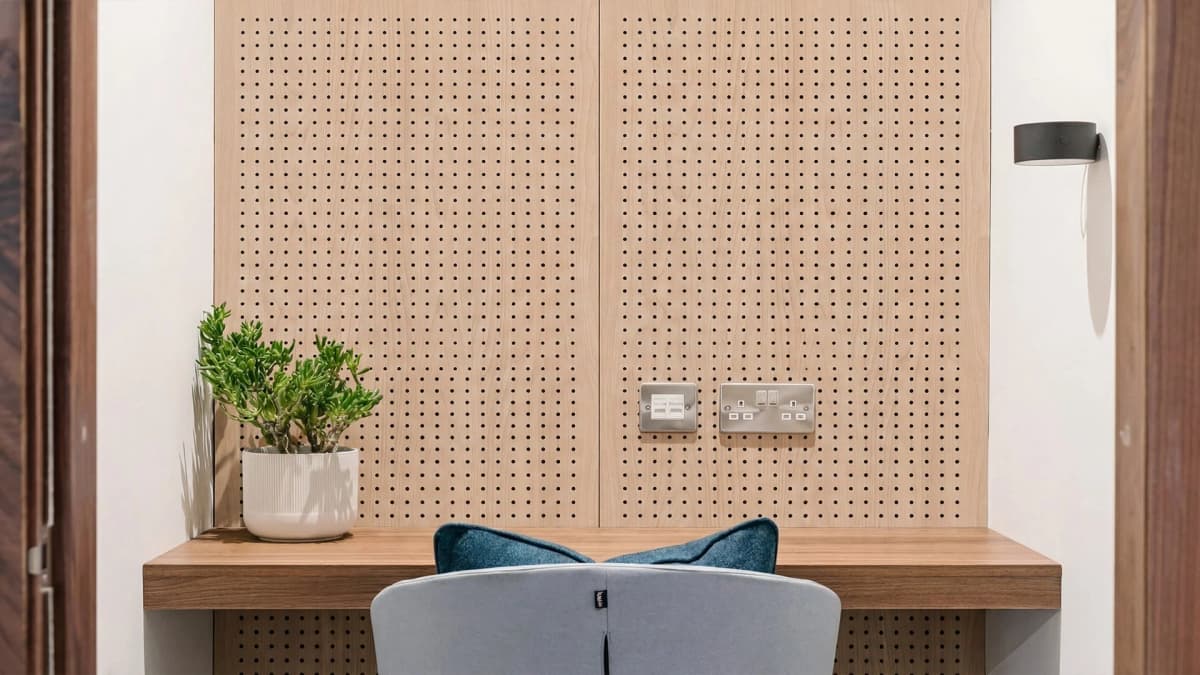
Perforated acoustic panels have a solid face — wood veneer, MDF, or timber — with a pattern of small holes, slots, or perforations punched or routed through the surface. Behind the perforated face is an acoustic backing material (typically acoustic felt) that absorbs sound passing through the perforations.
The result is a panel that looks like a continuous, solid surface from a distance — with the wood grain or painted finish reading as the dominant visual — but functions acoustically because sound can penetrate through the perforations to the absorbing material behind.
How Perforated Panels Absorb Sound
Perforated panels work through a mechanism called a Helmholtz resonator effect, combined with the standard porous absorption of the felt backing:
- Sound waves strike the solid panel face. Most are reflected.
- A proportion — determined by the perforation ratio (the percentage of surface that is open hole vs solid material) — passes through the perforations.
- This sound enters the cavity behind the panel face and reaches the acoustic felt backing, where it’s absorbed.
- The cavity depth between face and backing also influences which frequencies are most effectively absorbed.
The perforation ratio typically ranges from 10% to 25% of the panel surface area. Higher perforation ratios allow more sound through and increase absorption; lower ratios reduce the visual impact of the holes but decrease acoustic performance.
Perforated vs Slat Panels: Performance Comparison
| Feature | Perforated Panels | Slat Panels |
|---|---|---|
| NRC range | 0.55–0.80 | 0.65–0.85 |
| Open area | 10–25% | 25–40% (gap between slats) |
| Visual effect | Solid surface, subtle texture | Strong directional shadow lines |
| Backing visibility | Not visible from front | Visible through slat gaps |
| Design flexibility | High (various perforation patterns) | Moderate (slat width and spacing) |
When to Choose Perforated Panels
Perforated panels are the better choice when:
- You want a more restrained aesthetic — the solid face reads as a continuous wood or painted surface; the perforations are subtle rather than dominant.
- The backing material would look out of place if visible — in formal or traditional spaces where the open-gap look of slat panels feels too industrial.
- You want design flexibility — perforation patterns can be geometric, organic, or custom, giving more design options than the standard vertical slat profile.
- Curved or shaped installations — perforated solid panels can follow curves and shapes that open-slat systems handle less elegantly.
When Slat Panels Are the Better Choice
- Maximum acoustic performance (higher open area = more sound through to the backing)
- Strong contemporary, Scandinavian, or Japandi aesthetic
- Visible acoustic backing is not a concern (black felt reads well through light-wood slats)
Design and Specification Considerations
Perforated acoustic panels involve more specification decisions than slat panels because the hole pattern is a visible design element as well as a functional one. Getting the specification right before ordering prevents the kind of mismatch that’s expensive to fix after installation.
Perforation pattern and density: Hole diameter and spacing determine both the visual rhythm and the acoustic behaviour. Smaller, more densely spaced perforations create a finer visual texture and typically increase low-frequency absorption because they allow more sound to reach the backing material. Larger perforations create a bolder graphic quality and allow more direct sound absorption at mid frequencies. Ask for the perforation percentage (the ratio of hole area to total panel area) — this is a meaningful acoustic specification, not just a design choice.
Backing material: The panel backing is what actually absorbs the sound after it passes through the perforations. High-density acoustic felt (like AcuFelt) provides consistent NRC performance across the speech frequency range. Thinner or lower-density backings reduce the panel’s effective NRC rating. Always confirm the backing specification, not just the face material.
Substrate and finish: Perforated panels are available in MDF, plywood, and aluminium substrates. For residential use, painted or real-wood-veneer MDF is the standard — it takes paint well, is dimensionally stable, and delivers consistent perforation geometry. Aluminium panels are more appropriate for commercial and architectural applications where moisture or physical durability is a primary concern.
Panel dimensions and layout planning: Perforated panels require careful layout planning because the visual effect of the pattern depends on how panels align at joints. Panels that abut correctly create a continuous pattern; misaligned panels create a visible grid break. Confirm whether the panels are designed for butt-joint installation or require a specific gap.
Frequently Asked Questions
- Do perforated acoustic panels actually absorb sound?
- Yes. The perforations allow sound waves to reach the absorptive backing material behind the panel face — the backing (typically high-density acoustic felt or fibreglass) is what provides the actual absorption. The perforation percentage affects how much sound reaches the backing, which in turn affects the effective NRC rating.
- Are perforated panels better than slat panels for acoustics?
- Neither is inherently better — they have different performance profiles. Perforated panels can achieve broader frequency coverage, including some bass absorption, because more sound surface area is exposed to the backing. Slat panels with high-density felt backing (NRC 0.85) perform comparably in the speech frequency range. For most residential projects, slat panels are the default choice; perforated panels are chosen when the design brief specifically requires the aesthetic.
- Can perforated acoustic panels be painted?
- Yes, but only with a breathable paint applied carefully to avoid filling the perforations. Filling the holes reduces the acoustic performance by blocking sound from reaching the backing. A spray application rather than roller or brush is recommended if post-installation painting is required.
- What’s the NRC rating of perforated acoustic panels?
- It varies significantly by product. Panels with high perforation density and high-density felt backing can achieve NRC 0.80–0.95. Panels with low perforation density or thin backing materials may achieve only NRC 0.40–0.60. Always request the published NRC rating before purchasing — don’t assume that “acoustic” in the product name guarantees a specific performance level.
- Where are perforated acoustic panels most commonly used?
- Commercial offices, restaurants, educational facilities, and cinema rooms are the most common applications. In residential settings, perforated panels appear primarily in home theatres and dedicated recording spaces where a specific visual aesthetic is required alongside high acoustic performance.
Common Applications for Perforated Acoustic Panels
- Meeting rooms and conference spaces — subtle and professional
- Dining rooms — the solid face suits formal settings better than slat profiles
- Traditional interiors — perforated panels can be finished to match trim and moulding
- Ceilings — perforated panels as ceiling tiles offer acoustic treatment without the visual complexity of slat systems
Browse the SoundPanel® Perforated Acoustic Wood Wall Panels at The Panel Hub — available in American Walnut, Natural Oak, Dark Oak, and Charcoal finishes with AcuFelt™ backing from the SoundPanel™ acoustic range.
For context on how perforated panels fit within the broader acoustic panel category, see our complete acoustic wall panel buyers’ guide, and for the core principles of sound absorption that apply to both types, our soundproof wall panels guide has the foundations.