
Table of Contents
Why Texture Matters in Wall Design
Flat surfaces reflect light uniformly and read as visually neutral — which is why painted walls, however carefully coloured, rarely feel designed. Texture changes this. A textured wall creates shadows that shift through the day, catches raking light in ways that reveal surface depth, and adds a tactile quality that makes rooms feel considered rather than merely decorated.
Wall panels offer a range of texture approaches — from the soft-shadow rhythm of slat gaps to the dramatic relief of stone-effect surfaces. Here’s a clear breakdown of every major texture type.
Vertical Slat (Acoustic Slat Panels)
What it looks like: Parallel vertical timber slats with regular gaps between them, mounted on an acoustic felt backing. The shadow in the gap creates a strong vertical line that draws the eye upward and creates depth through shadow, not surface variation.
Light behaviour: Excellent for raking light and directional spotlights — the shadows in the gaps deepen or shallow depending on angle, creating a wall that looks different at different times of day.
Best rooms: Living rooms, bedrooms, home offices, cinema rooms. The acoustic backing also makes these the correct choice for any room where sound quality matters.
Style match: Contemporary, Japandi, Scandinavian, biophilic, mid-century modern.
Fluted (Rounded Grooves)
What it looks like: Regular convex (outward-curving) ridges running vertically across the panel face. The rounded profile creates softer shadows than slat panels — less graphic, more architectural.
Best rooms: Kitchen island fronts, bathroom vanity walls, entrance halls, formal living rooms. The solid face (no gaps) makes fluted panels more practical in areas close to moisture or impact than open-slot slat panels.
Style match: Transitional, classical, contemporary formal. See our fluted vs slat panel comparison for a full breakdown of the two profiles.
Reeded (Flat-Fronted Grooves)
What it looks like: Similar to fluted but with flat-topped ridges rather than rounded. Creates a slightly crisper, more graphic shadow line than fluted, but softer than slat. Available in both the natural wood finish and painted.
Best rooms: Dining rooms, bedrooms, entrance halls. Works particularly well painted — the painted reeded surface is one of the most successful minimalist wall treatments available.
Style match: Contemporary, minimalist, transitional. Our reeded panel guide covers the specific applications in detail.
Wire-Brushed / Distressed Veneer
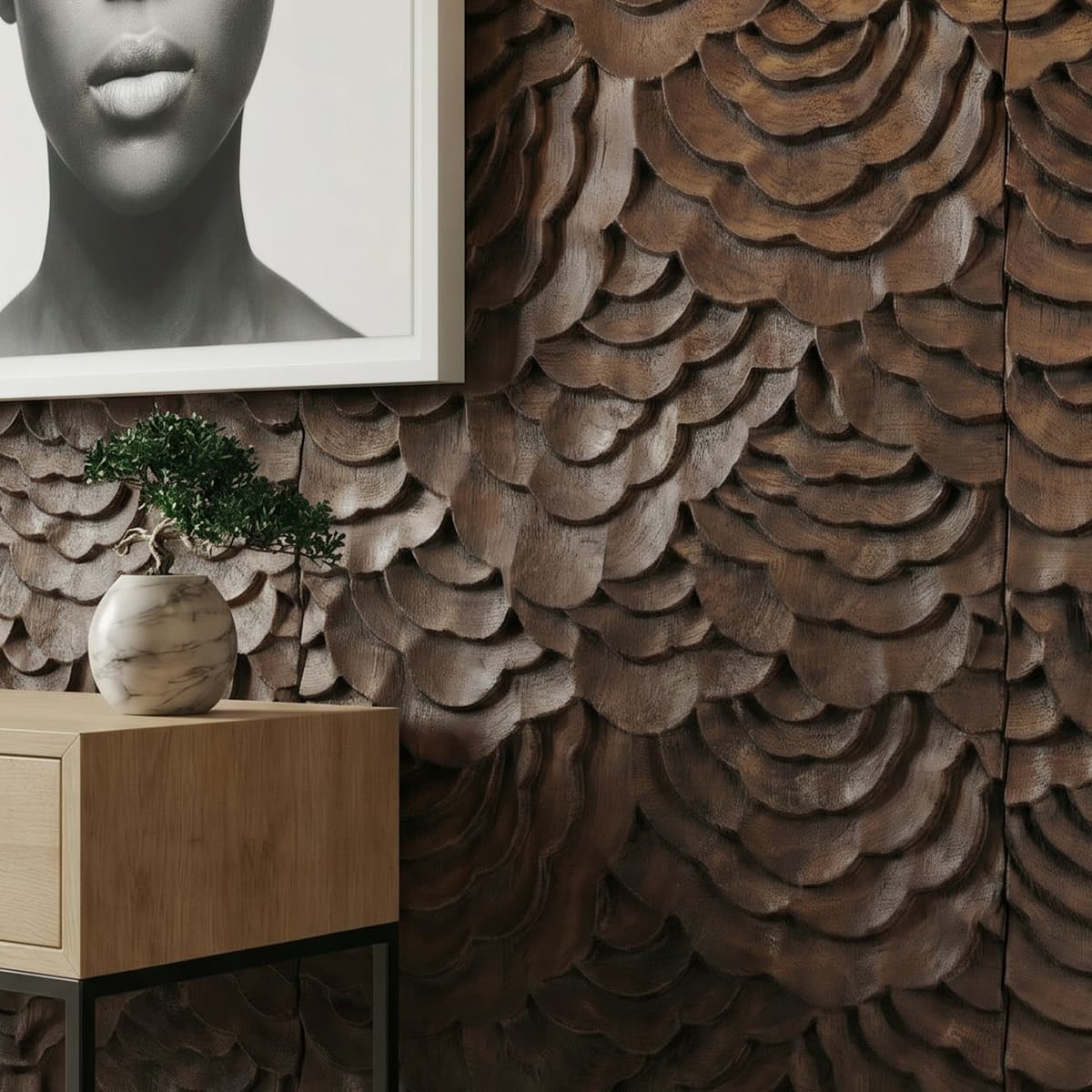
What it looks like: Real wood veneer that has been mechanically brushed to raise the grain and expose the soft fibre between growth rings. Creates a pronounced, physical grain texture — the surface is actually uneven, with hard and soft sections at different heights.
Best rooms: Rustic, organic, and biophilic interiors. Living rooms with natural-material schemes. Less suited to formal or minimalist contexts.
Style match: Biophilic, bohemian, rustic contemporary, Japandi with a rougher edge.
Mosaic / Geometric Wood Tile
What it looks like: Small-format solid wood tiles — including the 3D Geometric Pattern panel, triangle mosaics, and herringbone-arranged tiles — creating a patterned surface rather than a directional profile. The texture is in the joint lines and the natural variation in grain and tone between individual tiles.
Best rooms: Focal feature walls, fireplace surrounds, behind headboards. Too visually complex for full-room application in most domestic contexts.
Style match: Artisan, boho, maximalist, mid-century modern.
Stone Effect
What it looks like: High-relief panels moulded to replicate the texture of natural stone — coursed slate, split stone, rough granite. The texture is the deepest of any panel type, with relief depth of up to 20–30mm in some products.
Best rooms: Fireplaces, feature walls in living rooms and dining rooms, exterior cladding applications. Creates maximum visual drama.
Style match: Rustic, contemporary rustic, industrial, country house.
For help deciding between panel systems and understanding what affects the installation process for each type, our complete wood wall panel guide is the right starting point.