
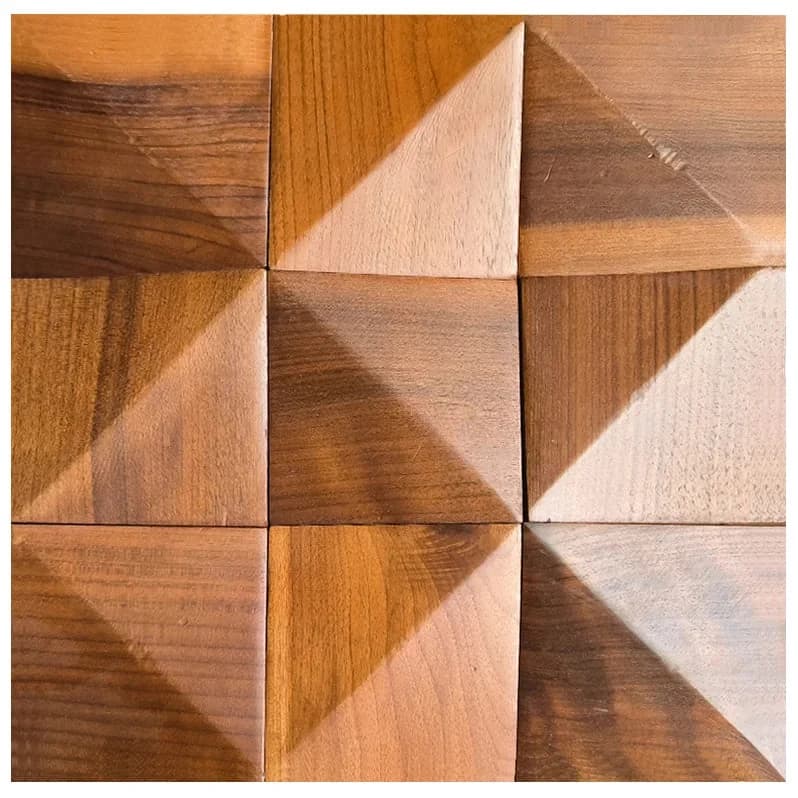
Of all the geometric shapes used in interior design, the triangle is the most dynamic. Where squares suggest order and hexagons suggest nature, triangles carry direction and energy. A wall covered in precision-cut solid wood triangles doesn’t just add texture — it commands the room.
Triangle wood wall panels have appeared in high-end hotel lobbies, Scandinavian-influenced residential projects, and contemporary living rooms for the past several years. They’re now accessible enough to be a realistic choice for any home renovation, and the right product makes installation straightforward.
Table of Contents
Why Triangles Work So Well on Walls
The triangle is the most structurally stable shape, and that stability translates visually. A mosaic of triangles feels intentional and precise without being cold. The grain of each individual timber piece runs in a different direction relative to its neighbours, creating subtle micro-contrast even within a single colour species.
Triangles also respond to light differently than squares or linear slats. As daylight tracks across a triangle-tiled wall, the shadow lines shift, giving the installation a quality that changes through the day.
The Walnut Triangle Panel: A Closer Look
Our Walnut Triangle Solid Wood Wall Panel is part of the GroovePanel® Geometric range. Each panel is composed of solid walnut triangles — not veneer, not laminate, but full-depth solid timber. The walnut species gives a naturally dark, rich brown tone with the irregular grain figuring characteristic of the species.
Because the panels are 100% solid wood, the grain pattern at the edge of each cut triangle is visible, adding depth to the tile boundary. This is something engineered panels cannot replicate — their edges show the composite core.
The panels are FSC-certified, meaning the timber is sourced from responsibly managed forests, and they carry an Environmental Product Declaration (EPD) for buyers who need verified sustainability credentials.
Design Ideas: How to Use Triangle Wall Panels
The full feature wall
The most impactful use. Cover an entire wall — behind a bed, sofa, or dining table — in triangle panels from floor to ceiling. Keep the rest of the room minimal: white or off-white on the remaining walls, furniture in complementary tones. The walnut triangle wall becomes the artwork.
Half-wall or dado treatment
Apply triangle panels to the lower half of a wall, terminating at a timber batten or picture rail. This works particularly well in hallways and dining rooms, where floor-to-ceiling pattern can feel oppressive in a narrow space.
Recessed alcoves and chimney breasts
Panel the inside of a recess or the face of a chimney breast. The contained geometry of the triangle pattern is perfectly suited to a bounded surface — the edges of the alcove act as a natural frame.
Ceiling panels
Triangle mosaic panels work on ceilings too, particularly in rooms with lower ceiling heights where a striking overhead surface creates drama without the visual weight of a dark paint colour.
Mixing Triangle Panels with Other Materials
Walnut triangle panels pair naturally with:
- Brushed brass hardware — the warm metal tone complements walnut’s dark brown without competing
- Concrete and plaster finishes — rough industrial texture next to precision-cut timber creates contrast
- White oak furniture — light wood furniture against a dark walnut triangle wall is a classic high-contrast pairing
- Stone and faux stone panels — use triangle wood panels on one wall and a RockSurface® stone panel on the adjacent surface for a layered material palette
Triangle Panels vs Other Geometric Formats
The triangle is one of several geometric formats in the GroovePanel range. Here’s how it compares:
- Triangle vs concentric square: Triangles create directional energy; concentric squares create depth and a hypnotic focal point. Concentric square panels tend to work better as a single centred feature; triangle mosaics cover a full wall more comfortably.
- Triangle vs crossing lines: The Crossing Lines panel is more architectural and graphic — better for rooms where you want pattern without strong directional movement.
- Triangle vs honey mosaic: The Honey Mosaic panel is warmer and more organic. Triangles are sharper and more contemporary.
For a broader comparison of geometric panel types, see our guide to geometric wood wall panel patterns and styles.
Installation Notes
Triangle mosaic panels are installed tile by tile using panel adhesive on a flat, clean wall surface. The key is establishing a true horizontal datum before you start — because triangles form directional rows, a single misaligned tile propagates the error across the full installation.
Allow the wall to dry fully before starting if you’ve recently plastered or skimmed. For walls with slight undulation, our guide on installing wall panels on uneven surfaces covers preparation methods that ensure a flat result.
Order a Sample First
Walnut varies naturally in tone from piece to piece. Before ordering a full quantity, it’s worth seeing the actual timber colour in your own space. Order a sample from our sample collection and live with it for a day or two under your room’s lighting conditions — artificial light changes warm wood tones significantly.
Browse the full triangle and geometric range in the GroovePanel® collection.