
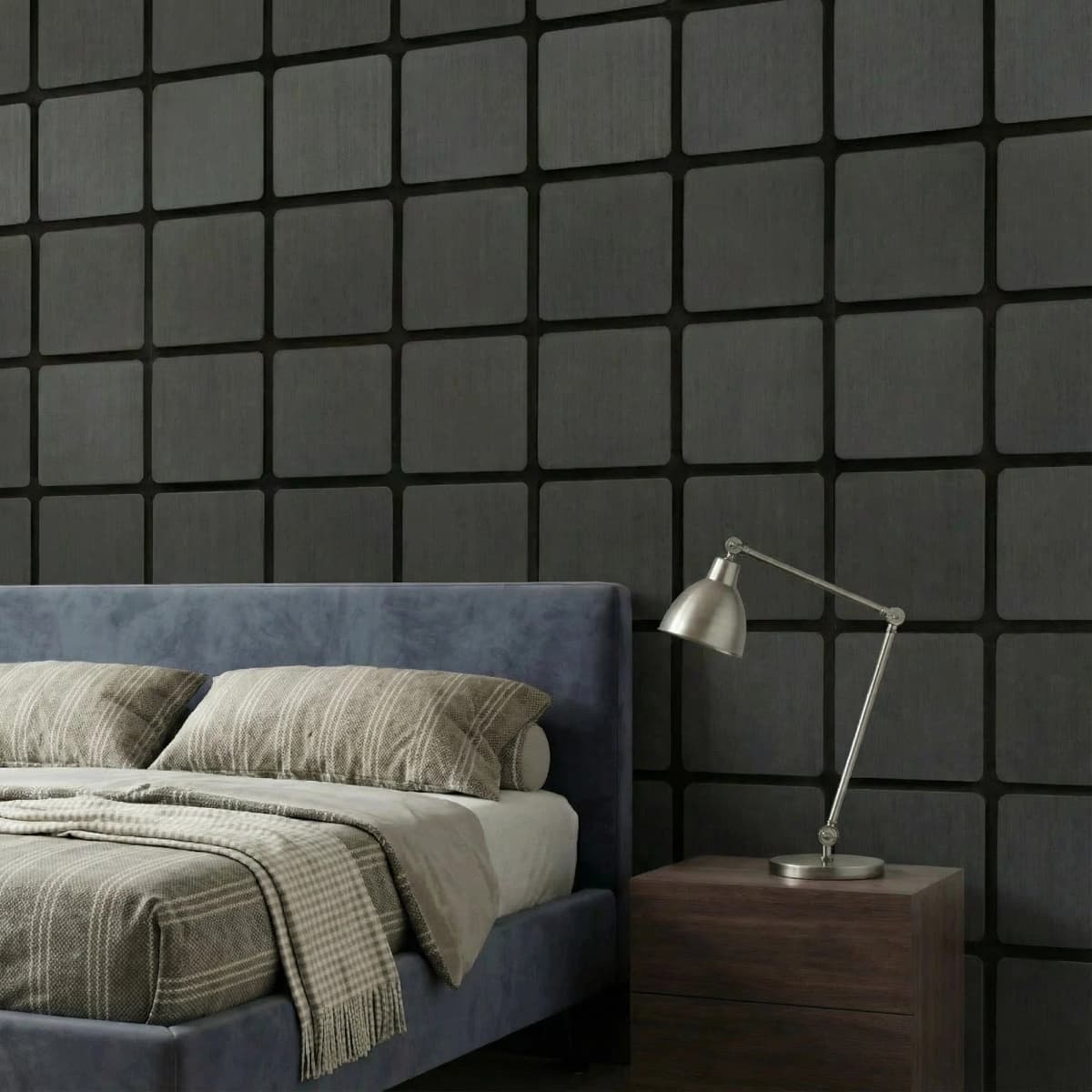
You’ve seen it in every room you’ve walked into this year. A warm, textured wall that immediately makes a space feel finished — like someone actually thought about it. That’s a wood wall panel. And if you’re here, you’re probably trying to figure out whether it’s right for your space, what it costs, how it goes up, and which type won’t look dated in three years.
This guide covers all of it. No padding, no vague suggestions — just what you actually need to know before you buy.
Table of Contents
- What Are Wood Wall Panels
- Why People Are Using Them in 2026
- Types of Wood Wall Panels
- Wood Wall Panels Cost: What to Expect
- Which Wood Species Should You Choose?
- Room-by-Room: Where Wood Wall Panels Work Best
- How to Install Wood Wall Panels: The Real Timeline
- Solid Wood vs MDF vs Wood Veneer: Which Is Right for You?
- Do Wood Wall Panels Actually Improve Acoustics?
- How to Choose the Right Panel for Your Space
- How to Care for Wood Wall Panels
- The Honest Comparison: Wood Panels vs Wallpaper vs Paint
- Keep Exploring: Style & Trends
- Frequently Asked Questions
- Where to Start
- Shop the Full Collection
What Are Wood Wall Panels
Wood wall panels are decorative surfacing installed directly onto interior walls. They come in sheets, planks, or modular tiles, and they transform blank drywall into something that has texture, depth, and character.
The term covers a wide range of products — from solid hardwood planks to engineered wood-core slat systems to MDF panels with a real wood veneer face. What they share is this: they’re a wall treatment designed to be permanent (or at least semi-permanent), and they change how a room sounds and feels, not just how it looks.
Worth knowing: wood wall panels are not the same as wood-look PVC or vinyl panels. This guide focuses on panels with real wood content — solid wood, HDF, MDF, or wood veneer-faced cores. If you want waterproof panels for a shower or bathroom, we cover those separately in our bathroom wall panels guide.
Why People Are Using Them in 2026
Wood wall panels aren’t a trend that appeared suddenly. They’ve been building momentum for years, and in 2026 the direction is clear: people want walls that do something. Not just cover a surface, but define a room — acoustically, visually, spatially.
A few things are driving this specifically:
Biophilic design has gone mainstream. The idea that natural materials improve how spaces feel isn’t fringe anymore. Wood grain, texture, and warmth are showing up in living rooms, bedrooms, and home offices because they work — rooms with natural surfaces feel calmer and more considered than bare painted walls.
Remote work made people actually look at their walls. If you’ve been on video calls for three years, you’ve had a long time to stare at the wall behind your desk. Acoustic slat panels solve two problems at once — they look good on camera and absorb sound.
The 2024–2026 aesthetic has moved past farmhouse. Shiplap and whitewashed wood had their moment. What’s happening now is richer, more architectural: walnut tones, vertical slat profiles, fluted and reeded textures, darker finishes paired with brass or matte black. It’s a more permanent, intentional direction.
Types of Wood Wall Panels
This is where most guides get vague. Here’s a clear breakdown of what’s actually available and who each type is for.
Acoustic Slat Panels
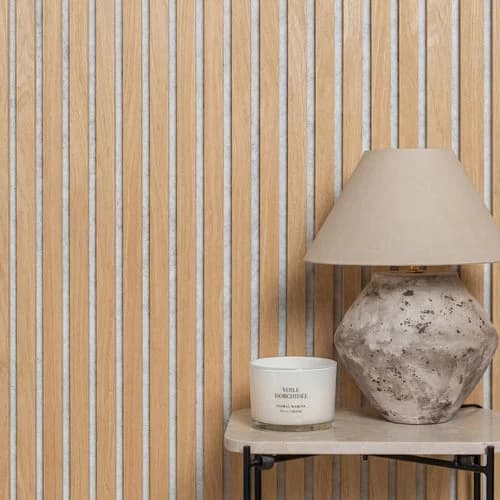
The most popular wood wall panel in the residential market right now. These are vertical or horizontal wooden slats — typically 10–20mm wide — mounted over a felt or acoustic backing. The gaps between slats allow sound to pass through, where the felt layer absorbs it.
TPH’s SoundPanel uses AcuFelt 1500 g/m² high-density backing and achieves an NRC (Noise Reduction Coefficient) of 0.85 — meaning it absorbs up to 85% of sound. That makes a measurable difference in home offices, home theaters, and open-plan living spaces where echo is a problem.
Material: Real wood veneer over HDF core, with acoustic felt backing
Best for: Living rooms, home offices, bedrooms, gaming rooms, home theaters
NRC rating: 0.85 — Shop SoundPanel
Decorative Slat Panels
Same profile as acoustic, but without the felt backing. These are purely visual — the focus is on the texture and warmth of the wood rather than acoustic performance. Because they’re lighter and simpler, they’re often lower cost and easier to cut.
Best for: Accent walls where aesthetics are the only goal
NRC rating: None
Solid Wood Panels
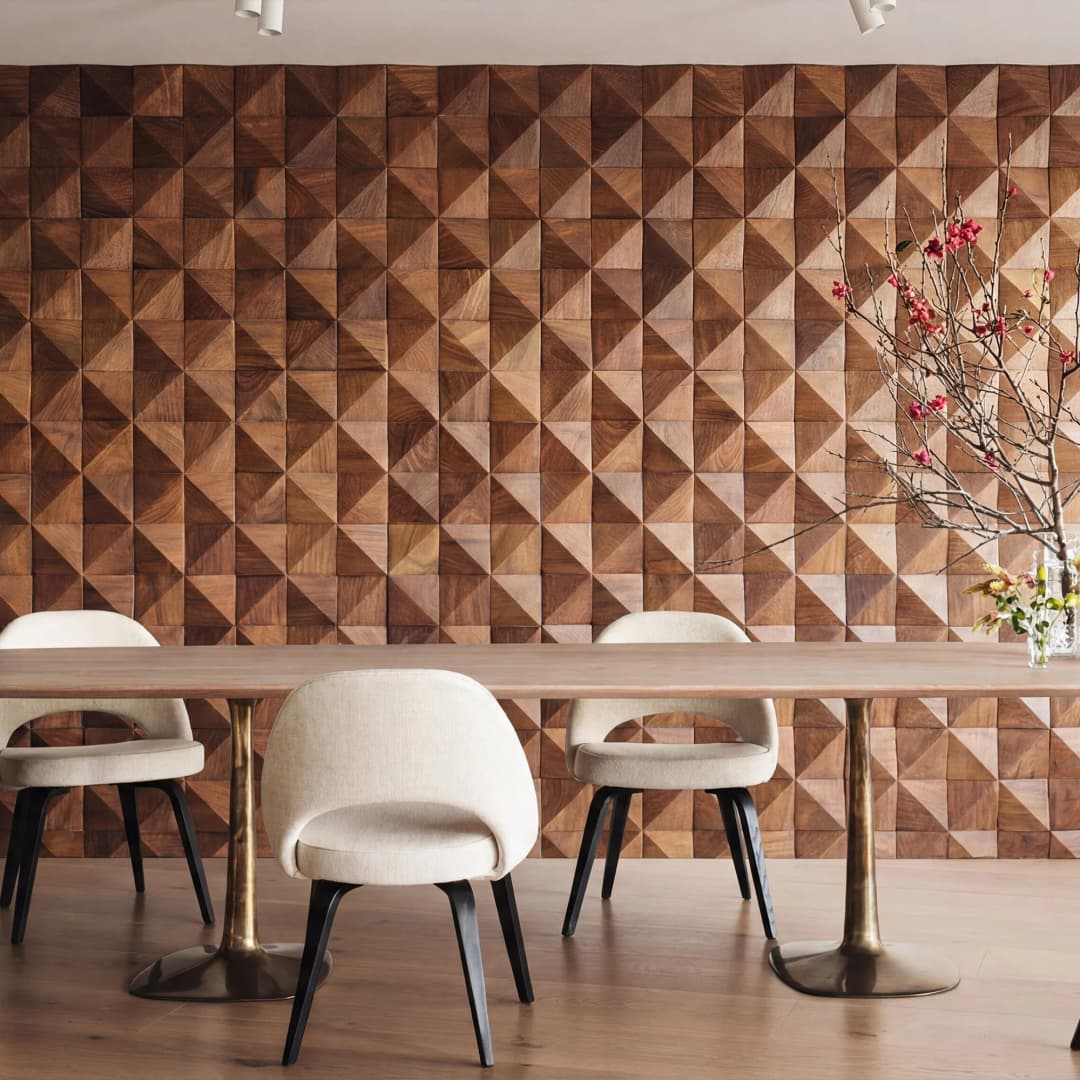
Planks or sheets of real, through-and-through timber. Oak, walnut, pine, and ash are the most common species. These have genuine wood grain all the way through, take stain beautifully, and last for decades. The tradeoff: they’re heavier, more expensive, and more sensitive to humidity changes than engineered options.
Best for: Dining rooms, hallways, statement feature walls
Price range: Higher end — solid walnut panels can reach $15–$25/sqft in materials alone
MDF Panels (Paintable)
MDF panels are engineered wood — dense, stable, and smooth. They’re typically sold unfinished, ready to prime and paint. Fluted MDF and ribbed MDF are popular because they give you sculptural texture at a lower cost than real wood, and you can paint them any color you want.
The limitation: they’re not real wood. If you want visible grain, warmth, or an honest material story, MDF isn’t it. But for a bold, painted feature wall — especially if you’re going dark — MDF is a practical and good-looking choice.
Best for: Painted feature walls, contemporary interiors where grain isn’t the point
Price range: $7–$11/sqft for materials — Solid wood vs MDF: full comparison
Wood Veneer Panels
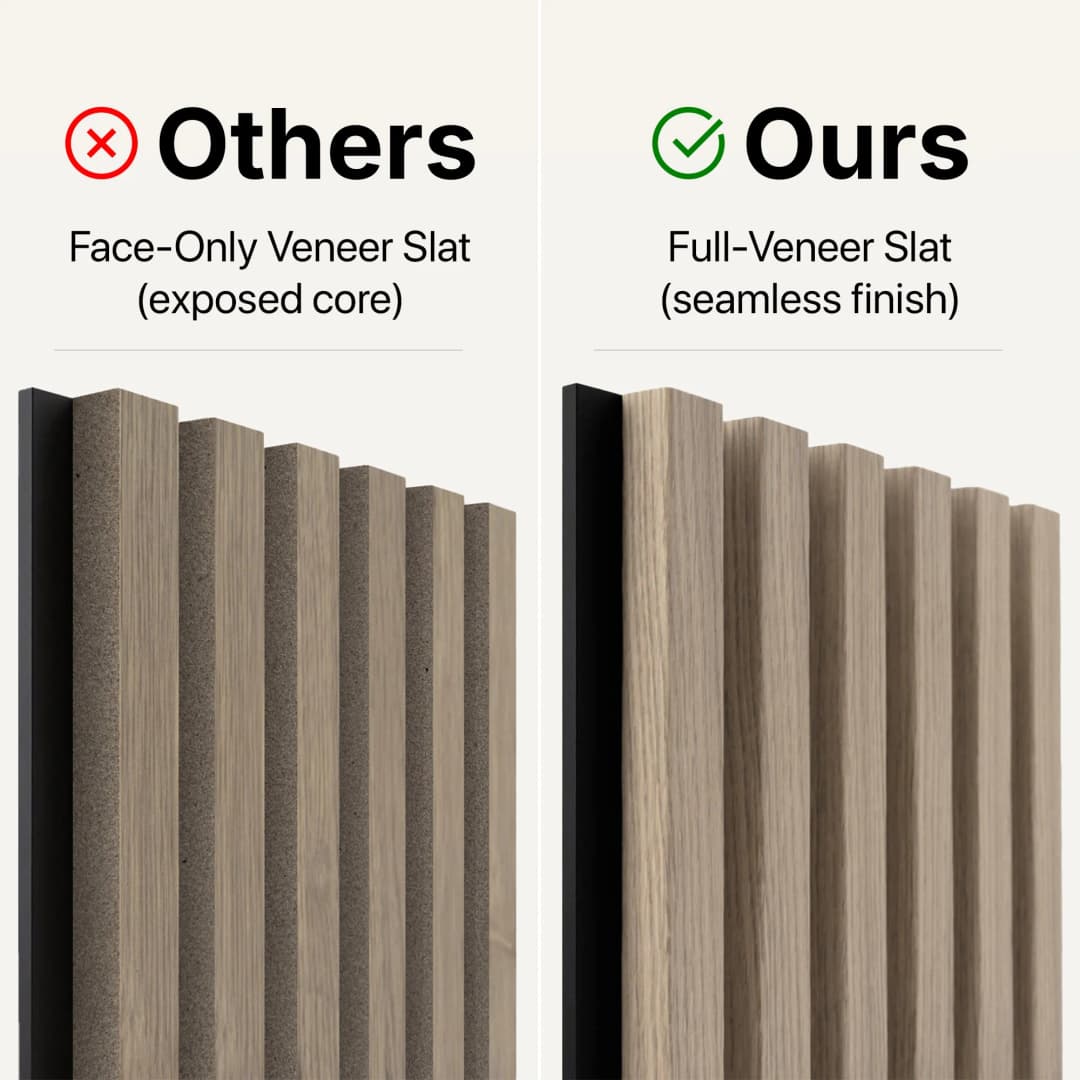
A thin layer of real wood — typically 0.6–3mm — bonded to an engineered core (usually HDF or MDF). You get the look and feel of solid wood at a fraction of the weight and cost. The veneer is real; you can see and feel the grain. The core provides dimensional stability.
Most of TPH’s slat panels use a wood veneer construction. It’s the sweet spot for 95% of residential applications.
Best for: Anyone who wants real wood appearance without solid wood cost or weight
Price range: $13–$22/sqft
Mosaic and Geometric Panels
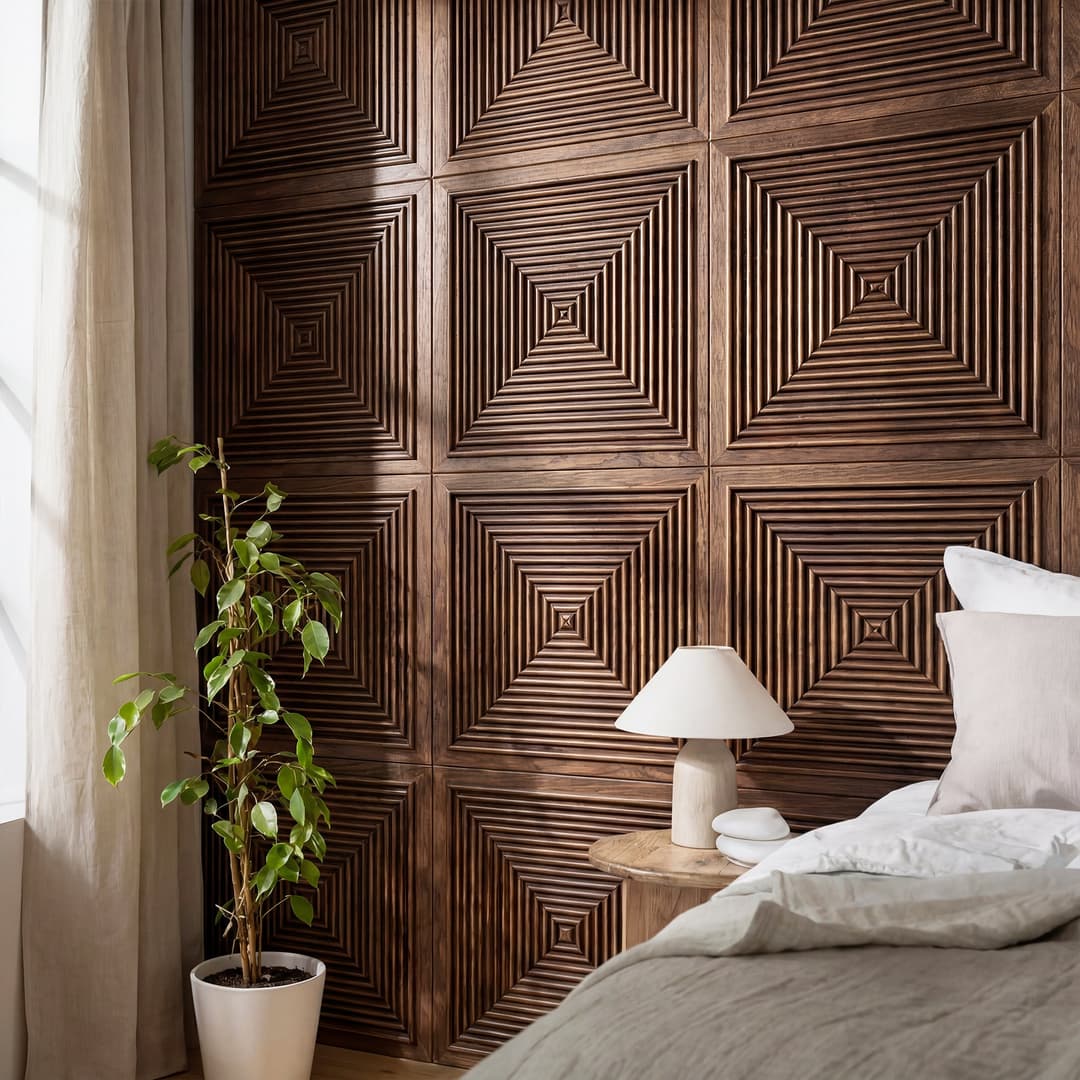
Solid wood pieces cut into triangles, hexagons, or other geometric shapes and assembled into patterns. These create a more artistic, statement-wall effect. They take longer to install and require more planning, but the result is genuinely unique.
Best for: Focal walls in dining rooms, entryways, or anywhere you want a conversation piece — Shop Mosaic Panels
WPC Outdoor Panels
Wood-plastic composite panels engineered for exterior use. Real wood fiber combined with polymer — stable, weather-resistant, and still warm-looking. If you’re cladding an exterior wall, covered patio, or garden room, WPC is the right material. Learn more about WPC outdoor panels.
Wood Wall Panels Cost: What to Expect
Wood panel walls typically cost between $7 and $22 per square foot for materials alone, depending on the type. Here’s how that breaks down in practice.
| Panel Type | Materials (per sqft) | DIY Install Time | Contractor Labor (per sqft) |
|---|---|---|---|
| Paintable MDF (fluted, ribbed) | $7–$11 | 2–4 hrs per wall | $3–$10 |
| Wood veneer slat (decorative) | $12–$18 | Under 2 hrs per wall | $3–$10 |
| Acoustic slat (SoundPanel) | $14–$22 | Under 2 hrs per wall | $3–$10 |
| Solid wood planks | $15–$40+ | 3–6 hrs per wall | $5–$15 |
| Mosaic / geometric | $18–$35 | 4–8 hrs per wall | $8–$20 |
Contractor labor runs $3–$10 per square foot for standard installations, with more complex layouts or solid wood work running higher.
A realistic budget for a single accent wall (roughly 60–80 sqft):
- Acoustic slat panels at $18/sqft = $1,080–$1,440 in materials
- DIY install: your time + a few basic tools
- Pro install: add $180–$800 depending on your area
Full room coverage in a standard 12×14 bedroom (approx. 400 sqft of wall) runs $2,800–$8,800 in materials depending on the panel type. Most homeowners do one or two walls, not a full room.
Which Wood Species Should You Choose?
The wood species defines the color, grain character, and overall feel of your wall. Here’s what each one does:
American Walnut — Dark chocolate brown with straight, sometimes wavy grain. The premium choice. Warm, rich, and pairs beautifully with brass hardware and natural linen. If your room has warm tones, walnut is hard to beat. See walnut wall panels.
White Oak — Medium golden-brown, clean grain, highly versatile. Works in Scandinavian, mid-century, contemporary, and transitional rooms. The safest choice if you’re not sure — it doesn’t clash with much and ages well.
Golden Oak — Warmer and more amber than white oak. Traditional feel. Pairs naturally with cream walls, dark floors, and warmer light sources.
Pine — Light, pale, and knotty. Rustic and casual. Works in cottages, farmhouse interiors, and anywhere you want wood to feel natural and unpretentious rather than designed. Lower cost than hardwood species.
Charcoal / Ebonized — Deeply stained or thermally treated wood with a near-black finish. Bold. Works in modern, industrial, and moody spaces. Increasingly popular in 2026 as darker tones replace the lighter Scandi palette of the previous decade.
Room-by-Room: Where Wood Wall Panels Work Best
Living Room
The most popular application, and for good reason. A single accent wall behind a sofa or TV immediately anchors the room. Vertical slat panels draw the eye upward and make ceilings feel higher. Acoustic panels also reduce echo in open-plan spaces.
Best types: Acoustic slat, wood veneer slat, mosaic for a statement wall
Most popular wall: Behind the sofa, or as a TV feature wall — Living room panel ideas
Bedroom
The headboard wall is the natural target. A full-width panel behind the bed creates a built-in headboard effect without the cost or permanence of custom millwork. Walnut and dark oak work especially well here — they create a sense of enclosure and calm.
Best types: Acoustic slat (for sound dampening), solid wood veneer
Most popular wall: Behind the bed
Home Office
The acoustics argument is strongest here. Hard surfaces — painted drywall, glass, hard floors — create a flutter echo that makes every video call feel like you’re talking in a parking garage. One acoustic panel wall changes that completely. The NRC 0.85 rating means absorbing 85% of sound energy hitting the surface.
Best types: Acoustic slat panels exclusively
Most popular wall: Behind the desk, doubles as a camera backdrop — Gaming and office wall panel ideas
Dining Room
Panels make dining rooms feel more intimate and formal without being heavy. The trick is restraint — one wall behind a banquette or sideboard is enough. Walnut or darker tones create that restaurant-booth warmth that makes people want to stay at the table longer.
Best types: Wood veneer slat, mosaic, solid wood
Most popular wall: Behind a bench seat or sideboard — Dining room wall panels
Hallway
Hallways are narrow, high-traffic, and usually boring. A slat wall panel transforms them into something architectural. Horizontal panels make narrow hallways feel wider; vertical panels add height in low-ceiling corridors. This is also one of the easiest spaces to panel because the wall area is manageable.
Home Theater and Gaming Room
If you’re spending money on a projector or screen, spend proportionately on the room. Acoustic panels on the side walls and back wall reduce the flutter echo that plagues untreated rooms. Dark finishes absorb light scatter and improve perceived contrast. Home theater room ideas.
How to Install Wood Wall Panels: The Real Timeline
Most acoustic slat and wood veneer panels are designed for DIY installation. Here’s what’s actually involved.
What you need:
- Tape measure, pencil, level
- Construction adhesive or panel-specific adhesive — adhesive guide
- Oscillating tool or circular saw for cuts
- Hammer and finishing nails (optional, for added security)
The process:
- Prepare your wall. Clean surface, check for level. The panels won’t fix a badly out-of-plumb wall — fix large dips before you start.
- Mark your starting point. Find the center of the wall or use a corner. A level chalk line saves time.
- Cut to fit. Measure your wall height. Most panels need a top cut to fit ceiling height. Score-and-snap works for many panel types; a circular saw handles anything trickier. How to cut wall paneling.
- Apply adhesive. Run a zigzag bead on the back of the panel, or apply to the wall directly if the manufacturer recommends it.
- Press, check level, secure. Press the panel firmly to the wall. Check level. For acoustic panels, the felt backing grips the wall — the bond is strong immediately.
- Repeat and stagger joints. Adjacent panels should have staggered end joints for a cleaner look.
Realistic time: A standard 8×10 ft accent wall takes most people 1.5–2.5 hours on their first installation. The second wall goes faster.
Solid Wood vs MDF vs Wood Veneer: Which Is Right for You?
The three materials serve different needs. Here’s how to think about the choice honestly.
Choose solid wood if: You want panels that will last 30+ years and improve with age. You’re okay with a higher price and some sensitivity to humidity. You want a material that’s honest — it’s wood all the way through, and you can feel it.
Choose wood veneer if: You want real wood appearance — visible grain, genuine warmth — without the weight, cost, or movement of solid wood. This is the right choice for 90% of residential walls. TPH’s veneer panels use real wood faces on stable HDF cores, so you get the look and the stability.
Choose MDF if: You want a painted finish and don’t need grain. MDF paints beautifully and holds crisp profiles for fluted and ribbed designs. It’s also the most budget-friendly option at $7–$11/sqft. The honest limitation: it’s not wood, and it won’t look like wood.
Full solid wood vs MDF comparison.
Do Wood Wall Panels Actually Improve Acoustics?
Yes — but the answer depends heavily on which panels you buy.
Decorative wood panels with no acoustic backing do almost nothing for sound. The wood itself reflects rather than absorbs. You’ll get a small improvement from the added surface mass, but nothing measurable.
Acoustic panels are different. The combination of slat gaps and high-density felt backing creates a mechanism for sound absorption. TPH’s SoundPanel achieves NRC 0.85 — that means 85% of sound energy hitting the panel is absorbed rather than reflected back into the room.
For context: a fully treated recording studio typically targets NRC 0.9–1.0. A bare drywall room sits around NRC 0.05. A single acoustic panel wall takes you most of the way to a treated room without turning your house into a studio.
Practical difference you’ll notice: fewer echoes on calls, voices that sound clearer and closer, less fatigue in rooms where you spend long periods talking or listening. More on acoustic wood panels.
How to Choose the Right Panel for Your Space
Five questions to narrow it down:
1. Do you need acoustic performance? If yes, go straight to acoustic slat panels. If no, decorative options open up.
2. What’s your wall’s moisture exposure? Bathrooms and kitchens need waterproof panels — WPC or PVC, not wood veneer. Bathroom panel options.
3. What’s your budget? Under $10/sqft in materials: paintable MDF. $12–$18: decorative wood veneer slat. $18–$22+: acoustic slat or solid wood.
4. What’s your room’s existing palette? Warm tones (cream, terracotta, warm grey): walnut or golden oak. Cool tones (white, charcoal, slate): white oak or charcoal finish. Industrial or modern dark rooms: ebonized wood.
5. Are you DIYing or hiring? Both are completely viable. DIY acoustic slat panels go up in under 2 hours on a standard wall.
Use the Room Visualizer to see how different finishes look on your actual walls before you commit. Open the Room Visualizer.
How to Care for Wood Wall Panels
Wood wall panels are low-maintenance. Here’s the short version:
- Dust regularly with a dry microfiber cloth. Don’t use wet cloths on untreated or unfinished wood.
- For marks: Damp cloth with mild soap, wiped quickly and dried immediately.
- Avoid direct sunlight on dark-stained panels — UV fading is real, and it’s slow enough that you won’t notice until you move furniture.
- Don’t steam clean. Heat and moisture are the enemies of any wood product.
- Acoustic felt backing: Vacuuming the slat gaps once a year keeps the felt from accumulating dust that would reduce its performance over time.
The Honest Comparison: Wood Panels vs Wallpaper vs Paint
Each does something different. The right answer depends on what you’re trying to achieve.
Paint is the cheapest and most reversible option. It changes color but not texture, and it does nothing for acoustics. If your walls are in good shape and you’re just after a new look, paint is fine.
Wallpaper adds pattern and some texture, but remains a flat surface. Modern wallpapers look good, but they don’t change how a room feels spatially or acoustically. And removal is a project.
Wood wall panels add genuine texture, warmth, and — if you choose acoustic panels — measurable sound improvement. They’re permanent in the best sense: they look better in 10 years than they do on day one, and they hold up to real use. The tradeoff is cost and installation time.
Wall panels vs wallpaper: full comparison.
Keep Exploring: Style & Trends
- 2026 Wall Panel Trends: What’s In, What’s Out
- Minimalist Wall Panels: Less Is More, Done Right
- Scandinavian Wall Panels: Nordic Interior Design Ideas
- Biophilic Design with Wood Wall Panels
- How Much Do Wall Panels Cost? 2026 Price Guide
- Wood Paneling Makeover: Transform Your Space
Frequently Asked Questions
How long do wood wall panels last?
Wood veneer panels installed correctly last 15–25+ years under normal indoor conditions. Solid wood panels last the life of the building. MDF panels are slightly more vulnerable to moisture damage at edges — seal them properly on installation and they’ll last 10–15 years without issue.
Can you install wood wall panels over existing wallpaper?
Not recommended. Wallpaper creates an uneven, potentially unstable substrate. Strip the wallpaper first, skim-coat any damage, and install onto a clean flat wall.
Do wood wall panels need to be sealed?
Pre-finished wood veneer panels (like TPH’s SoundPanel) arrive ready to install — no sealing required. Unfinished solid wood or MDF panels need primer or sealant before or after installation.
Are wood wall panels suitable for a bedroom?
Yes, and the bedroom is one of the best applications. The acoustic benefit is real — people sleep better in quieter rooms — and the visual warmth of wood behind a bed transforms the space.
Can I install wood wall panels myself?
Yes. TPH panels are designed for DIY installation and take under 2 hours per wall for most homeowners. The main requirement is a level wall, accurate measurements, and the right adhesive.
Where to Start
If you know the room but not the panel, the Room Visualizer is the right first step — it lets you see any TPH panel on a wall before you order. Open the Room Visualizer.
If you know you want acoustic performance, start with the SoundPanel collection. Shop SoundPanel.
If you want to explore wood types and finishes across the full range, the wood wall panels collection is the place. Shop all wood wall panels.
Sample boxes are available if you want to hold the finish in your hand before committing — which, honestly, you should. A photo on a screen tells half the story. Order a sample box.
The Panel Hub makes real wood acoustic wall panels from FSC-certified materials, designed in the USA and shipped from North Carolina. 3-sided rounded edges. AcuFelt 1500 g/m² backing. NRC 0.85.
Shop the Full Collection
Everything covered in this guide is available to explore and order at The Panel Hub. Browse the complete wood wall panel collection — including the SoundPanel™ acoustic slat range, the GroovePanel® mosaic tiles, and the RockSurface® faux stone panels. For room-by-room design inspiration, our interior slat wall ideas guide covers 50+ applications across every style. For detailed guidance on acoustic panel performance and specifications, the complete acoustic panel buyer’s guide is the right next step.