
Table of Contents
- Can You Use Wood Panels in a Bathroom?
- The Moisture Problem — and How to Solve It
- Zones: Where Wood Panels Work in Bathrooms
- Design Ideas for Bathroom Wood Panels
- Installation Tips Specific to Bathrooms
- Design Ideas: How Bathroom Wood Panels Look in Practice
- FAQs: Bathroom Wood Wall Panels
- Find the Right Panels for Your Bathroom
Can You Use Wood Panels in a Bathroom?
Yes — but the choice of panel and installation method matters significantly more in a bathroom than anywhere else in the home. Bathrooms are the highest-humidity environment in a typical house. Steam from showers, condensation on cold surfaces, and splashing around sinks all create conditions that will destroy a standard MDF panel within months if it isn’t properly specified and sealed.
Done correctly, bathroom wood panels look exceptional and last for years. Done incorrectly, they warp, swell, and delaminate. Here’s how to get it right.
The Moisture Problem — and How to Solve It
Standard MDF expands and loses structural integrity when it absorbs moisture. The edges are the most vulnerable point — moisture enters through cut edges and wicks into the core. For bathroom applications, you need panels built to resist this:
- MR-MDF core (Moisture-Resistant MDF): The green-coloured MDF manufactured with moisture-resistant resin. Significantly better than standard MDF in humid environments — specified for wet area applications.
- WPC panels (Wood Plastic Composite): A composite of wood fibre and plastic resin. Fully waterproof core, though typically with a less premium surface finish than real wood veneer.
- PVC foam board: Fully waterproof, lightweight, and easy to install. Less authentic in appearance than wood but highly practical in shower enclosures and wet zones.
- Sealed real wood veneer on MR-MDF: Premium option. Genuine wood veneer face with moisture-resistant core, all edges sealed with waterproof sealant or edge tape during installation.
Zones: Where Wood Panels Work in Bathrooms
Not all bathroom walls are equal in terms of moisture exposure. Think in zones:
- Zone 0 (inside the shower/bath): The wettest zone — direct water contact. Only fully waterproof materials (WPC, PVC, tiles) are appropriate here. Real wood veneer panels are not suitable.
- Zone 1 (within 600mm of shower/bath edge): High splash risk. MR-MDF with sealed veneer is the minimum spec. Many designers still prefer solid WPC or tile in this zone.
- Zone 2 (remainder of bathroom): Ambient humidity but no direct water. MR-MDF with sealed wood veneer works well. This is where wood slat panels shine — on the wall opposite the shower, the wall behind the vanity, or as a feature wall visible from the bath.
Design Ideas for Bathroom Wood Panels
Slat Panel Feature Wall Behind the Freestanding Bath
A wall of acoustic wood slat panels behind a freestanding bath creates a spa-quality backdrop. The vertical lines elongate the wall visually; the warm wood tones contrast beautifully with white or stone-coloured sanitaryware. Keep the panel wall in Zone 2 (away from direct water contact) and use a sealed veneer finish.
Fluted Panel Vanity Wall
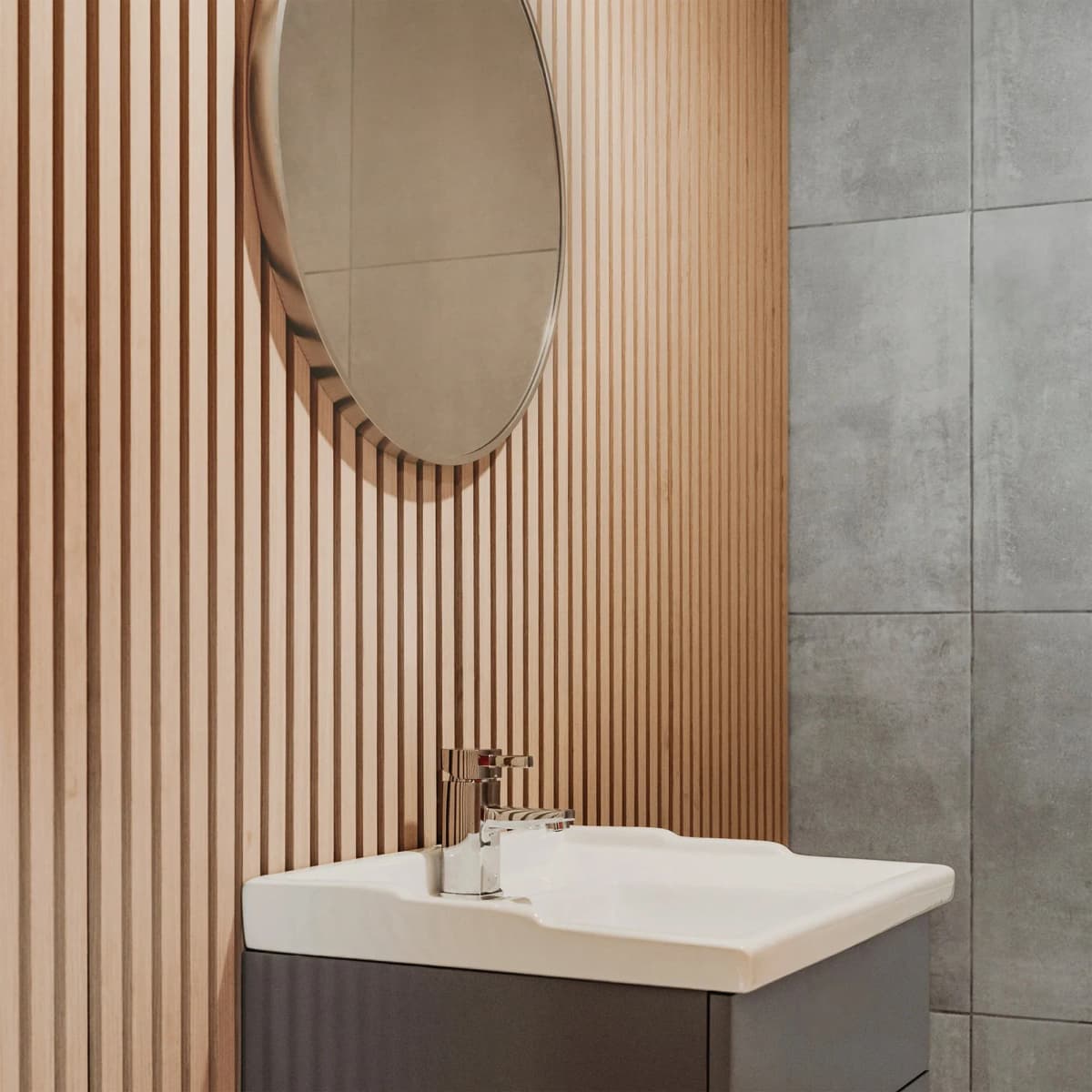
Clad the wall behind the vanity and mirror in fluted panels — in a light oak or painted finish — to create an architecturally composed vanity unit backdrop. The solid face of fluted panels handles splashing from the sink better than open-gap slat panels in close proximity to water.
Wainscoting with Panels
Panel the lower half of the bathroom wall up to dado height — using WPC or sealed MR-MDF — with a contrasting tile or painted finish above. This is the most practical approach for bathrooms where moisture exposure on the lower wall is a real concern. Our wainscoting ideas guide covers the design principles behind this approach.
Full-Wall Slat Panels in a Low-Humidity Bathroom
In bathrooms with excellent ventilation (powerful extractor fan, operable window) and where the shower is fully enclosed with a glass screen, Zone 2 effectively extends to most of the room. In this configuration, full-wall wood slat panels in sealed MR-MDF are genuinely achievable and look outstanding.
Installation Tips Specific to Bathrooms
- Seal all cut edges immediately after cutting with a waterproof edge sealant or matching silicone. This is the most critical step in bathroom panel installation — unsealed edges are where moisture enters.
- Use waterproof adhesive — standard construction adhesive works, but ensure it’s rated for humid environments. Some adhesives lose bond strength when repeatedly wetted.
- Ventilate the room during curing — adhesive and sealant off-gas during curing. Keep the extractor running for 24 hours post-installation.
- Apply a top coat — an additional coat of water-resistant oil or lacquer on the veneer face provides extra protection against steam and condensation.
For a general panel installation walkthrough, our guide to installing wall panels covers the core steps that apply in any room. For comparing panel finishes and materials in detail, see our real wood veneer vs laminate panel comparison.
Design Ideas: How Bathroom Wood Panels Look in Practice
Knowing a product is technically suitable is different from knowing how to make it look intentional. These four approaches deliver consistently strong results with wood panels in bathrooms.
Vertical slat panels behind a freestanding bath: A wall of vertical slat panels behind a freestanding bath creates an immediately recognisable luxury bathroom moment. The slats’ linear vertical rhythm suits the taller proportion of a bathroom wall, and the natural timber contrast against white sanitaryware is a classic material pairing. Acoustic slat panels are unnecessary here (acoustics aren’t a priority in a bathroom), but the visual effect is identical.
Half-height panel behind a basin and mirror: A full-wall panel treatment in a small bathroom can feel heavy. A half-height treatment — panels from floor to approximately 1,100mm — below a painted upper wall and mirror is a proportionate choice that adds warmth without reducing the sense of space. Works particularly well in en-suite bathrooms where the vanity wall is the primary design focus.
Single panel strip as a feature border: For bathrooms that already have tiling on the primary wet surfaces, a vertical strip of timber panels on a dry wall — behind a towel rail, beside a window, or framing a doorway — introduces a warm material contrast without requiring full-wall coverage. This treatment bridges the gap between a tiled bathroom and a panel bathroom without committing to a full installation.
Ceiling panel treatment: Timber panels on a bathroom ceiling — particularly slat panels installed perpendicular to the longest room dimension — add unexpected warmth overhead. The ceiling is outside all wet zones in most bathrooms, so standard timber panels are appropriate. Ensure adequate ventilation is in place to prevent condensation accumulation above the panels.
FAQs: Bathroom Wood Wall Panels
Which wood species is best for a bathroom?
Oak with a sealed oil finish or lacquered MR-MDF core panels are the most practical bathroom choices. Teak is naturally moisture-resistant but expensive. Engineered panels with a moisture-resistant core (MR-MDF or HDF) and a sealed veneer face are the most predictable performers in bathroom humidity conditions. Avoid untreated softwood species — pine and spruce absorb moisture readily and are unsuitable for bathroom applications without thorough sealing.
Can bathroom wood panels be used near a steam shower?
Adjacent to a steam shower enclosure (zone 1, within the enclosure), only products specifically rated for steam environments should be used — most timber panels are not. On the exterior wall of a steam shower (zone 2, within 600mm), sealed engineered panels can work if the room has adequate ventilation. For the shower interior itself, non-porous panels (acrylic, composite, stone effect) are more appropriate than timber.
How do I prevent mould behind bathroom wood panels?
The key is edge sealing — every cut edge, every joint between panels, and every junction with floor, ceiling, and adjacent surfaces must be sealed with waterproof silicone. Unsealed edges allow moisture to migrate behind the panel where it can’t dry out, creating conditions for mould. Adequate bathroom ventilation (extractor fan running during and after showering) reduces the overall moisture load in the room.
Can existing bathroom tiles be panelled over?
Yes, in most cases. Check that the existing tiles are firmly bonded — tap the surface to check for hollow spots. Adhesive panels over hollow tiles will eventually fail at the tile, not the panel. On solid, well-bonded tiles, construction adhesive can bond directly to the glazed tile surface. Mechanical fixings (screws into the substrate) may be required for heavier panel products over tiles.
Find the Right Panels for Your Bathroom
Browse the complete wood wall panel collection at The Panel Hub to find panels appropriate for your specific bathroom zone — from sealed veneer panels for ambient humidity areas to fully waterproof options. The SoundPanel™ acoustic slat range in sealed MR-MDF is suitable for Zone 2 bathroom applications with proper installation. For design inspiration showing how wood panels look in bathroom and adjacent spaces, our interior slat wall ideas guide covers relevant applications. The acoustic panel buyer’s guide covers material construction and specifications across the full panel range.