
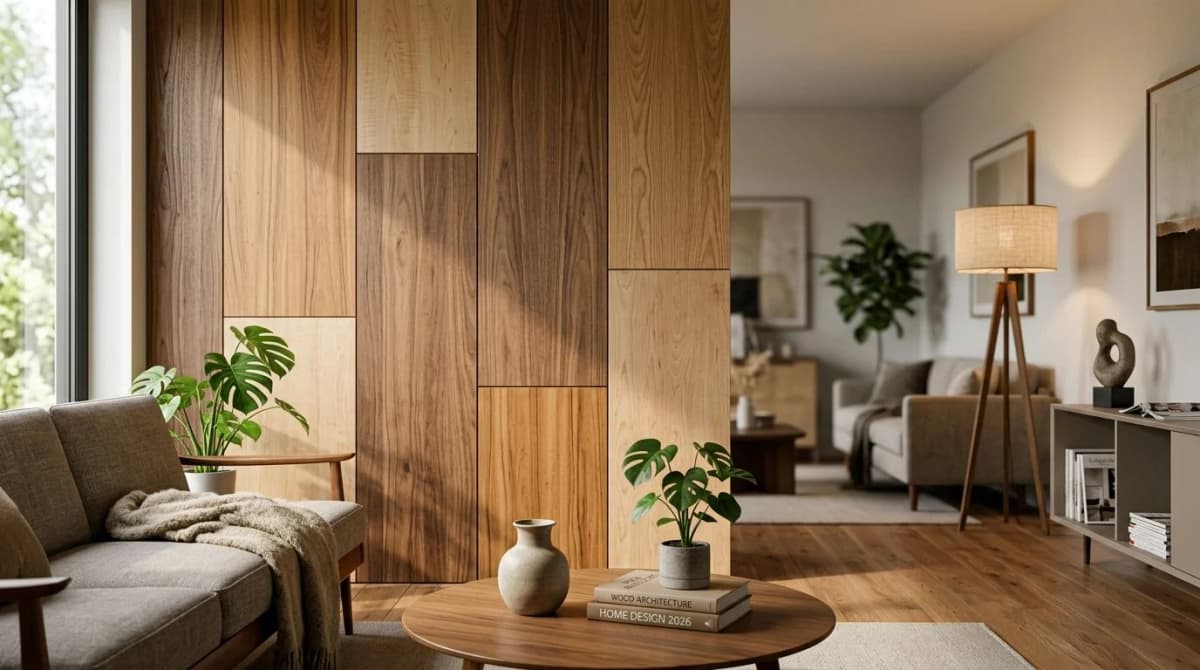
Six panels rise above the rest for real wood veneer bonded to a stable core, and the differences come down to acoustic performance, grain pattern, and which room you're dressing up. Best overall: SoundPanel Acoustic Slat Wood Wall Panels. Best for bedrooms: Acoustic Slat White Felt Wood Wall Panels. Best for rustic accent walls: Crossing Lines Solid Wood Wall Panels.
- SoundPanel Acoustic Slat wins as the best natural wood veneer wall panel overall for living rooms and home theaters in 2026.
- Crossing Lines Solid Wood Wall Panels suit rustic accent walls; Acoustic Slat White Felt calms down bedrooms.
- All six panels bond real wood veneer to an MDF core instead of a printed laminate skin.
- Check for an NRC 0.85 acoustic rating and FSC-certified sourcing before you buy a wood veneer wall panel in 2026.
Why this matters
Wood veneer gets stretched to cover everything from a thin printed foil to an actual sliced hardwood face glued to MDF. Only the second one behaves like real wood: it takes light differently across the grain, it dents instead of chipping, and it holds an acoustic slat wood wall panel rating that a vinyl print never will.
That distinction matters more in 2026 than it did five years ago, because more panels on the market now blend real veneer fronts with acoustic cores rated NRC 0.85 — enough to noticeably calm a hard-surfaced living room or home office. The six panels below are ranked on veneer authenticity, acoustic performance where it applies, install difficulty, and which room they're actually built for.
What makes the best natural wood veneer wall panel
- Real veneer, not printed laminate — a sliced wood face bonded to an MDF core, with visible grain variation panel to panel.
- Acoustic performance — an NRC rating (0.85 on The Panel Hub's SoundPanel line) for panels sold as sound-dampening, not just decorative.
- FSC-certified sourcing — veneer with a traceable chain of custody rather than an unverified mill.
- Install method and time — systems one person can finish in under two hours per wall.
- Finish consistency — grain and tone that read as intentional, not randomly mismatched between panels.
- Warranty length — a 5-year warranty is the baseline worth expecting on a real wood veneer product.
Wood veneer wall panels at a glance
| Panel | Best for | Standout feature | Key limitation |
|---|---|---|---|
| SoundPanel Acoustic Slat | Living rooms & home theaters | NRC 0.85 acoustic core under real oak veneer slats | Heavier than purely decorative panels |
| Crossing Lines Solid Wood | Rustic accent walls | Overlapping diagonal lines cut from solid wood | Not acoustic-rated |
| Acoustic Slat White Felt | Bedrooms | Felt backing plus wood veneer for a softer visual tone | Light felt shows dust over time |
| 3D Geometric Pattern Wooden | Entryways & statement walls | Raised 3D geometric relief in solid wood | Pattern reads busy in small rooms |
| Hexagon Acoustic Wood | Home offices | Tessellated hexagon veneer bonded to an acoustic layer | Cutting around outlets is fiddlier than square panels |
| 3D Concentric Square Wood | Dining rooms & formal spaces | Symmetrical concentric relief pattern | Needs precise alignment across multiple panels |
1. SoundPanel Acoustic Slat Wood Wall Panels: best natural wood veneer wall panel for living rooms and home theaters
The SoundPanel Acoustic Slat panels pair an American oak or walnut veneer slat face with an acoustic core rated NRC 0.85. That rating is why this panel leads the 2026 list: it is built to cut echo in a room with hard floors and a TV wall, not just look good on camera.
SoundPanel Acoustic Slat pros:
- NRC 0.85 rating measurably reduces echo in open-plan living rooms
- Real oak or walnut veneer face, not a printed skin
- Slat spacing hides wiring runs behind the panel
SoundPanel Acoustic Slat cons:
- Heavier per panel than non-acoustic options, so mounting hardware matters more
- Slat gaps collect dust faster than a flat veneer surface
Best for: living rooms, home theaters, and open-plan spaces with hard flooring.
Verdict: Buy when acoustic performance sits alongside real wood veneer on your list.
2. Crossing Lines Solid Wood Wall Panels: best for rustic accent walls
Crossing Lines Solid Wood Wall Panels cut overlapping diagonal lines into a solid wood face, giving a single accent wall texture that reads handmade rather than mass-produced. There is no acoustic core, which keeps the panel lighter and easier for a first-time installer to handle.
Crossing Lines pros:
- Distinct diagonal texture that photographs well on a feature wall
- Lighter than acoustic-core panels, so one-person installs go faster
- Works in both light oak and dark walnut finishes
Crossing Lines cons:
- No acoustic rating, so it will not dampen sound like SoundPanel
- The diagonal pattern needs careful alignment across multiple panels
Best for: a single statement wall in a rustic or farmhouse-leaning living room.
Verdict: Buy for texture and looks. Skip if sound dampening is the goal.
3. Acoustic Slat White Felt Wood Wall Panels: best for bedrooms
The Acoustic Slat White Felt Wood Wall Panels swap the standard dark felt backing for white, softening the tone against a golden oak veneer slat. That lighter backing makes it a better bedroom pick than the standard SoundPanel Acoustic Slat, which reads more commercial.
Acoustic Slat White Felt pros:
- Brighter tone suits bedrooms better than a dark felt backing
- Same acoustic slat construction as the flagship SoundPanel line
- Golden oak veneer face pairs with light and neutral bedding palettes
Acoustic Slat White Felt cons:
- White felt shows dust and lint more visibly than dark felt
- Same weight and mounting considerations as any acoustic-core panel
Best for: bedrooms and reading nooks that need warmth without a dark, formal look.
Verdict: Buy for bedroom installs specifically.
4. 3D Geometric Pattern Wooden Panels: best for entryway statement walls
The 3D geometric pattern wooden panels raise a geometric relief out of 100% real solid wood, built for a wall meant to be the first thing a visitor notices. No acoustic core here — the point is visual depth, not sound control.
3D Geometric Pattern pros:
- Genuine 3D relief, not a flat print made to look dimensional
- Reads as a strong focal point in entryways and stairwells
- Solid wood construction throughout the face
3D Geometric Pattern cons:
- The raised pattern reads busy in a small room
- No acoustic benefit, so it stays a decorative-only choice
Best for: entryways, stairwells, and any wall meant to be a conversation piece.
Verdict: Buy for a bold entryway. Hold if the room is small or already visually busy.
5. Hexagon Acoustic Wood Wall Panels: best for home offices
Hexagon Acoustic Wood Wall Panels tessellate real-wood-veneer hexagons over an acoustic backing. That combination makes them one of the few panels here built for both a video-call background and an echo-prone home office.
Hexagon Acoustic pros:
- Acoustic backing cuts echo behind video calls
- Tessellated hexagon layout looks intentional rather than repetitive
- Real wood veneer surface bonded to the same acoustic standard as SoundPanel
Hexagon Acoustic cons:
- Cutting hexagons around outlets and switches takes more planning than square panels
- Pattern commitment is harder to reverse than a straight slat wall
Best for: home offices and video-call backdrops that also need sound control.
Verdict: Buy for a home office, and plan the layout around outlets before the first panel goes up.
6. 3D Concentric Square Wood Wall Panel: best for dining rooms and formal spaces
The 3D Concentric Square Wood Wall Panel builds a symmetrical nested-square relief that suits a formal dining room or a wall behind a console table better than a busier geometric or slat pattern.
3D Concentric Square pros:
- Symmetrical relief reads formal rather than rustic
- Solid wood construction consistent with the rest of the GroovePanel line
- Looks strongest lit from an angle, which emphasizes the relief
3D Concentric Square cons:
- Alignment has to be precise across panels or the symmetry breaks
- No acoustic core, so it is decorative only
Best for: dining rooms, formal living rooms, and console-table feature walls.
Verdict: Buy for formal spaces. Skip if you want acoustic benefit from the same wall.


How this ranking works
Every panel was weighed against the same six criteria: veneer authenticity, acoustic rating where relevant, FSC-traceable sourcing, install time, finish consistency, and warranty length. SoundPanel Acoustic Slat leads because it is the only panel here combining an NRC 0.85 rating with a real oak or walnut veneer face. The other five win their slot on room fit, not acoustics.
Which natural wood veneer wall panel should you choose?
If you buy one panel in 2026, SoundPanel Acoustic Slat Wood Wall Panels is the safe default — it covers acoustic performance and a genuine wood veneer face in one product. Choose Crossing Lines Solid Wood Wall Panels when the wall is purely decorative and rustic in tone, or the Acoustic Slat White Felt when the room is a bedroom rather than a living room. The 3D Geometric and 3D Concentric Square panels earn their place only when the wall is a visual statement with no acoustic requirement.
FAQ
What is a natural wood veneer wall panel?
A natural wood veneer wall panel is a thin real-wood face sliced from a log and bonded to a stable core such as MDF, unlike printed laminate that only mimics grain. Tone and figure vary slightly panel to panel because it is actual wood, not a repeating print.
Are wood veneer wall panels waterproof?
No. Real wood veneer panels are not built for wet areas like showers, and PVC or waterproof panel lines exist for bathrooms instead. Keep wood veneer panels in living rooms, bedrooms, and offices where humidity stays low.
How long does it take to install wood veneer wall panels?
A single wall typically installs in under two hours with basic tools and an adhesive or click-lock system. Patterned walls such as 3D geometric panels take longer because alignment matters more.
What is the difference between wood veneer and solid wood wall panels?
Veneer panels bond a thin real-wood face to an engineered core, while solid wood panels are cut from wood throughout. Veneer panels are generally lighter and more dimensionally stable than solid equivalents.
Do wood veneer wall panels improve room acoustics?
Only panels built with an acoustic core do, such as those rated NRC 0.85. A plain decorative veneer panel with no acoustic backing will not reduce echo, so check for an explicit rating before assuming it dampens sound.
Are wood veneer wall panels eco-friendly?
Panels sourced under FSC certification trace the wood through a verified chain of custody, which is the clearest eco-credential to look for in 2026. Certification alone does not cover adhesives, so check that separately if it matters to you.
How much does a natural wood veneer accent wall cost?
Cost depends on panel size, whether there is an acoustic core, and how many panels the wall needs, so check current pricing on the product page. Acoustic-core panels generally sit above purely decorative veneer panels.
Which room works best for a wood veneer accent wall?
Living rooms and bedrooms are the strongest fit because they stay dry and benefit most from acoustic dampening where it is included. Entryways suit purely decorative 3D veneer patterns since sound control matters less there.
One last thing
The felt color behind an acoustic slat panel is not just cosmetic. White felt on the Acoustic Slat White Felt line bounces more light back into the room than the dark felt behind the standard SoundPanel Acoustic Slat, so the same oak veneer reads noticeably brighter on an identical wall. In two rooms with equal daylight, the felt is doing more visual work in 2026 than the grain choice.
Related guides