
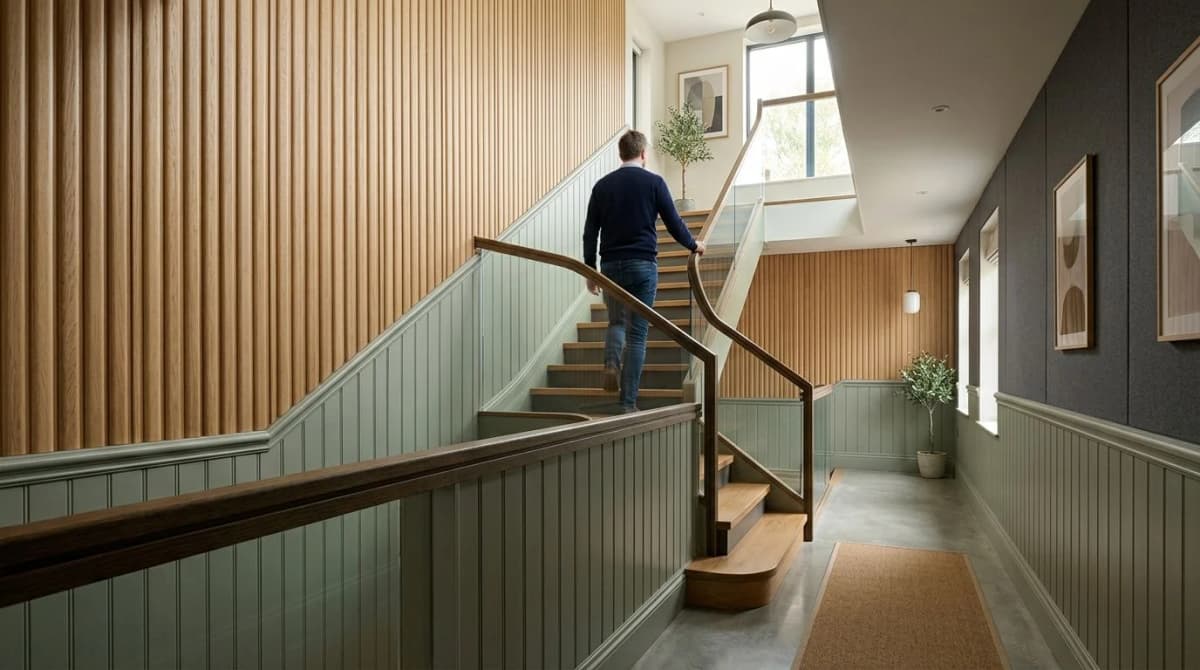
Stairwells and hallways take more foot traffic than any other wall in the house, and they bounce sound between floors worse than almost any other space. Best overall for stairwells and hallways: SoundPanel Acoustic Slat Wood Wall Panels. Best for narrow stairwell landings: Crossing Lines Solid Wood Wall Panels. Best budget option: Hexagon Acoustic Wood Wall Panels.
- SoundPanel Acoustic Slat Wood Wall Panels wins overall for stairwells and hallways with an NRC 0.85 acoustic core under real wood veneer.
- Crossing Lines Solid Wood Wall Panels is the pick for narrow stairwell landings where a bulky 3D profile won’t fit.
- Hexagon Acoustic Wood Wall Panels is the budget acoustic option, with smaller modules that cut waste on angled stair walls.
- All Panel Hub wood panels install in under 2 hours and carry a 5-year warranty, which matters on a high-traffic wall.
Why this matters
A hallway is a flat, straight run. A stairwell is an open shaft that carries footsteps, voices, and slammed doors between floors — the void acts like a chimney for noise. Both spaces also take more scuffs than a living room wall because people, bags, and furniture squeeze past them constantly in 2026 homes with tighter floor plans.
Picking the wrong panel means either an ugly acoustic slab in a space that needed decoration, or a decorative panel that does nothing for the noise problem you actually have. The ranking below separates the two jobs.
What makes the best wall panels for stairwells and hallways
- Acoustic performance — an NRC rating around 0.85 measurably cuts echo between floors; a purely decorative panel does not.
- Panel width and module size — narrow stairwell landings and turns need smaller repeating modules, not one giant slab.
- Impact and scuff resistance — high-traffic walls need a surface that hides marks, not a soft finish that dents.
- Installation method — angled stair walls and short hallway runs favor click-fit or adhesive systems that install in under 2 hours per section.
- Finish behavior under lighting — stairwell sconces and hallway downlights cast shadows that some slat finishes hide better than others.
- Material — real wood, FSC certified where relevant, versus faux stone or PVC changes weight, maintenance, and cost.
Wall panels for stairwells and hallways at a glance
| Panel | Best for | Standout feature | Key limitation |
|---|---|---|---|
| SoundPanel Acoustic Slat Wood Wall Panels | Hallway echo control | NRC 0.85 acoustic core under real wood veneer slats | Slat width limits pattern variety |
| Crossing Lines Solid Wood Wall Panels | Narrow stairwell landings | Diagonal groove pattern reads well in tight sightlines | No acoustic core, decorative only |
| Hexagon Acoustic Wood Wall Panels | Budget acoustic pick | Smaller hexagon modules cut waste on angled walls | Seams need careful alignment on stair pitch |
| 3D Geometric Pattern Wooden Panels | Statement entry hallway | Deep-relief profile catches light from multiple angles | Bulky profile struggles in single-file hallways |
| RockSurface Highland Rock Wall Panel | Rustic, textured stairwell wall | Faux stone surface hides scuffs and dents | Heavier panel, no acoustic benefit |
| Acoustic Slat White Felt Wood Wall Panels | High-traffic multi-story stairwells | Felt-backed slats plus light finish resist shadowing | Light finish shows dust and marks faster |


1. SoundPanel Acoustic Slat Wood Wall Panels: best overall for hallway echo control
This is a real wood veneer slat panel bonded over an acoustic core rated NRC 0.85, sold under The Panel Hub's SoundPanel line. It's built for exactly the problem stairwells and long hallways create: sound bouncing off hard, flat surfaces between floors. Installation runs under 2 hours per section and the panel carries a 5-year warranty.
SoundPanel Acoustic Slat pros:
- NRC 0.85 rating actually reduces reflected footstep and voice noise, not just visual texture
- Real wood veneer finish reads as a decor upgrade, not an acoustic patch
- FSC certified sourcing for buyers who care about the wood
SoundPanel Acoustic Slat cons:
- Slat pattern is fixed, so you don't get the pattern variety a 3D geometric panel offers
- Acoustic core adds thickness that some tight stairwell clearances can't accommodate
Best for: hallways and stairwells where noise between floors is the actual complaint. Verdict: Buy.
2. Crossing Lines Solid Wood Wall Panels: best for narrow stairwell landings
Crossing Lines is a solid wood panel with a diagonal groove pattern, part of The Panel Hub's GroovePanel range. On a narrow landing where a deep 3D profile would eat into walking clearance, the shallow crossing-line relief adds texture without adding bulk.
Crossing Lines pros:
- Shallow profile fits tight stairwell landings where deeper panels can't
- Diagonal pattern reads well from the angled sightlines a staircase creates
- Installs in under 2 hours, same as The Panel Hub's other wood panel lines
Crossing Lines cons:
- No acoustic core, so it does nothing for floor-to-floor noise
- Solid wood construction is heavier than PVC alternatives on the same wall
Best for: narrow stairwell landings where clearance matters more than sound. Verdict: Buy.
3. Hexagon Acoustic Wood Wall Panels: best budget acoustic pick
Hexagon Acoustic Wood Wall Panels pair a real-wood-veneer surface with the same SoundPanel acoustic bonding used across the line, but in smaller hexagon modules. Smaller modules cut waste when you're tiling around a stair pitch or a hallway doorway, which matters more here than on a flat wall.
Hexagon Acoustic pros:
- Smaller module size wastes less material cutting around stair angles and door trim
- Real wood veneer with acoustic bonding at the lowest entry point in the SoundPanel line
- Geometric hexagon shape works as a feature wall on its own
Hexagon Acoustic cons:
- Hexagon seams need careful alignment on a sloped stair wall or the pattern reads crooked
- Smaller modules mean more individual pieces to install than a single slat panel
Best for: buyers who want acoustic benefit without the largest-format SoundPanel option. Verdict: Buy.
4. 3D Geometric Pattern Wooden Panels: best for a statement entry hallway
This GroovePanel option is 100% real solid wood with a deep-relief geometric pattern designed to catch light from multiple angles. It works best in a wide entry hallway where the wall is a design feature, not a noise problem.
3D Geometric pros:
- Deep relief creates visible shadow lines under hallway downlights
- Solid wood construction ages better than a printed laminate
- Works as a single feature wall without needing a matching acoustic panel elsewhere
3D Geometric cons:
- Bulky profile is a poor fit for a hallway under about 3 feet wide
- No acoustic core, so it's decoration only
Best for: a wide entry hallway that needs visual impact, not sound control. Verdict: Buy for wide entries, Skip for narrow ones.
5. RockSurface Highland Rock Wall Panel: best for a rustic, textured stairwell wall
Highland Rock Wall Panel is a faux stone surface panel from The Panel Hub's RockSurface line, built to bring a natural stone look into an interior wall. On a stairwell that takes constant bag and furniture contact, the textured stone surface hides scuffs better than a smooth wood finish.
Highland Rock pros:
- Textured stone surface disguises scuffs and dents from daily traffic
- Rustic look pairs well with wood stair treads and railings
- No acoustic core to add unnecessary thickness where you don't need sound control
Highland Rock cons:
- Heavier than the wood panel options, which matters on a long stair run
- No sound-dampening benefit if floor-to-floor noise is the actual issue
Best for: stairwells that need durability and texture more than acoustics. Verdict: Buy.
6. Acoustic Slat White Felt Wood Wall Panels: best for high-traffic multi-story stairwells
This SoundPanel variant pairs the same acoustic slat construction with a white felt backing and lighter finish. On a multi-story stairwell that channels noise between three or more floors, the lighter finish also makes a narrow stairwell feel less closed-in than a dark walnut slat would.
White Felt Acoustic Slat pros:
- Same acoustic slat construction as the top pick, in a lighter finish
- White felt backing adds a second layer of sound absorption behind the slats
- Lighter tone opens up a narrow, low-light stairwell visually
White Felt Acoustic Slat cons:
- Light finish shows dust, scuffs, and shadowing faster than a darker stain
- Not the pick if you want a rich, dark wood look
Best for: tall, multi-story stairwells where noise travels between three or more floors. Verdict: Buy.
How we ranked these wall panels
Each panel was measured against the same six criteria: acoustic performance, module size for tight turns, scuff resistance, install method, finish behavior under stair lighting, and material. No panel wins on every dimension — that's the point of ranking by use case instead of by a single best badge, and it's why the six picks above cover six different jobs instead of competing for the same one.
“A stairwell isn’t a flat wall with stairs attached to it, so the acoustic panel and the decorative panel are solving two different problems.”
Which wall panels should you choose for your stairwell or hallway?
If floor-to-floor noise is the complaint, SoundPanel Acoustic Slat Wood Wall Panels is the default choice for 2026 — NRC 0.85, real wood finish, 5-year warranty, installed in under 2 hours. If the stairwell is narrow and clearance is the constraint, take Crossing Lines Solid Wood Wall Panels instead. If budget decides it and you still want acoustic benefit, Hexagon Acoustic Wood Wall Panels gets you there without the largest-format option.
Don't buy a deep 3D relief panel for a hallway under 3 feet wide, and don't buy a purely decorative panel if the real complaint is noise between floors — match the panel to the problem, not the photo.
FAQ
What’s the best wall panel for a narrow stairwell?
Crossing Lines Solid Wood Wall Panels is the best fit for narrow stairwell landings in 2026 because its shallow groove profile adds texture without eating into walking clearance the way a deep 3D panel does.
Do acoustic wall panels actually reduce noise in stairwells and hallways?
Yes. A panel rated NRC 0.85, like The Panel Hub’s SoundPanel Acoustic Slat line, absorbs sound reflecting off hard walls. A purely decorative panel with no acoustic core does not reduce noise at all.
Is real wood or faux stone better for a stairwell wall?
Real wood panels look warmer and pair better with wood stair treads, while faux stone panels like RockSurface hide scuffs and dents better on a high-traffic stairwell. Pick based on whether looks or durability matters more.
How long does it take to install wall panels on a staircase?
The Panel Hub’s wood wall panels install in under 2 hours per section using click-fit or adhesive systems. Angled stairwell walls take longer to measure and cut than a flat hallway run.
Can wall panels handle high foot traffic in a hallway?
Yes, but the finish matters. Textured or darker finishes like RockSurface Highland Rock Wall Panel hide scuffs better than a light felt-backed slat panel in a heavily used hallway.
What NRC rating do I need for a noisy stairwell?
An NRC rating around 0.85, like SoundPanel Acoustic Slat Wood Wall Panels, provides meaningful sound absorption for a stairwell. NRC is measured on a 0 to 1 scale, where 1 means full absorption.
Are 3D geometric wall panels hard to install on angled stairwell walls?
3D Geometric Pattern Wooden Panels install the same way as flat wood panels, but the deep-relief profile takes more careful cutting on angled stair walls than a shallow groove panel does.
Do wall panels come with a warranty?
The Panel Hub’s real wood wall panels carry a 5-year warranty. That matters more on a stairwell or hallway wall taking daily contact than on a low-traffic accent wall.
One last thing
A stairwell amplifies noise more than a flat hallway wall of the same size, because the open stair void funnels sound between floors — which is why an acoustic panel on the stairwell wall does more work per square foot than the same panel on a dead-end hallway. If you're only paneling one wall in the house for sound in 2026, put it on the stairwell, not the hallway.
Related guides