
Table of Contents
The Short Answer
Yes — drywall (also called gypsum board, plasterboard, or Sheetrock) is one of the best substrates for wood wall panel installation. It’s flat, smooth, consistent in thickness, and has excellent adhesive bonding characteristics when properly prepared. The vast majority of residential wood panel installations happen on drywall walls, and modern panel systems are specifically designed for this substrate.
What Makes Drywall a Good Substrate
- Flat surface: Factory-produced drywall has consistent flatness over its face — far better than old plaster which can bow, crack, and have significant surface variation.
- Good adhesion surface: Primed drywall paper provides excellent grip for construction adhesive. Bare or painted drywall bonds well to hybrid polymer and PU adhesives.
- Consistent thickness: Standard 12.5mm drywall provides a stable, predictable substrate. Panels sit flat and the adhesive creates a consistent bond depth.
- Easy to find studs: Drywall is fixed to studs at regular intervals (typically 400mm or 600mm centres), which is valuable if you want to add mechanical fixings in addition to adhesive.
What to Check Before Installing
Drywall Condition
Panels can only be installed over drywall that’s in sound condition:
- No water damage — drywall that has been wet loses structural integrity and becomes soft. Water-damaged drywall must be replaced before panel installation.
- No delamination — if the paper face of the drywall is peeling or bubbling, the adhesive will bond to the paper rather than the board. Sand, prime, or replace affected areas.
- Tape joints filled and flat — drywall tape joints and screw heads should be filled, sanded, and primed before panel installation. Even minor raised areas create visible panel imperfections.
Existing Paint
Panels can be installed over painted drywall, but the paint must be well-adhered. Test by pressing a strip of strong tape to the painted surface and pulling it away sharply. If paint comes off with the tape, the paint bond is insufficient for panel adhesive — sand back to bare drywall or apply a bonding primer before proceeding.
Drywall Thickness
Standard 12.5mm drywall is ideal. Thinner drywall (9.5mm) may not hold mechanical fixings securely if screw supplementation is desired. Check your wall thickness before specifying fixings.
Installation Process on Drywall
- Prepare the surface: Clean with a damp cloth to remove dust. Fill any holes with drywall compound. Sand smooth when dry.
- Prime: A coat of PVA primer on bare drywall dramatically improves adhesive bond strength. Allow to dry fully.
- Mark stud positions: Use a stud finder or knock-test to locate studs. Mark their positions in pencil at the top and bottom of the wall — useful if you choose to supplement adhesive with screws.
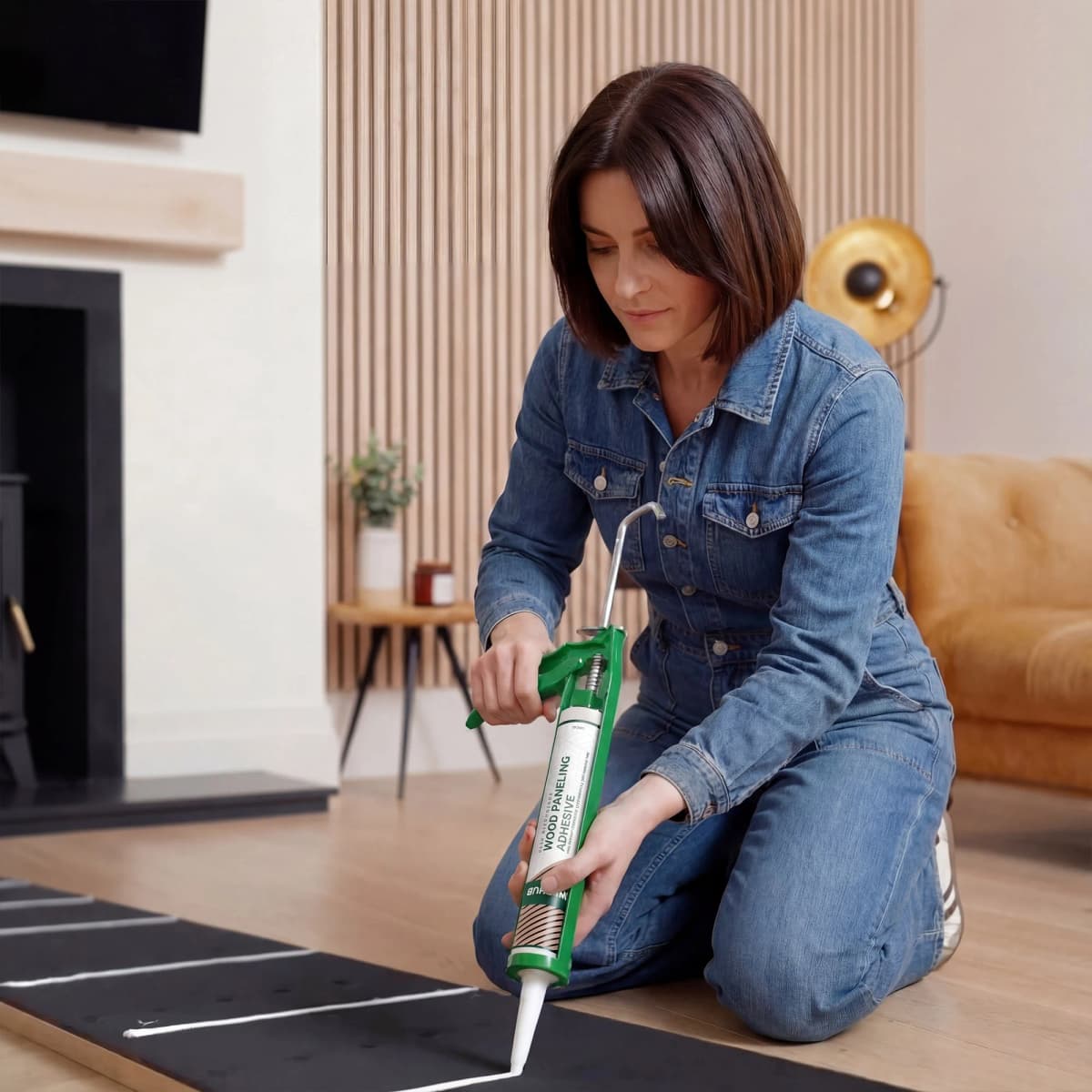
- Apply adhesive and install: Follow the standard installation sequence from our step-by-step installation guide.
Should You Add Mechanical Fixings?
For most standard domestic panel installations on sound drywall, construction adhesive alone provides sufficient holding strength. However, consider supplementing with screws if:
- Panels are particularly heavy (over 15kg per panel)
- The room experiences significant temperature or humidity variation
- You want a belt-and-braces approach for panels installed high up or in locations where a panel falling would be a safety risk
Use 50mm wood screws into studs where studs align with panels. Counter-sink and fill screw heads with a matching wood filler.
Ready to start? Browse the SoundPanel™ acoustic slat collection and the GroovePanel® mosaic range — both are designed for straightforward drywall installation with clear guidance included.
Drywall-Specific Installation Tips for Wood Panels
While drywall is one of the best panel substrates, a few specific preparation and installation steps maximise the result on this surface.
Prime the drywall first. New, unpainted drywall absorbs adhesive into the paper facing, reducing bond quality. A coat of diluted PVA (1:4 PVA to water) or a purpose-made primer seals the surface and ensures consistent adhesive coverage. On already-painted drywall, primer is not required unless the paint is flaking.
Locate your studs before installation. Even if you plan to rely entirely on adhesive, knowing where your studs are is useful. For heavier panels or for any installation in rooms with high humidity fluctuation (kitchens, bathrooms adjacent to the installation wall), supplementary fixings into studs provide long-term security that adhesive alone cannot guarantee.
Keep adhesive away from drywall seams. If your wall has drywall seams (the joints between sheets), avoid placing panel adhesive directly over them. Drywall seams can flex slightly and this movement can crack the adhesive bond over time. Apply adhesive on either side of a seam rather than across it.
Avoid installing panels over repair patches. Drywall patches (skim-repaired holes, filled screw holes) may have a different surface texture than the surrounding paper. Test your adhesive on any repaired areas before the main installation — if grip is inconsistent, a thin coat of PVA primer equalises the surface.
Drywall Panel Installation FAQs
How heavy a panel can drywall support with adhesive alone?
Standard 12.5 mm drywall can support panels up to approximately 15 kg/m² with correctly applied construction adhesive. Most residential slat and engineered panel systems are well within this range. For panels over 15 kg/m², supplement the adhesive with mechanical fixings into studs.
Can I install panels on newly plastered or skim-coated drywall?
Only once the plaster or skim is completely dry — typically 2–4 weeks for new plasterwork, depending on humidity and ventilation. Fresh plaster is alkaline and still contains moisture; both conditions reduce adhesive bond quality. Always test moisture levels with a moisture meter before installing panels on new plasterwork.
Will the panel adhesive damage my drywall if I want to remove panels later?
Removal of adhesive-fixed panels almost always damages the drywall paper facing to some degree. The extent depends on adhesive type and cure time — softer adhesives removed promptly cause less damage than fully-cured rigid adhesives removed months later. If you anticipate removal (rental property, temporary installation), use a peel-and-stick panel system or a batten mounting system that uses fewer wall fixings.
Can I use the same adhesive for drywall and for plaster walls?
Most hybrid polymer and polyurethane construction adhesives work on both surfaces. The key difference is that old plaster walls may be softer and less stable than drywall. Test the plaster surface with tape first — if paint pulls away with the tape, the surface needs consolidating with PVA primer before adhesive will bond reliably.
Browse Panels for Drywall Installation
Explore the complete wood wall panel collection at The Panel Hub — the SoundPanel™ acoustic slat range is specifically designed for adhesive installation on standard drywall. For design inspiration showing what’s achievable on a drywall substrate, our interior slat wall ideas guide covers 50+ real-room applications. The acoustic panel buyer’s guide explains the acoustic felt backing system that makes slat panels one of the most effective upgrades for a standard drywall room.