
Table of Contents
- What You’ll Need Before You Start
- Step 1: Prepare the Wall
- Step 2: Acclimatise Your Panels
- Step 3: Plan Your Layout
- Step 4: Apply Adhesive and Install the First Panel
- Step 5: Continue Across the Wall
- Step 6: Cut Panels to Fit
- Step 7: Finish Edges and Trim
- Troubleshooting: Common DIY Slat Wall Installation Problems
- FAQs: Installing Wood Slat Wall Panels
- Get Your Panels
What You’ll Need Before You Start
Gather everything before opening your panels. Stopping mid-installation to find a tool disrupts the process and risks panels drying in the wrong position.
Tools:
- Tape measure and pencil
- Spirit level (1m or longer)
- Fine-tooth hand saw or circular saw with fine-tooth blade (40–60 tooth)
- Utility knife
- Caulking gun
- Rubber mallet
- Sandpaper (120 grit)
- Damp cloth
Materials:
- Your slat wall panels (acclimatised for 24–48 hours in the room)
- Panel-compatible construction adhesive (solvent-free, hybrid polymer or PU-based)
- Matching trim strips or flexible caulk for edges
- Painters’ tape for temporary positioning
Step 1: Prepare the Wall
This is the most important step and the one most often rushed. A poorly prepared wall produces a poor installation regardless of panel quality.
- Remove anything on the wall: picture hooks, socket covers, skirting board if paneling to the floor
- Check for damp: tape a square of plastic sheeting to the bare wall for 48 hours; moisture on the wall-facing side indicates a damp problem to fix before proceeding
- Clean the surface: wipe down with a damp cloth to remove dust, grease, and any loose paint. Allow to dry fully.
- Repair damage: fill holes and cracks with interior filler; sand flush when dry
- Check flatness: hold a long spirit level or straight edge against the wall. Any deviation greater than 3–4mm over a panel width needs attention — either fill low spots or sand/plane high spots.
Step 2: Acclimatise Your Panels
Leave panels flat in the room for 24–48 hours before installation. Wood-based panels expand and contract with humidity, and installing before they’ve adjusted to the room’s conditions can cause bowing or gap changes after installation.
Store flat — never leaning against a wall, which causes bowing in panels that haven’t fully cured to room conditions.
Step 3: Plan Your Layout
- Measure the wall width and divide by your panel width to calculate how many panels you need and what the cut widths at each end will be.
- Mark the centre of the wall. Starting from the centre produces symmetrical end cuts on both sides. Starting from one corner is simpler but produces a different-width cut on the far side.
- Mark vertical reference lines at your starting position using a spirit level and pencil — these ensure your first panel is perfectly plumb, which all subsequent panels depend on.
- Plan around obstructions: mark the positions of sockets, switches, and any wall fixtures that panels will need to be cut around.
Step 4: Apply Adhesive and Install the First Panel
- Run a zigzag bead of construction adhesive across the back of the panel, approximately 5cm from each edge and in two or three runs across the middle. Avoid the very edge to prevent squeeze-out.
- Press the panel firmly against the wall at your reference line.
- Check immediately with a spirit level — both vertical and horizontal.
- Hold firmly for 60 seconds. Use painters’ tape to pin the panel in place while the adhesive develops initial grab (typically 10–15 minutes for most construction adhesives).
Step 5: Continue Across the Wall
Work outward from your starting panel. Butt each subsequent panel tight against the previous one — quality panel systems with machined edges will sit flush with no visible gap. Check level on every second or third panel; don’t assume the wall is flat enough to maintain level automatically.
Step 6: Cut Panels to Fit
At the ends of the wall and around obstructions:
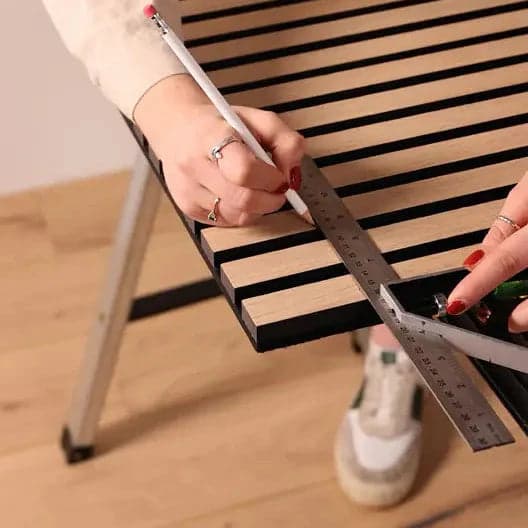
- For straight end cuts: measure the remaining gap, mark on the panel face, score the veneer with a utility knife, then cut with a fine-tooth saw. The scored line prevents veneer tear-out.
- For socket cutouts: mark the socket position on the panel back, drill a starter hole in each corner, then use a jigsaw to cut the opening.
- For ceiling or floor cuts: if the wall has a slight slope or the floor/ceiling isn’t perfectly level, scribe the panel to the surface using a compass set to the maximum gap.
Step 7: Finish Edges and Trim
- Apply matching timber trim strips to all exposed edges — where panels meet walls at corners, at the top edge if panels don’t reach the ceiling, and at the bottom if panels don’t meet the floor.
- Run a bead of flexible caulk where panels meet the ceiling and skirting board, smooth with a wet finger, and allow to dry before painting if required.
- Reinstall socket covers and switch plates over their cutout positions.
For the full context on what makes slat panel installations succeed or fail, our complete wood wall panel guide covers material selection and common pitfalls. And if your wall has specific challenges — old wallpaper, significant unevenness — our removing wallpaper before panel installation guide covers wall preparation in depth.
Troubleshooting: Common DIY Slat Wall Installation Problems
Even well-planned installations encounter issues. Here’s how to address the most common ones without starting over.
Panel drifting out of vertical after several rows: Caused by a wall that’s out of plumb or inconsistent spacers between panels. Solution: snap a fresh plumb line as a reference and re-check each panel against it before the adhesive sets. If panels have already set slightly off, introduce a thin correction shim behind the next panel to bring the run back to vertical.
Adhesive squeeze-out between panels: Excess adhesive that oozes into the gaps between slats is difficult to remove once cured. Prevention: apply adhesive in beads across the panel back, staying 20–30mm from panel edges. If squeeze-out occurs before curing, use a thin plastic card or spatula to remove the excess immediately. After curing, a sharp chisel carefully worked into the gap removes most adhesive without damaging the slat face.
Gap opening between panel modules after installation: Usually caused by skipping the acclimatisation period or installing in an unusually dry or damp environment. If gaps are minor (1–2mm), flexible wood-tinted caulk can be worked into the gap to close it visually. For significant gaps, remove and reinstall the affected panels with a 48-hour acclimatisation window first.
Cut panel edges looking rough: A circular saw or jigsaw with a fine-tooth blade will leave a cleaner cut edge than a coarse wood blade. For the cleanest finish, score the cut line with a sharp utility knife before cutting to prevent tear-out on the face side. Sand cut edges with 120-grit paper before installation — rough edges are visible in the finished wall.
FAQs: Installing Wood Slat Wall Panels
Do I need to remove skirting boards before installing slat wall panels?
Not always. Panels can be installed above skirting boards, with the panel base sitting on top of the skirting — this is the more common DIY approach. For a cleaner finished look, removing skirting boards and reinstating them in front of the panels after installation gives a more furniture-quality result.
What do I do about electrical sockets and switches?
Turn off power before working near electrical fittings. Cut the panel to fit around the socket box, leaving the socket accessible. Because the panels add 18–22mm of thickness to the wall surface, standard socket boxes will sit recessed behind the new panel surface. Use socket extender boxes (available from electrical suppliers) to bring the socket face flush with the new panel surface.
Can slat wall panels be installed over tiles?
Yes, but adhesive alone is not sufficient over a tiled surface. Mechanical fixing — screwing through the panel backing into the substrate behind the tiles — is required. This involves drilling through tiles, which requires a tile drill bit and careful technique to avoid cracking. Adhesive can be used as a secondary bonding layer, but shouldn’t be relied upon as the primary fixing method over tiles.
How do I install slat wall panels around a fireplace or chimney breast?
Panel installation around a chimney breast is a common application. The key considerations: maintain a minimum clearance from the fire opening as specified by the fireplace manufacturer (typically 150–300mm), use only non-combustible adhesive in areas near the heat source, and check that the timber species used has adequate fire resistance for the application. Consult the panel manufacturer’s installation guidelines for fireplace proximity requirements.
Get Your Panels
Browse the complete wood wall panel collection at The Panel Hub — including the SoundPanel™ acoustic slat range and the individual SoundPanel™ American acoustic slat panels, the most popular DIY installation product in the range. For room-by-room design inspiration before you install, our interior slat wall ideas guide covers 50+ applications. The acoustic panel buyer’s guide covers material specifications and acoustic performance in detail if you’re still choosing between panel types.