
Table of Contents
- Why Replace Wallpaper with Wall Panels?
- Can You Install Wall Panels Over Wallpaper?
- Tools and Materials You’ll Need
- Step 1: Score the Wallpaper
- Step 2: Soak and Strip
- Step 3: Remove the Backing Layer
- Step 4: Clean and Dry the Wall
- Step 5: Fill and Sand
- Step 6: Prime the Wall
- Step 7: Acclimatise Your Panels
- Step 8: Install the Panels
- Common Problems and How to Avoid Them
- The Finished Result
- Choose Your Panels
Why Replace Wallpaper with Wall Panels?
Wallpaper is beautiful when it’s new. But peeling seams, faded prints, and outdated patterns can make a room look tired quickly — and stripping it is notoriously difficult. Wood wall panels offer a longer-lasting, lower-maintenance alternative with the added benefit of acoustic performance, genuine material texture, and a look that doesn’t date the way patterns do.
This guide covers the full process from wallpaper removal to finished panel wall.
Can You Install Wall Panels Over Wallpaper?
In some cases, yes — but it’s not recommended. Adhesive-backed panels installed over wallpaper are only as secure as the wallpaper itself. If the wallpaper ever lifts, the panels lift with it. Additionally, old wallpaper can harbour moisture and mould that will be sealed in behind your new panels.
The correct approach: remove the wallpaper first, repair the wall, then install panels on a clean, stable substrate.
Tools and Materials You’ll Need
- Scoring tool or wallpaper scorer
- Warm water and wallpaper stripping solution (or fabric softener)
- Large sponge or sprayer
- Wide scraper / stripping knife
- Bucket
- Fine-grain filler and filling knife
- Sandpaper (120 grit)
- Primer (for bare plaster)
- Wall panel adhesive
- Caulking gun
- Spirit level
- Fine-tooth saw
Step 1: Score the Wallpaper
Use a scoring tool to perforate the wallpaper surface. This allows the stripping solution to penetrate through the facing layer to the paste beneath. Score evenly across the whole wall — don’t press too hard or you’ll damage the plaster underneath.
Step 2: Soak and Strip
Mix warm water with wallpaper stripping solution at the manufacturer’s recommended ratio. Soak a section of wall (roughly 1m²) and allow the solution to penetrate for 3–5 minutes. Using a wide scraper at a low angle (30°), work the wallpaper off in sheets. Rewet stubborn sections.
Work in small sections and keep the wall wet throughout — dried solution is harder to remove.
Step 3: Remove the Backing Layer
Most modern wallpapers have two layers — a decorative face and a backing paper. After removing the face, the backing often stays on the wall. Soak this too and scrape it away carefully. Don’t rush: backing paper left on the wall can cause adhesion problems for your new panels.
Step 4: Clean and Dry the Wall
Once stripped, wash the wall down with clean warm water to remove all paste residue. Any paste left on the surface will prevent your primer and panel adhesive from bonding properly. Allow the wall to dry completely — typically 24–48 hours depending on room temperature and humidity.
Step 5: Fill and Sand
Inspect the wall for damage: holes, cracks, uneven patches. Fill all defects with interior filler, allow to dry, and sand flush with 120-grit sandpaper. The flatter the wall surface, the better your panels will sit.
Step 6: Prime the Wall
Apply a coat of wall primer to bare plaster. This seals the surface, reduces suction, and ensures your panel adhesive bonds correctly. Allow to dry fully.
Step 7: Acclimatise Your Panels
Leave your panels flat in the room where they’ll be installed for at least 24 hours. This allows them to adjust to the room’s temperature and humidity, reducing the risk of warping or movement after installation.
Step 8: Install the Panels
- Plan your layout — measure the wall width and calculate panel positions. Mark the centre point.
- Apply adhesive — run a zigzag bead of panel-compatible construction adhesive across the back of the first panel.
- Position and level — press the panel firmly against the wall, check it’s plumb with a spirit level, and hold for 60 seconds.
- Continue across the wall — butt each subsequent panel tight against the last.
- Cut to fit — trim panels at corners, edges, sockets, and switches with a fine-tooth saw.
- Finish edges — apply matching trim strips or flexible caulk at wall edges and ceiling/floor joins.
Common Problems and How to Avoid Them
- Panels not sticking: Almost always caused by paste residue or damp on the wall. Thorough cleaning and drying before installation prevents this.
- Panels warping: Caused by installing before acclimatisation or on a damp wall. Allow 24–48 hours’ acclimatisation and check for damp before installing.
- Visible gaps between panels: Caused by uneven wall surface. Fill and sand the wall thoroughly before installation.
The Finished Result
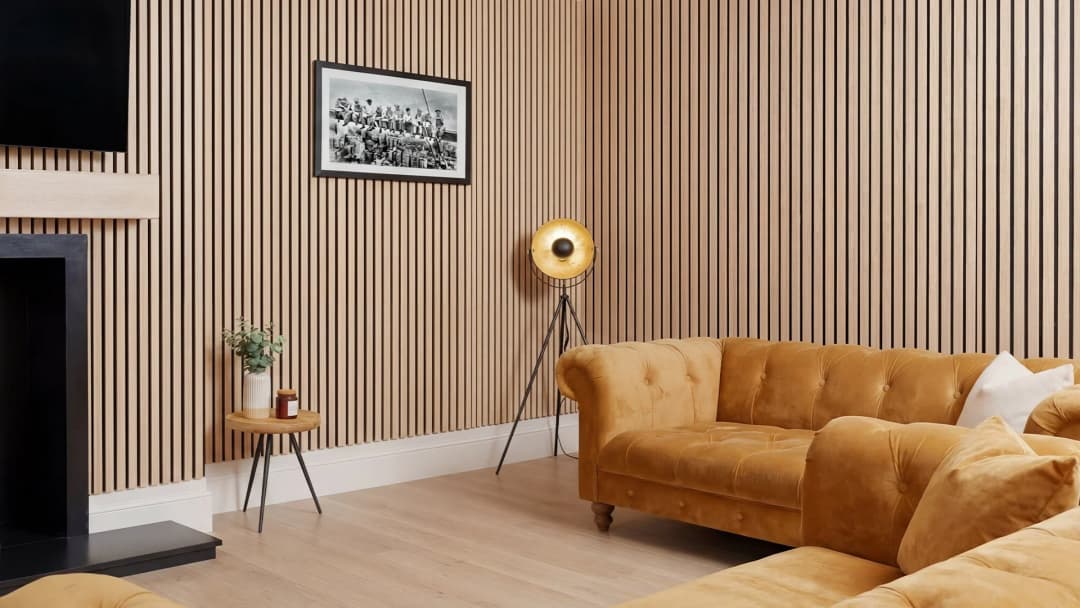
Done correctly, the transition from wallpaper to wood wall panels transforms both the look and feel of a room. Real wood veneer panels are more durable, easier to maintain, and more acoustically comfortable than any wallpaper — and they don’t peel at the seams after five years. The effort of proper wall preparation is always worth the result.
Choose Your Panels
Once your wall is prepared, browse the complete wood wall panel collection at The Panel Hub. The SoundPanel™ acoustic slat range is the most popular choice for DIY installations — designed for adhesive fixing on a properly prepared wall. For ideas on what to install once the wallpaper is gone, our interior slat wall ideas guide covers 50+ looks across every room. The acoustic panel buyer’s guide is useful if you’re still deciding between panel types.