
Table of Contents
What Are Hexagon Acoustic Panels?
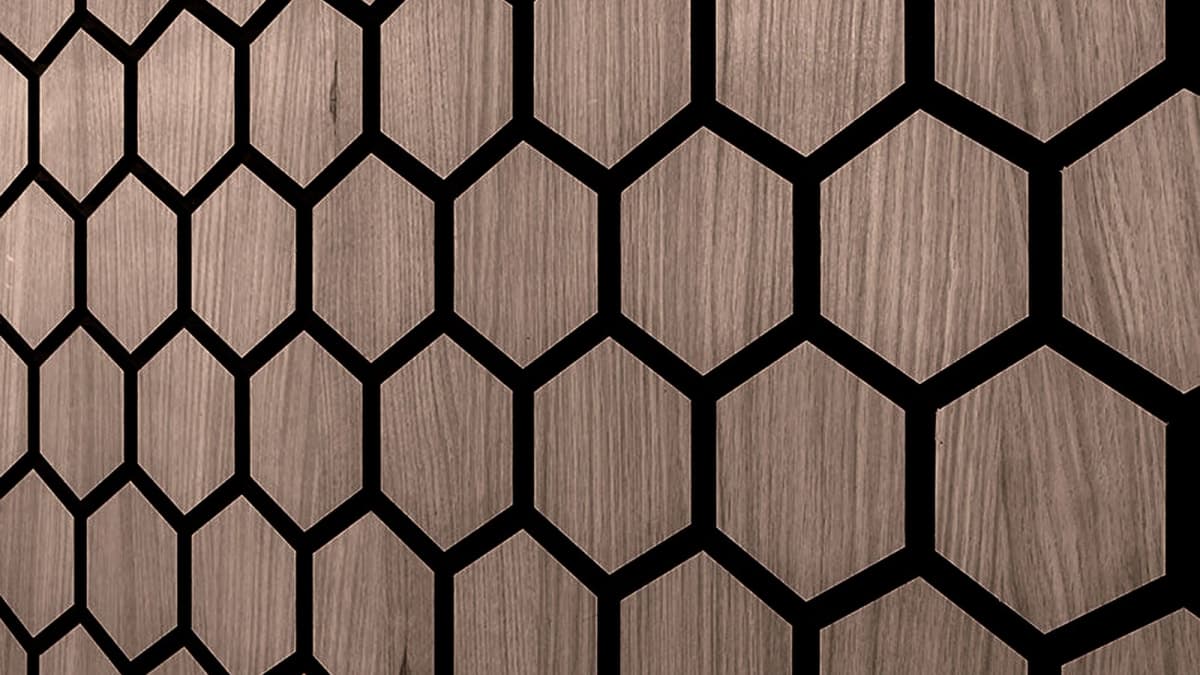
Hexagon acoustic panels are individual panel tiles cut to a six-sided hexagonal shape, designed to be arranged in a tessellating grid on a wall surface. Unlike full-width rectangular slat panels that cover a wall in continuous runs, hexagonal panels are modular — each tile is a discrete piece that can be arranged in different configurations, densities, and patterns.
They’re available in acoustic versions (with felt backing) for sound absorption and decorative versions for purely visual impact.
How They Differ from Standard Slat Panels
Standard acoustic slat panels are installed wall-to-wall in a continuous installation that typically covers an entire feature wall. Hexagonal panels offer a different design language:
- Modular: Each tile is independent. You can install a sparse arrangement, a tight grid, or a shaped cluster rather than a full wall.
- Graphic: The hexagonal tessellation creates a geometric pattern layer on top of the wood grain texture.
- Flexible placement: Tiles can be clustered around a specific area (above a desk, behind a sofa) rather than requiring a full wall installation.
- Scalable: Add tiles over time as budget allows, rather than committing to a full installation upfront.
Acoustic Performance
Acoustic hexagonal panels with felt backing achieve NRC ratings in the 0.55–0.75 range — effective, though typically slightly lower than full-coverage slat panel systems because the modular installation leaves untreated wall area between tiles.
Coverage strategy matters: a tightly packed hexagonal installation covering 30–40% of wall area will deliver meaningful acoustic improvement. A loose decorative scatter of 6–10 tiles will deliver minimal acoustic benefit despite the acoustic backing.
Design Ideas for Hexagon Panels
Statement Cluster Behind a Desk
A tight cluster of 12–20 hexagonal tiles directly behind a home office desk creates a focal point, identifies the work zone, and provides targeted acoustic treatment exactly where your voice projects during video calls. More visually dynamic than a rectangular panel installation for the same coverage area.
Bedroom Headboard Arrangement
Hexagonal tiles arranged in a honeycomb grid behind the bed create an architectural headboard wall effect. In a walnut finish against a light wall, the effect is graphic and premium. Allows you to vary the depth of coverage — wider at the centre, tapering toward the edges — for a shaped installation that a rectangular panel system can’t achieve.
Children’s Room Accent Wall
The hexagonal format suits children’s rooms and playrooms, where the geometric pattern adds visual interest appropriate to the space. Mix species or finishes within the tessellation for a more playful result.
Partial Coverage with Intentional Gaps
Rather than full tessellation, leave deliberate gaps between tiles to create a scattered, organic arrangement that feels more decorative than installed. Works particularly well in creative studios and informal living spaces.
Installation
Individual hexagonal tiles are typically lighter than full wall panels, making them easier to handle solo. Most use adhesive mounting — applying construction adhesive or heavy-duty double-sided tape to the back of each tile. The modular format means mistakes are easier to correct than with full-run slat installations.
Use a level and a consistent spacing guide for the first row — the hexagonal tessellation will compound any misalignment as you add rows.
Coverage Planning for Hexagon Panel Installations
Hexagon panels introduce a geometry that standard rectangular coverage calculations don’t account for. Getting the count right before ordering your wood wall panels prevents both shortfalls and expensive excess.
Account for edge geometry. A hexagonal tile grid creates irregular edges at wall boundaries — the partial tiles needed to fill the edge zone can account for 10–20% of your total tile count, depending on wall proportions. When measuring your wall and estimating tile count, add 15% over the theoretical coverage to account for edge cuts.
Map the layout before ordering. Unlike rectangular tiles that align automatically to a grid, hexagonal tiles require a defined centre-point for the installation. The visual balance of the finished panel arrangement depends heavily on where the first tile is placed. Mark the centre of your target wall, then plot the tile layout on paper or use a visual planning tool before you commit the first tile with adhesive. Changes to hexagon installations are disproportionately difficult — the interlocking geometry makes partial replacements visually obvious.
Consider the shadow gap effect. Hexagonal tiles installed with a consistent 2–3mm gap between tiles create a shadow line effect that adds visual depth and helps disguise minor alignment variations. Tiles installed flush (zero gap) require extremely precise alignment — any deviation is immediately visible. The gap installation method is more forgiving and typically looks better at larger scales.
Mixing colour and texture. Hexagon panels lend themselves to mixed-finish arrangements — alternating walnut and oak tiles, or a gradient from light to dark across the panel cluster. Plan the colour distribution before installation rather than making it up as you go; random-looking arrangements usually require deliberate planning to look genuinely balanced.
Frequently Asked Questions
- What are hexagon acoustic panels used for?
- Hexagon acoustic panels are primarily used as feature wall installations in living rooms, bedrooms, home offices, and home theatres. They serve the same acoustic function as rectangular acoustic panels (absorbing echo and reverberation) but with a distinctive geometric aesthetic that makes them a visual centrepiece rather than a flat treatment wall.
- Do hexagon acoustic panels absorb as much sound as regular panels?
- Performance depends on the backing material, not the shape. Hexagon panels with high-density acoustic felt backing achieve comparable NRC ratings to rectangular slat panels — typically NRC 0.75–0.85. The shape affects coverage pattern (more gaps between tiles than rectangular panels) but the felt backing absorbs sound effectively wherever it’s exposed.
- How are hexagon acoustic panels installed?
- Most hexagon panels are installed with construction adhesive applied to the back of each tile. The lightweight construction makes them suitable for adhesive-only installation on smooth plaster or drywall. Some systems include interlocking edge connectors that allow dry installation — tiles clip together before the assembled cluster is fixed to the wall.
- Can hexagon acoustic panels be removed and reinstalled?
- Adhesive-installed hexagon tiles are not easily removed without damage to the tile or the wall. Hook-and-loop (industrial Velcro) backing systems allow removal and reinstallation — useful in rental properties or where the installation may need to move. Check the manufacturer’s specification for whether this option is available.
- What size do hexagon acoustic panels come in?
- The most common residential hexagon tile size is 200mm or 300mm point-to-point (the distance between opposite corners). Larger tiles (400mm+) are typically used in commercial applications. For most domestic feature walls, 200–300mm tiles provide a well-proportioned visual scale relative to standard ceiling heights.
Are They Right for Your Project?
Hexagonal panels are the right choice when you want modularity, geometric character, and the ability to create a shaped or clustered installation rather than a wall-to-wall coverage. For maximum acoustic performance or the classic contemporary slat look, full-run rectangular panels remain the stronger choice.
For acoustic treatment ideas across different rooms, our accent wall ideas guide has broader inspiration, and the acoustic wall panel buyers’ guide will help you compare all panel types on performance. Browse the SoundPanel® Hexagon Acoustic Wall Panel at The Panel Hub for dimensions, finishes, and NRC data.