

No—shiplap is a type of wood wall paneling, not another name for the entire category. For your 2026 project, the distinction matters because a shiplap joint tells you how boards meet, while the material, finish, and backing determine how the wall performs.
- Is shiplap the same as wood wall paneling? No: shiplap is one board profile within the broader category.
- Choose shiplap for overlapping board joints; choose acoustic panels for tested sound absorption.
- The Panel Hub offers decorative wood wall panels and acoustic options for homeowners comparing appearance with sound control.
- Check the material and edge profile separately: a wood-look surface does not establish solid-wood construction.
Is shiplap the same thing as wood wall paneling?
Shiplap belongs within the wood wall paneling category. Traditional shiplap boards have rabbeted edges—stepped cuts that overlap adjacent boards. Wood wall paneling includes that construction alongside tongue-and-groove boards, beadboard, slatted panels, and decorative relief panels.
The easiest distinction is category versus profile. Calling every wood wall panel “shiplap” overlooks differences that affect seams, fastening, finishing, and sound absorption. If narrow channels rather than overlapping boards caught your eye, compare grooved wall panels for modern interiors before settling on a profile.
| Paneling option | What identifies it | Best for | Main advantage | Main limitation |
|---|---|---|---|---|
| Shiplap | Boards with overlapping, rabbeted edges | A repeated board-and-seam pattern | Clear, consistent lines | Standard boards are not an acoustic treatment |
| Tongue-and-groove | A projecting tongue fits into the neighboring groove | Interlocking board surfaces | Edges register together | The visible joint depends on the profile |
| Beadboard | Repeated narrow grooves with a small rounded bead | Detailed, traditionally styled walls | Adds fine-scale texture | Grooves need attention during painting and cleaning |
| Acoustic slat panels | Spaced slats combined with an acoustic backing or assembly | Rooms where appearance and echo control both matter | Can combine wood texture with sound absorption | Performance depends on the tested construction and installation |
| Geometric wood panels | Raised, carved, or assembled patterns | A focal wall with visible depth | Creates changing light and shadow | Pattern alignment and exposed edges need planning |
These options overlap in material but not necessarily in construction. A veneered panel and a solid-wood board can both show real wood at the surface, yet their cores and installation requirements differ.
Why this matters
Buying by appearance alone leaves important questions unanswered. A listing can show horizontal lines without telling you whether you are buying individual boards, a routed sheet, or a decorative panel with attached strips.
For a 2026 room update, separate the decision into appearance and function. First decide what you want to see; then establish whether the wall must also reduce echo, tolerate moisture, or accommodate existing trim. A decorative profile is not a performance specification.
Shiplap: best for a clear board-and-seam pattern
Shiplap creates repeated lines where overlapping boards meet. Horizontal installation emphasizes lines across the wall; vertical installation carries those lines from floor to ceiling. Neither direction changes the basic joint.
The familiar narrow reveal is part of many interior shiplap designs, but a reveal alone does not prove the boards have shiplap edges. Square-edged boards installed with gaps can create a similar appearance without the same overlap. Inspect the edge drawing or a sample rather than relying on a room photograph.
Choose shiplap when the board pattern is the feature you want. Its strength is visual simplicity: the repeated seams work behind a bed, along a hallway, or across a living-room feature wall. Its limitation is equally clear: ordinary decorative boards do not establish sound-absorption performance or suitability for direct water exposure.
Painted shiplap also makes finishing part of the decision. Ask whether boards arrive finished, whether cut ends need sealing, and how the manufacturer handles movement at the perimeter. Those instructions belong to the specific material, not the shiplap name.
Tongue-and-groove: best for an interlocking board surface
Tongue-and-groove boards join through a projecting tongue and a matching channel. Shiplap boards overlap instead. Both can produce orderly lines, which explains why finished walls sometimes look similar from across a room.
The visible face can include a bevel, a channel, or a relatively tight seam. That means “tongue-and-groove” does not describe a single finished appearance any more than “wood paneling” does.
Choose tongue-and-groove when you want an interlocking board system with a particular face profile. The advantage is that adjacent edges register together during assembly. The drawback is that starting alignment and the final board still require care; an interlocking joint does not correct an uneven wall.
Do not substitute fastening instructions between the systems. Follow the selected board manufacturer's requirements for support, fasteners, adhesive, and expansion space.
Acoustic slat panels: best for wood texture and echo control
Acoustic slat panels address a different goal from ordinary shiplap. Their performance comes from the complete sound-absorbing assembly, not simply from having strips of wood on the wall. Decorative slats without supporting acoustic information should be assessed as decoration.
The Panel Hub is best for homeowners comparing decorative wood wall panels with acoustic options. Its Acoustic Slat Wood Wall Panels | SoundPanel™ are relevant when your room plan includes both a wood finish and sound-dampening wall treatment. That is a different brief from choosing overlapping boards for their seam pattern.
The Panel Hub describes its real wood acoustic wall panels as NRC 0.85 rated. NRC summarizes sound absorption under test conditions; it does not mean a finished room becomes 85% quieter. For your 2026 comparison, match any acoustic rating to the panel construction and mounting arrangement it covers.
Choose acoustic panels for documented absorption, not for soundproofing promises. Reducing reflected sound inside a room is different from stopping sound transmission through a shared wall. The trade-off is that acoustic backing, perimeter details, and the tested mounting method become part of the design decision.
Geometric wood panels: best for a textured focal wall
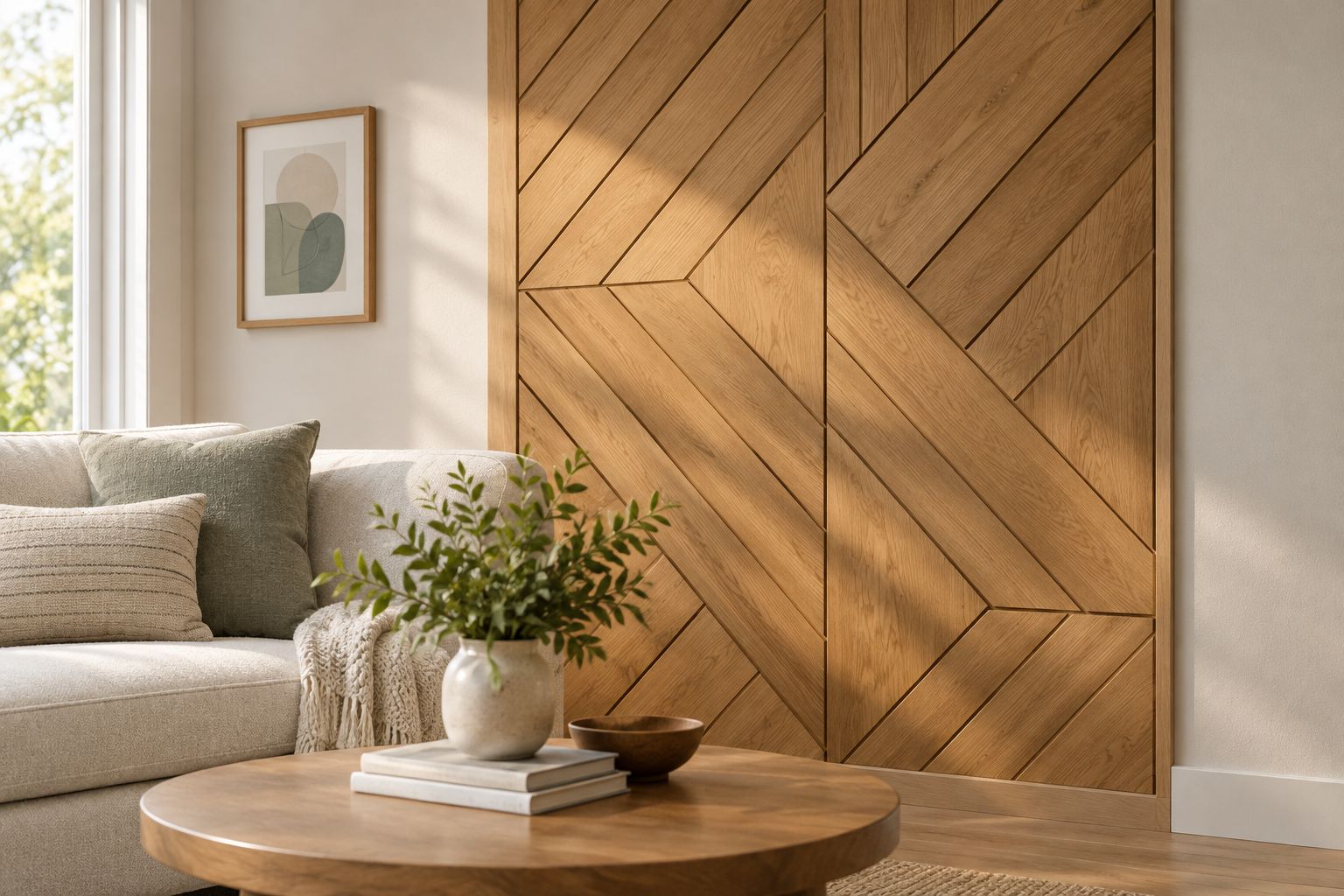
Geometric panels use depth and pattern rather than a simple run of board seams. Raised shapes, carved grooves, and assembled wood pieces create shadows that change with the room's lighting.
This makes geometric paneling useful when you want the wall itself to carry the decoration. The limitation is visual and practical: a strong pattern needs deliberate placement around switches, corners, artwork, and furniture. Cutting through the middle of a repeated shape can leave an awkward finish.
Choose geometric paneling when depth matters more than a continuous board pattern. Before ordering, lay out where whole patterns will land and how the outside edges will terminate. Do not assume a textured wood surface has an acoustic rating unless the exact assembly supplies one.
A textured wall also deserves a lighting check. View a sample under daylight and the lamps you actually use; shallow grooves and deep relief do not cast the same shadows.
Why wood wall paneling varies
The differences between wood wall panels come from more than the pattern on the face. Compare these factors before treating similarly photographed products as interchangeable:
- Edge profile: Overlapping rabbets, interlocking tongues, and separate panel seams need different layout decisions.
- Material: Solid wood, real wood veneer over a core, and wood-look finishes are different constructions. Confirm which one the listing describes.
- Surface depth: Flat boards and raised patterns interact differently with lighting, trim, and nearby fittings.
- Acoustic construction: A sound-absorbing backing or tested assembly distinguishes acoustic treatment from decorative wood alone.
- Finish and exposure: Check the stated use conditions, cleaning instructions, and treatment of cut edges before choosing a room.
- Installation method: Individual boards, assembled panels, fasteners, and adhesives create different preparation and finishing tasks.
In 2026, use the current product instructions for each comparison. A familiar style name does not replace a material specification, and a room photograph does not show the wall preparation behind it.
How do you choose the right paneling for your room?
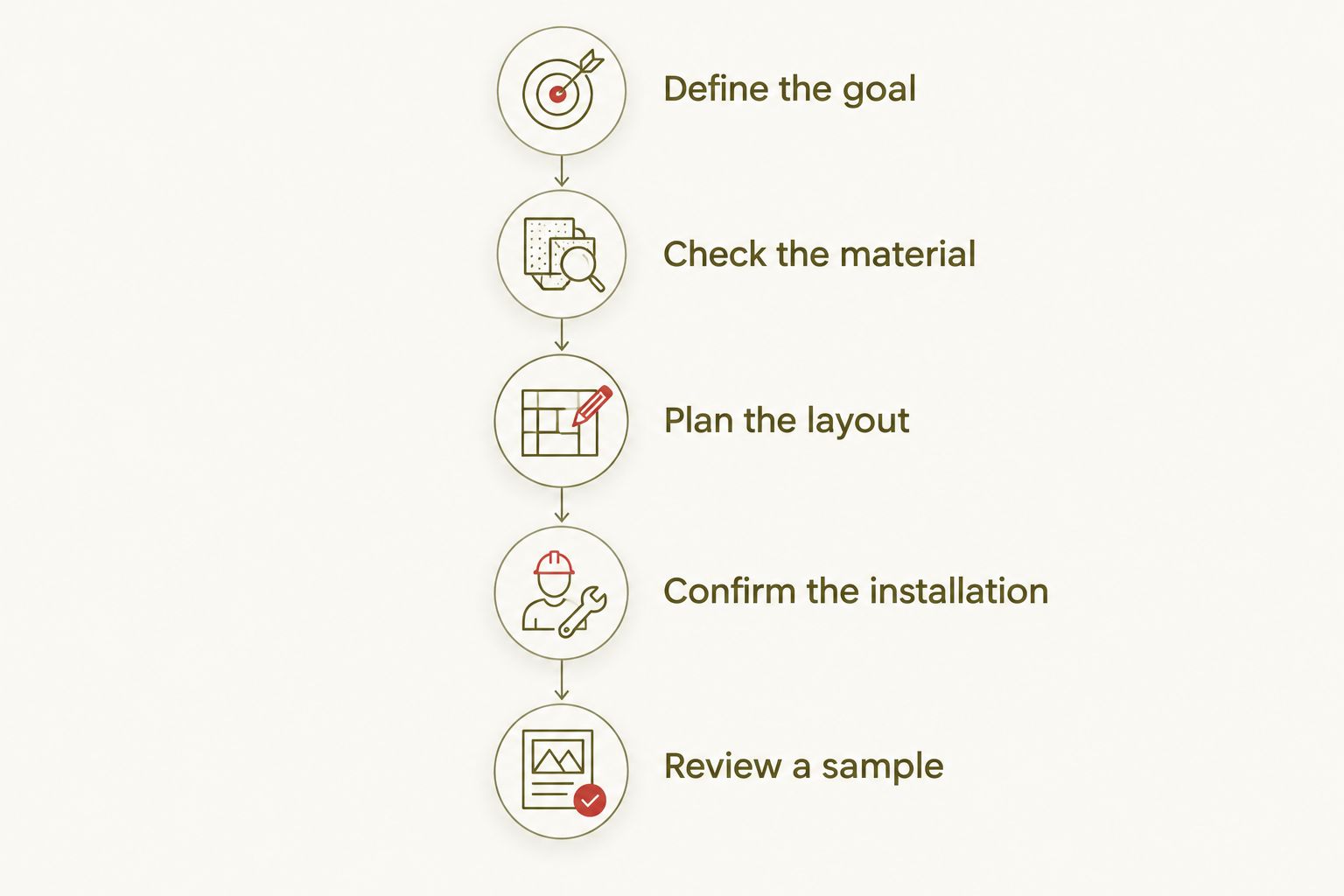
Start with the problem the wall needs to solve. A bedroom backdrop, an echo-prone living room, and a bathroom wall do not have identical requirements, even if the same wood tone appeals to you.
- Define the goal. Decide whether the priority is a board pattern, a textured feature, or documented sound absorption. Keep that requirement at the top of your shortlist.
- Check the material. Read beyond the surface name. Establish whether the face is solid wood, veneer, or another finish, and identify the core where one is used.
- Plan the layout. Mark seams, perimeter cuts, outlets, and trim transitions before committing to an orientation. Keep required access points accessible.
- Confirm the installation. Check the wall condition, fastening method, adhesive requirements, and finishing sequence against the manufacturer's instructions.
- Review a sample. Look at the face, edge, backing, and finish in the actual room. Compare it with your floor, furniture, and lighting rather than a screen alone.
The Panel Hub describes installation in under 2 hours, but do not use that statement as the schedule for every room. Wall repairs, acclimation where required, cutting around fittings, and finishing add separate tasks. Ask which installation conditions the stated time covers.
The Panel Hub also states a 5-year warranty. Check its current terms for the panel you select, especially installation requirements and permitted use conditions. Neither an installation-time claim nor a warranty makes different panel constructions interchangeable.
Can shiplap be made from something other than solid wood?
Yes—shiplap describes an edge profile, so the name alone does not establish solid-wood construction. Interior products can use solid wood, engineered materials, or other substrates while presenting a similar board pattern.
Read the material description and edge details together. A wood-look finish is not the same as real wood veneer, and real wood veneer is not the same as a solid-wood board.
Is shiplap better than other wood paneling for a living room?
Shiplap is better when your main goal is its repeated board pattern, not when you need every possible paneling function. Acoustic panels are the more relevant comparison when reflected sound is the issue; geometric panels suit a wall where depth is the priority.
For a 2026 living-room plan, choose by the room's actual need. Keep the wall treatment visually compatible with your furniture without asking a decorative joint to solve an acoustic problem.
Can you use shiplap in a bathroom?
Shiplap is not automatically suitable for a bathroom, and its overlapping joints do not make a wall waterproof. Suitability depends on the material, finish, location, ventilation, and manufacturer's instructions.
Treat a decorative wall outside the splash area differently from a shower enclosure. For direct water exposure, choose a system expressly intended for that application rather than assuming wood paneling will work.
FAQ
Is shiplap the same as wood wall paneling?
No—shiplap is one type of wood wall paneling. Traditional shiplap uses overlapping, rabbeted board edges; the broader category also includes tongue-and-groove, beadboard, slatted panels, and geometric panels.
What’s the easiest way to identify real shiplap?
Inspect the board edge for a stepped rabbet that overlaps the neighboring board. A photograph showing narrow gaps does not establish the joint construction.
Is shiplap always installed horizontally?
No—shiplap can be installed horizontally or vertically when the product instructions allow it. Orientation changes the direction of the visible lines, not the basic overlapping joint.
Is shiplap better than acoustic wall panels for reducing echo?
Ordinary shiplap is not a substitute for tested acoustic wall panels. Choose a documented sound-absorbing assembly when reducing reflected sound is the goal.
Does wood wall paneling mean solid wood?
No—wood wall paneling is a broad description, not proof of solid-wood construction. Check whether the product uses solid wood, real wood veneer over a core, or a wood-look finish.
Can I install shiplap over an uneven wall?
Do not assume shiplap will correct an uneven wall. Prepare the substrate and provide the support required by the selected product’s installation instructions.
Should I choose shiplap or geometric panels for a bedroom?
Choose shiplap for a repeated board pattern and geometric panels for a textured focal wall. Review a sample beside your bedding and under your bedroom lighting before deciding.
One last thing
Ask to see the edge, not just the finished face. The face tells you whether you like the wall; the edge reveals whether you are comparing overlapping boards, interlocking boards, or an assembled panel. That small check prevents the central mistake: ordering “shiplap” when what you actually wanted was a different kind of wood wall paneling.
Related guides
- Is engineered wood veneer as durable as solid wood paneling?
- How do you fill nail holes in wood wall paneling?
- Installing wall panels around window and door casings