
Table of Contents
Why the Core Material Matters
Most people focus on the surface of a wall panel — the veneer species, the colour, the profile — and overlook the core. But the core material determines how the panel behaves over time: whether it warps, how it responds to humidity, how much it weighs, and how well it holds fixings. For a product that’s going on your wall for the next decade, it’s worth understanding.
What Is MDF?
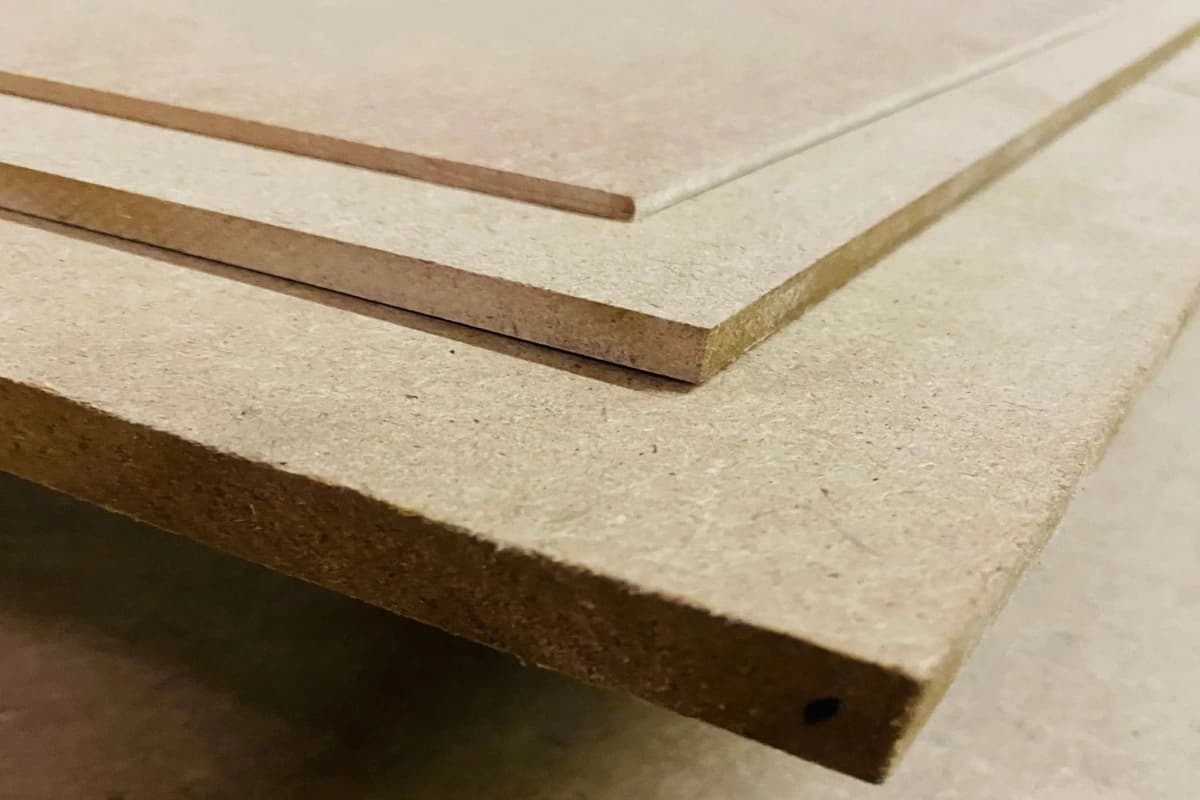
MDF — Medium Density Fibreboard — is an engineered wood product made from wood fibres compressed with resin under high heat and pressure. The result is a dense, uniform, smooth-surfaced board with no grain direction. It doesn’t expand and contract with humidity the way solid timber does, which makes it dimensionally stable — ideal for panels where flat, consistent surfaces are critical.
Most quality wood wall panels use MDF as their core, with real wood veneer bonded to the face.
What Are Solid Wood Panels?
Solid wood panels — or solid timber panels — are made from real timber throughout, with no engineered core. They can be single wide planks, edge-glued boards, or finger-jointed strips. The wood character runs all the way through the panel.
Head-to-Head Comparison
Dimensional Stability
- MDF core: Highly stable. Minimal movement with seasonal humidity changes. Panels stay flat.
- Solid wood: Expands and contracts with humidity. Can warp, cup, or crack if not properly acclimated and installed. Requires more careful management in rooms with variable humidity (kitchens, bathrooms).
Winner: MDF core
Surface Quality
- MDF core: Perfectly flat, smooth surface — ideal for veneering. The veneer bonds evenly with no grain telegraphing through.
- Solid wood: Surface texture and character depend on the species and cut. More variable, which is either a feature or a problem depending on your preference.
Winner: Draw (depends on preference)
Weight
- MDF core: Heavy for its size — denser than most solid timber species. Full wall panels can be heavy to manoeuvre during installation.
- Solid wood: Varies by species. Lighter species (pine) are easier to handle; hardwoods (oak, walnut) comparable to or heavier than MDF.
Winner: Draw
Moisture Resistance
- Standard MDF: Swells significantly when exposed to moisture. Not suitable for wet areas unless specified as MR-MDF (moisture-resistant).
- MR-MDF core (CoreShield™): Engineered for improved moisture resistance — suitable for most domestic interior applications.
- Solid wood: Naturally variable. Oily species (teak, cedar) perform better in moist environments; most hardwoods still require sealing.
Winner: MR-MDF core (for most applications)
Cost
- MDF core with veneer: Lower cost than solid wood at equivalent coverage area. Veneer makes premium wood species accessible at reasonable prices.
- Solid wood: Significantly more expensive per square foot, especially in premium species.
Winner: MDF core
Repairability
- MDF core with veneer: Veneer can be re-oiled and lightly sanded, but deep scratches reaching the MDF core cannot be repaired in-place.
- Solid wood: Can be sanded, planed, and refinished — scratches and marks can often be removed entirely.
Winner: Solid wood
What Most Quality Wall Panels Use
The vast majority of quality acoustic and decorative wood wall panels on the market use an engineered MDF or MR-MDF core with real wood veneer. This combination delivers the visual authenticity of real wood with the dimensional stability and surface consistency that makes a clean, professional installation possible.
Pure solid wood panels exist — particularly in the form of solid wood tile mosaics and solid timber planks — and they offer an unmatched sense of material authenticity. But for most wall panel applications, the veneer-over-MDF construction is the practical and economic choice.
See our guide to installing wall panels for advice on working with both panel types. And if you’re just starting your panel research, the complete wood panel wall guide gives a full overview of the category.
MDF vs Solid Wood Wall Panel FAQs
Is MDF strong enough for wall panels?
Yes — MDF is an appropriate substrate for wall panel applications in all normal interior environments. It provides a flat, consistent surface for veneer or paint finishes, machines cleanly for precise edge profiles, and is dimensionally stable enough for fixed-in-place wall installations where it is not subject to load-bearing stress or heavy impact. Its weakness is moisture: standard MDF degrades in high-humidity environments, so moisture-resistant MDF should be specified for kitchens, bathrooms, and basement rooms.
Can MDF wall panels be refinished?
Painted MDF panels can be repainted indefinitely — lightly sand the existing surface, apply a fresh coat of primer if the existing finish is chalky or peeling, and apply new topcoat. MDF panels with real wood veneer faces can be lightly sanded if the surface develops fine scratches, but cannot be refinished to the same depth as solid wood panels — the veneer is typically 0.6–1.0mm thick, which allows one or two light sandings before the substrate becomes visible. Solid wood panels can be planed, scraped, or sanded back multiple times over their lifetime.
Which is easier to cut: MDF or solid wood?
MDF is significantly easier to cut cleanly than solid wood. It is dimensionally consistent, has no grain direction to cause splitting, and requires no special technique to achieve clean edges. Solid wood requires sharper blades (to prevent splintering along grain lines), more careful feed rate, and attention to cutting direction relative to grain. For DIY installations, MDF is more forgiving to cut and work with. The trade-off is the fine dust produced by cutting MDF — always wear appropriate respiratory protection and work in ventilated conditions.
How do I fix MDF wall panels to a wall?
The standard method is a combination of panel adhesive and mechanical fixings. Apply adhesive to the back of the panel in a zigzag pattern, press to the wall and secure with panel pins or screws until the adhesive cures. For heavier panels (above 8kg), use mechanical fixings as the primary method with adhesive as a supplement. Always ensure fixings penetrate either wall studs, masonry plugs, or battens rather than just plasterboard — plasterboard alone will not hold the weight of a panel over time.
Browse by Core Material
Explore both core material options in the complete wood wall panel collection at The Panel Hub — and order samples to compare the difference in hand before committing to a full order. The SoundPanel™ acoustic slat range uses an engineered MDF core with real wood veneer face — the most practical combination for residential panel installations. For panels that are 100% solid timber throughout — no MDF core, no veneer face — the GroovePanel® geometric range is the definitive solid wood option, available in crossing lines, concentric square, mosaic, and 3D relief formats. For design inspiration, our interior slat wall ideas guide covers 50+ room applications. The acoustic panel buyer’s guide explains how core material choice interacts with acoustic performance.