
Table of Contents
Two Different Formats, Same Category
Wood wall panels come in two fundamentally different formats: large-format panels (full-height slat or plank systems that run floor to ceiling) and modular tile panels (smaller-format tiles — hexagonal, mosaic, geometric — arranged in patterns on the wall). Both use real wood; both install on walls; both add warmth and texture. But they create very different effects and suit very different applications.
Large Format Panels
Large format panels — typically 2.4m high × 0.5–0.6m wide — install in continuous vertical runs to create a seamless wall treatment. The scale is the point: floor-to-ceiling slat panels create a bold architectural statement with strong directional lines and a sense of visual continuity.
Visual character: Dramatic, architectural, defined. The vertical lines dominate the room’s visual field.
Installation: Straightforward for rectangular walls; more complex around obstacles. Fewer individual pieces to position.
Acoustic performance: Optimised for acoustic backing systems — large format panels with AcuFelt™ backing cover significant wall area efficiently.
Best applications: Living room feature walls, bedroom headboard walls, home office backgrounds, home theatre side walls.
Wood Panel Tiles (Mosaic, Hexagonal, Geometric)
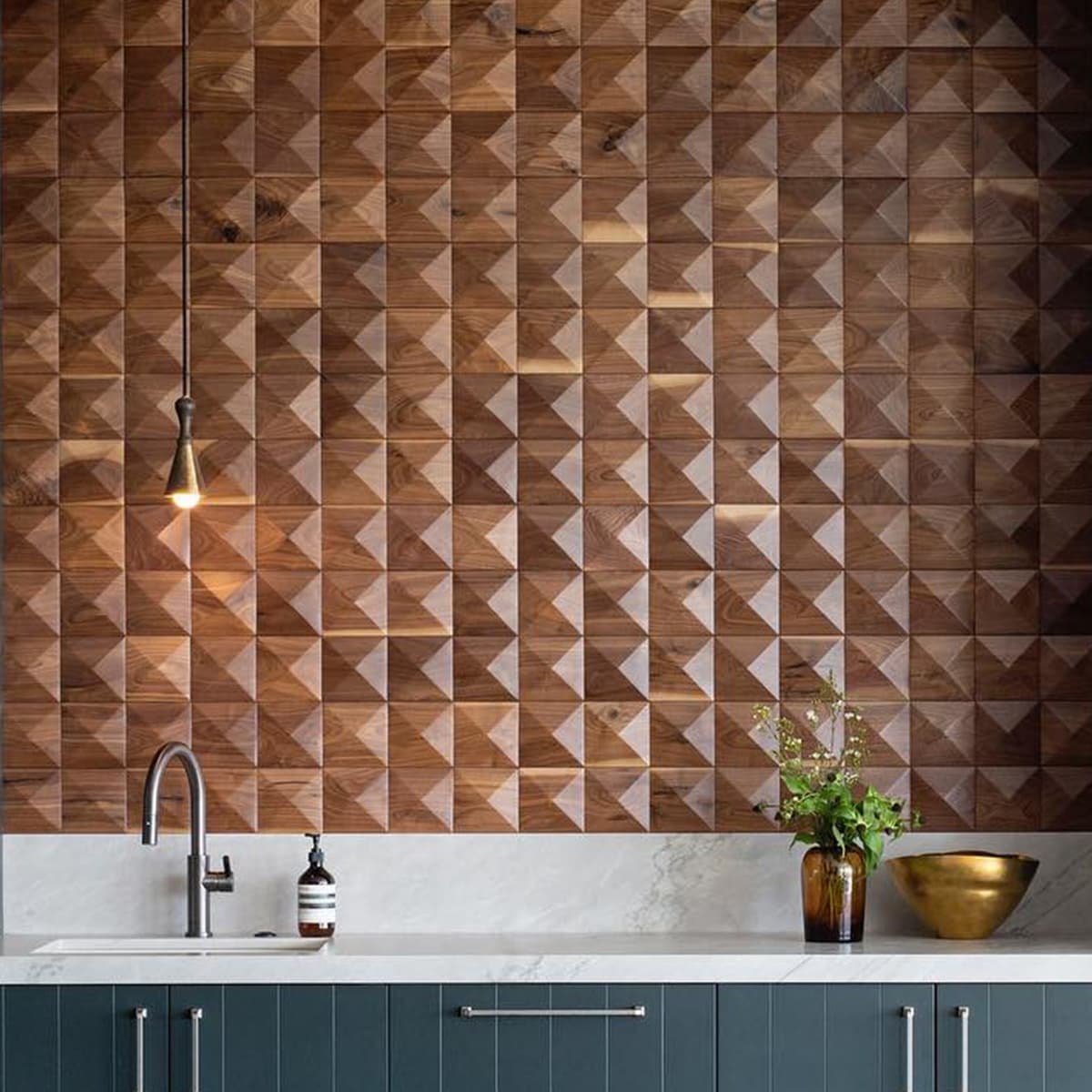
Modular tile panels — like the GroovePanel® mosaic collection — use smaller individual pieces arranged in patterns. Each tile is a discrete element; the wall treatment is built up tile by tile rather than panel by panel.
Visual character: Graphic, geometric, artisanal. The pattern layer adds visual complexity on top of the wood grain texture.
Installation: More pieces to handle and position, but each is lighter and easier to manage individually. Pattern alignment requires careful planning.
Acoustic performance: Dependent on backing and coverage — modular tiles typically leave gaps between tiles that reduce acoustic coverage per wall area.
Best applications: Feature clusters (above a desk, behind a bar), bathroom walls, kitchen splashbacks, children’s rooms, any application where a shaped or partial wall treatment suits better than full coverage.
Side-by-Side Comparison
| Feature | Large Format Panels | Tile/Mosaic Panels |
|---|---|---|
| Visual scale | Bold, room-defining | Graphic, decorative |
| Installation speed | Faster (fewer pieces) | Slower (more pieces, more alignment) |
| Flexibility of coverage | Best for full walls | Best for shaped or partial coverage |
| Acoustic performance | Higher (more coverage) | Lower per wall area |
| Cost per m² | Lower (less waste) | Higher (more waste at edges) |
| Pattern variety | Slat/fluted/reeded | Mosaic, herringbone, hexagon, geometric |
Can You Combine Both?
Yes — and this is an underused design approach. Large format slat panels as the primary feature wall, with a mosaic tile panel as an accent detail (above the fireplace, within an alcove, behind a bar area) creates layered visual interest that neither format achieves alone.
Which to Choose
- Large format panels for: maximum acoustic impact, full feature wall treatments, contemporary and Japandi aesthetics, home theatres. Browse the SoundPanel™ acoustic slat range.
- Tile/mosaic panels for: shaped installations, partial coverage features, bathrooms and kitchens, graphic pattern interest. Browse the GroovePanel® mosaic collection.
Installation Considerations for Each Format
The format difference isn’t just visual — it directly affects how you plan, cut, and install your panels, and how forgiving each format is when walls aren’t perfectly square.
Large format panels typically cover an entire wall height in one or two pieces. This means fewer seams, faster installation overall, and a more seamless finished look. The tradeoff: large panels require precise cutting around sockets, switches, and architectural features. Any measurement error becomes visible across the full height of the panel.
Wood panel tiles — mosaic, hexagonal, and geometric formats — install like wall tiles but without grout. Individual tiles are smaller and more forgiving. You can trim edge tiles to fit irregular walls, work around features easily, and correct a misaligned row as you go. Mistakes stay local rather than affecting the whole wall.
Wall preparation: Both formats need a flat, clean surface. Large format panels amplify substrate imperfections because their long straight edges reveal any bowing. Panel tiles can hide minor wall undulations slightly better due to their smaller individual size.
Coverage calculation: Large format panels are sold per panel with fixed dimensions. Tiles are typically sold by the square metre or box. For wall coverage estimates, measure total wall area in m², add 10% for cuts and waste, and select accordingly.
FAQs: Wood Panel Tiles vs Large Format Panels
What is the difference between panel tiles and large format panels?
Panel tiles are individual pieces installed in a repeating grid or pattern — similar to ceramic tiles but made from wood. Large format panels are single full-height or full-width boards covering a larger area with fewer pieces and fewer visible seams.
Which is easier to install for a first-time DIYer?
Panel tiles offer more margin for error on individual pieces, making them slightly more forgiving for first-time installers. Large format panels are faster overall but require more precise measuring and cutting before a single panel goes up.
Can wood panel tiles go in bathrooms?
Only if the product is rated for damp conditions. Most wood veneer panel tiles are not suitable for direct water contact. Some composite or engineered options are designed for bathroom feature walls where they won’t receive direct splashing. Always check the manufacturer’s specification.
Do large format panels need to hit studs?
Not necessarily. Panels installed with construction adhesive bond directly to the substrate. For heavier panels over 10kg/m², mechanical fixing — nails, screws, or concealed clips — is recommended alongside adhesive for long-term security.
Browse Both Panel Formats
Explore both formats at The Panel Hub — the GroovePanel® mosaic tile range and the SoundPanel™ large-format acoustic slat panels — alongside the full wood wall panel collection. Ordering samples of both formats before committing is the most reliable way to evaluate the visual scale difference in your specific room. Our interior slat wall ideas guide shows both formats in real-room applications, and the acoustic panel buyer’s guide covers how format choice affects acoustic performance.