
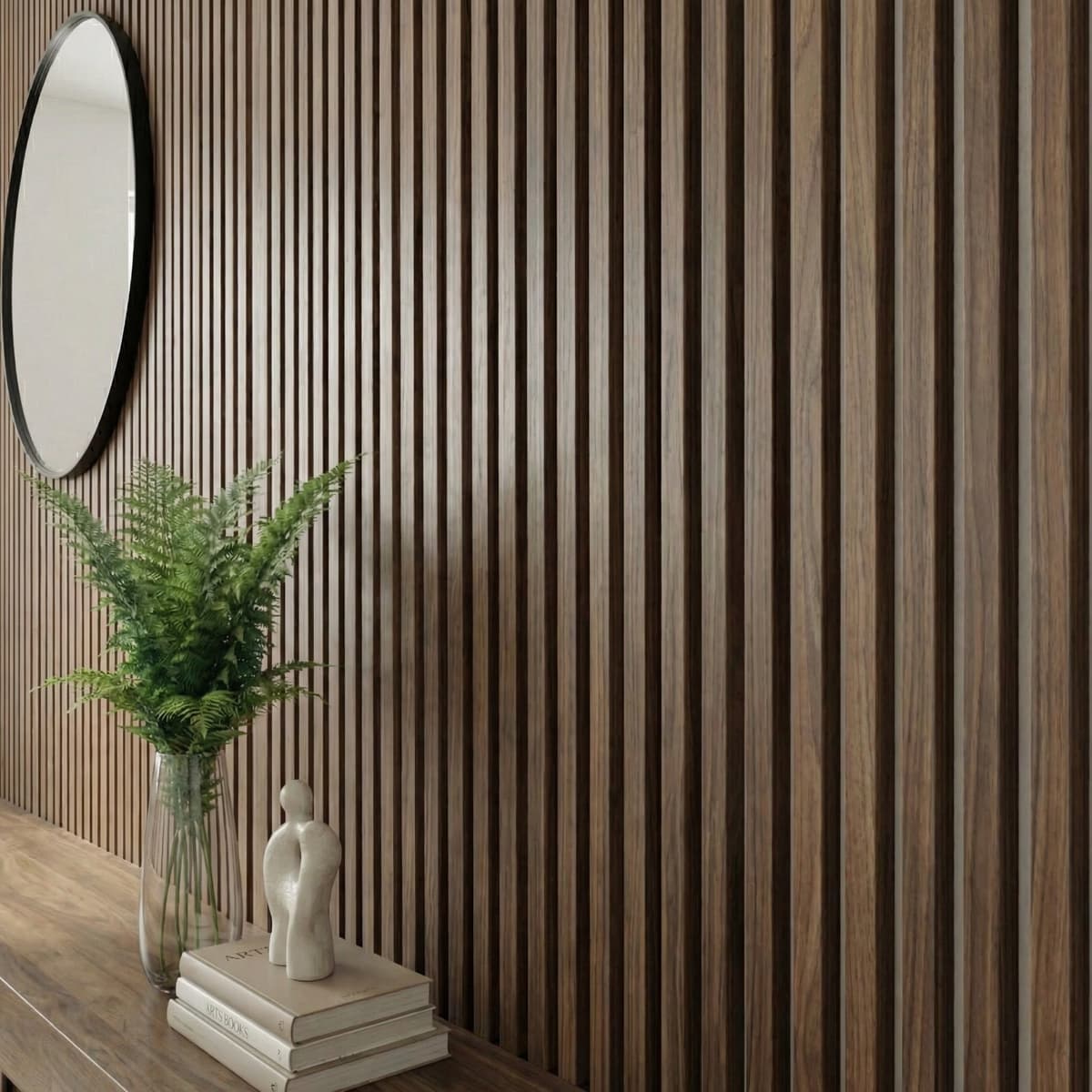
You’ve seen slat walls in hotel rooms, design blogs, home offices, and probably your Instagram feed more times than you can count. There’s a reason they keep showing up. A slat wall does something that paint, wallpaper, and most other wall treatments can’t — it changes the spatial feel of a room through geometry. The parallel lines create direction. The shadow between each slat creates depth. The wood surface creates warmth. All three together make a room feel considered in a way that’s hard to fake with anything else.
This guide covers everything you need to go from idea to finished wall: the types available, how to choose between them, which rooms they work best in, and a step-by-step install process that works for TPH’s SoundPanel line specifically.
Table of Contents
- What Are Slat Wall Panels?
- Types of Slat Wall Panels
- Vertical vs Horizontal: Which Direction?
- Slat Wall Ideas by Room
- Slat Wall Panel Ideas: Design Moves Worth Knowing
- How to Install TPH SoundPanel Slat Wall Panels
- Common Mistakes to Avoid
- Caring for Slat Wall Panels
- Frequently Asked Questions
- Where to Start
- Shop Slat Wall Panels
What Are Slat Wall Panels?
Slat wall panels are pre-built boards consisting of narrow wooden strips — slats — mounted at regular intervals over a backing material. You buy them as a panel, not as individual strips. One panel covers a section of wall at once, the panels connect to each other, and the result is a continuous slat surface across the full wall.
This matters more than it sounds. Buying individual slats and mounting them one-by-one means spacing 60–80 strips perfectly on a standard wall, keeping every gap identical, and dealing with any wall imperfections strip by strip. Panel-format slat walls are pre-spaced, pre-built, and connect with a clean edge. Installation is measured in hours, not days.
The backing material is where types diverge meaningfully — and where most guides stop being useful.
Types of Slat Wall Panels

Not all slat wall panels are the same product. The slat face is only half of what you’re buying. The backing — what’s behind the slats — determines acoustic performance, installation method, weight, and price. Here’s a clear breakdown.
Acoustic Slat Panels (Wood Veneer + Felt Backing)
The category TPH’s SoundPanel sits in, and currently the most popular residential slat panel in the market. Real wood veneer slats over an HDF core, mounted over high-density acoustic felt backing. The gaps between slats allow sound to pass through to the felt, which absorbs it rather than reflecting it back into the room.
TPH’s SoundPanel uses AcuFelt 1500 g/m² backing — that density matters, it’s what delivers the NRC 0.85 rating. Absorbs 85% of sound energy hitting the surface. FSC-certified. 3-sided rounded edges. Ships from North Carolina. Installs in under 2 hours per wall.
Best for: Any room where both aesthetics and acoustics matter — living rooms, bedrooms, home offices, home theaters, dining rooms
NRC: 0.85
Slat width: Typically 10–20mm
Installation: Adhesive + optional screws through felt backing
Decorative Slat Panels (No Acoustic Backing)
Same visual profile as acoustic panels — same slat spacing, same wood veneer face — but with no felt backing. Purely visual. These are lighter and lower cost, and are the right choice when acoustics genuinely don’t matter to you.
The honest limitation: without backing, the NRC is near zero. The slats reflect rather than absorb. If you’re treating a home office or a room with echo, decorative-only slat panels won’t solve the problem.
Best for: Accent walls where visual warmth is the only goal
NRC: Negligible
Installation: Adhesive direct to wall
Horizontal Slat Panels
The same construction as vertical, rotated 90 degrees. Horizontal lines read differently in a space — they emphasise width rather than height, which works particularly well in narrow corridors, low-ceiling rooms, or any space where you want the eye to travel along the wall rather than up it.
Horizontal slat panels can be acoustic or decorative depending on the backing. The installation process is identical — the orientation is a design decision, not a structural one. More on horizontal wall paneling.
Best for: Hallways, rooms with low ceilings, wide feature walls
Fluted and Reeded Panels
Technically not slat panels, but frequently confused with them. Fluted panels have concave channels milled into a solid face — no gaps between elements, no backing required. Reeded panels have convex ridges. Both create a linear texture without the open-gap structure of a true slat panel.
The tradeoff: no acoustic benefit at all, since there’s no gap for sound to pass through. The aesthetic is more architectural and formal than slat panels. Works well in hallways, dining rooms, and spaces where you want texture without the warmth of visible wood grain.
Best for: Formal spaces, painted feature walls, kitchen island cladding
WPC Slat Panels (Outdoor)
Wood-plastic composite panels for exterior use. Real wood fibre combined with polymer — the slat profile is similar to interior versions but the material is weather-resistant and stable in moisture. If you’re cladding an exterior wall, covered patio, or garden room, WPC is the right material. Standard wood veneer panels are not suitable outdoors. WPC outdoor panel guide.
Best for: Exterior walls, covered patios, garden rooms, outdoor kitchens
Vertical vs Horizontal: Which Direction?
This is the most common design question about slat walls, and the answer is spatial rather than stylistic.
Vertical slats draw the eye upward. They make ceilings feel higher and rooms feel taller. This is why vertical slat walls are the default in most living rooms and bedrooms — the proportional improvement is immediate and works in almost any room. If you’re unsure, go vertical.
Horizontal slats draw the eye sideways. They make walls feel wider and rooms feel lower and more intimate. This works well in narrow corridors where you want the space to feel less like a tunnel, or in rooms with high ceilings where you want to bring the visual weight down.
There’s no wrong answer — but knowing what each direction does spatially helps you make an intentional choice rather than just copying what you’ve seen elsewhere.
Slat Wall Ideas by Room
Living Room
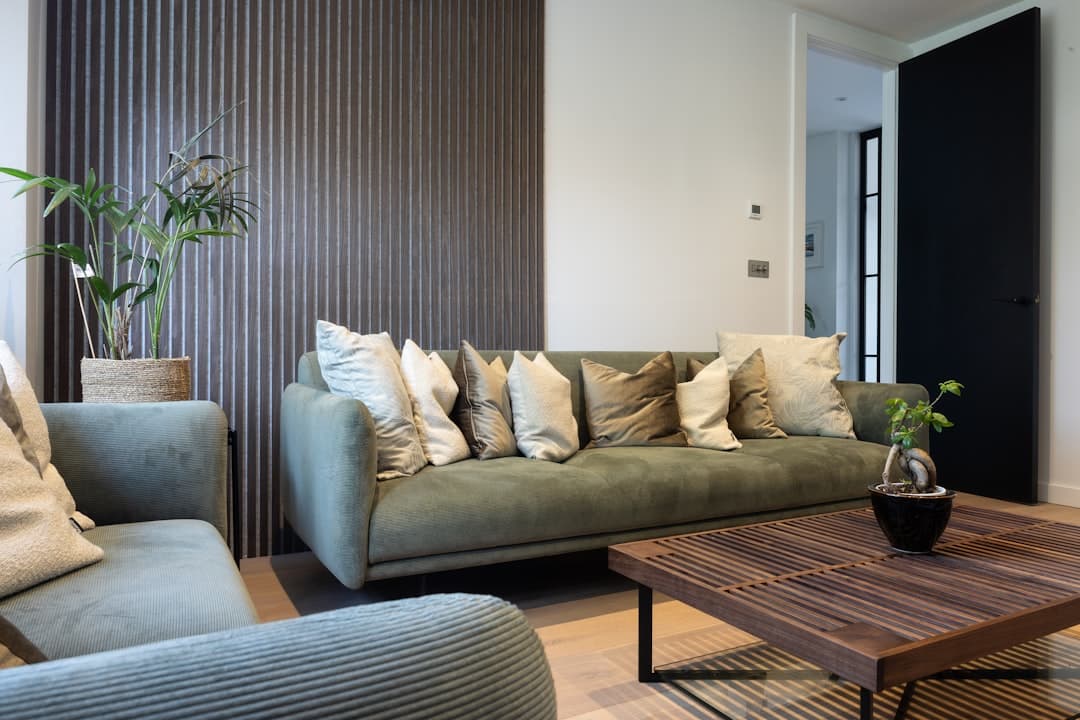
The most popular application. A full slat wall behind the sofa anchors the room and gives it a focal point that doesn’t require artwork or accessories. Behind a TV it frames the screen cleanly — the parallel lines of the wall echo the rectangular geometry of the display and make the whole setup look designed rather than assembled.
Acoustic slat panels work especially well in open-plan living rooms, where hard floors and high ceilings create flutter echo that makes conversations feel louder than they are. One treated wall changes the acoustic feel of the whole room.
Best wall: Behind the sofa or as a TV feature wall
Best finish: White Oak for lighter rooms, Walnut for warmer or darker schemes
Orientation: Vertical — draws the ceiling up — Living room panel ideas
Bedroom
A full-width slat wall behind the bed is the single most impactful bedroom upgrade you can make for the money. It replaces the need for a headboard, creates a hotel-suite quality backdrop, and — if you use acoustic panels — makes the room measurably quieter. People sleep better in lower-reverberation environments. That’s not marketing, it’s basic acoustics.
Extend the panel wall beyond the width of the bed and add wall-mounted bedside lights directly to the slat surface for a fully integrated look.
Best wall: Full headboard wall, floor to ceiling
Best finish: American Walnut — warm, dark, creates enclosure and calm
Orientation: Vertical — Bedroom panel ideas
Home Office
Two problems, one solution. Slat panels behind your desk absorb the echo that makes every video call sound hollow, and they create a clean, textured backdrop that reads well on camera. A grey painted wall looks flat and forgettable on a call. A walnut slat wall looks like you made a decision about your space.
This is the strongest acoustic argument for slat panels outside of a home theater. Hard surfaces — drywall, glass desk, hard floor — create a flutter echo at the speech frequency range (500Hz–2000Hz) that NRC 0.85 panels address directly.
Best wall: Behind the desk, camera-facing
Best finish: Charcoal or American Walnut — both read cleanly on camera
Orientation: Vertical — Office and gaming room setups
Hallway
Hallways are narrow, usually under-lit, and mostly ignored. A slat wall panel on one side transforms them into something architectural. The directional lines of vertical slats create visual movement that makes the corridor feel intentional rather than transitional. Horizontal slats on a particularly narrow hallway push the walls apart visually.
Hallways are also one of the easiest spaces to panel — the wall area is modest, there are usually no outlets to cut around, and a single wall is often enough.
Best wall: The longer wall
Best finish: White Oak brightens dark hallways; Charcoal creates drama in well-lit ones
Orientation: Vertical for height, horizontal for width
Dining Room
Hard floors, glass, and painted walls make dining rooms acoustically brutal — conversations bounce off every surface and the room gets louder as more people talk. One acoustic slat wall behind a banquette or sideboard absorbs enough to drop the ambient noise level without killing the energy of a dinner table.
Darker finishes work especially well in dining rooms — walnut or charcoal creates the warm, intimate quality of a restaurant booth that makes people want to stay at the table.
Best wall: Behind a bench seat or sideboard
Best finish: American Walnut or Golden Oak — Dining room wall panels
Home Theater and Gaming Room
Acoustic treatment isn’t optional in a home theater — it’s what makes the equipment investment worthwhile. Side walls are the highest priority: first reflection points from speakers are the primary source of flutter echo and image smearing. Rear wall treatment handles the echo that returns to your listening position after crossing the room.
Charcoal and dark walnut finishes also absorb light scatter and improve perceived screen contrast — a practical benefit on top of the acoustic one.
Coverage needed: Side walls + rear wall, 25–35% of total wall area
Best finish: Charcoal — absorbs light, maximises contrast — Home theater guide
Slat Wall Panel Ideas: Design Moves Worth Knowing
Floor to ceiling beats half-wall. The proportional impact of a full-height slat wall is dramatically stronger than stopping at mid-height. When you can see both the floor and the ceiling as a continuous plane, the room reads taller. Half-height panels look like a decision that ran out of budget.
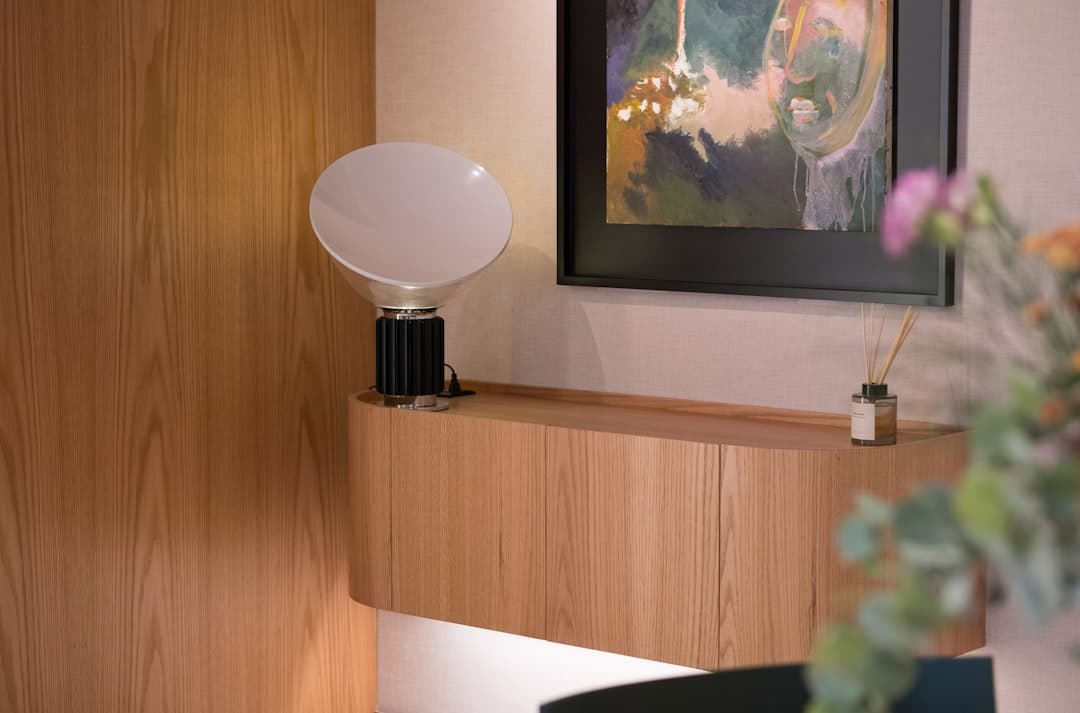
Light it from the side. Raking light — from a floor lamp, a wall sconce, or morning sunlight — catches the edge of each slat and creates the shadow pattern that makes slat walls look three-dimensional. Overhead downlights flatten the effect. If you’re installing in a living room, plan a side light source to make the most of the texture.
Let the wall breathe. A slat wall doesn’t need to be covered with things. Resist the instinct to hang art or shelves in front of it. The panel is the feature. One large piece of art to one side is fine. A gallery wall on top of a slat wall is visual noise.
Use the panel as a headboard platform. Mount wall sconces or reading lights directly through the felt backing on either side of the bed position. No holes in the plaster, no wall repair if you reposition. The felt takes screws cleanly.
Integrate LED strip lighting. LED strips in the channel between panels or behind the bottom edge create ambient underlighting that makes the slat pattern visible even without a side light source. Works especially well in home theaters and gaming rooms.
How to Install TPH SoundPanel Slat Wall Panels
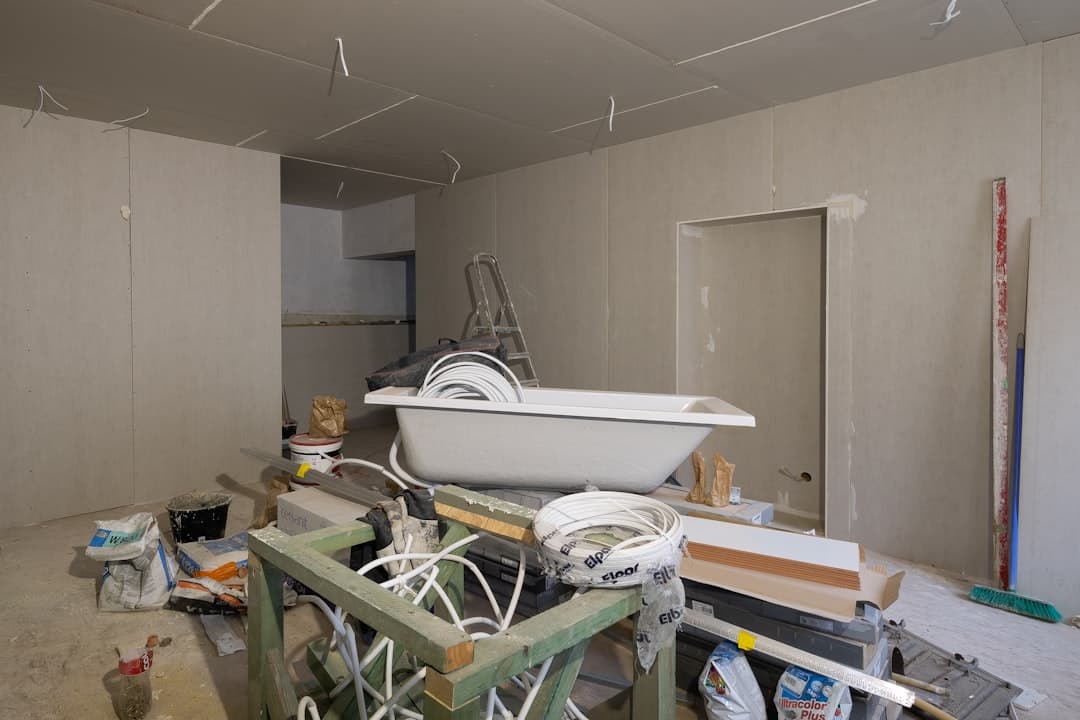
TPH’s SoundPanel is designed for DIY installation. Here’s the complete process for a standard flat interior wall.
What You Need
- Tape measure and pencil
- Spirit level or laser level
- Construction adhesive (Liquid Nails or panel-specific adhesive) — adhesive guide
- Adhesive gun
- Circular saw or oscillating tool
- Screws (3.5mm × 35mm minimum) and drill — optional but recommended for permanent installations
- Jigsaw for outlet cutouts
Before You Start
Acclimate the panels. Leave them flat in the room for 24–48 hours before installation. Wood acclimates to room humidity and temperature — installing cold panels into a warm room can cause slight movement after fixing.
Decide on orientation. Vertical or horizontal. Read the section above if you’re undecided. Commit before you start — you can’t change direction mid-wall.
Plan your layout. Measure your wall width. Divide by panel width to calculate how many panels you need and what width the end panel will be. Aim to avoid a very thin strip at one end — if the last panel would be less than a third of full width, trim a little from both the first and last panel so the margins look balanced and intentional.
Prepare the wall. Clean, dry, and reasonably flat. Remove loose paint, fix large dips or protrusions. You don’t need to skim or plaster — minor imperfections disappear behind the panel. Remove baseboards at the bottom if you’re going floor to ceiling, so panels sit flat to the floor. How to cut wall panels.
Step 1 — Mark Your Starting Line
Use a spirit level or laser to draw a true vertical line at your starting point. This is the most important step. Any drift here compounds across the wall. Take your time on this line — everything that follows references it.
If you’re starting from a corner, check whether the corner itself is plumb. Most aren’t perfectly vertical. Start your first panel against the line, not the corner, and fill any gap with a trim strip or caulk after.
Step 2 — Cut the First Panel to Height
Measure your floor-to-ceiling height. Most panels need a top cut to fit. Measure twice, mark the cut line across the full panel width, and cut with a circular saw. A straight edge clamped to the panel as a saw guide gives the cleanest cut. Cutting tips for wall panels.
If you’re going floor to ceiling without baseboards, cut the panel to the exact floor-to-ceiling measurement. If you’re leaving the baseboard in place, cut to the height from top of baseboard to ceiling.
Step 3 — Apply Adhesive
Run a zigzag bead of construction adhesive across the felt backing of the panel — not in straight lines, which can leave unbonded sections. Cover the full panel back. For permanent installations, apply adhesive to both the panel back and the wall surface for maximum bond strength.
Don’t apply adhesive to the slat faces themselves — only the felt backing contacts the wall.
Step 4 — Press and Secure
Lift the panel to the wall, align the edge with your starting line, and press firmly from top to bottom. The felt backing grips the wall immediately — you won’t need to hold it in place.
Check the edge alignment against your level line. Adjust now if needed — you have about 60 seconds before the adhesive starts to set.
For a permanent installation, drive screws through the felt backing into wall studs. 3 screws per row, roughly every 300–400mm vertically. The screws pass through the felt without splitting it and are hidden behind the slat faces — invisible from the front. For walls where you expect shelves or wall-mounted items, adhesive alone is sufficient for the panels themselves, but screw fixings give you additional load-bearing points.
Step 5 — Work Across the Wall
Butt the second panel tightly against the first. The slat lines create the visual alignment — when the slats of adjacent panels line up, the join disappears. Check the far edge of each new panel with your level before pressing to confirm you haven’t drifted.
Stagger any horizontal joins if your wall is taller than one panel height — offset by at least half a panel width so the joins don’t create a visible horizontal line across the wall.
Step 6 — Handle Outlets and Switches
Measure the position of the outlet on the wall precisely — distance from the floor and from the panel edge you’re working from. Transfer those measurements to the back of the panel. Drill a starter hole inside the marked area, then cut with a jigsaw. Test the fit before applying adhesive.
If a slat falls partly over an outlet opening, cut that slat cleanly at the edge of the opening. The small piece that falls off can be re-attached with a dab of construction adhesive after the panel is fixed to the wall.
Step 7 — Trim the Last Panel
Measure the remaining gap at the end of the wall. Rip the last panel to width with a circular saw using a straight-edge guide. The cut edge faces the wall corner or ceiling — the factory edge faces outward. If the cut edge is visible (at an external corner, for example), sand lightly and finish with a matching trim strip.
Realistic Timing
A standard 8×10 ft accent wall takes most people 1.5–2.5 hours on their first installation. The second wall is noticeably faster. A full room treatment — three or four walls — is a comfortable full-day project for two people.
Common Mistakes to Avoid
Not checking the starting line for plumb. Everything follows that first line. Spend five extra minutes getting it true with a proper level — not just eyeballing it against the wall corner.
Installing without acclimating. Panels that haven’t acclimated can shift slightly as the wood adjusts to room conditions. 24–48 hours flat in the room is all it takes.
Stopping at the baseboard height. If your baseboard is staying in place, panels sitting on top of it leave a gap at the floor that looks unfinished. Remove the baseboard first, install the panel to the floor, then reinstall the baseboard over the bottom edge of the panel. Clean result, no gap.
Rushing outlet cutouts. Measure twice before cutting. An outlet hole that’s 5mm too large can’t be undone. Mark it on the back, check the position twice, cut conservatively, and test the fit before gluing.
Covering the wall with things. The slat pattern is the feature. Give it room to breathe. One considered accessory is fine. Five things competing with the texture undermines the whole effect.
Caring for Slat Wall Panels
Low maintenance is part of the value. Here’s the short version:
- Dust regularly with a dry microfiber cloth. Run it along the slats, not across them.
- For marks: Damp cloth with mild soap, dried immediately. Don’t saturate the wood face.
- Acoustic felt: Vacuum through the slat gaps once a year. Dust in the felt reduces its absorption performance over time, slowly — annual maintenance keeps it performing at full efficiency.
- Avoid steam and sustained moisture. The wood veneer is real and responds to humidity. Not a bathroom material unless you’re using waterproof panels specifically.
Frequently Asked Questions
Do slat wall panels actually improve acoustics?
Only if they have a high-density acoustic backing. Decorative slat panels without backing have near-zero acoustic benefit — the wood reflects sound rather than absorbing it. TPH’s SoundPanel achieves NRC 0.85 because of the AcuFelt 1500 g/m² backing behind the slats. That backing is what does the acoustic work.
Can I install slat wall panels over existing wallpaper?
Not recommended. Wallpaper creates an uneven, potentially unstable substrate. Strip it first, skim-coat any damage, and install onto clean flat wall.
Can I install them myself?
Yes. TPH’s SoundPanel is designed for DIY. The tools you need are basic — a circular saw, a level, adhesive, and a drill if you’re screw-fixing. A standard accent wall takes 1.5–2.5 hours.
Vertical or horizontal — does it affect installation?
No. The installation process is identical. Orientation is purely a design decision about how you want the room to feel spatially.
How do I deal with a wall that isn’t perfectly flat?
Minor imperfections — small bumps, texture, old painted surfaces — are fine. The panel bridges across them. Large dips (more than 5mm deep over 300mm) should be filled first so the panel has enough contact area for the adhesive to hold properly.
How many panels do I need?
Use the Box Calculator — enter your wall dimensions and it returns a panel count with a waste allowance factored in.
Can slat panels be painted?
TPH’s wood veneer panels are pre-finished and designed to show the natural grain — painting them covers the wood character that makes them worth buying. If you want a painted slat panel, MDF-based slat panels are made for that purpose.
Where to Start
If you want to see how different finishes look on your actual wall before committing, the Room Visualizer does that. Open the Room Visualizer.
If you want to feel the wood and the backing material in hand before ordering — which you should — sample boxes are available. Order a sample box.
If you’re ready to browse finishes, sizes, and configurations across the full SoundPanel range: Shop SoundPanel acoustic slat panels.
And if you want to explore the decorative slat options without acoustic backing: Shop all wood wall panels.
The Panel Hub’s SoundPanel uses real wood veneer over HDF cores with AcuFelt 1500 g/m² high-density backing. NRC 0.85. FSC-certified. Designed in the USA, shipped from North Carolina. 3-sided furniture-grade rounded edges.
Shop Slat Wall Panels
Browse the complete wood wall panel collection at The Panel Hub — including the SoundPanel™ acoustic slat range and the GroovePanel® mosaic tiles. For even more slat wall inspiration beyond the ideas covered here, our interior slat wall ideas guide covers additional room applications and design approaches. The acoustic panel buyer’s guide explains the acoustic performance specifications for slat panels — NRC ratings, backing systems, and what to look for before you buy.