
Table of Contents
- Why Wood Slat Panels Dominate Living Room Design Right Now
- The Three Main Living Room Applications
- Acoustic Benefits in Open-Plan Living
- Choosing the Right Species for Your Living Room
- Colour and Finish Combinations That Work
- Frequently Asked Questions: Wood Slat Panels for Living Rooms
- Lighting the Panel Wall
- What to Expect From Installation
- Shop Living Room Wall Panels
Why Wood Slat Panels Dominate Living Room Design Right Now
Scroll through any interior design platform and you’ll see the same wall treatment appearing in living rooms across every style and budget tier: vertical wood slat panels, typically floor-to-ceiling, typically behind the sofa or framing the TV. The reason for their dominance isn’t trend for trend’s sake — it’s that slat panels solve multiple living room problems simultaneously.
They add warmth to rooms dominated by hard, cold surfaces. They provide genuine acoustic improvement in open-plan spaces. They create a focal point and frame furniture without requiring structural work. And they install in an afternoon without professional help.
The Three Main Living Room Applications
1. Behind the Sofa
The most common and most effective placement. A full wall of acoustic slat panels behind the main sofa creates an immediate focal point, frames the seating area, and — critically — absorbs the sound that bounces from the opposite wall and creates the echoey quality that open-plan living rooms suffer from.
Floor-to-ceiling coverage reads as more intentional and architecturally resolved than stopping at dado height or mid-wall. Go the full height.
2. TV Wall
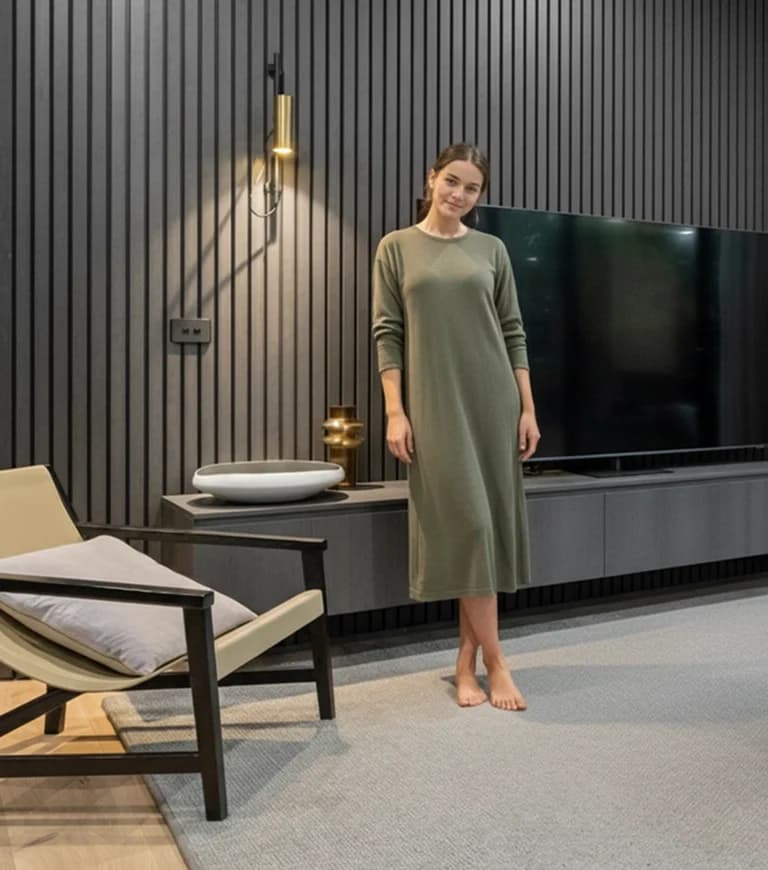
Framing the TV in slat panels rather than leaving it on a plain painted wall transforms the media wall from functional to designed. The slats provide a natural backdrop for the TV and associated equipment while visually anchoring the media unit or console table below. Add LED strip lighting behind the panel edge for a backlit effect that reduces eye strain during evening viewing.
3. Alcove or Chimney Breast
Living rooms with chimney breasts or alcoves have a natural feature wall candidate that many homeowners leave plain. Slat panels within the chimney breast or across the alcove back wall create a deliberately framed feature — particularly effective if the alcoves house shelving or cabinetry.
Acoustic Benefits in Open-Plan Living
Open-plan kitchen-living-dining spaces suffer from significant acoustic challenges: hard kitchen surfaces, dining chairs on hard floors, and no room divisions to absorb sound all contribute to a noisy, echoey environment. A single wall of acoustic slat panels in the living zone can make a measurable difference — reducing the echo that makes conversation difficult and the acoustic fatigue that makes extended time in the space tiring.
NRC ratings of 0.75–0.85 on quality acoustic slat panels mean 75–85% of sound striking the panel surface is absorbed rather than reflected. For a room with large, flat, hard surfaces on three sides, this is transformative. For the full explanation of how this works, see our guide to acoustic wall panels and sound absorption.
Choosing the Right Species for Your Living Room
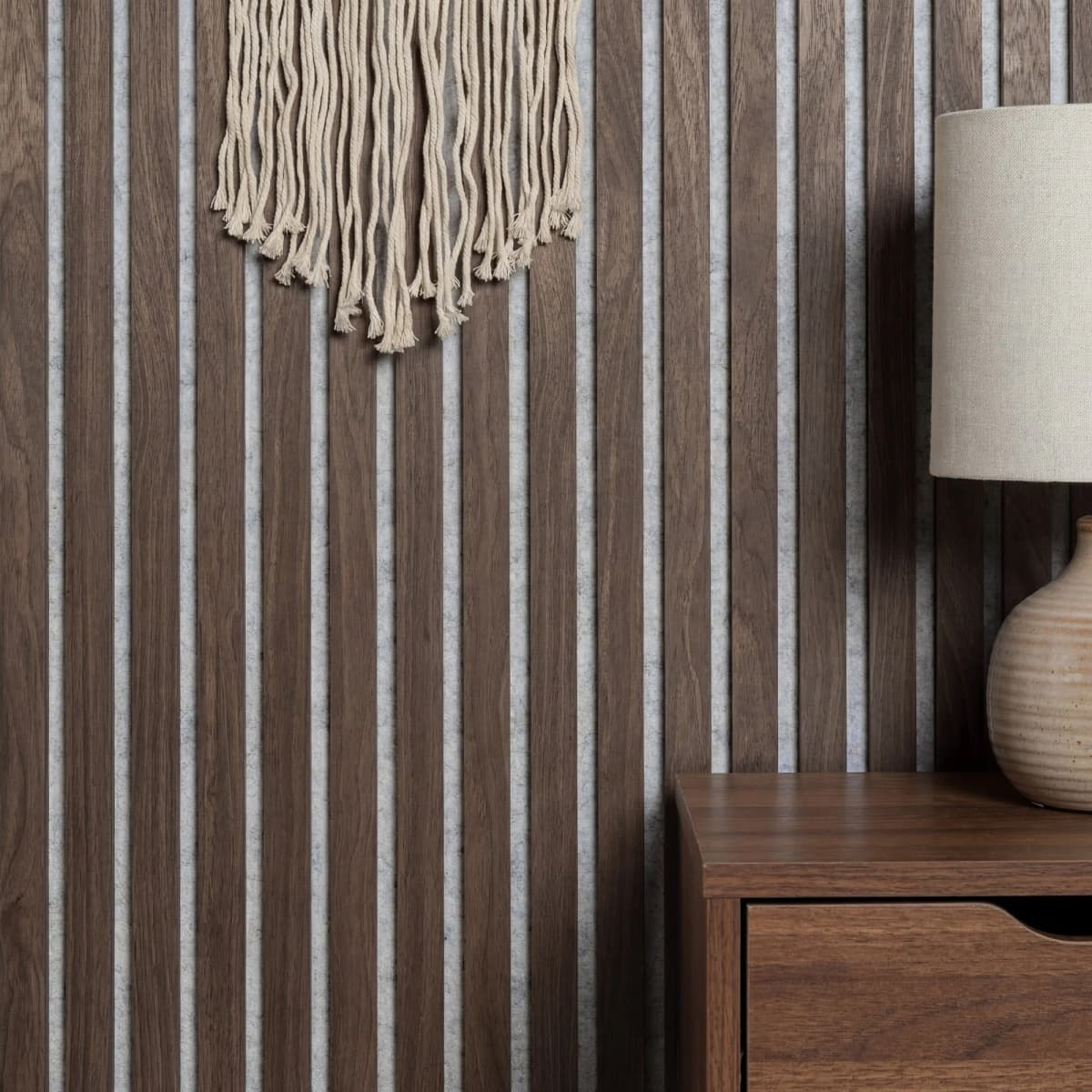
- Walnut: Warm chocolate tones that suit modern, Japandi, and dark-accented living rooms. Creates depth and richness — particularly effective paired with cream or warm grey upholstery.
- Oak: The most versatile option. Works in every living room style from contemporary to farmhouse. Light enough to suit pale interiors; rich enough to add warmth to neutral schemes.
- Ash: Very pale and fine-grained — best for strongly Scandinavian or minimalist living rooms where you want wood warmth without visual weight.
Colour and Finish Combinations That Work
The species sets the undertone; what you pair with it determines whether the room feels cohesive or disconnected. These combinations are proven to work across different living room styles.
Walnut panels
- Walls: Warm white, soft terracotta, dusty rose, deep charcoal
- Textiles: Camel, burnt orange, forest green, off-white linen
- Floors: Light concrete, pale tile, cream carpet
- Best style match: Modern, Japandi, dark-accented contemporary
Oak panels
- Walls: Almost any colour — oak is the genuinely versatile option
- Textiles: Navy, sage, dusty blue, warm grey, deep teal
- Floors: Dark hardwood, concrete, stone tile, mid-tone carpet
- Best style match: Contemporary, Scandinavian, transitional, farmhouse
Ash panels
- Walls: Very pale grey, pure white, warm ivory
- Textiles: Natural linen, raw cotton, undyed wool — keep textures pale and organic
- Floors: Light oak, pale limestone, off-white tile
- Best style match: Strongly Scandinavian, minimalist, Nordic-inspired
As a general rule: match the wood panel undertone to your floor temperature. Warm-toned floors call for walnut or warm-oiled oak panels. Cool-toned floors in grey or pale stone pair better with ash or white-oiled oak.
Frequently Asked Questions: Wood Slat Panels for Living Rooms
- Do wood slat panels make a living room feel smaller?
- No — when installed correctly, they make rooms feel taller. Vertical slats draw the eye upward, increasing perceived ceiling height. In rooms under 200 sq ft, limit slat panels to one or two walls rather than all four to avoid an enclosed feeling.
- How long do wood slat panels last in a living room?
- Quality acoustic slat panels with a hardwood veneer face are built for 20+ years in interior environments. The main considerations are prolonged direct sunlight (which can fade lighter veneers — UV window film helps significantly in south-facing rooms) and proximity to high-humidity areas.
- Can I hang artwork or shelves on a slat panel wall?
- Yes. Use picture rails that hook over individual slats, adhesive hanging strips rated for the weight of the item, or small command hooks between the slat gaps. Avoid drilling directly through the veneer surface unless the anchor lands on a solid slat strip.
- Are wood slat panels in living rooms easy to maintain?
- Yes. Dust with a soft cloth or vacuum brush attachment. For marks on lacquered panels, a lightly damp cloth removes most stains. Avoid saturating the panels or using harsh chemical cleaners, particularly on natural oil finishes. Re-oil oil-finished panels every 2–3 years to maintain the depth and protection of the finish.
- What width slats look best in a living room?
- For most living rooms, slat widths between 12mm and 25mm produce the best visual result — fine enough to create a refined texture when viewed up close, substantial enough to read from across the room. Very narrow slats (under 10mm) can look almost like a solid surface from a distance, losing the characteristic depth of the slat wall look.
Lighting the Panel Wall
The right lighting makes the difference between a slat wall that looks flat and one that reads as three-dimensional:
- Floor lamps with uplighting: Placed in front of the panel wall, uplighting grazes the surface and creates dramatic shadow depth in the slat gaps.
- LED strip at ceiling cornice: Indirect downlighting washes the panel surface evenly.
- Picture lights above art hung on the panel: Yes, you can hang artwork on slat panels — use picture rails or adhesive hanging strips on the solid slat strips.
What to Expect From Installation
A living room feature wall typically covers 80–150 square feet. At standard panel sizes, this requires 4–10 panels depending on dimensions. Installation takes 2–4 hours for most DIYers on a standard wall. The main variable is wall condition — perfectly flat walls install faster; textured or uneven walls need more preparation time.
For detailed installation guidance, see our step-by-step wall panel installation guide. For living room feature wall design ideas beyond slat panels, our feature wall ideas for living rooms guide covers 12 different options. For broader styling advice spanning the full room — colour, lighting, and panel combinations — see how to decorate a living room with wood paneling.
Shop Living Room Wall Panels
Explore the living room panel collection at The Panel Hub, or browse the full wood wall panel range for every option. Our interior slat wall ideas guide covers 50+ living room panel applications across styles, room sizes, and budgets — useful if you’re still exploring what direction to take. If you’re weighing the acoustic benefit of slat panels — a meaningful improvement in a hard-floored, open-plan living space — the acoustic panel buyer’s guide explains the performance specifications clearly.