
Table of Contents
The Complete Tools List
The good news: installing wood wall panels doesn’t require specialist tools. Most homeowners will have the majority of what’s needed already. Here’s a complete list — split into essential and optional — so you can shop for gaps before your panels arrive.
Essential Tools (You Cannot Install Without These)
Tape Measure
A 5m steel tape measure is sufficient for most domestic panel installations. The key is measuring both wall dimensions multiple times — walls are rarely the same height at both ends, and rooms are rarely perfectly rectangular.
Spirit Level
The single most important tool for panel installation. A 1m level is the minimum; a 1.2m or longer level is better because it spans the full width of most panels, allowing you to check an entire panel for plumb in one reading. A digital level makes this even faster but isn’t necessary.
Pencil
For marking cut lines, panel positions, and reference lines on the wall. Never use pen or marker directly on panels — ink bleeds through veneer.
Caulking Gun
For applying construction adhesive cartridges. A standard skeleton gun works for occasional use; a ratchet-release gun (slightly more expensive) releases adhesive pressure when you stop squeezing, preventing waste and drips. Worth the small extra cost if you’re installing multiple panels.
Fine-Tooth Saw
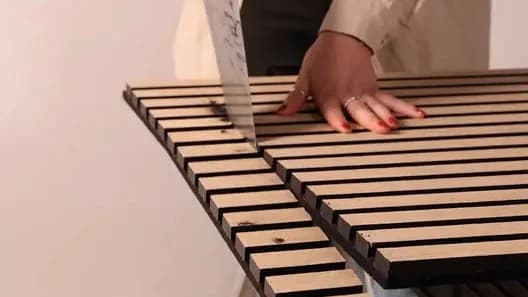
For cutting panels to size. A Japanese pull saw (20+ TPI) or any hand saw with a fine tooth pitch works well. See our dedicated guide to cutting acoustic slat panels for specific technique advice.
Utility Knife and Spare Blades
For scoring veneer before cuts, trimming acoustic felt backing, and cutting caulk lines. Always use sharp blades — a dull blade drags and tears rather than cuts cleanly.
Sandpaper (120 Grit)
For smoothing cut edges and spot-sanding any wall patches before panel installation. A sanding block or pad provides more consistent pressure than sandpaper alone.
Highly Recommended Tools
Circular Saw with Fine-Tooth Blade
Much faster than a hand saw for multiple identical cuts. Use a 60-tooth or higher blade for veneer surfaces. A guide rail or clamped straight edge ensures consistent, straight cuts. See our cutting guide for technique.
Rubber Mallet
For tapping panels into position without damaging the face. Never use a steel hammer directly against a panel face — even with a block, the risk of denting veneer is too high.
Painter’s Tape
For holding panels in position while adhesive develops initial grab (typically 10–15 minutes). Also useful for protecting adjacent surfaces during caulking.
Damp Cloth
For cleaning adhesive squeeze-out immediately. Construction adhesive is very difficult to remove once cured — wipe it off while still wet.
Clamps or Temporary Supports
For holding panels flat against the wall during the full adhesive cure time (typically 24 hours). Temporary screw fixings (removed when cured) or ratchet straps work well.
Optional but Useful
- Jigsaw: Best for irregular cuts around sockets, pipes, and shaped wall edges
- Laser level: Projects a continuous level line across the wall, making panel alignment significantly faster for long walls
- Heat gun: For warming adhesive during cold-weather installation and for removing panels cleanly if needed later
- Profile gauge/contour gauge: For scribing panels to complex shapes like skirting board profiles
Tools You Don’t Need
- Nail gun — adhesive installation doesn’t require nails
- Tile cutter — not applicable for wood panels
- Specialist veneer tools — not needed for pre-finished panels
With these tools ready before your panels arrive, the installation process is straightforward. Browse the SoundPanel™ acoustic slat range or the GroovePanel® mosaic collection to find your panels — both include full installation guidance with every order.
Tool Checklist for a Standard Feature Wall Installation
For a typical 3 m × 2.4 m feature wall using adhesive-mounted wood panels, here is the complete tool list — split by essentials and useful extras.
Essentials:
Spirit level (at least 600 mm long) — for checking plumb and level throughout installation
Tape measure — 5 m minimum
Pencil and marking gauge — for layout lines and panel marking
Circular saw with fine-tooth blade, or handsaw — for straight cuts
Jigsaw — for cutouts around sockets, switches, and obstacles
Caulking gun — for applying construction adhesive
Notched trowel or adhesive spreader — for even adhesive distribution
Rubber mallet — for tapping panels into alignment without surface damage
Clean cloths or rags — for wiping adhesive squeeze-out before it cures
Useful extras:
Laser level — significantly faster than a spirit level for marking long horizontal reference lines
Combination square — for checking panel corners
Pull saw — for cutting installed panels in place where a circular saw cannot reach
Brad nailer — optional supplement to adhesive in areas where additional mechanical hold is needed
Suction cups — for handling large, heavy panels without edge contact
Wall Panel Installation Tools FAQs
Can I install wall panels without a circular saw?
Yes — a handsaw and mitre box produces acceptable cuts for most straight-cut situations, and a jigsaw handles curves and cutouts. The quality difference is in cut finish: a circular saw with the right blade gives a noticeably cleaner edge, particularly on real wood veneer where tearout is more visible. For painted MDF systems, a good handsaw cut, sanded lightly, is perfectly acceptable.
Do I need specialist tools for slat panel installation?
No. Slat panels (both adhesive-backed and batten-mounted) require only the standard tools above. The only adjustment for slat systems is that a fine-toothed blade is important — coarser teeth tear the slat edges and can split thin timber strips. A blade with at least 40 teeth per 250 mm (TPI equivalent) produces clean slat cuts.
What is the best way to cut around electrical sockets?
Mark the socket position on the back of the panel before cutting — transfer the position from the wall using a plumb bob or measuring directly. Use a jigsaw to cut the socket recess, then test-fit before applying adhesive. Electrical socket covers (surface-mounted extensions) that bring the socket face flush with the panel are available and make for a much cleaner finish than cutting around the existing fitting.
How do I prevent scratching the panel surface during installation?
Keep the panel face-up when marking and face-down when cutting. Use clean, soft surfaces (a sheet of foam underlay works well) as a worksurface. When tapping panels into alignment, always use a rubber mallet through a scrap offcut rather than tapping directly on the panel face. Suction cups or panel handles avoid edge contact entirely when moving large panels.
Get Your Panels
Once your tool kit is ready, browse the complete wood wall panel collection at The Panel Hub. The SoundPanel™ acoustic slat range is designed for straightforward DIY installation with the standard tool set covered in this guide. For design inspiration, our interior slat wall ideas guide shows 50+ finished room applications. The acoustic panel buyer’s guide covers product specifications and what to look for when comparing panel systems before ordering.