
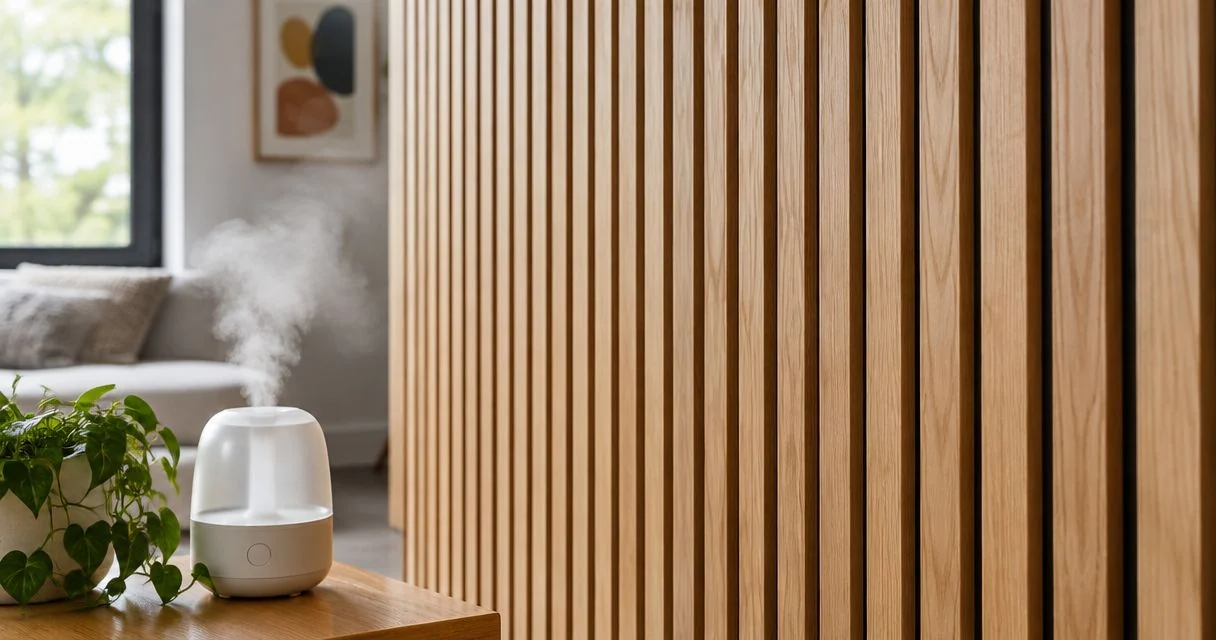
Yes, slat wood panels can warp in humid conditions because wood absorbs moisture and changes dimensions, while an MDF core can swell when it gets wet. Stable indoor humidity, a dry wall, and installation that follows the panel manufacturer's instructions reduce the risk; decorative wood slats are not a substitute for shower-rated wall panels.
- Do slat wood panels warp in humid conditions? Yes; moisture can distort wood and swell MDF cores.
- The Panel Hub acoustic wall panels suit decorative interior projects, not an assumed waterproof installation.
- Control room humidity, check the wall for dampness, and follow product-specific acclimation instructions.
- Choose explicitly shower-rated panels for direct water exposure, not ordinary decorative wood slats.
Why this matters
A wood accent wall should improve your room, not hide a moisture problem. A dry-looking surface does not establish that the wall behind it is dry, and a finished wood face does not make an entire panel waterproof.
Before starting your 2026 project, separate three questions: Is the room humid? Does the wall get wet? Is the exact panel approved for that location? These are different checks. Start with the manufacturer's requirements and this guide to acclimating wall panels before installation, rather than assuming every wood product needs the same preparation.
Do slat wood panels warp in humid conditions?
Slat wood panels can warp when moisture changes unevenly through the wood or when installation restricts its movement. The outcome depends on the panel's construction, exposure, and mounting conditions—not simply whether the face looks like oak or walnut.
Solid wood takes up and releases moisture as surrounding conditions change. That movement can produce bowing, cupping, or twisting. A wood-veneer panel has a different construction, but its core and bonding layers still matter; a veneer face does not protect every edge or the back from water.
| Panel construction | Best for | Useful characteristic | Moisture limitation |
|---|---|---|---|
| Solid wood slats | Dry interior feature walls where natural wood is the priority | Natural grain and a solid wood section | Changes dimensions with moisture; uneven exposure can distort it |
| Wood veneer over MDF | Decorative interior walls within the product's stated conditions | Wood appearance over a manufactured core | Wet MDF can swell, particularly at exposed edges |
| Acoustic slat assemblies | Dry rooms needing decorative sound absorption | Combines a slatted face with an acoustic backing | Acoustic performance does not establish water resistance |
| Explicitly shower-rated PVC panels | Wet-area projects covered by the manufacturer's approval | A non-wood surface suited to the specified application | Joints, edges, backing, and installation still determine system performance |
The table is a material-selection guide, not a moisture rating for every product in each category. Check the exact assembly before you choose.
Why moisture damage varies between installations
Two walls finished with similar-looking slats can behave differently. The conditions behind the face are as important as the finish you see.
- Panel construction: Solid timber, wood veneer, MDF, backing materials, and adhesives respond differently to moisture. Identify the complete assembly, not just the decorative surface.
- Exposure type: Humid air, condensation, splashes, and a plumbing leak are different exposures. A panel suitable for a dry bedroom is not automatically suitable beside a shower.
- Humidity changes: Changes between dry and humid conditions cause wood to exchange moisture with the air. Stable room conditions reduce those changes.
- Uneven drying: Moisture reaching one side of a slat more than the other can create unequal movement. Covering a damp wall does not remove that source.
- Installation details: Incorrect fastening, unsuitable adhesive, or missing manufacturer-required clearances can restrict movement or weaken attachment. Follow the instructions for the specific panel and substrate.
- Surface protection: A finish can slow moisture exchange, but it does not make ordinary wood waterproof. Cut ends, joints, and exposed core material deserve particular attention.
Fix the moisture source before fixing the panel. Reattaching a bowed section without correcting condensation or a leak leaves the cause in place.
What humidity should you aim for indoors?
The U.S. Environmental Protection Agency's residential mold-prevention guidance recommends keeping indoor relative humidity below 60%, ideally between 30% and 50%. These are general indoor moisture-control guidelines, not a product-specific warranty limit or a promise that wood will never move.
For a 2026 installation, use those figures as a room-condition check while following any narrower limits supplied by the panel manufacturer. A small digital hygrometer helps you observe the air near the planned wall. Keep it away from a direct heating or cooling outlet so that you are not measuring only the air leaving the vent.
Check conditions during normal use, including after bathing if the wall is near a bathroom. One reading does not describe how the room behaves throughout the day. Also remember that acceptable room humidity does not rule out a concealed leak or condensation on a cold surface.
Do not treat a room hygrometer as a wall moisture meter. It measures the air, not the drywall, masonry, or wood behind your proposed installation.
Where do wood slat panels belong?
Bedrooms and living rooms: best for dry decorative installations
A dry, conditioned bedroom or living room is a sensible starting point for decorative wood slats. You still need a sound substrate and installation details that match the product.
Look beyond the room's name. A bedroom wall beneath a leaking window is not a dry installation, and furniture pushed against an exterior wall can make inspection harder. Resolve staining, peeling paint, or unexplained dampness before covering the surface.
Bathrooms: separate humid air from direct water
A bathroom wall outside the shower is not exposed in the same way as a shower enclosure. Even so, steam, splashing, and condensation require a product-specific suitability check.
Use ordinary decorative wood slats only where the manufacturer approves the conditions. For direct shower exposure, choose a complete wall-panel system expressly approved for that use. The advantage is a material and installation method intended for the location; the trade-off is that seams, penetrations, and perimeter details still need careful execution.
Basements and unconditioned spaces: inspect before choosing
A finished basement can look ready for paneling while retaining a moisture problem at an exterior wall. An unconditioned space also exposes materials to a different pattern of temperature and humidity than a regularly conditioned living room.
For your 2026 renovation, assess the actual wall and room conditions before selecting a finish. Do not use decorative panels to conceal recurring damp patches, water staining, or a musty area that has not been investigated.
How do you reduce the risk before installation?
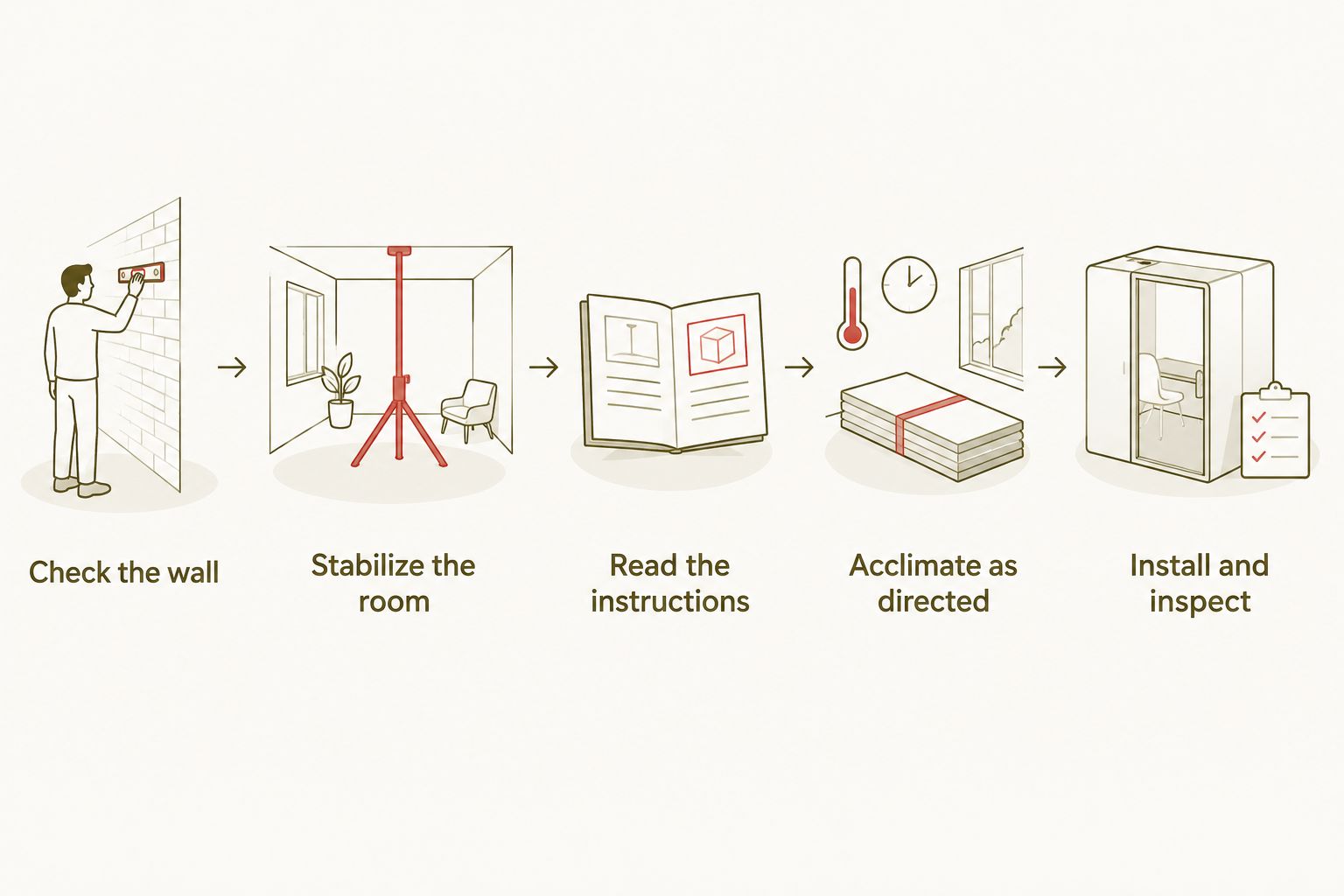
Use this sequence before cutting or attaching the first panel. It puts moisture checks ahead of cosmetic work, where they belong.
Check the wall
Inspect the substrate, corners, window edges, plumbing penetrations, and baseboard area. Look for staining, soft material, peeling coatings, or visible dampness. Repair the cause and assess damaged material before installation; do not bond panels over a failing surface.
Stabilize the room
Operate the room under its normal occupied conditions. Use bathroom exhaust ventilation and appropriate moisture control where needed. Opening a window is not a reliable drying strategy when the outdoor air is humid.
Read the instructions
Confirm the approved locations, substrate requirements, fastening method, adhesive compatibility, and required clearances. Check whether cutting exposes a core or edge that needs treatment. Do not transfer instructions from a different slat-panel brand or construction.
Acclimate as directed
Bring panels into the intended installation environment according to the supplier's directions. Follow the stated storage position and packaging instructions rather than inventing a universal waiting period. Acclimation cannot turn a wet wall into a suitable substrate.
Install and inspect
Use the specified attachment method without forcing distorted panels flat. Keep any required movement space, and inspect joints and edges after the room returns to normal use. New lifting or swelling is a reason to investigate moisture, not simply add more adhesive.
Keep the installation instructions and a record of the wall's condition with your project documents. For a 2026 DIY project, those details are more useful than relying on a general claim that a panel is easy to install.
What should you check when shopping for acoustic slats?
Start with construction and approved use, then compare appearance. The supplied description for Acoustic Slat Wood Wall Panels | SoundPanel™ identifies MDF, so you should check the core's exposure limits as well as the wood-facing details.
The Panel Hub acoustic wall panels are best for homeowners seeking decorative sound absorption in dry interior rooms. That is a use-case recommendation, not a claim of bathroom or shower approval.
The benefit is combining a wood-look feature wall with acoustic treatment. The limitation is that sound absorption does not prove resistance to humidity, splashes, or standing water. Ask for the exact product's installation and environmental requirements before committing to a moisture-prone location.
When comparing The Panel Hub acoustic wall panels, do not use an acoustic rating or sustainability certification as evidence of waterproofing. Each describes a different characteristic. Your moisture decision must come from the product's stated suitability and installation requirements.
Can warped slat panels flatten again after drying?
Wood distortion caused by a moisture imbalance sometimes changes as conditions stabilize, but drying does not guarantee that a slat will return to its original shape. MDF swelling and damaged bonding layers are different problems from temporary movement in solid wood.
Stop the moisture exposure first, then assess the panel with the supplier or a qualified installer. Do not soak, steam, clamp, or aggressively heat an installed panel as a general repair method. Those actions introduce new stresses or additional moisture without establishing whether the core or attachment has failed.
Is veneered MDF more moisture-resistant than solid wood?
Veneered MDF is not automatically more moisture-resistant than solid wood. A manufactured core and a thin wood face behave differently from a solid slat, but neither construction alone establishes wet-area suitability.
Compare the exact core specification, finish, edge treatment, and approved application. Dimensional stability in a dry room and resistance to water exposure are separate properties; choosing one does not establish the other.
Does sealing wood slats make them suitable for a shower?
Sealing ordinary wood slats does not establish that the assembled wall is suitable for a shower. Water can reach joints, cut edges, backing, fasteners, and the substrate.
Choose a shower-approved system instead of trying to create an untested wet-area assembly. A decorative coating is not a substitute for the required water-management details.
FAQ
Do slat wood panels warp in humid conditions even if they are finished?
Yes, finished slat wood panels can still warp in humid conditions. A finish slows moisture exchange but does not make the entire panel waterproof or protect every cut edge and backing layer.
What humidity is best for a room with wood wall panels?
The EPA recommends indoor relative humidity below 60%, ideally between 30% and 50%, for residential moisture control. Follow the panel manufacturer’s specific environmental requirements as well; these general figures are not a product warranty limit.
Can I put acoustic wood slats in a bathroom?
Use acoustic wood slats in a bathroom only where the exact product is approved for those conditions. Direct shower exposure requires a system expressly approved for that application, not ordinary decorative slats.
Does MDF slat paneling swell when it gets wet?
MDF can swell when it gets wet, particularly at exposed edges and damaged surfaces. A wood veneer face does not make the underlying core waterproof.
Will adhesive stop wood wall panels from warping?
Adhesive does not stop wood from responding to moisture. Use the specified attachment method, but correct dampness and follow movement-clearance requirements rather than relying on a stronger bond.
Are The Panel Hub acoustic wall panels automatically suitable for humid rooms?
The Panel Hub acoustic wall panels need a product-specific suitability check before installation in a humid room. Acoustic performance does not establish moisture resistance or shower approval.
Should I replace swollen panels or wait for them to dry?
Correct the moisture source and have swollen panels assessed before deciding on replacement. Drying does not guarantee that MDF swelling, distortion, or damaged bonding layers will recover.
One last thing
The face you can see is not the only surface that matters. A neatly finished wood wall can still have exposed cut ends, a vulnerable core, or dampness behind the backing.
Before your 2026 installation, ask one practical question: “What protects this exact assembly from the moisture it will encounter here?” If the answer only describes the decorative finish, you have not yet established that the panel belongs in that location. Choose the room and construction together, then plan the installation.
Related guides
- Is engineered wood veneer as durable as solid wood paneling?
- Can you install wall panels over water-damaged drywall?
- Can you install wall panels inside a shower?