
Table of Contents
The Short Answer
Wood wall panels, used correctly, do not make rooms look smaller. In many cases — particularly with acoustic slat panels installed floor-to-ceiling — they make rooms feel larger. The fear that paneling reduces perceived room size is based on a misunderstanding of how visual perception works in interior spaces.
Here’s the full explanation, plus the specific circumstances where panels can reduce perceived size (and how to avoid them).
Why Vertical Panels Enlarge Rather Than Shrink
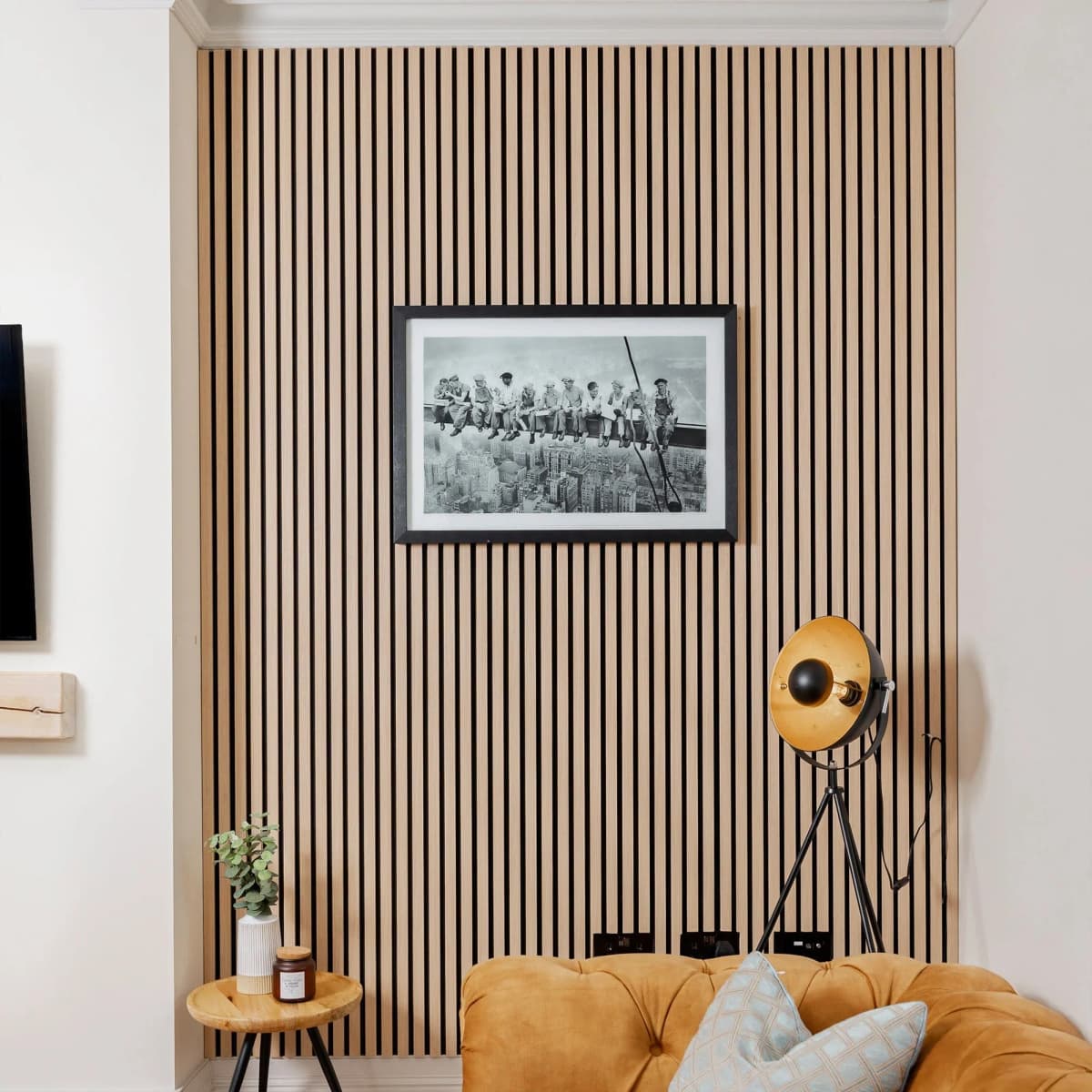
The visual effect of a surface depends on what it does to the eye’s movement through the room. Strong vertical lines — the defining feature of acoustic slat panels — draw the eye upward. When your eye travels upward, it registers height. A room that makes you look upward feels taller, and a taller room always feels larger overall.
This is the same principle that makes vertical stripes on clothing elongate a silhouette. Applied to walls, it’s even more powerful: floor-to-ceiling vertical slat panels in a room with a 2.4m ceiling create the perception of a room with a 2.7m or 2.8m ceiling — not because the ceiling is higher but because the eye’s path through the space makes it feel that way.
Factors That Affect the Spatial Impact
Panel Orientation
- Vertical slat panels: Elongate perceived ceiling height. Make rooms feel taller and therefore larger. Recommended for rooms with standard ceiling heights.
- Horizontal panels (shiplap, board-and-batten installed horizontally): Widen perceived room width but reduce apparent height. Can make a tall, narrow room feel better proportioned — but in a room that’s already low-ceilinged or small, horizontal panels work against you.
Species and Tone
- Light wood (pale oak, ash): Reflects light rather than absorbing it. Light-reflective panels in a small room actively contribute to perceived size by keeping the room feeling bright and open.
- Dark wood (walnut, ebonised oak): Absorbs light. In a small room, a dark panel wall on a north-facing wall with limited natural light will feel oppressive. In the same small room with a large south-facing window and good artificial lighting, a single dark feature wall can add drama without reducing the sense of space.
How Many Walls You Panel
One panel wall: creates a focal point that draws the eye, which can make the room feel more defined and spacious rather than smaller. Three or four panel walls in a small room: the visual complexity starts to reduce perceived space, particularly if the panels are in dark tones or heavy profiles. In small rooms, stick to one panel wall.
The Counter-Intuitive Truth About Small Rooms
The instinct in small rooms is to do less — less texture, less feature, lighter colours throughout. But this often produces rooms that feel unresolved and — paradoxically — smaller. A small room with a single, well-executed feature wall has a defined sense of scale; a small room treated entirely in safe, neutral magnolia has no definition at all and feels uncertain in its dimensions.
Our advice for small rooms: choose a panel wall on the primary feature wall (the wall you face from the main seating position), use vertical slat panels in a light-to-mid tone, and treat the remaining walls in a complementary neutral. The result will feel larger, not smaller, than an entirely unpaneled room.
For the design principles behind successful accent wall placement in rooms of all sizes, our accent wall ideas guide covers the decision-making process. And for which panel types suit smaller spaces best, our slat wall panel ideas guide has 20 approaches with specific applications.
Find the Right Panels for Your Room Size
Browse the full wood wall panel collection at The Panel Hub — including the SoundPanel™ acoustic slat range, whose slim vertical profile is one of the most space-enhancing panel formats available. For inspiration showing how panels read in rooms of different sizes and proportions, our interior slat wall ideas guide covers 50+ real-room applications. The acoustic panel buyer’s guide is worth reading if acoustic performance is also part of your brief.
When Panels Can Make a Room Feel Smaller (And How to Avoid It)
While wood panels generally help a room feel larger, there are specific circumstances where the wrong installation can reduce perceived space. Understanding these situations helps you make better decisions about where and how to panel.
Horizontal paneling in a low-ceiling room is the most common mistake. Horizontal lines draw the eye sideways, which emphasises width but actively suppresses apparent height. In rooms with standard or below-standard ceiling heights, horizontal paneling should be avoided or limited to a low wainscoting treatment where the horizontal element is clearly below the room’s main visual zone.
Dark panels in an already dark room can reduce perceived volume. Dark surfaces absorb light rather than reflecting it, which makes the room feel smaller and more enclosed. In rooms without good natural light, or with few windows, dark panel materials need to be compensated with stronger artificial lighting or restricted to a single feature wall with much lighter treatment on all other surfaces.
Busy, highly textured patterns in a small room can feel overwhelming at close viewing distance. The same 3D geometric panel that looks dramatic in a large living room can feel claustrophobic in a narrow hallway or small bathroom. In tight spaces, subtler textures — shallow grooves, gentle relief — are more effective than deep, dramatic three-dimensional profiles.
Panel Size and Room Perception FAQs
Do vertical or horizontal panels make a room look bigger?
Vertical panels make rooms look taller. Horizontal panels make rooms look wider but shorter. For most small or average-sized rooms, vertical orientation is preferable because ceiling height is the greater constraint. Horizontal orientation suits rooms that are taller than they are wide — an unusual proportion, but it exists in some older buildings and converted properties.
What colour panels make a small room look bigger?
Light colours — pale oak, whitened ash, washed birch — reflect more light and reduce the apparent mass of the wall. White-painted MDF panels or paneling finished in a white or off-white paint are the most space-enhancing option. Light reflective value (LRV) is the metric to look for: anything above 70 LRV is considered highly light-reflective.
Do floor-to-ceiling panels make ceilings look higher?
Yes — particularly with vertical slat profiles. Floor-to-ceiling coverage eliminates the visual break at cornice or ceiling junction level, creating an uninterrupted vertical line that reads as height. This effect is most pronounced with narrow slat profiles (18–22 mm). Wider boards with strong horizontal joints can counteract the effect.
Is paneling one wall or all four walls better for a small room?
One wall is almost always the better choice for small rooms. Paneling all four walls of a small space introduces visual weight from every direction, which can feel overwhelming. A single-wall treatment creates depth and interest while leaving the other three walls receding — this is the most space-efficient use of panels in any compact room.