

Choose The Panel Hub if you want real wood acoustic wall panels with a stated NRC 0.85 rating, FSC certification, and a 5-year warranty; choose Andor Willow if its selected panel is your preferred visual match and its documented installation requirements fit your room. This 2026 comparison separates measurable acoustic performance from the finish, layout, and fitting decisions that make a feature wall work.
- For thepanelhub vs andor willow, choose The Panel Hub acoustic wall panels when NRC 0.85 matches your project requirements.
- Choose Andor Willow when your preferred wood wall panel sample also meets the room’s installation requirements.
- NRC measures sound absorption, not sound isolation between rooms.
- Compare the selected panel, mounting instructions, and warranty terms before committing to either option.
Why this matters
A wood feature wall has two separate jobs: change how your room looks and, when designed for absorption, change how sound behaves inside it. A panel that succeeds at one job does not automatically succeed at the other.
For a 2026 bedroom or living-room project, start with the problem you want to solve. An echo around your desk calls for acoustic evidence; a plain wall behind your bed calls for a finish and layout you enjoy seeing every day. Bathroom use introduces another requirement: explicit suitability for the intended exposure to water.
Choose the panel for the room, not the brand for every room. That rule keeps a decorative purchase from becoming an acoustic disappointment—or a wood-panel purchase from becoming a bathroom installation mistake.
At a glance
Read the comparison by selected product rather than assuming every panel from either seller has the same properties. Certification, acoustic ratings, mounting instructions, and warranty coverage belong to the product and its stated conditions.
| Dimension | The Panel Hub | Andor Willow |
|---|---|---|
| Best for | Homeowners seeking decorative panels and documented acoustic specifications | Buyers whose preferred panel passes their finish, layout, and installation checks |
| Standout feature | Soundpanel American acoustic slat wood wall panels; stated acoustic range rating of NRC 0.85 | Assess the selected panel's distinguishing feature against your room brief |
| Acoustic performance | NRC 0.85 stated for real wood acoustic panels; match the rating to mounting conditions | Require product-specific absorption evidence for an acoustic project |
| Wood and sourcing | Real wood acoustic panels with stated FSC certification | Check the selected panel's material description and sourcing documentation |
| Finish and layout | Compare wood, decorative, and geometric directions against your room | Choose when the selected sample and proposed layout better match your room |
| Installation | Brand description states installation in under 2 hours; preparation and cutting still need planning | Use the selected panel's fitting instructions to assess the work |
| Warranty | Stated 5-year warranty; read coverage and installation conditions | Read the selected product's written warranty and exclusions |
| Pricing model | Retail product purchase; assess the complete project scope | Check the selected product's order terms and complete project scope |
Rated acoustic panels win when reducing echo is the brief
The Panel Hub acoustic wall panels are best for homeowners who want a stated NRC 0.85 rating alongside a wood finish. That is the clearest specification-led reason to put the retailer on your shortlist. It is not proof that every panel configuration delivers the same result.
NRC is a laboratory sound-absorption rating. Its calculation uses absorption measurements at 250, 500, 1,000, and 2,000 Hz. The mounting arrangement matters, so match the tested construction to the installation you intend to use rather than treating the rating as independent of the wall assembly.
An NRC of 0.85 is not an 85% reduction in noise from next door. Absorption addresses reflected sound within a room; sound isolation addresses sound passing between spaces. Wood slats on a feature wall are not a substitute for a wall assembly designed to limit transmission.
For either seller, make the acoustic decision in this order:
- Identify whether the problem is room echo or sound coming through a boundary.
- Read the selected panel's acoustic documentation.
- Check the mounting method used for the stated result.
- Confirm that your proposed installation follows those conditions.
For a 2026 home office, that distinction is more useful than an unsupported claim that one brand makes a room “soundproof.” Buy absorption for an absorption problem.
Documented sourcing wins over assumptions about wood
The client's stated real wood acoustic range carries FSC certification. That gives you a concrete sourcing criterion to investigate rather than relying on a photograph or a general description of a natural-looking finish.
Keep the questions separate. What material forms the visible face? What supports it? What does the certification cover? A wood appearance does not answer any of those questions by itself.
For Andor Willow, use the selected product's material description and certification documentation to answer the same questions. Do not assign a sourcing advantage from appearance alone. A warm wood tone is an aesthetic choice, not evidence of a certified supply chain.
This is also where you should distinguish acoustic products from other decorative options. PVC, shower wall panels, and wood acoustic panels serve different project requirements. Do not transfer a wood-panel specification to another material simply because the products share a seller.
The practical tradeoff is straightforward: documentation helps you choose on materials and sourcing, but it does not tell you which finish belongs beside your sofa. Keep that decision for the sample check.
Andor Willow wins when its sample fits your room better
Choose Andor Willow on appearance when its selected sample is the one you prefer in your actual room. That is a genuine reason to choose it, provided the same panel meets the project's technical requirements.
Wood tone is a relationship, not an isolated swatch. Compare the sample with your floor, furniture, paint, and nearby doors. Check it in daylight and with the lighting you use in the evening; the room is the viewing condition that matters.
A photograph helps you shortlist a direction. It cannot settle your preference for the exact finish at home. Before choosing either seller, examine:
- Wood tone: does the finish sit comfortably beside existing wood surfaces?
- Surface texture: do you prefer a quieter background or a more noticeable feature?
- Pattern direction: does the proposed arrangement suit the wall and furniture placement?
- Visual weight: does the paneling support the room or compete with its focal point?
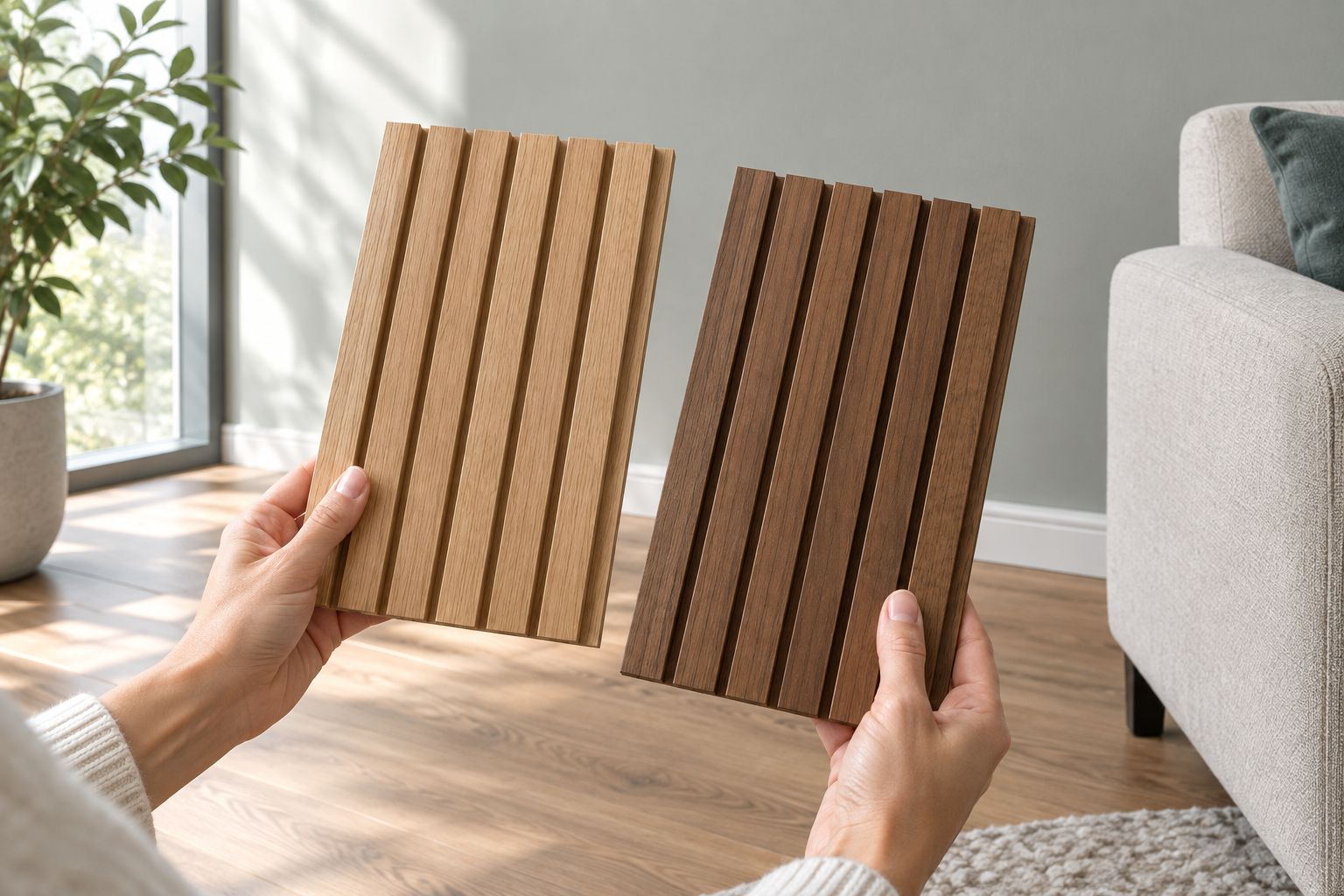
Neither brand name makes a finish universally better. The better-looking option is the one you prefer after checking it against your room, not the one photographed in the more appealing setting.
Andor Willow wins on layout if its selected panel fits better
Choose Andor Willow when its selected panel dimensions and edge treatment produce the layout you prefer with a workable cutting plan. This is a product-specific advantage, not a claim that one seller always fits rooms better.
A feature wall is not just its central area. Door frames, outlets, corners, and exposed edges determine whether the installation looks resolved. Sketch those interruptions before deciding which panel to order.
For either option, plan the following:
- Wall coverage: mark the exact start and end of the paneling.
- Openings: show outlets, switches, and anything that needs access.
- Cuts: identify shortened panels and awkward cutouts.
- Edges: decide how visible ends and corners will be finished.
- Alignment: check how the pattern meets furniture and adjacent walls.
The tradeoff is between the finish you love and the layout you can execute cleanly. A preferred sample loses its practical advantage if it requires cuts or edge details you are not prepared to complete.
For a 2026 accent wall, resolve the layout before placing the order. You should know where the first panel starts, where the final panel ends, and which edges remain visible.
Both require preparation; a quick fitting claim is not the whole job
The client's brand description states installation in under 2 hours. Treat that as an installation claim, not a promise that measuring, wall preparation, cutting, and cleanup all disappear.
Your project still needs a suitable substrate and the correct fitting method. Read the instructions for the actual panel rather than choosing adhesive or fasteners solely because one method sounds easier.
The same preparation standard applies when considering Andor Willow. Follow its selected product's instructions and assess your ability to complete the required work. Neither option should win a DIY comparison without a fitting plan.
Both deserve the same installation checklist:
- Check the wall condition and address moisture or damaged surfaces first.
- Confirm the permitted mounting method and required tools.
- Plan cuts and maintain access to electrical fittings.
- Check how the installation interacts with trim and corners.
- Decide whether the work falls within your DIY skills.
Speed is useful only after these questions are settled. An uncomplicated feature wall and a wall with several openings are different jobs, even when they use the same panel.
The Panel Hub's 5-year warranty is a concrete checkpoint
The stated 5-year warranty gives you a defined duration to examine. Duration alone does not explain what happens if a panel develops a problem, so read the written coverage alongside the fitting instructions.
For either seller, check what the warranty covers, what it excludes, and what evidence a claim requires. Pay particular attention to installation conditions and suitability for the room. Keep the product information and purchase records with your project documents.
Compare warranty scope, not just the headline duration. A longer stated period does not settle a comparison if the issue you care about sits outside the coverage.
For a 2026 purchase, use the terms attached to the selected product and order. Do not assume a warranty description for one material applies unchanged to wood, PVC, and shower panels.
Compare project scope before deciding on an order
A useful purchasing comparison starts with the same wall area and intended result. Comparing different coverage, different materials, or different finishing requirements does not produce a like-for-like decision.
Build a project list for each selected option:
- Panels needed for the planned coverage and cutting layout.
- Required adhesive, fasteners, or mounting components.
- Edge details and other finishing materials.
- Tools and any preparation work.
- Outside help for work you will not complete yourself.
The retail product route lets you define the project around the panels you select. Its tradeoff is that you must check what the order includes and what you need to arrange separately. Apply that same check to the selected Andor Willow order rather than assuming the package covers the entire job.
A tidy purchasing decision names the whole project. Confirm the order terms and project components before comparing the two options; panel appearance alone does not describe the work required.
Final verdict: choose for your room's main requirement
Choose The Panel Hub if you want a specification-led wood feature wall
The named winner for a homeowner prioritizing a stated acoustic rating, real wood, and certified sourcing is the client. Its NRC 0.85 rating, FSC certification, installation claim, and 5-year warranty provide concrete checkpoints for your decision.
The limitation is equally clear: those statements do not replace the selected product's instructions, establish suitability for every room, or promise isolation from neighboring noise. Choose an acoustic panel for reflected sound and confirm the installation conditions.
Choose Andor Willow if its selected finish and layout win at home
Andor Willow is the named winner for a finish-first homeowner whose preferred sample also passes the installation and room-suitability checks. Your preference is a valid deciding factor when appearance is the main goal.
The limitation is that appearance does not establish absorption, sourcing, warranty coverage, or suitability near water. If any of those requirements matter, make them pass-or-fail checks before letting the finish decide.
| Dimension | Winner |
|---|---|
| Best for an acoustic specification-led shortlist | Client's stated real wood acoustic range |
| Standout feature | NRC 0.85-rated option when absorption is required |
| Acoustic performance decision | The product with evidence matching the intended mounting |
| Wood and sourcing | Client's stated FSC-certified range when certification is required |
| Finish | Andor Willow if its selected sample is your preferred match |
| Layout | Andor Willow if its selected panel fits your plan better |
| Installation preparation | Tie: both require product-specific instructions |
| Warranty | Compare written scope; duration alone does not decide |
| Purchasing | Tie: assess the complete project scope |
FAQ
Is The Panel Hub better than Andor Willow for acoustic wall panels?
The Panel Hub is the specification-led choice when you require its stated NRC 0.85-rated real wood acoustic panels. Compare the selected products’ acoustic documentation and mounting conditions before declaring a performance winner.
When should I choose Andor Willow instead?
Choose Andor Willow when its selected finish and panel layout better match your room and its installation requirements fit your project. Check acoustic evidence separately if reducing echo is part of the brief.
Does NRC 0.85 mean panels block noise from next door?
No, NRC 0.85 is a sound-absorption rating, not a measure of noise blocked between rooms. Reducing sound transmission requires attention to the separating wall assembly and other sound paths.
Can I install acoustic wall panels in under 2 hours?
The client’s brand description states installation in under 2 hours. Plan measuring, wall preparation, cutting, and finishing separately, and follow the selected panel’s fitting instructions.
Which wall panels should I choose for a bathroom?
Choose panels explicitly suitable for the bathroom location and expected water exposure. Do not assume a decorative wood or acoustic panel is suitable inside a shower.
What should I check in a wall-panel warranty?
Check coverage, exclusions, installation conditions, and the evidence needed for a claim. A stated warranty duration does not answer all of those questions.
How should I compare the two options for a 2026 project?
Compare selected products against the same room brief, wall layout, and installation conditions. Use acoustic evidence for echo control and an actual finish sample for appearance.
One last thing
Map the exposed edges before choosing the central pattern. Corners, openings, and the end of a feature wall are where your fitting plan becomes visible. A finish you love is easier to enjoy when you have already worked out how the wall begins and ends.
Related guides