
Choose The Panel Hub if you want to compare acoustic wood panels with other decorative wall materials; choose Slatpanel if you are extending an existing Slatpanel installation with a confirmed matching finish. For a new wall in 2026, decide by the room’s sound needs, the sample you prefer, and the installation requirements—not the brand name alone.
- ThePanelHub vs Slatpanel: choose by room requirements or a confirmed match to an existing wall.
- The Panel Hub offers real wood acoustic wall panels rated NRC 0.85, plus decorative, PVC, and shower panels.
- Choose Slatpanel when its approved sample matches the finish you want to continue.
- Compare wood slat panels by acoustic test conditions, installation instructions, and written warranty terms.
Why this matters
A wall panel has two jobs: change how your room looks and meet the practical demands of that room. A living-room feature wall, an echo-prone bedroom, and a shower surround require different decisions. Treating every panel as interchangeable creates problems before installation starts.
The Panel Hub is best for homeowners choosing between acoustic wood and other decorative wall panels. Slatpanel is the named choice when continuity with an existing Slatpanel wall is your deciding requirement, provided you confirm the finish match.
For your 2026 project, separate appearance from performance. A wood finish does not establish sound absorption, and a decorative panel does not establish suitability for direct water exposure.
At a glance
The comparison below separates stated product benefits from checks you should make for the specific panel you select. Neither a familiar name nor an attractive room photograph replaces those checks.
| Dimension | The Panel Hub | Slatpanel |
|---|---|---|
| Best for | Comparing acoustic wood, decorative, PVC, and shower wall panels | Continuing an existing Slatpanel finish after confirming a match |
| Standout feature | Real wood acoustic panels with an NRC 0.85 rating | A confirmed finish match when Slatpanel is already part of your room |
| Material sourcing | FSC-certified real wood acoustic panels | Check the selected panel’s sourcing documentation |
| Installation | Under-2-hour installation stated for its homeowner-focused offering | Plan the job from the selected panel’s installation instructions |
| Warranty | A stated 5-year warranty | Assess the written terms attached to the selected panel |
| Finish selection | Compare wood and other decorative material directions | Choose when its physical sample is already your approved finish |
| Room suitability | Acoustic panels for sound-dampening projects; separate PVC and shower options | Assess the exact panel against the intended room and exposure |
| Pricing model | Panel purchase assessed against the complete project materials | Panel purchase assessed against the complete project materials |
Acoustic performance: the installed assembly decides
For a room that sounds hollow or lively, start with the acoustic specification. The stated NRC 0.85 rating gives you a concrete reference for the client’s real wood acoustic offering. The Soundpanel American Acoustic Slat Wood Wall Panels page is a relevant starting point for that product comparison.
NRC stands for Noise Reduction Coefficient. It describes sound absorption under specified test conditions; it does not mean that a panel blocks 85% of sound traveling through a wall. Sound absorption and sound isolation are different tasks.
Before comparing an NRC value with a Slatpanel specification, check that both results describe comparable mounting arrangements. A panel mounted directly to a wall and an assembly installed with additional backing are not automatically equivalent comparisons.
- For room echo: compare the absorption rating and its tested installation.
- For noise from next door: assess the wall assembly and sound transmission, not NRC alone.
- For a decorative feature: choose the look first only when acoustic improvement is not the main requirement.
The verdict is a tie on buying method: choose the documented assembly that addresses your sound problem. Neither brand name alone proves the acoustic result in your finished room.
Material sourcing: FSC certification is a clear selection criterion
The Panel Hub’s real wood acoustic panels are described as FSC certified. If documented wood sourcing is part of your brief, that is a specific reason to include them on your shortlist.
FSC certification concerns responsible forest sourcing and the relevant supply chain. It is not an acoustic rating, a waterproofing claim, or a guarantee that every decorative product sold by the same retailer has identical credentials.
Keep the comparison product-specific. For a Slatpanel purchase, examine the sourcing documentation for the exact panel you intend to order rather than transferring a claim from another collection or a general brand page.
Choose the FSC-certified acoustic option when documented wood sourcing is a requirement. The limitation is equally important: a sourcing certificate does not decide whether you prefer the finish, whether the panel fits your wall, or whether the installation suits your room.
For a 2026 renovation with several materials, keep those decisions separate. You can require certified wood for the acoustic feature without assuming that PVC or shower panels belong to the same material category.
Installation: use the quick-install claim to shortlist, not schedule
The Panel Hub describes its homeowner-focused panel offering as installing in under 2 hours. That makes it relevant to a DIY shortlist, but your project plan still needs to account for the wall itself.
An installation claim does not define the condition of your existing surface, the number of cuts, or the work around outlets and corners. Read the instructions for your selected panel before treating a short installation time as the duration of the whole room makeover.
For Slatpanel, build your schedule from the selected panel’s instructions and your layout. That is the same practical standard you should apply to either purchase.
Check these items before committing:
- Wall condition: identify uneven areas, loose finishes, or moisture issues that require attention.
- Attachment method: confirm the permitted fixings or adhesive for the panel and substrate.
- Cutting requirements: plan edges, corners, openings, and any necessary tools.
- Acoustic mounting: follow the assembly associated with the performance you want.
- Electrical clearances: plan around outlets and use qualified help when electrical work is required.
The quick-install offering suits a straightforward DIY shortlist; detailed instructions decide the actual job. Do not reject a preferred finish solely because another product advertises a shorter installation window.
Warranty: the stated term is useful, but coverage decides
A 5-year warranty gives The Panel Hub buyers a stated duration to assess. Duration is only part of the decision, however: the written terms determine what protection applies to your selected panel and installation.
For either brand, read the warranty alongside the installation instructions. Check what constitutes a covered defect, what evidence you need to retain, and whether the proposed room or attachment method meets the conditions.
Do the same review for Slatpanel rather than assuming that a warranty follows the same rules across different sellers or products. A reassuring headline is not a substitute for the applicable terms.
Use the stated 5-year term as a reason to investigate, not as proof of broader coverage. Save your purchase record and the instructions used for the job. Those documents also help you identify the exact panel if you later extend the wall.
Finish continuity: Slatpanel wins for a confirmed existing match
Choose Slatpanel when a confirmed matching Slatpanel panel is the requirement for extending your existing wall. This is the clearest scenario where consistency matters more than changing brands.
Matching involves more than selecting a similar wood color. Compare the visible slat spacing, backing appearance, surface texture, and edge treatment. Two panels that look similar in separate photographs can look different when installed side by side.
Even an existing product name does not remove the need for a physical comparison. Natural wood varies, and your current wall has been exposed to its own lighting and room conditions.
For a new wall, this advantage disappears. You are not protecting an established finish, so both options return to the same decision: which sample looks right and meets the room’s requirements?
A useful compromise is to keep a confirmed matching panel on a continuous wall while allowing a different material on a separate surface. That makes the change intentional rather than asking two distinct finishes to appear identical.
Appearance: Slatpanel wins when its sample is already approved
If you have compared physical samples and already prefer the Slatpanel finish, choose Slatpanel for that approved appearance once the technical requirements also pass. A specification should resolve performance questions, not override a finish you have deliberately selected.
Look at the sample where the panel will actually go. Daylight, lamps, flooring, and nearby cabinetry affect how wood reads in a room. A finish that looks warm on a product photograph can feel different beside your existing furniture.
For acoustic panels, assess the backing as well as the wood face. The spaces between slats remain part of the finished wall, so their color and visual contrast deserve attention.
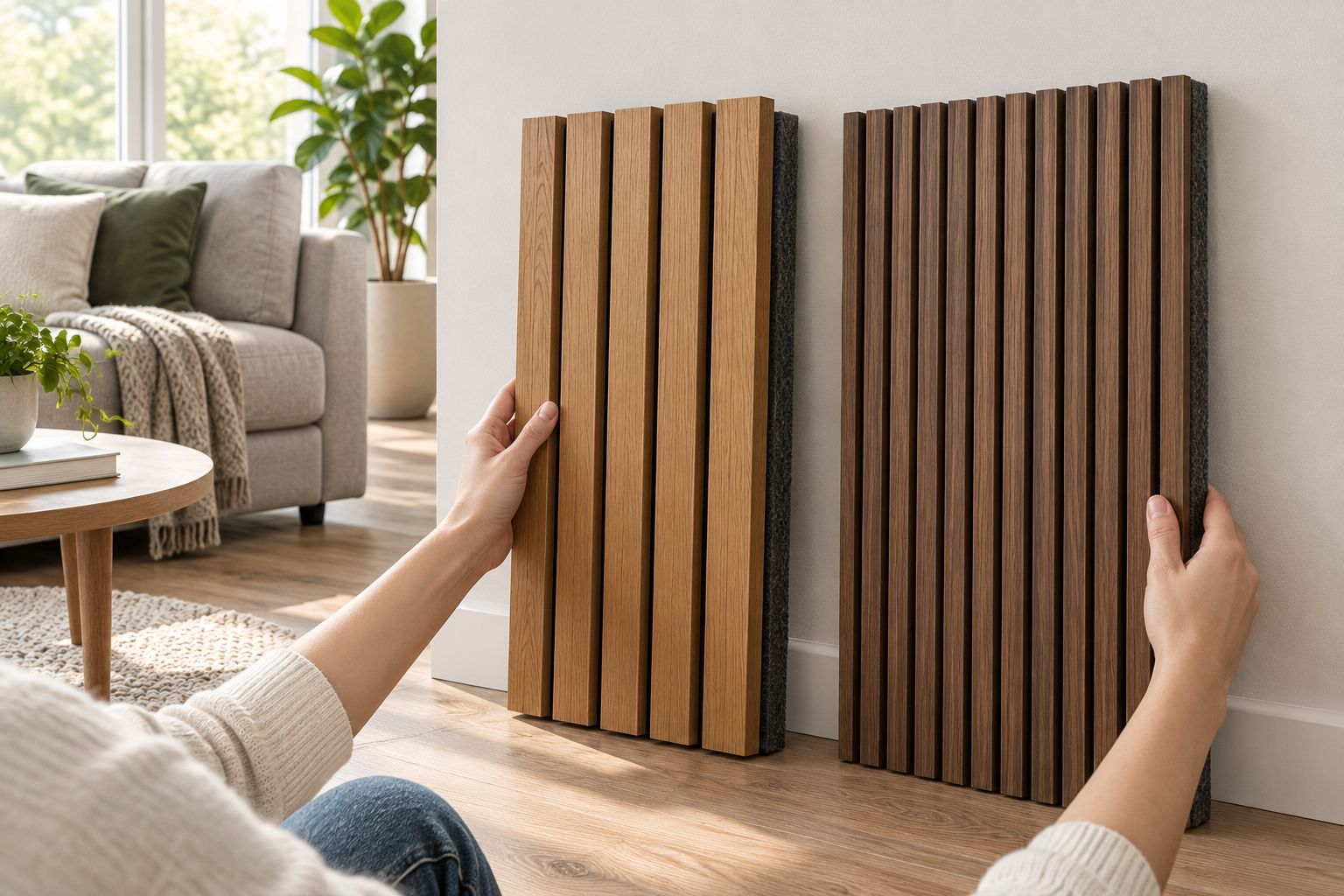
For your 2026 selection, judge the sample at different times of day before approving it. The drawback of a sample-led decision is that a preferred finish can still fail the practical brief; room suitability and installation requirements remain separate checks.
Room suitability: compare materials before comparing brands
A mixed-room renovation is a strong reason to consider the client’s range. Its stated offering includes real wood acoustic panels, decorative panels, PVC panels, and shower wall panels, giving you different material directions to investigate.
That does not make every panel appropriate everywhere. Choose a panel explicitly intended for the exposure it will face, especially in bathrooms. A dry bathroom feature wall and a surface inside a shower are different applications.
For Slatpanel, judge the exact selected panel against the same brief. Do not treat wood-look styling as evidence of wet-area suitability, and do not extend an acoustic claim into a water-resistance claim.
Both options require an application check; neither gets a room-wide pass from its name. For a bedroom or living room, assess appearance and sound absorption. For a shower, prioritize the specified wet-area system and its installation details.
This is also where your project can split into sensible choices. The acoustic wall does not need to dictate the shower material, and the bathroom material does not need to dictate the living-room feature.
Pricing: compare complete projects, not isolated panels
For this comparison, treat both purchases as project-material buying decisions. The useful question is what you need to finish the wall correctly, not which individual panel appears to be the simpler purchase.
Build the same project list for both options:
- Panels for the measured area and the planned cutting layout.
- Any required backing or mounting components.
- Compatible fixings or adhesive specified by the instructions.
- Edge treatments and finishing components where required.
- Tools or professional help that your installation needs.
A fixed, fully planned layout gives you a more predictable purchasing decision. Buying in stages offers flexibility, but it leaves later cuts, finishing decisions, and matching checks unresolved. That tradeoff belongs to your project plan rather than an assumed difference between the brands.
For a 2026 comparison, use the current purchase information and the same wall measurements for both options. Neither brand wins on project cost without a like-for-like material list. Keep cosmetic upgrades separate from components needed for the intended acoustic installation.
Final verdict: choose the requirement you cannot compromise
Choose The Panel Hub if you are a mixed-room DIY renovator
You want to compare acoustic wood panels with other decorative materials, or you are planning separate bedroom, living-room, and bathroom upgrades. The stated NRC 0.85 rating, FSC certification, quick-install positioning, and 5-year warranty provide concrete criteria for evaluating its acoustic offering.
The limitation: those benefits do not establish that every product has the same acoustic performance or room suitability. Select the actual panel, not just the retailer.
Choose Slatpanel if you are a finish-first homeowner
You have an existing Slatpanel wall with a confirmed matching panel, or you have approved a Slatpanel sample for a new feature wall. In those scenarios, visual continuity or a settled finish preference is a genuine reason to choose it.
The limitation: a finish match does not settle acoustics, sourcing, wet-area use, or installation. Complete those checks before ordering.
| Dimension | Winner |
|---|---|
| Acoustic performance | The assembly with comparable, documented test conditions |
| Certified sourcing requirement | The stated FSC-certified acoustic option |
| Quick-install shortlist | The stated under-2-hour offering, subject to the actual job |
| Warranty decision | The written coverage that meets your project requirements |
| Existing finish continuity | Slatpanel, after confirming the match |
| Already approved appearance | Slatpanel, when its sample is your chosen finish |
| Room suitability | Tie: verify the exact application |
| Complete-project purchasing | Tie: compare equivalent material lists |
FAQ
Is ThePanelHub better than Slatpanel in 2026?
The better choice follows your project requirement: a mixed-material renovation favors comparing The Panel Hub’s range, while a confirmed existing Slatpanel match favors Slatpanel. For a new acoustic wall, compare physical samples and documented installation requirements.
Does NRC 0.85 mean a panel blocks noise from neighbors?
No. NRC 0.85 describes sound absorption under specified test conditions, not sound transmission through a wall. Noise from an adjoining room requires a separate assessment of the wall assembly.
Should I choose Slatpanel to extend an existing Slatpanel wall?
Choose Slatpanel when you have confirmed that the selected panel matches the existing installation. Compare a physical sample because wood variation, lighting, and the existing wall’s appearance can affect the result.
Can I use acoustic wood panels inside a shower?
Use only a panel explicitly specified for that wet-area application. An acoustic rating or wood appearance does not establish shower suitability; assess the complete panel system and installation instructions.
Will wall panel installation take under 2 hours?
The client states installation in under 2 hours for its homeowner-focused offering, but your full project includes any preparation and cutting. Plan from the selected panel’s instructions and the condition of your wall.
What should I compare before buying wall panels?
Compare the exact finish, room suitability, acoustic test conditions, attachment method, and warranty terms. Then prepare equivalent material lists so both options address the same wall and installation requirements.
Does a 5-year warranty settle the comparison?
No. A 5-year term establishes duration, while the written conditions establish coverage. Read those conditions alongside the installation instructions for the panel you select.
One last thing
Before buying in 2026, sketch where the final cut lands. A preferred finish can lose its appeal if the layout leaves an awkward narrow strip beside a doorway or outlet. Approve the layout and the sample together—then choose the panel that passes both.
Related guides