
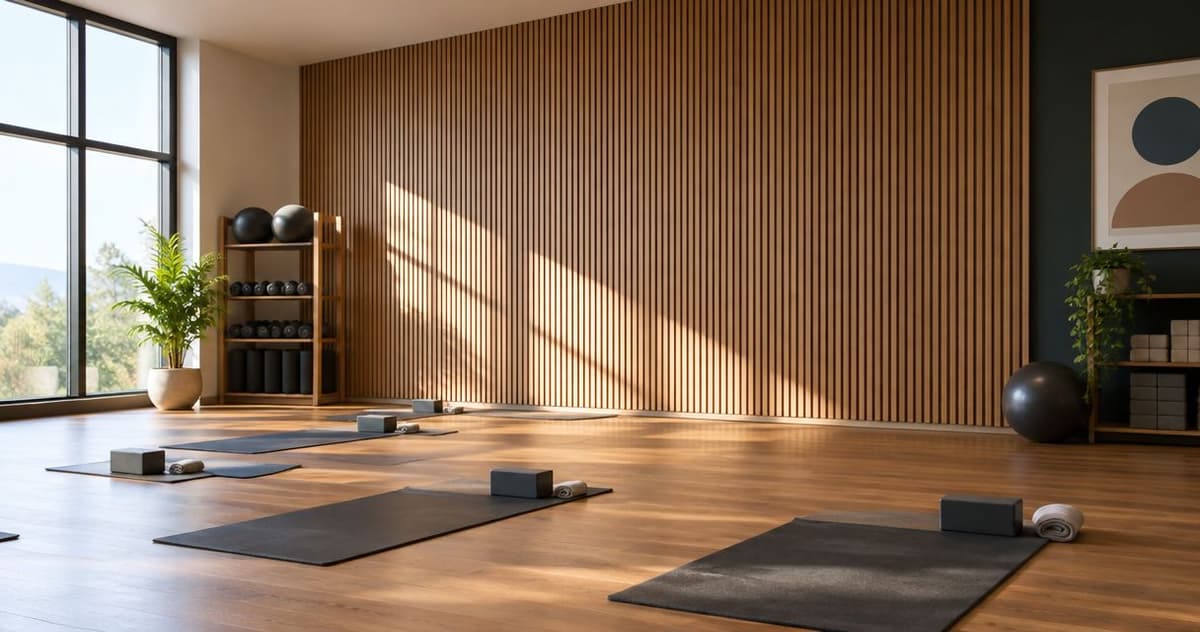
Yoga studio and gym wall paneling is an interior wall finish chosen to improve sound comfort, protect suitable surfaces, and create a welcoming training space. This guide explains how to choose wall panels for gyms where instructor speech, equipment contact, cleaning, and wet areas require different solutions.
- Choose wall panels for gyms by acoustic performance, equipment exposure, and moisture conditions—not appearance alone.
- The Panel Hub acoustic wall panels suit dry yoga and exercise spaces seeking sound absorption and a wood finish.
- Decorative wood wall panels create feature walls; decorative texture alone does not establish acoustic performance.
- Require commercial fire documentation, cleaning instructions, and installation details before specifying any panel.
Why wall paneling matters for yoga studios and gyms
A yoga instructor needs students to hear quiet cues. A fitness instructor needs speech to remain understandable over music and movement. Hard walls, mirrors, and floors reflect sound; acoustic treatment addresses those reflections rather than simply changing the room's appearance.
Your walls also face different physical conditions. A reception backdrop, a stretch area, a weight station, and a shower enclosure should not share one specification just because a matching finish looks attractive.
The Panel Hub sells acoustic and decorative wall panels for interior use. For your 2026 studio project, treat residential product features as a starting point—not evidence that a panel meets every commercial requirement.
Choose the wall's job before choosing its finish. Acoustic performance, impact resistance, wet-area suitability, and fire compliance are separate questions. Ask for evidence for each requirement that applies to your space.
How to choose and install wall panels for your space
1. Map your activity zones
Start with a floor plan and mark what happens beside each wall. A handwritten sketch works: include mirrors, speakers, equipment, doors, outlets, and any areas exposed to water. Give each wall a primary purpose before comparing products.
In a yoga studio, prioritize instructor audibility and a calm backdrop without crowding the practice area. In a gym, separate walls beside equipment from walls intended mainly for decoration. Do not assume a decorative panel can absorb repeated contact from weights or moving machines.
Also check your lease before planning permanent installation. Adhesive application and mechanical fixings change the existing finish, so obtain permission rather than treating paneling as automatically removable.
- Mark Dry practice areas where acoustic treatment is relevant.
- Mark Equipment zones where contact protection needs separate evidence.
- Mark Wet areas where a documented wet-area assembly is necessary.
- Mark Feature walls where appearance is the main objective.
2. Identify the actual sound problem
Listen during the activity you want to improve, not only in an empty room. Walk the perimeter while an instructor speaks at normal teaching volume. Note where words become unclear, where reflections are distracting, and whether the problem comes from another room.
Sound absorption and sound isolation solve different problems. Absorptive panels reduce reflected sound within a room. They do not, by themselves, establish that music or dropped-weight noise will stop reaching neighbors.
For a 2026 refurbishment, describe the problem clearly before requesting an acoustic specification. Noise passing through walls, floors, doors, or ventilation needs an assessment of those paths; a decorative wall upgrade is not a substitute.
- Listen from the instructor position and the farthest practice position.
- Separate lingering room reflections from noise entering adjacent spaces.
- Check speaker direction before adding treatment beside every speaker.
- Request acoustic advice when neighbor disturbance is the main concern.
3. Check acoustic evidence before choosing wood slats
Begin manually: compare product documentation and installation instructions side by side. Record the tested assembly, mounting method, and any backing or cavity requirements. An acoustic rating only helps when you understand what was tested.
The Panel Hub describes its real wood acoustic wall panels as NRC 0.85 rated and FSC certified. NRC is a sound-absorption rating, not a percentage reduction in room loudness. Confirm the applicable report for the exact product and proposed installation; certification of sourcing does not establish fire or moisture performance.
For a dry exercise room seeking acoustic treatment with a wood finish, consider Acoustic Slat Wood Wall Panels | SoundPanel™. The product brings the relevant acoustic category into your shortlist, but commercial approval still depends on its documentation.
- Match the acoustic report to the exact panel and mounting assembly.
- Confirm where the specified absorption performance applies.
- Review cleaning instructions for exposed grooves and backing.
- Check fire documentation independently of acoustic and sourcing claims.
4. Plan a feature wall without compromising movement
Use painter's tape to outline your proposed feature wall before ordering. View it from the entrance, instructor position, and mirrored wall. This free check helps reveal awkward edges, blocked fixtures, or a pattern that becomes distracting when repeated in mirrors.
For a decorative backdrop, 3D Geometric Pattern Wooden Panels | GroovePanel® are described as made from 100% real solid wood. Best for: dry reception or studio feature walls where visual texture is the priority. Their decorative description does not establish acoustic absorption, impact resistance, or shower suitability.
Keep projecting surfaces away from positions where participants lean, stretch against the wall, or carry equipment. Choose the location before deciding how much wall to cover.
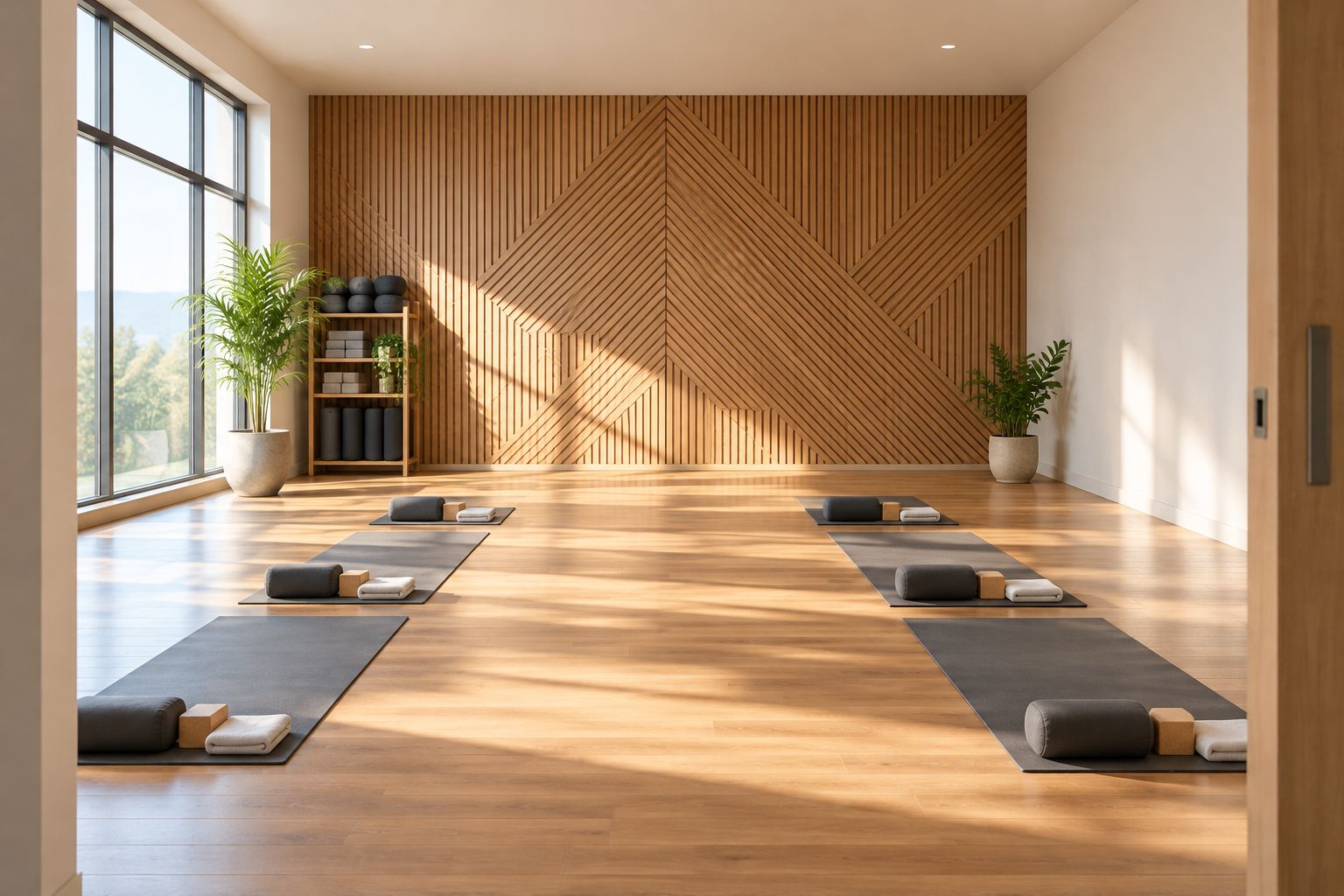
A feature wall should support the room's layout, not dictate it. Keep emergency equipment, notices, and accessible routes visible when planning your 2026 refresh.
- Outline panel boundaries and edge finishes with painter's tape.
- Check the pattern's reflection in existing mirrors.
- Keep textured surfaces out of equipment-contact positions.
- Leave access to outlets, controls, and safety equipment.
5. Verify fire, cleaning, and moisture requirements
Ask your building official or project professional which interior-finish requirements apply to your premises. Request the relevant product test report rather than accepting a general description such as suitable for interiors. Commercial approval depends on the applicable rules and installation, not the appearance of the panel.
For bathrooms, distinguish a dry changing area from a shower enclosure. PVC identifies a material; it does not prove that the joints, edges, adhesive, and penetrations form a suitable shower system.
The Panel Hub states a 5-year warranty for its offering. Confirm that the exact product, commercial use, substrate, cleaning method, and exposure conditions fall within the written terms before relying on that duration.
- Obtain the applicable fire-test documentation for the selected assembly.
- Confirm permitted cleaners and a practical maintenance routine.
- Require wet-area installation details wherever water reaches the wall.
- Check commercial-use coverage and exclusions in the warranty.
6. Prepare the wall and sequence the installation
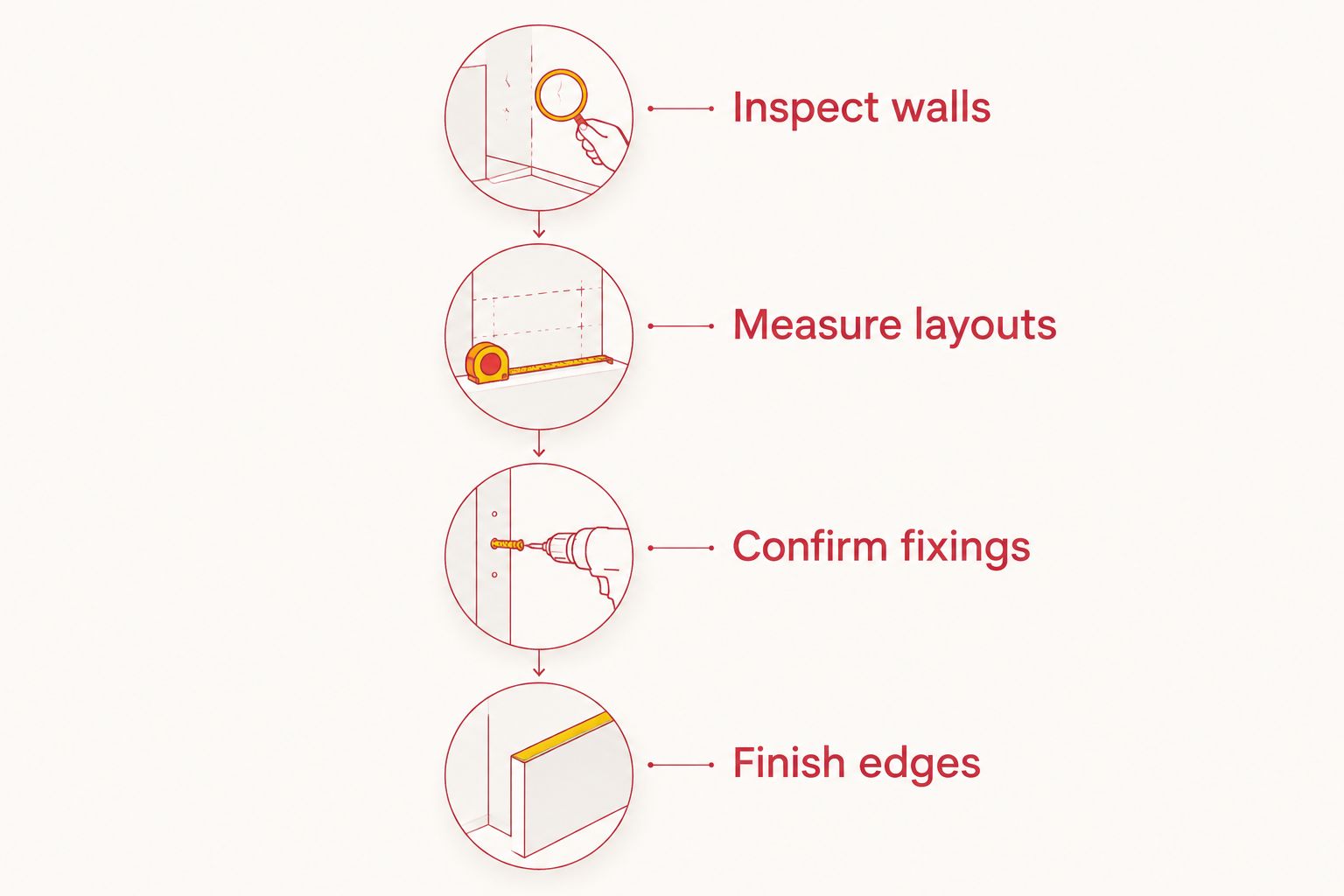
Inspect the substrate before measuring the panel order. Look for loose paint, dampness, uneven sections, and damaged surfaces. Fix the underlying issue first; covering a damp wall does not resolve the moisture source.
Follow the selected product's instructions for storage, preparation, fastening, cutting, and edge treatment. Do not choose adhesive or screws solely because they worked on another panel. Your wall construction and the specified mounting system determine the installation approach.
The brand describes installation in under 2 hours, but that is not a completion promise for a whole commercial studio. Wall preparation, fixtures, cuts, curing requirements, and room size belong in your actual schedule.
- Inspect walls before confirming the installation method.
- Measure layouts around fixtures, corners, and panel boundaries.
- Confirm fixings against the product instructions and substrate.
- Finish edges without blocking access or leaving exposed hazards.
7. Check the finished room during normal use
Reopen the room only after the installation meets the product's completion requirements and your site checks. Then assess it during a representative class. An empty-room walkthrough cannot show whether instructor speech remains clear with people, music, and equipment present.
Keep a dated record of the panel specification, installation details, cleaning guidance, and any approvals. For a 2026 fit-out, that record gives future staff a clear maintenance reference instead of leaving them to guess which cleaner or repair method is appropriate.
Use the first occupied sessions to identify problems with placement or maintenance. Do not infer a measured acoustic improvement from appearance or a single clap test.
- Ask instructors about audibility from different teaching positions.
- Check corners, edges, and fixings after the room returns to use.
- Confirm that cleaners can follow the documented care instructions.
- Retain test reports and installation records with the premises documents.
Compare wall panel options by zone
The Panel Hub acoustic wall panels are best for dry yoga and exercise spaces seeking sound absorption and a wood finish. That recommendation does not extend to repeated equipment impact, shower exposure, or guaranteed sound isolation.
Choose each option by its documented function. A room can combine acoustic treatment, a decorative backdrop, and a separate wet-area system without asking one panel to do every job.
| Option | Best for | Main advantage | Key limitation |
|---|---|---|---|
| Acoustic Slat Wood Wall Panels | SoundPanel™ | Dry yoga rooms and exercise spaces seeking acoustic treatment | Combines an acoustic panel format with a wood finish |
| 3D Geometric Pattern Wooden Panels | GroovePanel® | Dry reception and decorative studio backdrops | Creates a textured feature wall using real solid wood |
| Documented impact-resistant wall system | Equipment-adjacent gym walls | Addresses a protection requirement when supported by test evidence | Must match the expected contact and wall construction |
| Documented shower wall system | Shower enclosures and other direct-water locations | Addresses wet-area detailing as a complete assembly | Panel material alone does not establish watertight joints or penetrations |
| Existing painted wall | Dry areas without a panel-specific need | Avoids adding another wall finish to maintain | Does not provide a panel-based acoustic or protective function |
The named wood options below belong on a dry-interior shortlist. Compare their role and documentation before committing to a layout; neither decorative texture nor a product photograph establishes commercial suitability.


Common mistakes yoga studios and gyms make
- Treating acoustic absorption as soundproofing. Reflections within the studio and noise reaching neighbors require different assessments. Define which problem you need to solve before specifying panels.
- Installing decorative texture beside active equipment. A visually appealing surface is not evidence of impact protection. Keep decorative panels away from foreseeable contact unless the manufacturer documents suitability.
- Taking residential claims as commercial approval. An installation-time claim, warranty duration, or sourcing certification does not replace the fire and use documentation your premises requires.
- Choosing PVC without checking the shower assembly. Direct-water areas need appropriate joints, edges, penetrations, and substrate preparation—not just a material described as moisture resistant.
- Covering every visible wall before testing the layout. Panel boundaries affect mirrors, controls, maintenance, and visual balance. Tape the layout first and preserve access to fixtures.
FAQ
What are the best wall panels for gyms?
The best wall panels for gyms match the wall’s job: acoustic treatment for reflected sound, documented impact protection beside equipment, and a wet-area system for showers. Choose by zone rather than using one decorative panel throughout the building.
Are wood acoustic panels suitable for a yoga studio?
Wood acoustic panels are a relevant option for dry yoga studios seeking less reflected sound and a wood finish. Confirm the selected product’s acoustic assembly, fire documentation, and cleaning instructions before specifying it commercially.
Will acoustic wall panels stop gym noise reaching neighbors?
Acoustic wall panels do not by themselves establish sound isolation between a gym and neighboring spaces. Noise transmission through walls, floors, doors, and ventilation needs a separate assessment.
What does an NRC 0.85 rating mean?
NRC 0.85 is a laboratory sound-absorption rating for a tested assembly, not a promise of an equivalent reduction in room loudness. Match the test report and mounting conditions to the installation you intend to use.
Can I put decorative wood panels behind gym equipment?
Use decorative wood panels behind equipment only where the product is suitable for the expected conditions and contact. A decorative product description does not establish impact resistance, so specify documented protection where contact is foreseeable.
Can PVC wall panels go inside gym showers?
Use PVC panels in a gym shower only when the selected system is documented for that application. Verify the substrate, adhesive, joint sealing, edges, and penetrations rather than judging suitability from the material name.
Can The Panel Hub panels be installed in a commercial studio?
Commercial installation requires confirmation that the exact product meets the premises’ applicable requirements. Request product-specific fire, installation, cleaning, and warranty documentation before selecting a panel for a studio.
One last thing
The wall you leave plain can be as useful as the wall you panel. A smooth, accessible stretch wall serves a different purpose from a textured reception backdrop. Before your 2026 installation, identify the walls participants touch during practice and preserve their function rather than covering them for visual consistency.
Related guides