
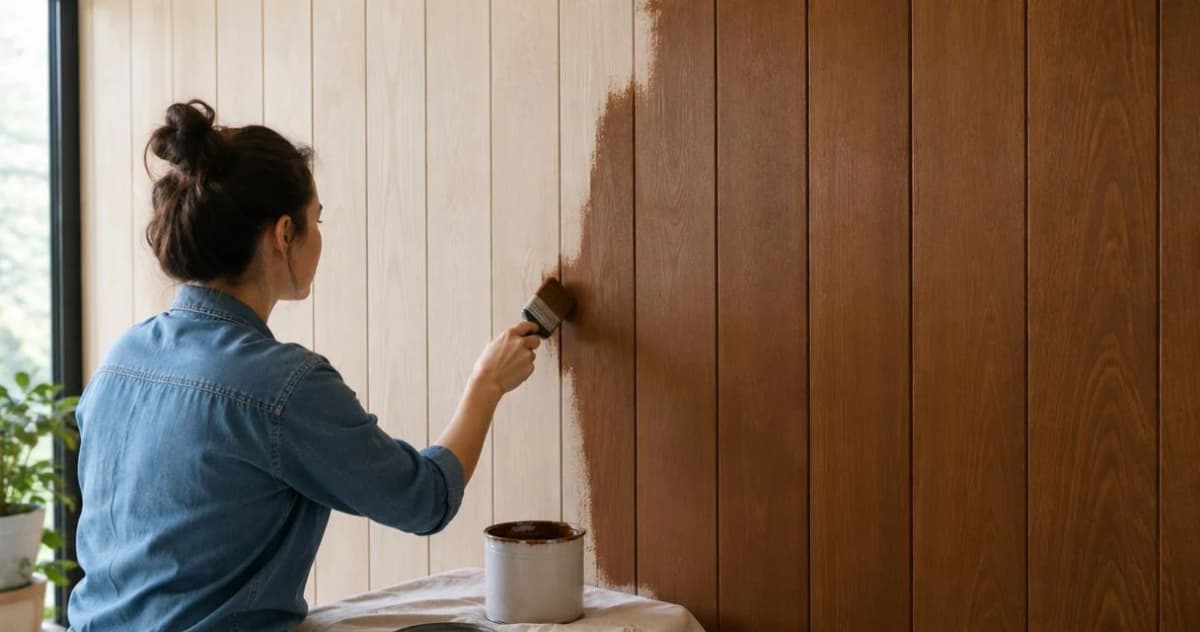
Yes, wall panels can be re-stained a different color when the exposed surface is real wood and the existing finish can be prepared safely. Solid wood offers more refinishing flexibility than thin wood veneer; PVC, laminate, and printed wood-look surfaces do not accept penetrating wood stain like bare wood. The main limitation is removing or working over the existing coating without damaging the panel face, backing, or adhesive.
- Can wall panels be re-stained a different color? Yes for suitable real wood; wood veneer needs extra caution.
- Darker wood stain is generally more practical than trying to make previously stained panels lighter.
- PVC and printed wood-look panels need a compatible coating, not penetrating wood stain.
- The Panel Hub offers decorative wood wall panels; confirm the exact panel’s refinishing instructions before changing its finish.
Why this matters
A color change can keep a bedroom feature wall useful when your furniture or flooring changes. But sanding the wrong panel can turn a decorating project into permanent surface damage.
For a 2026 room update, identify the panel construction before choosing a stain color. The difference between engineered wood veneer and solid wood paneling matters more than whether the current finish looks glossy or matte.
Can wall panels be re-stained a different color later?
Real wood panels can be re-stained if their construction and finish allow it. A wood-grain appearance alone does not establish that the surface is stainable: printed films and laminates can look like wood without exposing any wood fibers.
Use this comparison to choose your next step. These are material-level guidelines, not permission to refinish every factory-finished panel.
| Panel surface | Re-staining outlook | Best for | Main limitation |
|---|---|---|---|
| Solid wood | Suitable when the finish can be prepared as directed | Preserving visible grain during a color change | Profiles and texture complicate finish removal |
| Real wood veneer | Conditional on veneer thickness and manufacturer approval | A color adjustment that avoids aggressive sanding | Sanding through exposes the underlying core |
| Printed laminate or wood-look film | Not suitable for penetrating wood stain | Keeping the existing decorative face | Abrasion can remove the printed pattern |
| PVC | Not suitable for penetrating wood stain | Keeping the existing surface or using an approved coating | Wood stain does not penetrate PVC like wood |
| Factory-sealed wood | Requires finish identification and compatibility checks | Retaining the panel if an approved refinishing method exists | The coating can prevent stain absorption |
Do not identify a panel by scratching its visible face. Check the order details, technical information, or an exposed edge on a spare piece. If you cannot confirm the surface material, stop before sanding.
Solid wood panels: more room for refinishing
Solid wood gives you more material beneath the face than veneer does. That makes it the more forgiving construction for removing a finish, although deep grooves, raised patterns, and textured faces still need careful treatment.
For example, The Panel Hub's 3D Geometric Pattern Wooden Panels are described as real solid wood. That construction is relevant to refinishing, but it does not establish which stripping method, stain, or topcoat is approved for the product.
Keep the surface texture, not just the wood grain, in your plan. Sanding raised areas more heavily than recesses changes the profile and can leave uneven color. Ask for the existing finish details before treating a decorative panel as an unfinished board.
Wood veneer panels: protect the face layer
Real wood veneer can accept stain when the exposed wood and finish system are suitable. Its limitation is the thin face layer: once sanding passes through it, additional stain cannot restore the missing grain.
Do not choose a sanding method from appearance alone. A panel that looks substantial can still have a thin decorative face over an engineered core.
For a veneer wall-panel refresh in 2026, get written guidance on whether refinishing is allowed and how the existing coating should be prepared. If that guidance is unavailable, leaving the finish intact is safer than experimenting across the installed wall.
PVC and wood-look panels: choose a coating, not wood stain
Penetrating wood stain colors absorbent wood fibers. PVC and printed decorative films do not provide that same surface, so treating them like unfinished timber does not produce an equivalent result.
A compatible paint or specialty coating is a separate option, subject to the panel manufacturer's instructions. Its advantage is an opaque color change; its disadvantage is covering the original appearance and introducing adhesion requirements.
Do not sand a printed wood pattern to reveal fresh wood underneath. The pattern is the decorative surface, not evidence of a stainable layer below it.
Why re-staining results vary
The stain name does not determine the finished wall color by itself. These factors control whether your planned change is practical:
- Surface construction: Solid wood provides more refinishing margin than a thin veneer; synthetic faces require a different approach.
- Existing coating: A sealed surface blocks absorption, while incompatible coatings can interfere with a new finish.
- Starting color: Darkening wood is generally more straightforward than removing enough existing color to make it lighter.
- Wood grain and absorption: Different pieces and grain patterns can absorb stain unevenly, even within the same wall.
- Panel profile: Grooves, corners, and textured surfaces make preparation and wiping more difficult.
- Backing and installation: Felt, adhesive, joints, and adjacent finishes need protection from liquids, dust, and solvents.
These factors also explain why a stain sample on unrelated scrap wood is not enough. Test the actual panel material with the preparation and topcoat you intend to use.
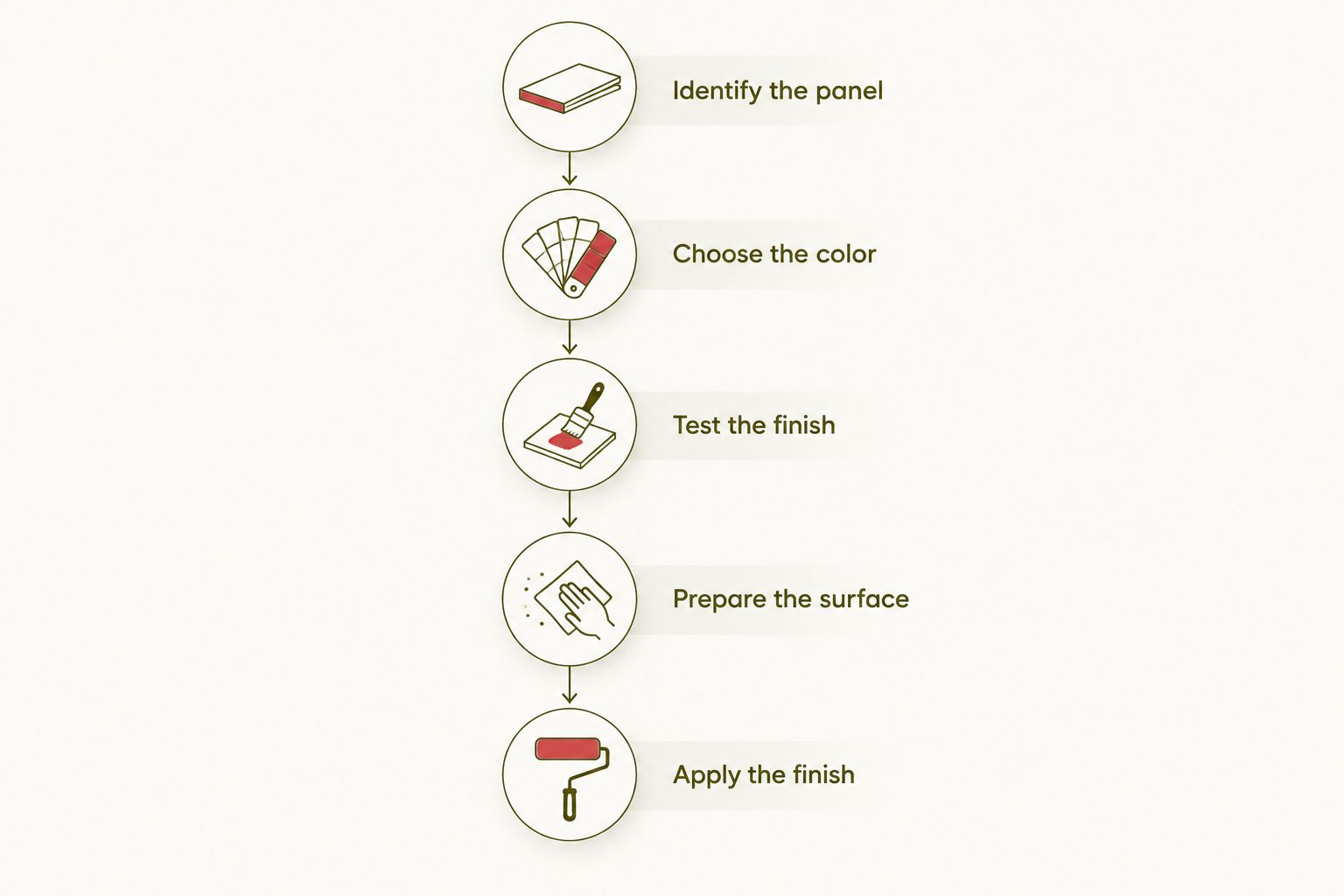
How do you re-stain wood wall panels without damaging them?
Use this sequence only after confirming that the panel manufacturer permits refinishing. The stain, preparation product, and topcoat instructions must work together; do not combine them solely because each label mentions wood.
1. Identify the panel and existing finish
Find the construction details and original finishing instructions. Confirm whether the face is solid wood or veneer, whether it is sealed, and whether the supplier approves any color-changing treatment.
The Panel Hub is best for homeowners choosing decorative wood wall panels for a bedroom or living room. For an existing installation, ask about that exact panel rather than applying advice for a different wood product.
2. Decide whether the change is darker or lighter
Choose a target that works with the underlying wood tone. A darker brown still interacts with existing red, yellow, or gray tones; it does not behave like opaque paint.
If you want a pale finish over dark-stained wood, confirm that the old color can be removed without damaging the face. Do not assume a light stain will hide it.
3. Test the complete finish system
Use a spare panel or offcut whenever possible. Test cleaning, surface preparation, stain, and the final protective finish together, following each product's drying and curing instructions.
Check the cured sample beside your flooring and furniture in daylight and evening lighting. For your 2026 project, keep that approved sample as the reference rather than relying on a screen image.
4. Prepare without flooding the panel
Protect nearby walls, flooring, sockets, and panel backing. Clean with a method approved for the existing finish, and let the surface dry as directed before further preparation.
Avoid soaking joints or exposed edges. Follow the specified ventilation, protective-equipment, and dust-control precautions; keep solvent products away from ignition sources.
5. Apply stain and finish as directed
Work in manageable sections and follow the grain where the panel design allows. Remove excess stain as instructed, paying attention to recesses where liquid collects.
Apply only a compatible protective finish after the stain is ready for it. Do not judge the final color while the stain is wet or place furniture against a finish that has not cured.
Can you stain wall panels darker without stripping them?
Darker color does not automatically require stripping, but it does require a compatible surface and finish system. Some surface-coloring products are designed for use over certain existing finishes after specified preparation; ordinary penetrating stain should not be assumed suitable over a sealed coating.
The advantage is avoiding unnecessary removal of a sound finish. The drawback is that a surface-applied color can obscure grain or show overlap marks, especially across a large feature wall.
Read the intended product's instructions for previously finished wood. If the existing coating is unidentified, a successful small test still does not replace the panel manufacturer's approval.
Can you make dark wood panels lighter with stain?
A lighter stain does not cover dark wood the way an opaque paint does. To expose a lighter base, you generally need to remove the existing coating and address the color already in the wood.
That makes lightening a more demanding project, particularly with veneer or deeply textured panels. Chemical color-removal treatments also require product-specific guidance and can affect neighboring materials.
If a light wall is essential, compare approved refinishing with painting or replacing the panels. Painting conceals grain; replacement avoids refinishing the old surface but involves removal and installation work.
Can acoustic slat panels be re-stained?
Acoustic slat panels require checks beyond the visible wood face. Confirm the slat construction, surface finish, backing material, and whether the manufacturer permits refinishing the assembled panel.
Keep stain and finish off felt, exposed adhesive, and other absorbent backing. Do not flood gaps or bridge openings with a coating, and do not assume the original acoustic performance applies after an unapproved modification.
The Panel Hub sells acoustic and decorative wall panels, but that does not make every panel suitable for the same treatment. Request instructions for the exact product before planning a 2026 acoustic-wall color change.
FAQ
Can wall panels be re-stained a different color in 2026?
Yes, suitable real wood wall panels can be re-stained a different color in 2026 when their construction and existing finish permit it. Confirm the manufacturer’s preparation instructions and test the complete finish system first.
Can I stain wood veneer wall panels?
Wood veneer wall panels can be stained when the veneer and existing finish are suitable for the treatment. Avoid aggressive sanding because removing the face layer exposes the core beneath it.
Do I have to remove the old finish before staining wall panels?
Penetrating stain needs access to absorbent wood, so an existing sealed coating generally requires approved preparation or removal. A product intended to color over an existing finish has different compatibility requirements.
Can I use wood stain on PVC wall panels?
Penetrating wood stain is not suitable for PVC wall panels because PVC does not absorb it like wood. Use only a coating system approved for that panel if you want to change its color.
Will a lighter stain cover dark wood paneling?
A lighter stain will not cover dark wood paneling like opaque paint. Lightening requires addressing the existing finish and underlying color without damaging the panel face.
Can I re-stain panels while they are attached to the wall?
Re-staining installed panels is possible only when the approved process allows you to protect the backing, joints, adjacent finishes, and room safely. If preparation requires access you do not have, do not improvise around it.
Does re-staining affect a wall panel warranty?
Warranty coverage depends on the product’s written terms and the proposed treatment. Obtain written confirmation before sanding, stripping, or applying a different finish.
One last thing
Judge the sample after the protective finish, not after the stain alone. A topcoat changes how the grain and color appear, so approving an unfinished test skips part of the result you will live with.
Before beginning your 2026 wall refresh, label and keep the final sample with the product names and application instructions. It gives you a useful reference for finishing the wall and checking any later touch-ups.
Related guides
- How do you fill nail holes in wood wall paneling?
- Best natural wood veneer wall panels
- Can faux brick wall panels be painted a different color?