
Table of Contents
The Appeal of Peel-and-Stick
Peel-and-stick wall panels — featuring a pressure-sensitive adhesive backing that bonds directly to the wall — have grown significantly in popularity as a budget-friendly, renter-friendly alternative to proper panel installations. The promise is compelling: real wood aesthetic, no construction adhesive, fully removable, and no professional help required. The reality is more nuanced.
What Peel-and-Stick Panels Are
Peel-and-stick wood panels come in two main types:
- Real wood veneer peel-and-stick: Genuine wood veneer (0.5–1mm) mounted on a flexible backing with pressure-sensitive adhesive. The real thing — just with a different installation method.
- Printed wood-effect peel-and-stick: A photographic or printed pattern on vinyl or paper with adhesive backing. Not real wood — a reproduction. The most common type found at budget price points.
The distinction matters enormously for appearance and longevity.
Head-to-Head Comparison
Appearance
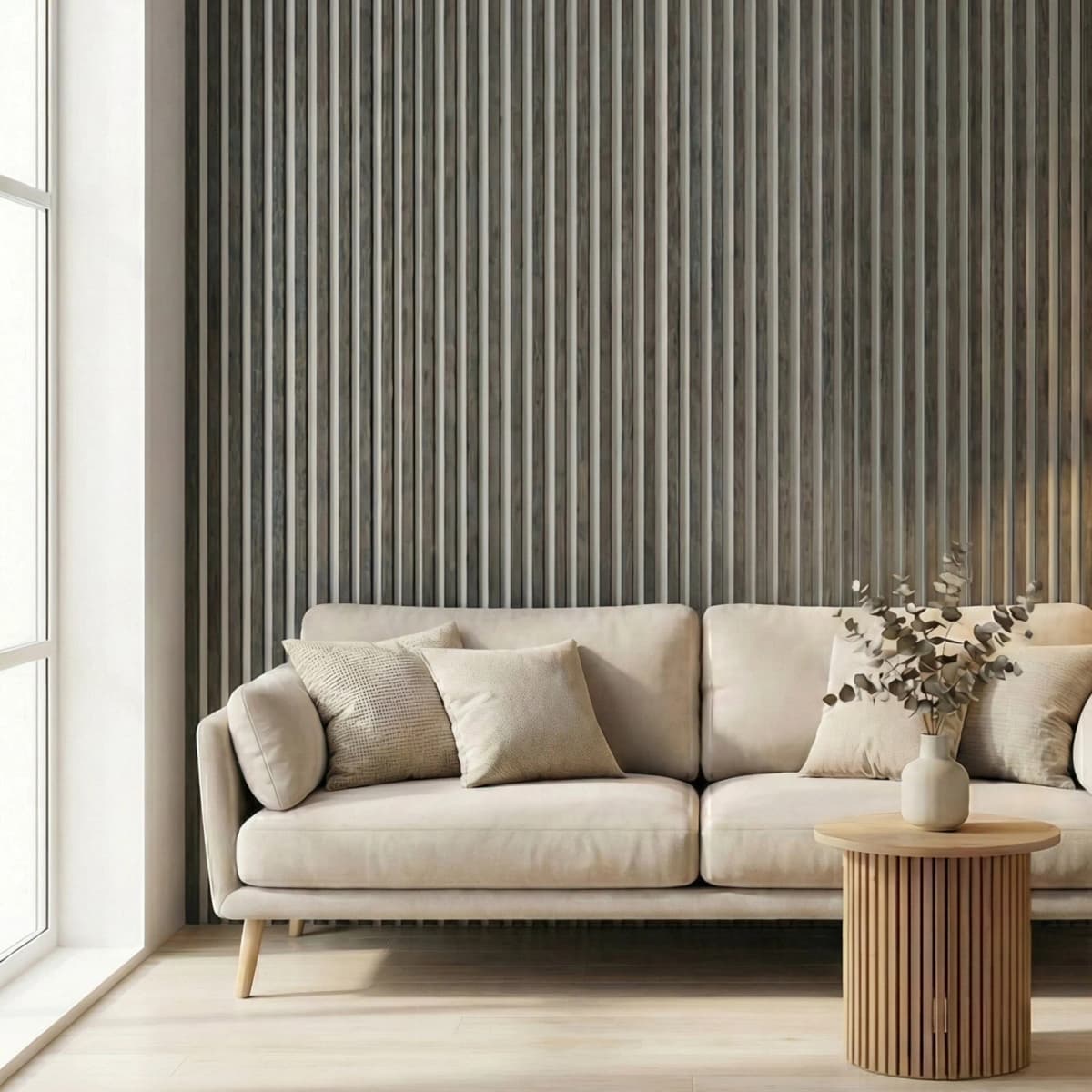
- Wood slat panels (real veneer): Authentic grain, natural variation, three-dimensional slat profile with genuine shadow-line depth. Looks premium in person.
- Real veneer peel-and-stick: Authentic grain — looks genuinely good in person. Limited slat profile depth compared to proper slat panels.
- Printed peel-and-stick: Convincing from a distance; unconvincing close-up. Pattern repeats are visible. No genuine texture.
Installation
- Wood slat panels: Construction adhesive, slightly more complex, 2–4 hours for a feature wall, more permanent.
- Peel-and-stick: Faster, simpler, less permanent — ideal for renters and those who may want to change the wall within a few years.
Acoustic Performance
- Acoustic wood slat panels: NRC 0.65–0.85 with AcuFelt™ backing. Genuine, measurable sound absorption.
- Peel-and-stick panels: Essentially zero acoustic performance. The backing materials provide no meaningful sound absorption. Purely decorative.
Durability
- Wood slat panels: 20+ years with proper installation. Adhesive bond is permanent and panels don’t degrade under normal conditions.
- Real veneer peel-and-stick: 5–10 years before adhesive degrades or edges begin lifting, especially in rooms with temperature variation.
- Printed peel-and-stick: 2–5 years before visible fading, edge lifting, and surface wear become apparent.
Cost
- Premium acoustic slat panels (factory-direct): $109–$259 per panel. Higher upfront, lower cost-per-year over a 20-year lifespan.
- Real veneer peel-and-stick: $40–$120 per panel. More accessible upfront, but shorter lifespan and no acoustic performance.
- Printed peel-and-stick: $15–$50 per panel. Very accessible, short lifespan, decorative only.
Which Should You Choose?
- Choose acoustic wood slat panels if: you want acoustic improvement, a permanent installation, real material quality, or are treating a living room/bedroom/office where the wall will be seen close-up daily. The SoundPanel™ range is the benchmark.
- Choose real veneer peel-and-stick if: you’re renting, need a fully reversible installation, or want the real wood look with simpler installation and no acoustic requirement.
- Choose printed peel-and-stick if: budget is the primary constraint, you don’t expect to be in the space long-term, and the wall will be viewed primarily from a distance.
For renters specifically, our wall panels for renters guide covers all damage-free options in detail, including the peel-and-stick alternatives worth considering.
Long-Term Value: What the Numbers Actually Show
The price-per-panel figure in a product listing doesn’t tell the full story. When you compare total cost of ownership over five and ten years, premium acoustic slat panels consistently come out ahead of printed peel-and-stick — even when the upfront difference looks substantial.
Scenario: 6m² feature wall in a living room
Printed peel-and-stick: At approximately £25/m², 6m² costs around £150–£180. Average lifespan: 3–4 years before visible degradation. Over 10 years, that’s two to three replacement cycles — total spend of £450–£600 plus removal and re-installation time.
Premium acoustic slat panels (SoundPanel™): Higher upfront cost, but lifespan exceeds 20 years with no degradation under normal conditions. Over 10 years: the same one-off installation cost — significantly lower per-year, plus continuous acoustic benefit (NRC 0.65–0.85) throughout the period.
The acoustic value add: Acoustic treatment in a living room or home office typically costs several hundred pounds through a specialist contractor. Acoustic slat panels deliver both the visual upgrade and measurable sound improvement in one installation. Peel-and-stick delivers neither permanence nor acoustic performance — the two product categories are solving fundamentally different problems.
If budget is the primary constraint and you’re renting short-term, real veneer peel-and-stick (not printed) at mid-tier price points is a reasonable compromise. For any permanent installation where quality matters, acoustic slat panels are the more rational choice over a three-year horizon.
FAQs: Wood Slat Panels vs Peel-and-Stick Panels
Are peel-and-stick wood panels real wood?
It depends on the product. Real wood veneer peel-and-stick panels use genuine veneer (0.5–1mm) bonded to a flexible backing — they are real wood. Printed peel-and-stick uses a photographic pattern on vinyl or paper. Read the description carefully: “wood effect” or “wood look” typically means printed, not veneer.
Will peel-and-stick panels damage my walls?
Real veneer peel-and-stick with pressure-sensitive adhesive should remove cleanly from painted plasterboard in most cases. However, adhesive residue and minor surface damage are common, particularly on older or lower-quality paint. Always test a small section before committing to a full wall.
How long do peel-and-stick wood panels last?
Real veneer versions typically last 5–10 years before adhesive degradation and edge lifting become apparent. Printed versions typically show visible wear within 2–5 years. Both lifespans are significantly shorter than properly installed acoustic slat panels.
Can peel-and-stick panels go over existing wallpaper?
Not recommended. Wallpaper surfaces are unstable for adhesive bonding — the adhesive pulls at the wallpaper rather than the wall, and the whole assembly eventually fails. For best results, apply to clean, smooth, painted plasterboard or primed walls.
Shop Real Wood Slat Panels
Browse the full wood wall panel collection at The Panel Hub — including the SoundPanel™ acoustic slat range, the benchmark for real wood veneer slat panel quality. For design inspiration showing how genuine slat panels look in finished interiors, our interior slat wall ideas guide covers 50+ real-room applications — a useful comparison to the digital renderings typically used to market peel-and-stick alternatives. The acoustic panel buyer’s guide explains why acoustic felt backing — standard on quality slat panels, absent from most peel-and-stick products — makes a measurable difference in room acoustics.